Skip to content
When you're standing in a house filled with a shared life, one of the hardest questions is also the most personal: what are you entitled to keep?
If you're asking what is a wife entitled to in a divorce in Texas, the answer isn't a simple list or automatic formula. Texas law protects some property as yours alone, treats other property as part of the marital estate, and gives judges room to divide that estate in a way the law calls “just and right.” That phrase holds more significance than commonly understood.
A lot of spouses come in believing Texas is a strict half-and-half state. It isn't. Some women receive an equal share of community property. Others receive more because the facts support it. Some expect support payments automatically and later learn Texas has strict limits. The details of your marriage, your finances, your children, and your evidence all shape the outcome.
Texas divorce also follows a process. A case usually begins with filing, temporary orders may be needed to stabilize the situation, both sides exchange information about assets and debts, many cases go through mediation, and the divorce ends with a final decree. If retirement accounts are involved, separate paperwork may be needed to divide them correctly. If children are involved, custody and support become just as important as property.
The Foundation of Your Divorce Community vs Separate Property
Divorce feels overwhelming because you're not just ending a relationship. You're sorting a whole financial life. The clearest way to understand Texas property law is to think in terms of two buckets. One bucket is “ours.” The other is “yours.”
Under Texas law, assets and debts acquired by either spouse during the marriage are community property, regardless of whose name is on the title, and the court divides that property in a “just and right” manner according to this explanation of Texas community property rights. That rule comes from Texas Family Code § 3.002 and drives nearly every property discussion in a divorce.
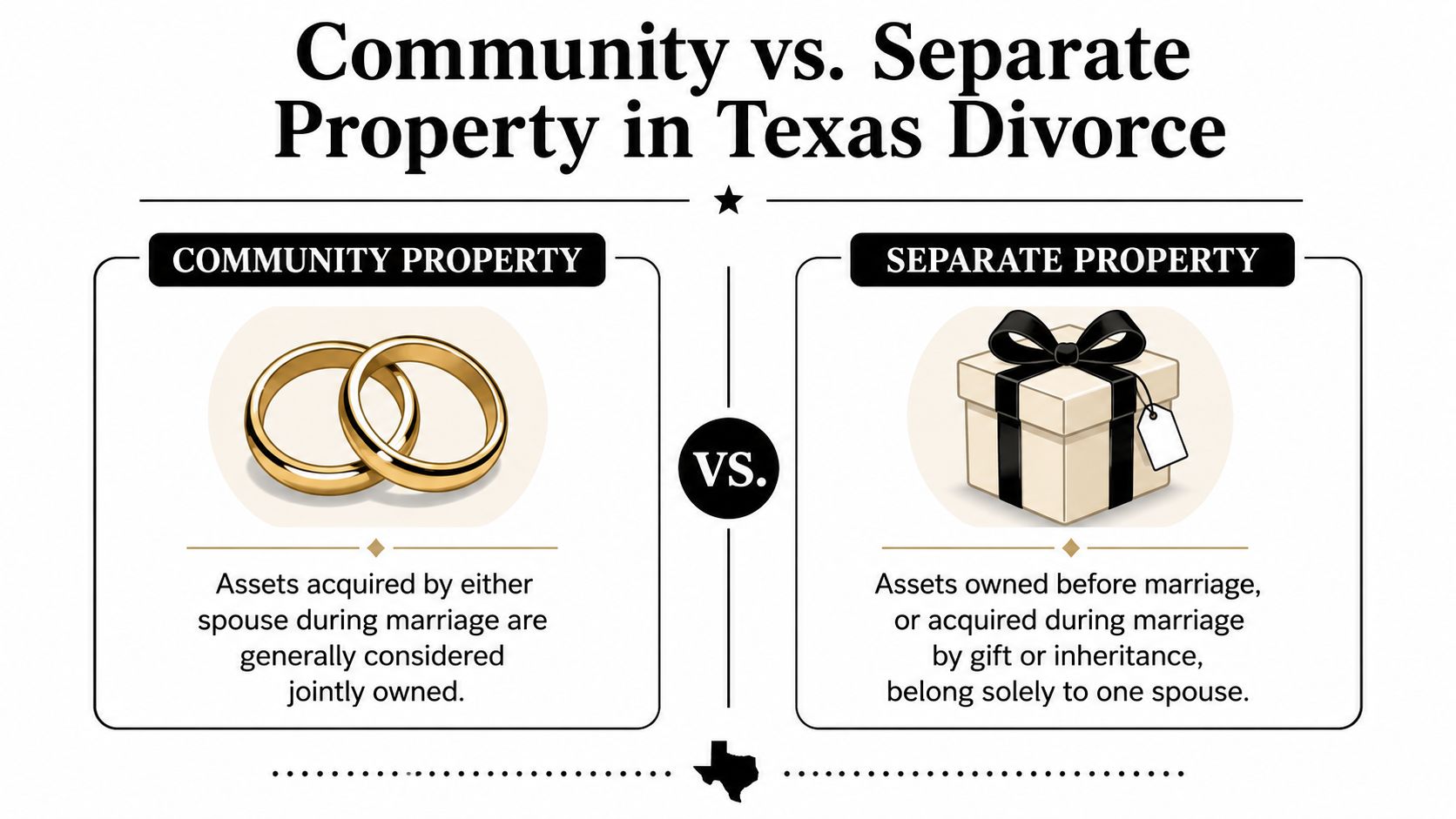
The two-bucket rule
Community property usually includes what either of you acquired during the marriage. That can include income, bank balances built during the marriage, real estate purchased during the marriage, and debts taken on during the marriage.
Separate property generally belongs to one spouse alone. That usually includes property owned before marriage, plus gifts or inheritances given specifically to one spouse.
Texas also starts with an important legal presumption. If property exists at the time of divorce, the law presumes it's community property unless someone proves otherwise. That's why documentation matters so much.
Practical rule: In a Texas divorce, it isn't enough to say an asset is “mine.” You need records that show why the law should treat it that way.
Why the date of acquisition matters
Texas often looks at the “inception of title” rule. In plain English, the court asks when the right to own the asset began. If that right began before marriage, the property may be separate. If it began during marriage, the property is often community.
That rule trips people up. A home deed may list only one spouse. That alone doesn't decide ownership. The key question is usually when and how the asset was acquired, not whose name appears on the paperwork.
For a fuller explanation of how Texas classifies marital property, this overview of whether Texas is a community property state is useful background.
Community Property vs. Separate Property in Texas
| Asset Type | Typically Community Property If Acquired During Marriage | Typically Separate Property |
|---|---|---|
| Wages and salary | Yes | No |
| House purchased during marriage | Yes | No, unless separate funds and proof support that claim |
| Car purchased during marriage | Yes | No |
| Bank funds built from marital earnings | Yes | No |
| Gift given to one spouse | No | Yes |
| Inheritance received by one spouse | No | Yes |
| Property owned before marriage | No | Yes |
Where people get confused
The biggest confusion is this: being married does not make everything divisible. At the same time, labeling something separate doesn't protect it. If you mixed inherited funds with marital funds or failed to keep records, proving the separate character of an asset can become much harder.
That is why the first practical step in a divorce is often simple and unglamorous. Gather deeds, account statements, retirement records, loan documents, tax returns, and anything showing when property was acquired and how it was paid for. Those records become the foundation for everything that follows.
How Property Is Actually Divided The Just and Right Standard
Many individuals walk into divorce expecting a clean split down the middle. Texas law doesn't promise that. It asks the court to divide community property in a way that is just and right under Texas Family Code § 7.001.
That standard gives judges discretion. According to this discussion of Texas property division, a 50/50 split is common, but courts have awarded one spouse 55%, 60%, or even 70% of the community estate when fault, significant health disparities, or marked differences in earning capacity are proven. That doesn't mean every case becomes a fight for an uneven split. It means fairness in Texas is fact-specific.
What a judge may weigh
A judge doesn't pull a number out of thin air. The court looks at the marriage as it was.
Common issues that can affect a just-and-right division include:
- Fault in the breakup: If one spouse can prove adultery, cruelty, or other marital misconduct, the court may consider that.
- Earning disparity: If one spouse has far greater income potential, that can matter.
- Health concerns: Serious physical or mental health differences can affect what is fair.
- Children's needs: A parent who will carry more day-to-day responsibility may have a stronger argument for certain assets.
- Waste of assets: If one spouse spent community money recklessly or on an affair, that can become a major issue.
If infidelity is part of your case, a practical starting point is understanding how that issue can affect strategy, evidence, and property claims. This CheatScanX guide for infidelity and divorce gives a useful general overview.
A just-and-right division is not the same as an equal division. It is the division a judge believes fits the evidence.
Why evidence changes outcomes
Many spouses find themselves at a disadvantage. They know what happened, but they can't prove it in a way the court can use. If you're claiming fault, hidden spending, or a major earning imbalance, your lawyer needs documents, testimony, financial records, and a theory that ties those facts to a fair division.
A simple example
Suppose one spouse earns far more, the other has a health condition that limits future income, and there is proof of misconduct that damaged the marriage. In a case like that, the court may decide that an equal split isn't fair.
On the other hand, if both spouses are healthy, employed, and there are no unusual facts, a near-equal division may be more likely. The phrase what is a wife entitled to in a divorce in Texas depends less on labels and more on the specific evidence the court sees.
Proving What Is Yours Protecting Separate Property
Knowing that separate property exists isn't enough. You have to prove it.
Texas law starts from the position that property on hand at divorce is community property. To reclaim separate property, a wife must rebut that presumption with “clear and convincing evidence” such as bank statements, titles, or witness testimony, as explained in this guide to fair asset distribution under Texas law.
What clear and convincing evidence looks like
This standard is higher than a casual explanation. You need a paper trail that makes the history of the asset believable and complete.
Strong proof often includes:
- Account statements: These help show where money came from and where it went.
- Titles and deeds: These can help establish when ownership began.
- Gift or inheritance records: Wills, letters, checks, and estate documents can be useful.
- Witness testimony: Sometimes a family member, executor, or financial professional can help explain the asset's origin.
For a deeper look at how these claims work, this resource on separate property in Texas divorce can help you understand the legal framework.
How tracing works in real life
Tracing means following an asset from its starting point to where it is now.
Suppose you inherited money during the marriage. You placed it in a bank account, then later used that money for a down payment on a home. If you can show the inheritance deposit, the account history, and the payment from that account into the home purchase, you may be able to prove that part of the home has a separate property claim.
If you can't show that path, the court may treat the money as mixed with community funds.
Keep this in mind: Separate property claims are often won or lost on recordkeeping, not memory.
A useful companion read is How Property Is Divided in a Texas Divorce, which explains the just-and-right division of community property in more depth.
Reimbursement claims matter too
Some cases involve more than classification. If community money or effort benefited separate property, reimbursement may come into play. That can happen when marital funds helped pay down debt on separate property, or when one spouse's labor significantly increased the value of an asset owned separately by the other spouse.
That issue becomes especially important with businesses, real estate, and high-value investments.
Understanding Spousal Maintenance in Texas
Many people call it alimony. In Texas, the legal term is usually spousal maintenance, and it isn't automatic.

A spouse must show real financial need and show that the other spouse can pay. According to this explanation of Texas spousal maintenance rules, spousal maintenance is not automatically granted, and eligibility generally requires a marriage of at least 10 years or specific circumstances such as domestic violence.
When maintenance may be available
Texas courts look closely at whether the spouse asking for maintenance can meet minimum reasonable needs without support.
Situations that may support a maintenance request include:
- Longer marriage: A marriage lasting at least 10 years may open the door, but it doesn't guarantee an award.
- Family violence: Domestic violence can affect eligibility.
- Disability: A spouse with a disability may have a stronger claim.
- Special-needs child care: If caring for a child with special needs prevents a spouse from earning enough, that may matter.
If you want a detailed look at the legal requirements, this page on spousal maintenance eligibility in Texas is a helpful reference.
What the court examines
The court usually asks practical questions. Can you support yourself right now? What income and property will each spouse have after divorce? How long did the marriage last? Is there a realistic path for the requesting spouse to become self-supporting?
That makes maintenance different from property division. Property division addresses what you own and what gets divided. Maintenance addresses whether ongoing support is justified after the divorce.
For readers comparing legal guidance, Spousal Maintenance in a Texas Divorce discusses when Texas courts award post-divorce spousal maintenance.
Before you assume support will be ordered, it helps to hear a broader discussion of how these cases are approached in practice.
Courts don't use maintenance to punish one spouse or reward the other. They use it to address proven need within a narrow legal framework.
Where readers often get this wrong
A common mistake is thinking that if your spouse earned more, you automatically receive monthly support. That isn't how Texas works. Another mistake is ignoring maintenance entirely when you do have a valid claim because you've assumed courts “never” award it. The truth is narrower than either extreme.
Entitlements for Your Children Custody and Support
If you have children, divorce stops being only about who keeps what. It becomes about building a stable routine your children can live in.
Texas courts focus on the best interest of the child. That standard shapes both custody and support. In many cases, parents share rights and duties, but the details of parenting time, decision-making, and financial support still need to be worked out carefully.
Custody and support work together
Custody determines how major parenting responsibilities are handled and when the children spend time with each parent. Child support helps cover the child's needs in the home where those daily expenses are being met.
These issues affect each other, but they aren't identical. A parent can have meaningful possession time and still pay support. A parent with primary day-to-day care may still need a clear order for decision-making, exchanges, school issues, and medical responsibility.
What the process usually looks like
Parents often move through these stages during a divorce:
- Temporary orders: The court may put short-term rules in place for possession, support, and household bills while the case is pending.
- Information exchange: Each parent provides financial and parenting information relevant to the case.
- Mediation: Many courts expect parents to try to resolve custody and support disputes before trial.
- Final orders: The decree and related orders set the long-term parenting plan.
If you're dealing with divorce and parenting issues at the same time, Divorce With Children in Texas explains how custody, support, and parenting time are decided in a divorce.
What parents should focus on
- Stability: Judges care about consistency in school, home life, and routines.
- Communication: Keep messages respectful and child-focused.
- Documentation: Save records involving schedules, medical needs, and school issues.
- Decision-making: Think ahead about education, medical care, counseling, and extracurricular activities.
Your strongest position in a custody case usually comes from showing that you support your child's routine, safety, and emotional well-being.
Navigating Complex Assets Businesses and Retirement Accounts
Some divorces look straightforward until you reach the retirement plan or the family business. Then the case becomes more technical very quickly.

Retirement accounts need special handling
Texas treats retirement benefits earned during the marriage as community property, even if the employee spouse hasn't retired yet. Dividing many retirement plans requires a Qualified Domestic Relations Order, often called a QDRO, to direct the plan administrator. Texas law materials also note that the final decree must include the right information about retirement benefits, and a QDRO is generally required unless the asset is an IRA, as described by Texas Law Help on dividing property and debt in divorce.
That paperwork matters. A decree may say a spouse gets a share of a retirement account, but the transfer often can't be carried out correctly without the required order.
If retirement assets are part of your case, Dividing Retirement Accounts in a Texas Divorce explains how 401(k)s, pensions, and IRAs are split, including QDROs.
Businesses are harder than people expect
A business can be separate property, community property, or a mix of both issues. One spouse may have owned the business before marriage, but the growth during marriage may still raise serious claims. Texas does not recognize legal separation, so property and debts accumulated from marriage until divorce is final are generally presumed community property. That timing issue can matter when a business continued to grow after the spouses started living apart.
If a wife actively contributed to the appreciation of a business owned by her spouse, she may be entitled to a share through a reimbursement claim even if the business started as separate property, according to this discussion of Texas community property and reimbursement claims.
Questions to ask early
When a business is involved, you need answers to practical questions:
- When was it formed: Before marriage or during marriage?
- How was it funded: With marital income, separate funds, or both?
- Who worked in it: Did one spouse contribute unpaid labor, management, or client development?
- What changed over time: Did the business increase in value during the marriage?
For business owners and high-value estates, the paperwork stage of divorce is especially important. Early disclosures, account records, operating documents, tax returns, compensation records, and valuation work can all shape the final result.
Take Control Your Next Steps in a Texas Divorce
You sit down at the kitchen table with a stack of bank statements, retirement account printouts, and questions no one ever wants to ask. What am I entitled to? Is this supposed to be split evenly? What if I gave up career opportunities, or my spouse earned far more, or money from my separate property went into the marriage?
In Texas, the answer usually turns on one central rule. A judge must divide the community estate in a way that is "just and right." That standard is more flexible than many people expect. It does not promise a clean 50 50 split. It asks what is fair under the facts of your marriage, and that is why preparation matters so much.
A court may look at earning disparity, fault in the breakup of the marriage, reimbursement claims, waste of marital assets, the needs of the children, and whether one spouse will leave the marriage in a much stronger financial position than the other. If your case involves any of those facts, your divorce is not just about listing property. It is about telling a clear, well-supported story of why a certain division is fair.
That is also why mistakes early in the case can follow you all the way to the final decree. Missing records can weaken a reimbursement claim. A vague inventory can blur the line between separate and community property. An incomplete retirement order can delay or reduce what you receive.
What to do next
Start with a focused plan:
- Gather the paper trail: Collect bank statements, retirement records, deeds, tax returns, loan documents, pay stubs, and business records.
- Build a timeline: Note when major assets were acquired, when debts were incurred, and when any large transfers happened.
- Identify fairness factors: Write down facts that may affect a just and right division, such as a large income gap, fault, unpaid work for a family business, or use of separate funds for marital expenses.
- Do not shift money around: Unusual withdrawals or transfers often create distrust and can become an issue in court.
- Limit new debt: Credit card balances and new loans can complicate settlement talks and temporary orders.
- Plan for the first 90 days: Housing, cash flow, parenting schedules, insurance, and access to accounts often need attention before final settlement.
- Prepare for mediation early: Good mediation results usually come from organized records and a realistic understanding of what a judge might do under the just and right standard.
The divorce process usually moves through filing, disclosures, temporary orders, negotiation, mediation, and final orders. At each stage, your decisions shape influence, settlement options, and trial risk. A careful legal strategy can help you protect what is yours and make a stronger case for a fair result.
Law Office of Bryan Fagan, PLLC is a Texas family law firm that handles divorce, custody, mediation, support, and enforcement matters across a range of family law cases.