Skip to content
Facing the end of your marriage is one of life’s most profound challenges. You just want to move on without a drawn-out, public battle. In Texas, a no-fault divorce is the most common and compassionate way to do just that, allowing you and your spouse to end your marriage without having to point fingers or prove one person was to blame for the breakdown. This approach is all about finding a solution, not assigning blame.
What Is a No Fault Divorce in Texas?
How do you start the legal process when you feel your marriage just can’t be fixed, but you don't want a messy fight? The answer for most Texans is a no-fault divorce, which hinges on a single, straightforward concept in the Texas Family Code.
That concept is insupportability.
Under Texas Family Code Section 6.001, a divorce can be granted on the grounds of insupportability. This simply means the marriage has become unworkable because of "discord or conflict of personalities" and there's no "reasonable expectation of reconciliation." It’s the legal system's way of acknowledging that you and your spouse have grown apart and the relationship can’t be repaired.
This isn’t about pointing fingers. You don’t have to get up in court and provide evidence of things like adultery or cruelty. In fact, all it takes is for one spouse to testify that the marriage is insupportable, and the court has grounds to grant the divorce.
The Most Common Path for Texans
Ever since Texas adopted no-fault divorce back in the 1970s, it has become the go-to method for couples ending their marriage. Today, an overwhelming 95% of all divorces filed in Texas are based on these no-fault grounds.
Why is it so popular? The reasons are both practical and personal, boiling down to greater privacy and a whole lot less conflict. You can get a deeper look into how this compares to the alternative by reading about no-fault divorce vs. fault-based divorce legal considerations in Texas.
The main benefits of choosing the no-fault route include:
- More Privacy: You won't have to air the intimate, and often painful, details of your marriage in public court records. The focus stays where it should be: on resolving the legal issues of your separation.
- Less Conflict: When you remove the need to prove blame, it's often much easier to work together on big issues like dividing property and creating a custody plan. This leads to a far less adversarial and stressful experience for everyone involved, especially your children.
- Lower Costs: Fault-based divorces can get expensive, fast. They often require digging up evidence, conducting depositions, and spending more time in court, all of which drive up attorney fees. An uncontested no-fault case might cost between $1,500 and $5,000 in legal fees, while a bitter fault-based fight can easily top $15,000.
No-Fault Versus Fault-Based Divorce in Texas
To make the distinction even clearer, let's break down the key differences between a no-fault divorce and one where fault is alleged. Understanding this can help you see why the no-fault path is so frequently recommended.
| Aspect | No-Fault Divorce (Insupportability) | Fault-Based Divorce (e.g., Adultery, Cruelty) |
|---|---|---|
| Grounds | The marriage is insupportable with no chance of reconciliation. | One spouse's actions (like adultery, cruelty, abandonment) caused the divorce. |
| Evidence | Testimony from one spouse is usually sufficient. | Requires specific, provable evidence of the wrongdoing. |
| Cost | Generally lower due to less conflict and discovery. | Can be significantly more expensive due to litigation and evidence gathering. |
| Timeline | Typically faster, as agreements are often reached more easily. | Often takes much longer due to disputes and court backlogs. |
As you can see, the no-fault approach streamlines the process considerably. It focuses on the reality of the situation—that the marriage is over—rather than getting bogged down in a he-said-she-said battle over why it ended.
Ultimately, choosing a no-fault divorce empowers you to close this chapter of your life with dignity and allows you to put your energy toward what's next.
Your Step-by-Step Guide to the Divorce Process
Thinking about the legal side of divorce can feel overwhelming, but a clear roadmap makes the entire journey far more manageable. While every family's situation is different, the Texas no-fault divorce process generally follows a standard sequence of events.
Knowing what to expect removes the element of surprise and gives you back a sense of control. Let's walk through the exact steps, from the moment you decide to file until your divorce is final.
Step 1: Meeting the Residency Requirements
Before a Texas court can hear your divorce case, it needs to have jurisdiction—the legal authority to make decisions. This starts with meeting the state's residency rules, which are non-negotiable.
The Texas Family Code lays out a two-part test:
- State Residency: At least one spouse must have lived in Texas for the last six months.
- County Residency: At least one spouse must have lived in the county where you plan to file for the last 90 days.
If you file without meeting these timelines, the court will simply dismiss your case. It’s critical to confirm you’re eligible before you take any other action.
Step 2: Filing the Original Petition for Divorce
Once you've confirmed your residency, the divorce officially begins by filing a document called the Original Petition for Divorce. You'll file this with the district clerk in the appropriate county. The spouse who files is the Petitioner, and the other spouse becomes the Respondent.
This petition isn't about airing grievances; it's a formal document that gives the court basic information. It includes details like your names, the date you were married, information on any children, and the legal grounds for the divorce. For a no-fault divorce in Texas, the grounds are simply "insupportability."
Filing the petition opens your case and gets the legal ball rolling.
Step 3: Notifying Your Spouse and the Waiting Period
After you file the petition, your spouse must receive formal, legal notice. This is called service of process. You can't just hand them the papers or send a text; it has to be done officially by a sheriff, constable, or a private process server.
Once your spouse is served, a couple of important clocks start ticking.
First, your spouse has a specific amount of time to file a formal "Answer" with the court. More importantly, Texas law kicks in a mandatory 60-day waiting period. This countdown starts the day after the petition is filed.
This is often called a "cooling-off" period. No matter how quickly you and your spouse agree on everything, your divorce cannot be finalized until at least 61 days have passed. For a deeper dive into these timelines, take a look at our guide on the complete Texas divorce process from filing to finalization.
The infographic below shows why the no-fault route is the one most Texans take.
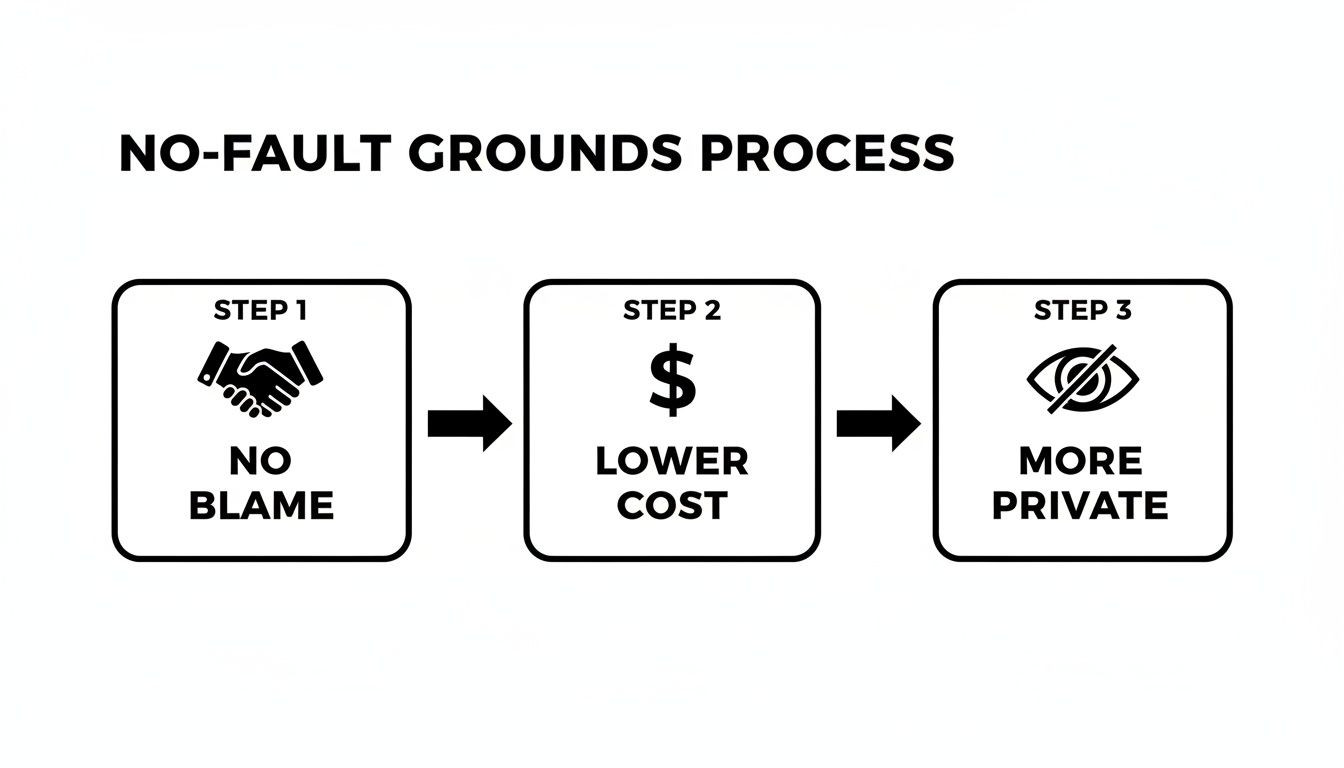
As you can see, choosing insupportability from the start paves the way for a less combative, more private, and often less expensive process.
Step 4: Reaching an Agreement and Finalizing the Divorce
The 60-day waiting period (and often beyond) is when the real work happens. This is the time for you and your spouse to negotiate and resolve all the major issues: dividing your property, working out a parenting plan for your kids, and settling any support questions.
If you reach a full agreement on every point, you have what's known as an uncontested divorce. All of these agreed-upon terms are then drafted into a legal document called the Final Decree of Divorce.
Once the waiting period is over and the decree is ready, one spouse will go to the courthouse for a short, informal hearing to "prove up" the divorce. The judge will ask a few simple questions, confirm the agreement is "just and right," and sign the decree. The moment the judge's pen lifts from the paper, your divorce is legally final.
How No-Fault Divorce Impacts Property, Children, and Support

It’s one of the biggest myths we see in our practice: people assume that because they’re filing for a no-fault divorce, everything else will be simple. But that’s a common and often costly mistake. While filing on the grounds of "insupportability" gives you a more peaceful way to legally end the marriage, it has zero effect on how your property, finances, and parenting plan are decided.
Think of it this way: choosing a no-fault divorce is just the key that unlocks the door. How you divide a lifetime of assets and create a new future for your family once you’re inside—that’s a completely different conversation.
Dividing Your Property Under Texas Law
Texas is a community property state. In simple terms, this means that almost everything you and your spouse acquired from the day you got married until the day you divorce is presumed to belong to both of you. This isn’t just about the house; it includes cars, bank accounts, retirement funds, and even business ventures.
But here’s where it gets tricky. "Community property" doesn’t mean an automatic 50/50 split. The Texas Family Code mandates that a judge must divide your estate in a "just and right" manner. That phrase is incredibly important.
A "just and right" division starts with a 50/50 split as a baseline, but the judge has the authority to award a disproportionate share—say, 55/45 or even 60/40—to one spouse. This can happen for many reasons, like disparities in earning capacity, health issues, or if one spouse was proven to have wasted community assets.
Even in an otherwise amicable no-fault case, figuring out how to divide these assets is one of the most critical parts of your divorce. If you own a business or have complex investments, navigating this requires sharp valuation and experienced guidance. For a deeper dive, you can learn about Texas divorce property division in our comprehensive article.
Creating a Plan for Your Children
For any parent, nothing matters more than protecting your children’s well-being. In a Texas divorce, every decision about the kids is guided by one single standard: the "best interest of the child." The fact that you filed for a no-fault divorce doesn’t change that one bit.
You and your co-parent will need to create a formal parenting plan covering three core areas:
- Conservatorship (Custody): This defines your legal rights and responsibilities. Most Texas parents are named Joint Managing Conservators, which means you share the power to make decisions about your child's education, healthcare, and upbringing. Typically, one parent is named the "primary" conservator, which gives them the right to determine the child's main residence.
- Possession and Access (Visitation): This is the actual calendar schedule that dictates when the children are with each parent. The Texas Standard Possession Order is the default schedule presumed to be in the child's best interest, and it provides a detailed calendar for weekends, holidays, and summer vacation.
- Child Support: This is the financial support one parent pays to the other to help with the costs of raising the children. The amount is calculated using a specific formula based on the paying parent's net monthly income and how many children are involved.
Spousal Support in a No-Fault Case
Finally, let's talk about financial support for a spouse after the divorce, which Texas law calls spousal maintenance. A lot of people incorrectly think you can't get maintenance in a no-fault divorce. That’s simply not true.
While proving a fault ground like adultery is one way to qualify for maintenance, it isn’t the only way. You might still be eligible if you meet certain strict criteria, including:
- You've been married for 10 years or more and can’t earn enough income to meet your minimum reasonable needs.
- You are unable to support yourself due to an incapacitating physical or mental disability.
- You are the primary caregiver of a child of the marriage who needs substantial care because of a disability.
These issues are decided on their own merits, completely separate from the no-fault grounds you used to file. Your financial future and your children's stability depend on getting these complex matters right.
Common No-Fault Divorce Myths That Can Hurt Your Case
When you’re going through a divorce, it feels like everyone has an opinion. Friends, family, and coworkers are quick to offer advice, but a lot of what you’ll hear is based on persistent myths. Relying on this kind of misinformation about no-fault divorce can lead you down the wrong path, costing you time, money, and peace of mind.
Let's cut through the noise and get the facts straight. Understanding the reality of Texas no-fault divorce is the first step toward making smart decisions for your future.
Myth 1: "No-Fault" Means Everything Is Split 50/50, No Questions Asked
This is probably the most dangerous misconception out there. People hear "no-fault" and immediately assume it's a simple, mathematical formula where all community property gets chopped right down the middle. That's a huge oversimplification.
The term "no-fault" only refers to the legal reason you're filing for divorce—in Texas, this is called insupportability. It just means the marriage has become unworkable, and there's no reasonable hope of reconciliation. It has nothing to do with how your property will be divided.
While Texas courts start with the idea of a 50/50 split, the law actually requires a "just and right" division, which can be anything but equal. A judge has the power to award a disproportionate share to one spouse based on several factors, including:
- A significant difference in earning power between you and your spouse.
- The health of each spouse.
- The size and nature of your separate property estates.
- And yes, even fault in the breakup of the marriage.
So, while you don't have to prove blame to get the divorce, the circumstances surrounding the end of your marriage can absolutely impact who gets what.
Myth 2: My Spouse's Bad Behavior Is Now Irrelevant
This myth goes hand-in-hand with the first one. Many people believe that filing on no-fault grounds means a spouse’s affair, cruelty, or financial irresponsibility gets swept under the rug. This is completely false.
Think of it this way: the "no-fault" petition is your ticket into the courthouse. It's the key that unlocks the door to divorce without having to air out all your dirty laundry just to get the process started. But once you're inside, what happened during the marriage can still have a massive impact on the final outcome.
Under the Texas Family Code, a judge is explicitly allowed to consider fault when making a "just and right" division of property. If you can prove your spouse wasted thousands of dollars from your joint savings on an affair, the judge can award you a larger percentage of the remaining estate to make things fair.
Choosing a no-fault divorce is often a strategic move to keep the proceedings more private and less contentious. But it doesn't mean you forfeit your right to hold a spouse accountable for actions that harmed the community estate.
What to Do Next
Building your divorce strategy on facts, not fiction, is critical. Your financial future isn't something to leave to chance or bad advice from a well-meaning neighbor.
Understanding these key distinctions is the first step, but applying them to your unique situation is where real expertise comes in. The compassionate attorneys at The Law Office of Bryan Fagan, PLLC, are here to provide the clarity you need. We can help you navigate the truth of Texas divorce law and build a strategy that protects your rights.
Call us today for a free, no-obligation consultation to talk about the specifics of your case.
Deciding Between a DIY Divorce and Hiring an Attorney

Choosing how to handle your divorce is one of the very first, and most important, decisions you'll face. The thought of a Do-It-Yourself (DIY) divorce is tempting, especially when you're worried about money and just want it all to be over quickly. But this path is littered with hidden risks that can seriously impact your financial future and your family’s well-being for years to come.
While a no-fault divorce in Texas makes it easier to state the reason for ending the marriage, it does absolutely nothing to simplify the process of dividing a life you built together. The legal documents you sign are permanent and binding. One small mistake now could cost you thousands of dollars in assets or cause you to accidentally sign away crucial parental rights you can never get back.
When a DIY Divorce Might Seem Feasible
A DIY approach, which the courts call a "pro se" divorce (meaning you represent yourself), is only even a remote possibility in the absolute simplest situations. You might think about it if, and only if, all of the following are true:
- You have no minor children.
- Your marriage was for a very short period of time.
- You have no shared property (like a house or cars) or debts to divide.
- There are no retirement accounts or other investments to split.
- You and your spouse are in 100% complete agreement on every single detail.
If even one of these points doesn't apply to you, trying to handle your own divorce is like performing your own surgery. You might understand the general concept, but the odds of making a critical, irreversible error are incredibly high.
The Real Cost of Going It Alone
The financial stakes in any divorce are high. Recent Texas divorce statistics show the average divorce costs $15,600 even without children, a figure that jumps to $23,500 for couples with kids. While the no-fault ground helps keep conflict down, the financial negotiations over property, assets, and support demand a professional strategy. You can read more about these Texas divorce statistics and what they mean for you.
Hiring an attorney is about more than just having a legal expert on hand; it’s about having a protector, a strategist, and an objective advocate in your corner. Here’s where a good lawyer becomes invaluable:
- Protecting Your Assets: An attorney makes sure all community property is found, correctly valued, and fairly divided—from hidden bank accounts to complex 401(k)s and pensions.
- Drafting an Ironclad Decree: A poorly written Final Decree of Divorce can be vague, unenforceable, or full of loopholes that create massive headaches down the road.
- Navigating Custody and Support: If you have children, an attorney is essential for building a detailed parenting plan that protects your rights and truly serves your children’s best interests.
- Providing Objective Advice: Divorce is emotional. You need a clear-headed professional to guide you toward decisions that benefit your long-term future, not just your feelings in the moment.
In short, an attorney doesn't just fill out forms. They safeguard your future, protect your relationship with your children, and ensure the final agreement is fair and legally sound. The cost of hiring an experienced lawyer is an investment in your security.
What to Do Next
Your future is simply too important to leave to chance. While a DIY divorce might look like it saves money upfront, the potential for expensive, life-altering mistakes is far too great for most people. Protecting your family and your finances starts with getting expert advice.
The compassionate attorneys at The Law Office of Bryan Fagan, PLLC, are here to provide the clarity and guidance you need. We can help you understand your rights and build a strategy that protects what matters most. Call us today for a free, confidential consultation to discuss the specifics of your case and find the right path forward.
Your Next Steps and Path Forward
Taking that first step toward divorce can feel overwhelming. You now know that a no-fault divorce in Texas provides a less contentious path, but the journey ahead still demands careful planning to protect your family and your future. Understanding the law is the first step; now it's time to turn that knowledge into confident action.
The most important thing to remember is that "no-fault" simplifies the reason for your divorce, not the critical decisions about your property, finances, and children. Choosing insupportability as your grounds is a strategic starting point. The real work is in negotiating a fair outcome for the life you’ve built.
What to Do Next
A clear plan is the best defense against uncertainty. Here is a simple, actionable checklist to help you move forward from a position of strength.
Gather Your Financial Documents: Start collecting key papers like bank statements, recent tax returns, pay stubs, retirement and investment account information, and loan documents. Getting these organized now is essential for the property division process.
Outline Your Ideal Parenting Plan: If you have children, begin thinking about what a post-divorce schedule could look like. Consider holidays, school nights, and who will make important decisions. This gives you a solid starting point for negotiations focused on your children’s best interests.
Seek Personalized Legal Advice: This is the most critical step. Every family's situation is unique, and an online article can never replace the tailored strategy you get from a qualified attorney who understands the specifics of your case.
As you plan, staying informed on relevant Texas legislation like Texas House Bill 4224 can also give you a broader understanding of the support systems available to families.
You don’t have to walk this path alone. Your family's well-being and your financial security are too important to leave to chance. The decisions you make now will shape your future for years to come, and getting them right is our top priority.
Facing a divorce is one of life’s most challenging chapters, but you have the power to write the next one with clarity and confidence. The Law Office of Bryan Fagan, PLLC, is here to provide the compassionate support and expert legal guidance you deserve.
Contact us today to schedule a free, confidential consultation. Let us help you protect what matters most and build a secure path forward.
Answering Your Questions About Texas No-Fault Divorce
Even after you’ve grasped the basics of a no-fault divorce, the practical questions start to surface. What does this really mean for your timeline, your property, and your ability to move forward? Getting clear answers to these common questions can give you the confidence to plan your next steps. Let's walk through the questions we hear most often from clients just like you.
How Long Does a No-Fault Divorce Take in Texas?
Filing on no-fault grounds can certainly make things smoother, but it doesn't get you around the state’s required timelines. Texas has a mandatory 60-day waiting period that begins the day after the Original Petition for Divorce is filed. No divorce can be finalized before that clock runs out.
For a truly uncontested divorce, where you and your spouse are in complete agreement, the whole process usually takes about three to six months. But if disagreements pop up over property, kids, or support, the case becomes contested. A contested divorce can easily stretch out for a year or even longer as you work through negotiations, mediation, or court hearings.
Can My Spouse Stop a No-Fault Divorce?
This is a huge source of anxiety for many people, but the answer is simple: No, your spouse cannot stop you from getting a divorce in Texas.
The legal basis for a no-fault divorce is insupportability, which just means the marriage has broken down with no reasonable hope of getting back together. All it takes is for one spouse to tell the court this is the case. As long as you've met the state residency requirements and filed the right paperwork, a judge will grant the divorce—even if your spouse objects or refuses to show up.
That said, while they can't stop the divorce from happening, an uncooperative spouse can absolutely make the process harder, longer, and more expensive.
Is Texas a 50/50 Community Property State?
Not quite, and this is a critical distinction to understand. Texas is a community property state, which means most property and debt you both acquired during the marriage belongs to the marital estate. However, the law does not demand a rigid 50/50 split.
Instead, the Texas Family Code instructs a judge to divide the community estate in a way that is "just and right."
So, what does "just and right" actually mean? A 50/50 split is often the starting point, but a judge has the authority to order an unequal division, like 55/45 or even 60/40. This might happen if the judge considers factors like a big difference in earning power, one spouse's fault in the breakup (like wasting community funds on an affair), or the specific needs of the children.
This "just and right" standard applies whether you file on no-fault or fault-based grounds.
What Happens If We Agree on Everything?
If you and your spouse see eye-to-eye on all the issues—from who gets the house to the child custody schedule—you have an uncontested divorce. This is by far the fastest, most private, and least expensive path to ending your marriage.
But even when you agree, you can’t just shake hands and walk away. Your agreement must be formally documented in a legally binding contract called a Final Decree of Divorce. This decree has to be signed by a judge to make your divorce official.
Without that signed decree, you are still legally married, no matter how long you've lived apart or how friendly your separation has been. An experienced attorney can make sure your agreement is drafted correctly, protecting your rights and preventing future legal headaches.
You've taken the first step by educating yourself, but personalized legal guidance is essential to protect your family and your future. The experienced attorneys at The Law Office of Bryan Fagan, PLLC are here to provide the compassionate support and strategic advice you need. Contact us today for a free, confidential consultation to discuss your case by visiting https://texasdivorcelawyer.us and start building a secure path forward.