Skip to content
Facing a divorce is tough enough, but the thought of dividing everything you've built together can feel overwhelming and stir up intense anxiety about your financial future.
How Texas Divides Property in a Divorce
Untangling a life you shared is never easy, but understanding how the process works is the first step toward regaining control. In Texas, the law provides a clear framework for dividing property. Knowing these rules will empower you to protect what's yours and plan for what comes next.
Unlike some states that simply cut everything in half, Texas uses a unique system focused on what’s fair, not just what's equal.
The Community Property Principle
At the heart of Texas property division lies the concept of community property. Simply put, nearly everything you and your spouse acquired from the day you married until the day you divorce is considered part of the "community estate."
This typically includes:
- Income earned by either of you during the marriage.
- The house you bought together.
- Retirement funds that grew while you were married.
- Cars, furniture, and other assets purchased as a couple.
On the other side is separate property. This is anything you owned before the marriage, or anything you personally received during the marriage as a gift or inheritance meant just for you. Your separate property remains yours and is not subject to division.
The "Just and Right" Standard
This is where Texas law truly stands out. Even though the state presumes that assets acquired during the marriage are community property, the split isn't automatically 50/50. Instead, courts apply a "just and right" standard to ensure the final division is fair and equitable, considering your family's specific circumstances.
According to the Texas Family Code, Section 7.001, a judge’s primary goal is to achieve a division that is fair, not necessarily one that is perfectly equal. This gives the court the flexibility to examine the realities of your life and make a decision that fits.
So, while Texas is a community property state, the division is guided by what a court believes is just and right. The judge will look at factors like each spouse's health, earning potential, and who was at fault in the breakup. You can learn more about what counts as community and separate property to get a clearer picture of your rights.
To make this easier to understand, here’s a table breaking down the key differences between community and separate property.
Community Property vs. Separate Property at a Glance
| Asset Category | Community Property (Subject to Division) | Separate Property (Not Subject to Division) |
|---|---|---|
| Income & Wages | All income earned by either spouse during the marriage. | Income from separate property (e.g., rent from a pre-owned building), if kept separate. |
| Real Estate | Homes or land purchased during the marriage with marital funds. | Property owned by one spouse before the marriage; property inherited by one spouse. |
| Retirement Accounts | The portion of 401(k)s, IRAs, or pensions earned during the marriage. | Funds contributed to retirement accounts before the marriage. |
| Personal Property | Vehicles, furniture, art, and jewelry bought with community funds. | Items owned before marriage; gifts or inheritance received by one spouse. |
| Bank Accounts | Money in joint accounts; funds in separate accounts if from marital income. | Funds in an account owned before marriage, as long as no marital funds were added. |
| Business Interests | A business started or grown using marital funds or labor. | A business owned entirely before the marriage, with no commingling of funds. |
This guide will walk you through every step, from identifying what's yours to understanding how a judge might view your case. Our goal is to replace your anxiety with clarity and give you the confidence to move forward.
Defining Your Community and Separate Property
The first step in untangling your finances is to see everything you own through the eyes of Texas law. It can feel like sorting puzzle pieces from different boxes, but this process is essential—it determines what gets divided between you and what is yours alone to keep.

The Community Property Presumption
In Texas, the law starts with a powerful default setting: the "community property presumption." As outlined in Texas Family Code Section 3.003, anything you or your spouse own when the divorce is filed is presumed to be community property.
This means the burden of proof is on the person who wants to claim an asset as their separate property. If you can't prove it with clear and convincing evidence, a judge will treat everything—from the house and cars to the retirement accounts—as part of the marital estate to be divided.
Think of your marriage like a joint venture. From the day you said "I do," most of what you both earned or acquired became joint assets. When the marriage ends, the court's job is to fairly divide the venture's assets.
What Is Separate Property?
Separate property is the exception to the rule. These are the assets that are not subject to division and remain with the spouse who owns them. According to Texas Family Code Section 3.001, separate property generally includes:
- Property Owned Before Marriage: Anything you owned outright before your wedding day is yours. This could be a car you paid off, a bank account, or real estate you bought while single.
- Gifts Received During Marriage: If a friend or family member gave you a gift that was clearly intended only for you—like jewelry for your birthday or cash in your name—it’s your separate property.
- Inheritances Received During Marriage: Any property or money you inherited from a loved one's estate during your marriage is also considered your separate property.
The key is that the asset must be a gift or inheritance to you individually. A wedding gift addressed to both of you, for example, is almost always community property.
The Challenge of Commingling and Tracing
Life is messy, and so are finances. Over years of marriage, it's common for separate and community funds to get mixed together in a process called "commingling." A classic example is depositing inheritance money (separate property) into a joint checking account where your paychecks (community property) are also deposited.
When property is commingled, it can lose its separate character unless you can prove its origin. This is where the legal process of "tracing" comes in.
Tracing means following an asset's history to prove it came from a separate property source. This requires a detailed paper trail—bank statements, deeds, receipts, and investment reports—to connect the dots. For instance, to prove the down payment on your marital home came from your pre-marriage savings, you would need bank statements showing the funds leaving your separate account and going directly toward the home purchase.
Without successful tracing, a court will likely classify the commingled asset as community property. This is why keeping detailed financial records is one of the most proactive steps you can take to protect your assets. For a deeper dive, you can learn more about what is community property in Texas in our detailed guide.
Correctly categorizing your assets and debts is the foundational work of any Texas divorce. It puts you in a position of strength, allowing you to advocate for a fair settlement with a clear understanding of what's truly at stake.
How the “Just and Right” Standard Shapes Your Settlement
The phrase “just and right” might sound vague, but in a Texas divorce, it’s a powerful legal standard that directly shapes your financial future. It's the core principle that gives judges the flexibility to look beyond a simple 50/50 split and create a property division that is genuinely fair based on the realities of your marriage and your family’s needs.

A judge’s decision-making is guided by a set of established factors that help them determine what an equitable division looks like in your specific case. This standard is why the unique details of your marriage matter so much.
Key Factors a Court Will Consider
When a judge is tasked with dividing your community estate, they weigh several circumstances to get the full picture. No single factor decides the outcome, but together, they tell your story.
Some of the most significant factors include:
- Disparity in Earning Capacity: The court will look at whether one spouse has a significantly higher ability to earn income. A spouse who stayed home to raise children may be awarded a larger share of the assets to help them get back on their feet.
- Each Spouse's Health: The physical and mental health of each person is a crucial consideration. If one spouse has a chronic illness or disability that impacts their ability to work, a judge may award them more of the community property.
- Fault in the Breakup: Texas allows for fault-based divorces. If one spouse's actions—like adultery, cruelty, or abandonment—caused the marriage to end, the judge can award a disproportionate share of the assets to the other spouse.
- The Needs of the Children: If you have minor children, their needs are paramount. The court will consider which parent will have primary custody and may award the marital home or a larger portion of the assets to that parent to ensure stability.
- Benefits the Innocent Spouse Would Have Received: A judge might also consider the future benefits the non-fault spouse would have enjoyed if the marriage had continued.
The "just and right" standard is designed to prevent an unfair outcome. It recognizes that life isn't always a 50/50 partnership, and sometimes, an unequal division is the only truly fair result.
How These Factors Play Out in a Real Case
It's easy to assume "community property" means everything gets split down the middle. But court decisions consistently show that the real focus is on fairness, not strict equality.
For example, the 2025 case of Edgar Humberto Paez v. Myriam Rodriguez involved a 47-year marriage. The Texas Court of Appeals confirmed that a "just and right" division does not require an automatic 50-50 split. The court’s decision reaffirmed that factors like each spouse's needs, contributions, and any fault can lead to an unequal but fair percentage. You can discover more insights about how courts apply this standard in real Texas cases.
This case illustrates a critical point: your property division is not predetermined. It can be argued and shaped based on the specific facts of your life. This is why having an experienced attorney who can effectively present these factors on your behalf is so important.
Untangling Your Finances: A Guide to Complex Assets and Debts
Divorce gets complicated quickly when your financial picture includes more than just a house and a savings account. Adding business interests, retirement accounts, or significant debt can feel overwhelming. This is where you need to understand how Texas law works to protect your financial future.
Property division isn’t just about splitting obvious assets. It’s about a careful, strategic approach to real estate, 401(k)s, business valuations, and even the credit card balances you accumulated together.
Dividing Real Estate Holdings
For most Texas couples, the marital home is their single biggest asset. Deciding what to do with it is a mix of emotional decisions and financial math. Before you can do anything, you need an accurate valuation. Getting a professional appraisal is non-negotiable; for a good overview, check out a comprehensive guide to the home appraisal process.
Once you have a solid number for the home's fair market value, you have a few options:
- Sell the home: This is often the cleanest break. You sell the house and split the proceeds as outlined in your divorce decree.
- One spouse buys out the other: If one of you wants to stay, you can refinance the mortgage in your name and pay the other spouse their share of the home's equity.
- Continue co-ownership: This is less common, but some couples agree to own the house together for a period, especially if it provides stability for children.
If you own investment properties or real estate in other states, things get more tangled. Under Texas Family Code Section 3.002, property acquired during the marriage is considered community property regardless of its location. However, valuing and enforcing the division of out-of-state property can add layers of legal work.
Handling Retirement Accounts and Pensions
Retirement funds like 401(k)s, IRAs, and pensions are almost always a significant piece of the community estate. The key is that only the portion earned or contributed during the marriage is subject to division. Determining that community share often requires detailed financial analysis.
To divide certain retirement plans, like a 401(k) or a pension, your attorney will need to draft a specific court order called a Qualified Domestic Relations Order (QDRO). This legal document instructs the plan administrator to pay a portion of the benefits directly to the non-employee spouse without tax penalties.
A QDRO is a highly technical legal document that must follow both federal law and the specific rules of the retirement plan. If drafted incorrectly, it will be rejected, leading to major delays and financial headaches.
Valuing and Dividing a Business
If you or your spouse started or grew a business during your marriage, you're looking at one of the most complex assets to divide. The business itself has value that must be determined before it can be split. This isn’t as simple as looking at the company’s bank account.
You'll almost certainly need to hire a professional business appraiser. They will analyze:
- Company revenue, profits, and cash flow
- Tangible assets like equipment and inventory
- Intangible assets like goodwill and brand recognition
- Market conditions and the industry outlook
Once a fair market value is established, you can figure out the division. One spouse might buy out the other's interest, or the non-business-owning spouse might receive other community assets to offset the value. For a deeper dive, see our guide on business valuations in a Texas divorce.
Don't Forget About Community Debt
Just like your assets, the debts you took on during the marriage are also community property. Mortgages, car loans, credit card balances, and personal loans are all part of the community estate and must be divided in a "just and right" manner.
A judge will look at which spouse is in a better financial position to handle a particular debt when assigning responsibility. It is crucial to create a complete and honest list of every liability so they can be dealt with fairly in the final decree.
Dividing a complex estate isn’t just about numbers; it’s about smart legal and financial strategy. The keys are to identify every asset and debt, get accurate valuations, and use the right legal tools—like a QDRO—to get the job done right.
The Property Division Process From Start to Finish
The thought of untangling your financial life can feel like standing at the base of a mountain with no clear path. This section is your roadmap. We'll break down the entire Texas property division journey into clear, manageable stages to reduce the fear of the unknown and empower you to move forward with confidence.
The journey starts when a divorce petition is filed and follows a structured legal path designed to ensure a fair outcome: identify what you own, determine its value, and then decide how to divide it.
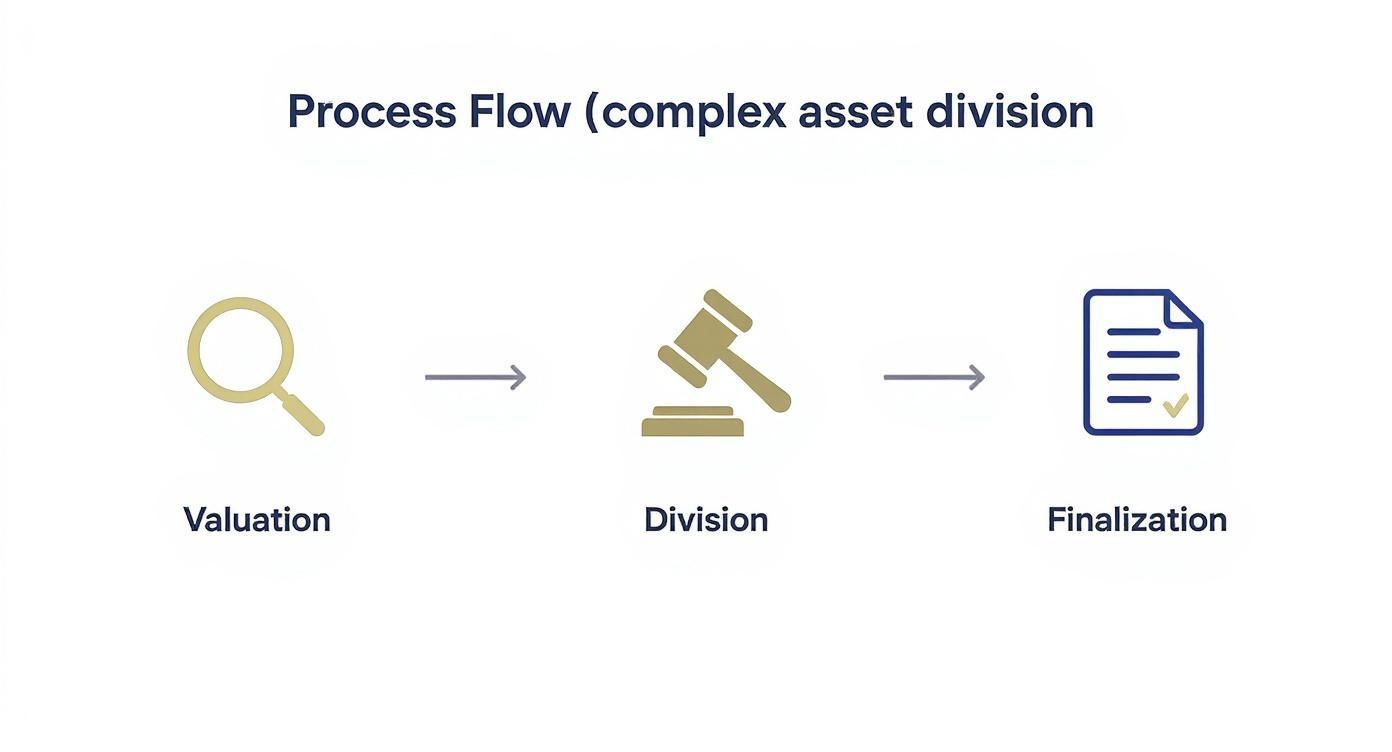
As you can see, the process hinges on a logical flow, from identifying what you both own all the way to legally finalizing the division.
Step 1: Initial Filings and Financial Disclosures
When one spouse files the Original Petition for Divorce, it kicks off a series of legal requirements. Both you and your spouse will have to exchange initial financial disclosures. This is a mandatory first step where you each provide a sworn statement listing all known assets and debts. This stage sets the foundation for everything that follows. Complete honesty is non-negotiable, as hiding assets can bring severe court penalties.
Step 2: Discovery and Information Gathering
After initial disclosures, your case moves into the discovery phase—the official investigation stage. Your attorney can use formal legal tools to request detailed information from your spouse and third parties like banks, employers, or business partners.
Common discovery tools include:
- Requests for Production: Asking for physical documents like bank statements, tax returns, and loan applications.
- Interrogatories: Written questions your spouse is required to answer under oath.
- Depositions: Formal interviews where your spouse or other witnesses answer questions under oath before a court reporter.
This process ensures both sides have a complete financial picture before negotiations begin. No surprises, no hidden accounts—everything comes out into the open.
Step 3: Creating the Inventory and Appraisement
Once all financial information is gathered, the next step is to create a detailed document called an Inventory and Appraisement. This is a comprehensive spreadsheet that lists every community asset and liability with its estimated value.
This inventory becomes the central document for your property division. It’s a complete snapshot of your marital estate, from real estate and retirement accounts to vehicles and credit card debt. Both sides create and exchange their own proposed inventories.
Step 4: Negotiation and Mediation
With a clear inventory, you can start working toward a settlement. The vast majority of Texas divorces—over 90%—are resolved without a trial through direct negotiation or mediation.
Mediation is a structured process where you, your spouse, and your attorneys meet with a neutral third-party mediator. The mediator’s job is to facilitate a productive conversation and help you find common ground. If you reach a deal, it’s written into a Mediated Settlement Agreement, which is a binding and irreversible contract.
Step 5: Finalizing the Divorce Decree
Whether you settle in mediation or a judge decides at trial, the final step is drafting the Final Decree of Divorce. This is the official court order that legally ends your marriage and spells out the exact division of all your property and debts. Once signed by a judge, this document is legally enforceable and brings the property division process to a conclusive end.
Key Stages of the Texas Property Division Timeline
| Stage | Key Objective | What You Need to Do |
|---|---|---|
| Stage 1: Filing & Initial Disclosures | Set the legal foundation and provide an initial overview of all known assets and debts. | File the divorce petition and complete and exchange sworn financial disclosure forms with your spouse. |
| Stage 2: Discovery | Gather comprehensive financial information to create a complete picture of the marital estate. | Work with your attorney to request documents and answers from your spouse and third parties (banks, etc.). |
| Stage 3: Inventory & Valuation | Create a detailed list of all community property and debt, assigning a fair market value to each item. | Compile your Inventory and Appraisement. Hire experts like appraisers or valuators if needed. |
| Stage 4: Negotiation & Mediation | Reach a mutually agreeable settlement on how to divide the property and debts. | Participate in settlement negotiations or a formal mediation session to resolve all outstanding issues. |
| Stage 5: Finalization | Obtain a legally binding court order that officially divides the property and ends the marriage. | Draft, review, and sign the Final Decree of Divorce. Attend a brief "prove-up" hearing for the judge to approve it. |
This table maps out the core journey. Remember, every case is unique. Complex estates may require more time in the discovery and valuation stages, while simpler cases might move quickly to negotiation. The key is to follow the process methodically to ensure a fair and just result.
Protecting Your Assets: Practical Steps to Take Now
Understanding the rules of Texas divorce property division is one thing, but putting that knowledge to work is what will safeguard your future. This is the moment to shift from learning to doing. You have the power to take control of this process, and you don't have to do it alone.
Being proactive is your best strategy. By getting organized now, you build a solid foundation for negotiations and ensure your financial interests are protected from the start.
Your Immediate Next Steps
Getting started can feel overwhelming, but a simple checklist makes it manageable. Focus on these critical first tasks:
- Gather Critical Financial Documents: Collect at least three to five years of bank statements, tax returns, mortgage documents, retirement account statements, and recent pay stubs. These records are the evidence you'll need to trace assets and prove your claims.
- Create a Personal Budget: Map out a realistic post-divorce budget. Knowing your monthly expenses and income needs clarifies what you truly need from a settlement to remain financially stable.
- Identify All Community Debts: Make a complete list of every liability—credit cards, car loans, personal loans. Debts are divided just like assets, so a full accounting is essential.
- Avoid Major Financial Changes: Do not make large purchases, sell significant assets, or take on new debt without first talking to your attorney. Such moves can complicate property division and may not be viewed favorably by the court.
You are your own best advocate. By taking these organizational steps, you are not just preparing for your divorce; you are actively shaping a more secure financial future for yourself.
The goal is to move from uncertainty to empowerment. For a deeper dive, read our guide on how to protect assets during your divorce, which offers more practical advice.
Frequently Asked Questions About Property Division
When your marriage is ending, it’s natural to have questions, especially about money and property. You need clear answers to feel confident as you step into your next chapter. Here, we tackle some of the most common concerns we hear about Texas divorce property division.
Our goal is to cut through the legal jargon and give you the practical answers you need.
What Happens to Our House?
For most couples, the house is more than an asset; it's a home filled with memories, making it one of the most emotionally charged parts of a divorce. In Texas, the marital home is almost always community property.
You and your spouse generally have a few options:
- Sell the home and split the profits as laid out in your divorce decree. This is often the cleanest financial break.
- One spouse buys out the other. This usually means refinancing the mortgage in one spouse's name and paying the other for their share of the equity.
- Agree to co-own the house for a while. This is less common but can provide stability for children, with a clear plan to sell later.
The right choice depends on your finances, what's best for your children, and what a judge decides is "just and right."
Is My Spouse Entitled to My Inheritance?
This is a major source of anxiety, but the short answer is generally no. Under the Texas Family Code, any property you receive as a gift or inheritance is your separate property.
Separate property is not subject to division in a divorce. However, you must prove its separate nature with "clear and convincing evidence."
The biggest mistake you can make is commingling—for example, depositing your inheritance into a joint bank account. If you can't cleanly trace those funds back to their separate origin, a court could reclassify them as community property. Keeping meticulous records is critical.
How Is Debt Divided in a Texas Divorce?
Just like assets, debts you and your spouse took on during the marriage are community liabilities. This includes mortgages, car loans, and credit card balances. These debts are also divided in a "just and right" manner.
A judge won't just split every debt 50/50. They will look at the bigger picture, considering which spouse is in a better financial position to pay a certain debt or who benefited more from it. This is why a complete and honest list of all community debts is so important for a fair outcome.
Can I Get More Than 50% If My Spouse Cheated?
Yes, this is a definite possibility. Texas law allows for fault-based divorces, and adultery is one of the official grounds for fault. A judge has the discretion to consider a spouse's infidelity when dividing the community estate.
If your spouse spent community money on their affair—on expensive gifts or trips, for example—a court might see that as wasting marital assets. To make things fair, the judge can award you a larger, disproportionate share of the remaining property. This is a key part of what "just and right" means in practice.
What to Do Next
Navigating the complexities of property division requires more than just knowing the rules; it requires strategic legal guidance. You don’t have to figure all this out on your own. The experienced attorneys at The Law Office of Bryan Fagan, PLLC are here to protect your rights and help you secure a fair settlement.
Schedule a free, no-obligation consultation today to discuss your case and create a clear path forward. Let us help you understand your rights, protect what you've built, and navigate this journey with confidence. Learn more by visiting us at https://texasdivorcelawyer.us.