Skip to content
Facing the possibility of divorce can feel like standing on shaky ground, especially when you think about the financial future you've worked so hard to build.
The good news? You can take steps right now to protect your assets and gain a sense of control. It all starts with two things: understanding how Texas law views marital property and creating a crystal-clear inventory of what you own and what you owe. This isn't just about making a list; it's about replacing uncertainty with clarity from the very beginning.
Your First Steps to Protecting Your Financial Future
Let's be honest, the financial unknowns are one of the most stressful parts of divorce. The best way to quiet that anxiety is to replace it with solid information. Your first mission is to create a complete and accurate snapshot of your financial life, which will serve as the foundation for every decision you make.
This isn't about hiding assets or gearing up for a fight; it's about being organized, transparent, and strategic. A clear financial picture gives you the power to understand exactly what’s at stake and advocate for a fair outcome for you and your family.
Understanding Community vs. Separate Property in Texas
Before you begin, you need to understand the most fundamental rule in a Texas divorce: the difference between community and separate property. This distinction, laid out in the Texas Family Code, is the lens through which every single asset will be viewed by the court.
- Community Property: This is the legal presumption for almost everything you or your spouse acquired during the marriage. It doesn't matter whose paycheck bought it or whose name is on the title. Your income, the family home, cars, and retirement accounts earned while you were married are all presumed to be community property.
- Separate Property: This is the exception to the rule. It includes anything you owned before your wedding day. It also covers assets you received during the marriage as a specific gift to you, an inheritance, or a personal injury settlement. Proving something is separate property isn't always easy; it requires "clear and convincing evidence."
Understanding this concept is non-negotiable. Only your community property is on the table for a "just and right" division by the court. If you can prove an asset is your separate property, it stays yours.
Community vs. Separate Property: A Quick Reference
| Asset Category | Generally Considered Community Property | Generally Considered Separate Property |
|---|---|---|
| Real Estate | Home purchased during the marriage. | A house you owned before the marriage. |
| Income | Salaries, bonuses, and commissions earned during the marriage. | N/A |
| Bank Accounts | Funds deposited from paychecks earned during the marriage. | An account containing only funds from a pre-marriage sale or inheritance. |
| Retirement | The portion of a 401(k) or pension earned during the marriage. | The value of an IRA on the date of your marriage. |
| Inheritance/Gifts | N/A | Money or property inherited by one spouse; a car gifted to one spouse. |
Keep in mind, these are general rules. The lines can get blurry, especially when funds are mixed together (commingled), which is why meticulous record-keeping is so important.
Creating Your Comprehensive Financial Inventory
The single most powerful action you can take today is to create a detailed inventory of all your assets and debts. This document will become the bedrock of your entire divorce case. Start gathering statements, deeds, titles, and any other financial paperwork you can access.
To truly get a handle on your financial situation and protect your future, having a clear overview of all your investments is critical. Many people find that using one of the top portfolio tracking software options can be a massive help in consolidating this information.
Your inventory needs to include everything:
- Real Estate: Your marital home, any rental properties, vacation homes, or land.
- Bank Accounts: Every checking, savings, and money market account.
- Retirement & Investment Accounts: 401(k)s, IRAs, pensions, brokerage accounts, and stock options.
- Vehicles: Cars, trucks, boats, and RVs.
- Personal Property: Don't forget valuable jewelry, art, furniture, and collectibles.
- Debts & Liabilities: List all mortgages, car loans, credit card balances, and student loans.
This visual guide can help you conceptualize the core steps as you start to pull all your financial information together.
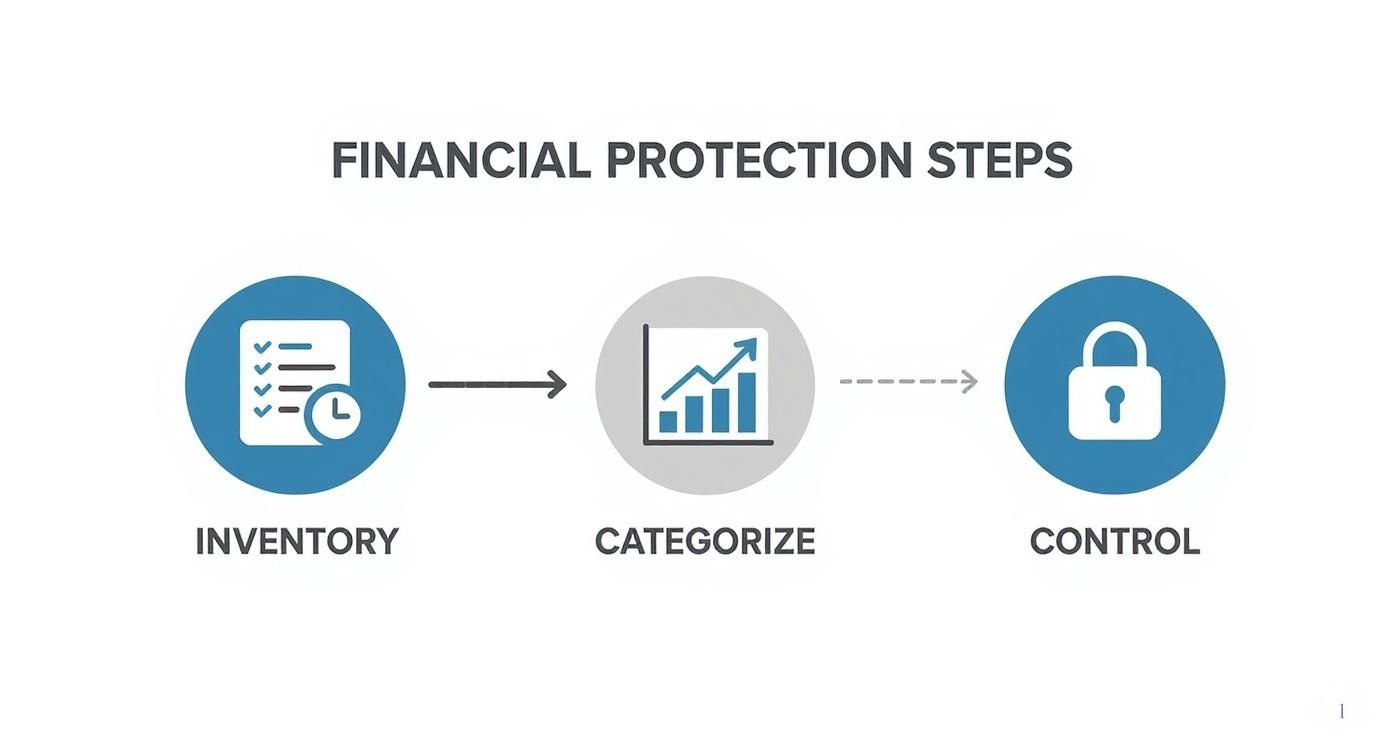
This process—inventorying your assets, categorizing them, and getting control of your financial data—empowers you to make decisions based on facts, not fear. For a deeper dive, our guide on planning your finances for a divorce in Texas offers even more detailed checklists and practical tips.
Navigating Texas Community Property Laws
To protect your assets in a divorce, you have to understand the legal ground you're standing on. In Texas, that ground is defined by community property law. It all starts with a powerful legal assumption: any asset acquired from your wedding day until the day the divorce is final is presumed to be community property.
This is a big deal. It means that even if a car is titled only in your name, or a bank account was funded solely by your paycheck, the court’s default position is that it belongs to the marital estate. This presumption is the starting line for every property division negotiation in a Texas divorce.
The Standard of a "Just and Right" Division
So, if everything is community property, does that mean it all gets split 50/50? This is one of the most common—and costly—misconceptions. The Texas Family Code doesn't mandate an equal division. It requires a just and right division. That phrase gives judges a tremendous amount of discretion to divide the community estate in a way they believe is fair based on the unique facts of your case.
A judge will consider the entire picture of your marriage and family, including:
- Fault in the Breakup: Was there adultery or cruelty? A judge can award a larger share of the community property to the spouse who was not at fault.
- Differences in Earning Capacity: If one of you has a significantly higher earning potential, the court might award a larger share to the spouse with fewer financial resources to help them get back on their feet.
- Child Custody: The parent who has primary custody of the children may receive a larger portion of the assets, or even the right to live in the family home, to ensure the children's needs are met with minimal disruption.
- Business Opportunities: The court can look at future business prospects available to each of you and adjust the division accordingly.
- Health and Age: The physical condition and age of each spouse are also part of the equation, as these factors can impact future earning ability and needs.
Proving an Asset is Your Separate Property
Because the court starts with that community property presumption, the responsibility is on you to prove an asset is your separate property. To succeed, you must provide "clear and convincing evidence" that traces the asset back to its separate origins—meaning it was a gift to you alone, an inheritance, or something you owned before the marriage.
This is where meticulous record-keeping becomes your best friend. For example, if you inherited $50,000 and deposited it into a joint savings account where it mixed with community funds, that act is called commingling. It can make proving the separate nature of your inheritance incredibly difficult, if not impossible.
For a deeper dive into these rules, be sure to read our guide on what is community property in Texas.
What About Debts?
Just like assets, liabilities are also part of the community estate. Debts acquired during the marriage—mortgages, car loans, credit card balances—are typically considered community debts. These will also be divided in a "just and right" manner, often without regard to whose name is on the account.
When you understand how a Texas court views property, you can better anticipate outcomes, gather the right documents, and work with your attorney to build a smart strategy that protects your financial interests.
Dealing with High-Value and Complex Assets

When your divorce involves more than a house and a savings account, the path forward gets more complicated. The same Texas community property rules apply, but assets like a family business, executive compensation, or investment properties add layers of complexity that demand specialized strategies.
It’s easy to feel overwhelmed. But protecting these assets isn’t about hiding them; it's about accurately valuing them, understanding their legal character, and ensuring they are divided fairly. This is where proactive, expert guidance becomes absolutely essential.
Protecting Your Business Interests
For many entrepreneurs and business owners, a business isn't just an asset—it's your legacy. The first question to answer is whether the business is community or separate property. If you started it before the marriage, the business itself is likely your separate property.
But here’s the catch: any increase in its value during the marriage due to your or your spouse's efforts—what we call "sweat equity"—may be considered a community asset.
This is why a professional business valuation is one of the most critical steps for any business owner facing divorce. A valuation expert will analyze everything from cash flow and goodwill to market position to determine the business's true worth. This gives you a defensible, objective number for negotiating a fair buyout of your spouse's community interest or presenting a solid case in court.
Once you have a solid valuation, you can explore options to protect the business itself. You might buy out your spouse's share with other community assets, set up a payment plan, or, in some cases, continue to co-own the business. Our guide on business valuation in a Texas divorce offers a much deeper look into this complex process.
Handling Retirement Accounts and Executive Compensation
High-level careers often come with compensation that goes far beyond a salary. Stock options, restricted stock units (RSUs), and deferred compensation plans are all assets that must be addressed. The challenge? Some of these may have been granted during the marriage but won't "vest" or become available until after the divorce is final.
Under Texas law, any portion of these benefits earned during the marriage is community property. An attorney can work with financial experts to perform a tracing analysis, which pinpoints the community property portion of these complex assets.
Retirement accounts like 401(k)s and pensions are treated similarly—they're divided based on the value accumulated during the marriage. To split these accounts without triggering massive tax penalties, you need a special court order.
- Qualified Domestic Relations Order (QDRO): This legal document instructs a retirement plan administrator to divide an account and pay a portion directly to the non-employee spouse.
- Without a QDRO: Trying to withdraw funds to pay your spouse directly can trigger early withdrawal penalties and a huge income tax bill, needlessly draining the asset's value for both of you.
The Unique Challenges of High-Value Estates
When your financial portfolio includes significant investments, real estate holdings, or unique assets, the complexity multiplies. The potential for hidden or undervalued assets also increases. Uncovering these requires forensic accountants and legal strategies that can navigate complex financial systems. It’s a specialized field, but it’s absolutely necessary when you’re dealing with a high-net-worth estate.
Critical Mistakes That Can Jeopardize Your Assets
During the emotional storm of a divorce, it’s easy to make a wrong move that could cost you dearly. You might be tempted to act impulsively to protect what you believe is yours. But certain actions, even with good intentions, can backfire with severe legal and financial consequences.
Navigating this period successfully means understanding the common pitfalls and actively avoiding them. By knowing what not to do, you can approach your divorce more strategically and prevent costly errors that could undermine your financial future.
Attempting to Hide or Transfer Assets
The temptation to move money, sell property, or "gift" a valuable asset to a family member can be strong, but this is one of the most damaging mistakes you can make. Texas courts demand full financial transparency. Once a divorce is filed, you are legally required to disclose all of your finances.
Hiding assets isn't just unethical; it's a serious legal violation. If you are caught—and financial experts are very good at their jobs—the penalties can be severe:
- Judicial Penalties: A judge has the authority to award a disproportionate share of the community estate to your spouse as a direct punishment.
- Loss of Credibility: Your dishonesty will damage your credibility in court, which can impact other crucial decisions, like those involving child custody.
- Financial Sanctions: The court can order you to pay your spouse's attorney fees and the costs they incurred uncovering the assets you tried to hide.
Once a divorce is filed, a Standard Temporary Restraining Order (TRO) often goes into effect automatically. This order essentially freezes the financial status quo, preventing either of you from making unusual expenditures or liquidating assets without the court's permission.
Relying on Informal Agreements
You and your spouse might feel you can work things out amicably with a simple handshake agreement. While the sentiment is admirable, these informal understandings are not legally enforceable and often fall apart under pressure.
One person's memory of the "deal" can change, or new circumstances can arise that make the old agreement unworkable. When that happens, you have no legal recourse. Every single detail of your property division must be formally documented and included in your Final Decree of Divorce. This is the legally binding document that a court can enforce.
Undervaluing or Overlooking Assets
A common and costly error is failing to get a proper, professional valuation for certain assets. You simply can't achieve a "just and right" division if you don't know what your property is actually worth.
Assets that are frequently misvalued in a divorce include:
- Pensions and Retirement Plans: These require specialized calculations by a financial expert to determine the community property portion.
- Family Businesses: As discussed, a professional business valuation is non-negotiable. Don’t rely on book value or what you think it’s worth.
- Collectibles and Art: An appraiser is essential to determine the fair market value of unique items like jewelry, fine art, or rare collections.
- Tax Consequences: Forgetting to consider the tax implications of certain assets is a huge mistake. A $100,000 brokerage account is not the same as $100,000 cash. The brokerage account will be subject to capital gains tax when the assets are sold, making its real-world value much lower.
By maintaining transparency, getting everything in writing, and ensuring every asset is properly valued, you build a case based on integrity and facts—the strongest foundation for protecting your future.
Using Legal Tools to Your Advantage
Protecting your assets isn't about being combative; it's about being prepared. When you understand the legal tools available at each stage of a Texas divorce, you can remove the fear of the unknown and think strategically. These mechanisms are designed to ensure fairness and prevent financial chaos.
Step 1: Agreements That Can Define Your Property
One of the most powerful tools you have is a marital property agreement. These are contracts that let you and your spouse decide how your property will be divided, rather than leaving it up to a judge.
- Prenuptial Agreements: Signed before marriage, these are perfect for clearly defining what will remain separate property. If you own a business or have significant assets before marriage, a prenup ensures those assets are shielded.
- Postnuptial Agreements: These work just like prenups but are signed during the marriage. Couples often use them after a major financial event, like one spouse receiving an inheritance, to formally agree that the asset will remain separate property.
Step 2: Locking Down Finances When a Divorce is Filed
Once someone files a divorce petition, the court steps in to stop either spouse from making any sudden financial moves. The main tool for this is a Temporary Restraining Order (TRO), which is standard practice in Texas.
A TRO is a court order that freezes the marital estate. It typically prevents both of you from:
- Selling or transferring property without agreement.
- Taking on significant or unusual new debt.
- Draining bank accounts or cashing out investments.
- Changing beneficiaries on insurance policies or retirement plans.
This order is critical. It preserves the financial status quo, ensuring there's a complete estate to divide fairly.
Step 3: Navigating the Texas Divorce Process
Knowing the process itself is a key part of your strategy. A Texas divorce follows a predictable path from filing to final decree.
- Filing the Petition: One spouse files an Original Petition for Divorce, and the other is formally served with the lawsuit. The TRO goes into effect.
- Discovery: This is the formal information-gathering phase. Both sides exchange financial documents, answer written questions under oath (Interrogatories), and may give sworn testimony (Depositions).
- Mediation: Before you go to trial, nearly all Texas courts will require you to attend mediation. This is a structured negotiation session led by a neutral third-party mediator who helps you and your spouse find common ground and reach a settlement. It is your best opportunity to control the outcome, save money, and reduce stress.
- Final Decree: If you reach an agreement in mediation, your attorneys will draft a Final Decree of Divorce. This document contains every term of your settlement, from property division to child custody. Once a judge signs it, it becomes a legally binding court order.
Another powerful legal tool for asset protection is a trust. For those looking to safeguard assets for future generations or to firmly establish their separate character, a trust can be an invaluable instrument. Getting a handle on understanding trust funds can give you the foundational knowledge of how these structures operate.
Top FAQs on Protecting Your Assets in a Texas Divorce
When you're facing divorce, you deserve clear, straight-talk answers. Here are some of the most common questions we hear from clients in your situation.
Can I keep my inheritance in my divorce?
Yes, your inheritance is generally safe. Under the Texas Family Code, property you receive through inheritance, as a gift, or from a personal injury settlement is considered your separate property.
However, the burden is on you to prove it’s separate with "clear and convincing evidence." If you deposit an inheritance check into a joint checking account, you have commingled it with community funds, which makes it extremely difficult to protect. The best practice is to always keep inherited assets in a separate account under your name only.
What happens to our house?
The marital home is often a couple's biggest and most emotional asset. There are a few common outcomes:
- One spouse buys out the other. One person keeps the house by refinancing the mortgage and paying the other for their share of the equity.
- You sell the house and split the profit. The home is sold, and after the mortgage and fees are paid, the remaining cash is divided according to your divorce decree.
- One parent has temporary use of the home. A judge may grant the parent with primary custody of the children the right to live in the home for a set period to provide stability for the kids.
During the divorce, temporary orders will dictate who lives in the home and who pays the mortgage and bills.
My spouse owned a business before we got married. Do I get part of it?
This is a complex issue. Since the business was started before the marriage, it is likely your spouse's separate property. However, that isn't the end of the story.
Any growth in the business's value that occurred during the marriage due to the work of either of you ("sweat equity") could be considered a community property asset. Determining this value often requires a forensic accountant to conduct a detailed business valuation and trace the source of its growth. This means the community estate may have a claim for reimbursement for the value it helped create.
How does a Temporary Restraining Order (TRO) actually protect our assets?
A Standard Temporary Restraining Order (TRO) acts like a pause button on your finances. It is a powerful court order that freezes the marital estate to prevent either spouse from making sudden moves with your money.
A TRO typically prohibits both of you from:
- Selling major assets like cars or property.
- Taking on significant new debt.
- Draining bank accounts or cashing out investments.
- Changing beneficiaries on life insurance or retirement accounts.
This order is a critical first step that protects the financial status quo, ensuring there is a complete and honest estate to divide fairly.
What to Do Next
Going through a divorce can feel overwhelming, but you do not have to navigate it alone. The most important thing you can do for yourself and your family is to get clear on your rights and your options. By taking the initiative to create a financial inventory and understanding how Texas community property law works, you are already building a stronger foundation for your future.
The choices you make now will shape your financial stability for years to come. If you are ready to take control with a clear, strategic plan, our team is here to offer the guidance and advocacy you need. We understand what you are going through, and we are committed to helping you move forward with confidence.
Don't leave your future to chance. Schedule a free, confidential consultation with The Law Office of Bryan Fagan, PLLC today. We will help you understand your options and map out a plan to protect everything you've worked so hard to build.