Skip to content
You are three months into a divorce. Hearings are on the calendar, bills keep arriving, and your lawyer still has not answered the questions that matter most to you. At that point, the first issue usually is not whether Texas allows a switch. It does. The issue is whether changing lawyers will improve your position or create more cost and delay than it solves.
Yes, you can change divorce lawyers in Texas, and doing so usually does not reset the case. The court keeps the same case, the same filings, and the same deadlines unless a judge orders otherwise. What changes is who is responsible for protecting your interests from this point on.
That distinction matters. Some clients need new counsel because communication has broken down, strategy is unclear, or trust is gone. Others are dealing with a normal rough patch in a hard case, and a candid meeting with current counsel may fix the problem without the expense of a transition. A smart decision starts with an honest review of what is going wrong.
If you are unsure whether the problem is serious enough to justify a change, these signs it might be time to change your divorce lawyer in Texas give you a practical way to assess the situation before you act.
Clients often assume switching lawyers will undo prior work, derail settlement talks, or force them to start over. Usually, that is not how Texas divorce cases work. The bigger concern is timing. A change made early in the case is often easier than a change on the eve of mediation, temporary orders, or trial, when file transfer, unpaid fees, and court deadlines can create real friction.
The goal is not to switch lawyers just because the process is stressful. The goal is to decide whether your current representation is still helping your case, your finances, and your long-term outcome.
Is It Time to Change Your Divorce Lawyer
You send a question about custody pickups, the hearing is next week, and no one answers for days. Then you get a short email telling you what will happen without any real explanation. That is usually the moment clients stop asking, "Can I switch lawyers?" and start asking, "Should I?"

In Texas, you are generally allowed to change divorce lawyers. The harder question is whether a change will improve your position or merely add cost, delay, and stress at a bad point in the case.
That decision should be made on facts, not frustration.
Some problems justify a serious reassessment. Repeated unanswered messages, confusion about the plan for temporary orders or mediation, surprise billing, or a clear loss of trust can damage the attorney-client relationship in ways that are hard to fix. Other problems are real but temporary. A slow week in discovery, a postponed hearing, or blunt advice you did not want to hear does not always mean your lawyer is doing poor work.
A useful starting point is to compare your experience to concrete warning signs, not just your stress level. These signs it might be time to change your divorce lawyer in Texas can help you judge whether you are dealing with a normal rough stretch or a representation problem that needs action.
One practical test helps. You should know, in plain language, what your lawyer is trying to accomplish next and why that approach makes sense for your goals. If you cannot get a straight answer after asking directly, the issue may be larger than communication style.
Retainer fees also trap people into staying longer than they should. Clients sometimes assume that paying a large upfront fee means they need to wait it out. That is not how the decision should be made. The better question is whether current counsel is helping your case today. Sunk cost is not strategy.
Timing still matters. A switch early in the case is usually easier than a switch right before mediation, a temporary orders hearing, or trial. That does not mean you should stay with a lawyer you no longer trust. It means you should weigh the benefit of new counsel against the disruption of transferring the file, catching a new lawyer up to speed, and dealing with any unpaid balance before the change is complete.
The goal is not to change lawyers because divorce is hard. The goal is to decide whether your current lawyer is still advancing your case in a way you understand and can support.
Evaluating Your Current Legal Representation
The most common reasons people switch lawyers are poor communication, personality conflict, and strategy disagreements, and that's exactly why a useful decision framework matters. Texas family law commentary points out that the key issue is telling the difference between a fixable communication problem and a deeper mismatch that could hurt your position on custody, support, or property negotiations (Texas discussion of common switching reasons).
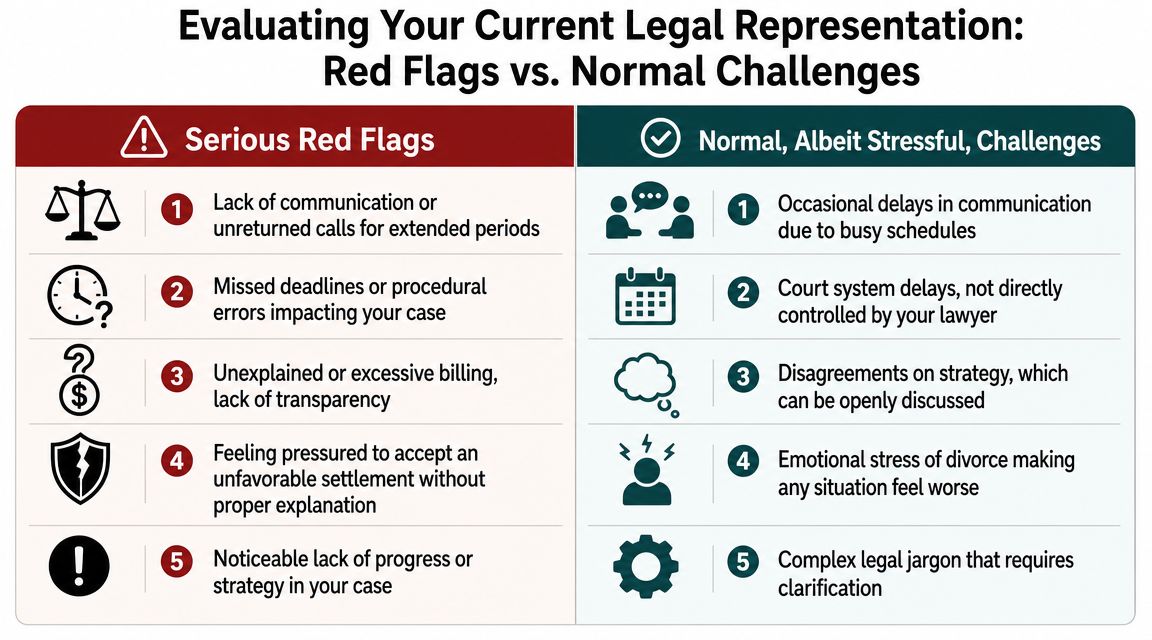
Red flags that usually justify serious concern
Some problems point to a real breakdown in representation.
- Repeated silence: If your lawyer regularly leaves major questions unanswered, ignores urgent messages, or fails to prepare you for hearings, the issue isn't just annoyance. It affects decision-making.
- No visible strategy: You should know the goal for temporary orders, discovery, mediation, or trial preparation. If every conversation feels reactive, your case may be drifting.
- Billing that doesn't match the work: You may not like every invoice, but you should be able to understand what was done and why.
- Pressure without explanation: If you're being pushed to settle and no one can explain the trade-offs, that's a danger sign.
- Missed procedural responsibilities: If deadlines, filings, or court preparation are being mishandled, the risk becomes immediate.
Problems that may be fixable
Other frustrations are common in divorce and don't always mean you need a new lawyer.
| Situation | What it may mean |
|---|---|
| Slow response during a busy week | Frustrating, but not necessarily neglect |
| A disagreement about whether to settle | May reflect professional judgment, not disloyalty |
| A slow-moving case | Courts, opposing counsel, and required procedures often control pace |
| Legal language that feels opaque | You may need clearer explanations, not a new attorney |
A direct conversation can solve more than many clients expect. Ask for a case-status meeting. Request a written summary of next steps. Ask what the plan is for discovery, mediation, temporary orders, or trial. If your lawyer responds clearly and concretely, the relationship may be repairable.
You're not looking for perfect bedside manner. You're looking for competence, candor, responsiveness, and a strategy you can understand.
Ask yourself these four questions
- Do you trust your lawyer's judgment, even when you don't like the news?
- Do you understand what your case is trying to accomplish next?
- Do you feel heard when you raise concerns?
- Would staying create more risk than changing?
If the answer to most of those questions is no, the issue probably isn't temporary frustration. It's likely a poor fit.
That matters even more in cases involving children, closely held businesses, separate property claims, reimbursement issues, or high-value estates. In those cases, a weak attorney-client relationship can affect negotiation advantage and the quality of the evidence your side develops.
The Official Process for Switching Attorneys in Texas
Once you decide to make the change, the legal part is usually more routine than people expect. In Texas, a client has the right to switch lawyers at any time, but if the case is already on file the transition typically requires a formal substitution-of-counsel filing so the new lawyer can appear in the case. Courts usually allow the change unless it's clearly being done in bad faith to stall the proceeding (Texas substitution-of-counsel guidance).
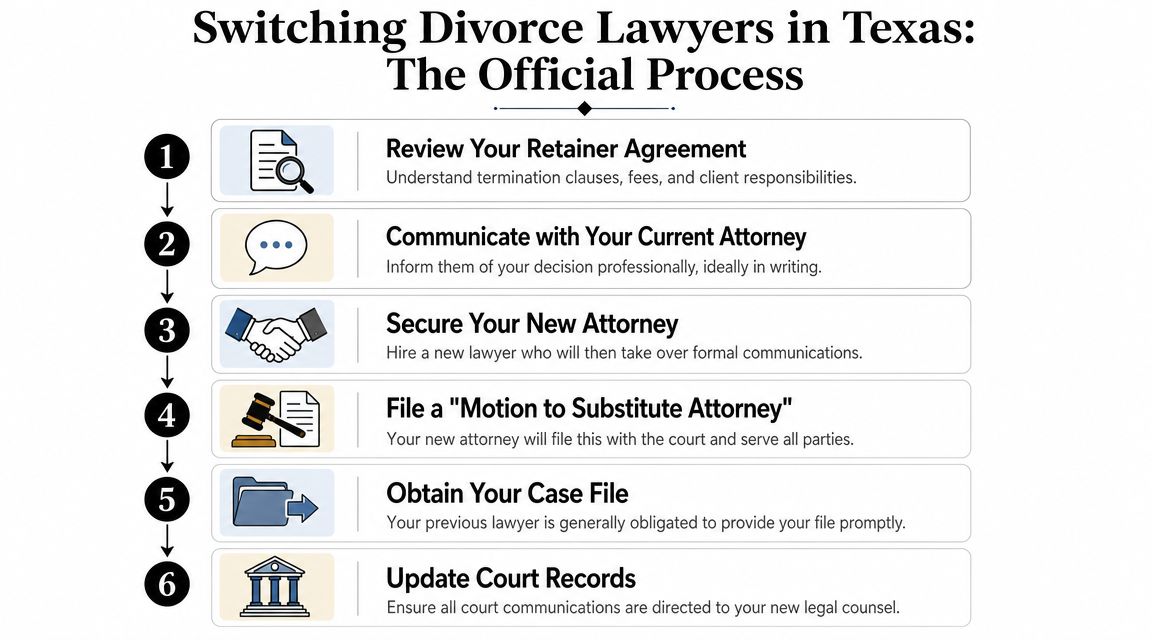
What your new lawyer usually handles
The practical filings often include a Notice of Appearance and a Motion to Substitute Counsel or similar paperwork, depending on the court and posture of the case. The point is simple. The court, your spouse's lawyer, and everyone involved need formal notice about who now represents you.
Your incoming lawyer should usually take the lead on this process after you sign the new engagement paperwork.
Here's a useful overview before the paperwork starts:
The sequence usually looks like this
- Review your current fee agreement. Look for termination language, any outstanding invoice issues, and how the file transfer is handled.
- Hire replacement counsel first. This avoids a gap where no lawyer is responsible for your case.
- Notify current counsel. This is usually done professionally and in writing.
- File substitution paperwork. Your new lawyer makes the change official with the court.
- Redirect communication. Opposing counsel and the court should send future notices to your new attorney.
- Move immediately into case management. Hearings, mediation settings, discovery, and settlement discussions don't pause just because lawyers changed.
A lawyer change is usually an administrative event, not a courtroom showdown.
Why this process matters
The filing isn't just clerical. It protects you from confusion about who receives deadlines, notices, and court communications. If a hearing is close or trial settings are approaching, formal appearance by your new lawyer becomes urgent.
For people involved in temporary custody disputes, support issues, enforcement claims, or protective-order-related conflict, that formal handoff can't wait until “sometime next week.” It needs to happen before the case outruns the transition.
Managing Your Case Files Fees and Deadlines
The most stressful part of switching lawyers is usually not the court filing. It's the handoff.
Texas practice commentary treats that handoff as the primary operational challenge. The new lawyer files the substitution paperwork, obtains the prior file, and resumes the case. Existing pleadings, discovery responses, and trial deadlines stay active and must be handled immediately to preserve continuity (Texas guidance on file transfer and active deadlines).
Your file is the backbone of the transition
A divorce file often contains more than court pleadings. It may include financial records, sworn inventories, draft settlement proposals, custody notes, medical records, business documents, correspondence, and billing history. Your new lawyer needs those materials quickly to avoid repeating work or missing context.
In a well-managed transition, the new firm coordinates directly with the old one to collect the file. That's often faster and cleaner than putting you in the middle of every detail.
What happens with fees
Clients often assume switching lawyers means they lose all money already paid. That isn't always how it works. The answer depends on the fee agreement, the work already performed, and whether part of the retainer remains unapplied.
What you should do is straightforward:
- Ask for a final statement: You want a clear accounting of work completed, charges posted, and any balance issues.
- Request clarity on the retainer: If funds remain, ask how they'll be handled under the agreement.
- Discuss startup costs with new counsel: A new lawyer may need time to review the file, learn the history, and prepare for upcoming events.
If you want a better sense of what legal fees can look like as your case moves forward, this guide on the cost of a divorce lawyer in Texas is a useful companion.
Deadlines don't move just because you changed lawyers
Clients often face difficulties. Temporary orders remain in place. Discovery requests still need answers. Mediation settings still matter. Trial preparation deadlines don't disappear.
A common example looks like this:
- Your old lawyer has mediation scheduled.
- You terminate that lawyer before hiring the next one.
- The file transfer takes longer than expected.
- Your spouse's attorney keeps moving.
- You arrive at mediation underprepared, or you need a continuance you might have avoided.
That sequence is preventable.
Client protection point: Hire the new lawyer first, then let the lawyers coordinate the transfer so your case keeps moving under active supervision.
If children or complex assets are involved
The handoff needs even tighter control when the case includes conservatorship, possession schedules, child support disputes, a family business, stock compensation, tracing claims, or separate property arguments. Those cases depend heavily on timing, documents, and strategic consistency.
If your case is headed to mediation, your new lawyer should review prior offers, temporary orders, and discovery before taking a fresh position. If trial is possible, the new lawyer needs to identify what has already been done well and what needs immediate repair.
Potential Pitfalls and How to Avoid Them
A lawyer change can help a divorce case. It can also create new problems if the decision is emotional, rushed, or poorly timed.
The key question is not just whether you are unhappy. It is whether changing lawyers is likely to improve your position enough to justify the cost, delay, and adjustment period. If the answer is yes, the next step is to control the transition carefully.
Where switches usually go wrong
The first problem is poor timing. A new attorney needs time to read pleadings, review temporary orders, understand prior negotiations, and identify what still needs immediate attention. If a hearing or mediation is close, that learning curve matters.
The second problem is duplicated work and expense. Your former lawyer may bill for wrapping up the file, preparing a withdrawal, and responding to transfer questions. Your new lawyer may bill for reviewing the same record, correcting gaps, and setting a new strategy. That extra cost can be justified, but only if the switch solves a real representation problem.
The third problem is inconsistency. If your position on custody, support, or property division changes abruptly without a clear reason, the other side may read that as uncertainty and press harder in settlement talks or motion practice.
How to avoid those problems
Treat the switch like a planned case event, not a breakup.
Start by confirming that new counsel can step in quickly and assess immediate risk. If you are still deciding what kind of lawyer you need, this guide on how to choose the right divorce lawyer in Texas and spot red flags can help you make that decision with more discipline.
Then focus on execution:
- Get clear on why you are switching: Communication problems, lack of preparation, strategic disagreement, or trust issues are different problems and call for different solutions.
- Pin down the next 30 days of your case: Identify hearings, mediation, discovery deadlines, expert deadlines, and any pending temporary matters.
- Request a complete file promptly: Ask for pleadings, correspondence, discovery, orders, billing records, settlement proposals, and attorney notes that can legally be released.
- Keep the termination message short and professional: A direct written notice usually works better than a long emotional explanation.
- Ask your new lawyer to set priorities immediately: The first goal is usually protecting deadlines and court settings. Strategy adjustments come after that.
Cases that require extra caution
Some transitions are less forgiving. That is especially true when there is a temporary orders fight, a custody dispute that is heating up, a business valuation, separate property tracing, or missing financial records. In those cases, even a short gap in direction can create avoidable setbacks.
A change in counsel should improve your position, not interrupt it.
Clients usually do best when they approach the switch with a simple framework. Decide if the problem with current counsel is serious enough to justify change. Confirm that new counsel can step in without exposing the case. Then make the handoff orderly, documented, and fast. That is how a difficult decision stays manageable.
How to Choose Your New Texas Divorce Lawyer
You meet with a new lawyer after weeks of frustration with your current one. The right consultation should leave you with a clearer view of your case, the risks in changing counsel, and whether this attorney can step in without losing momentum.
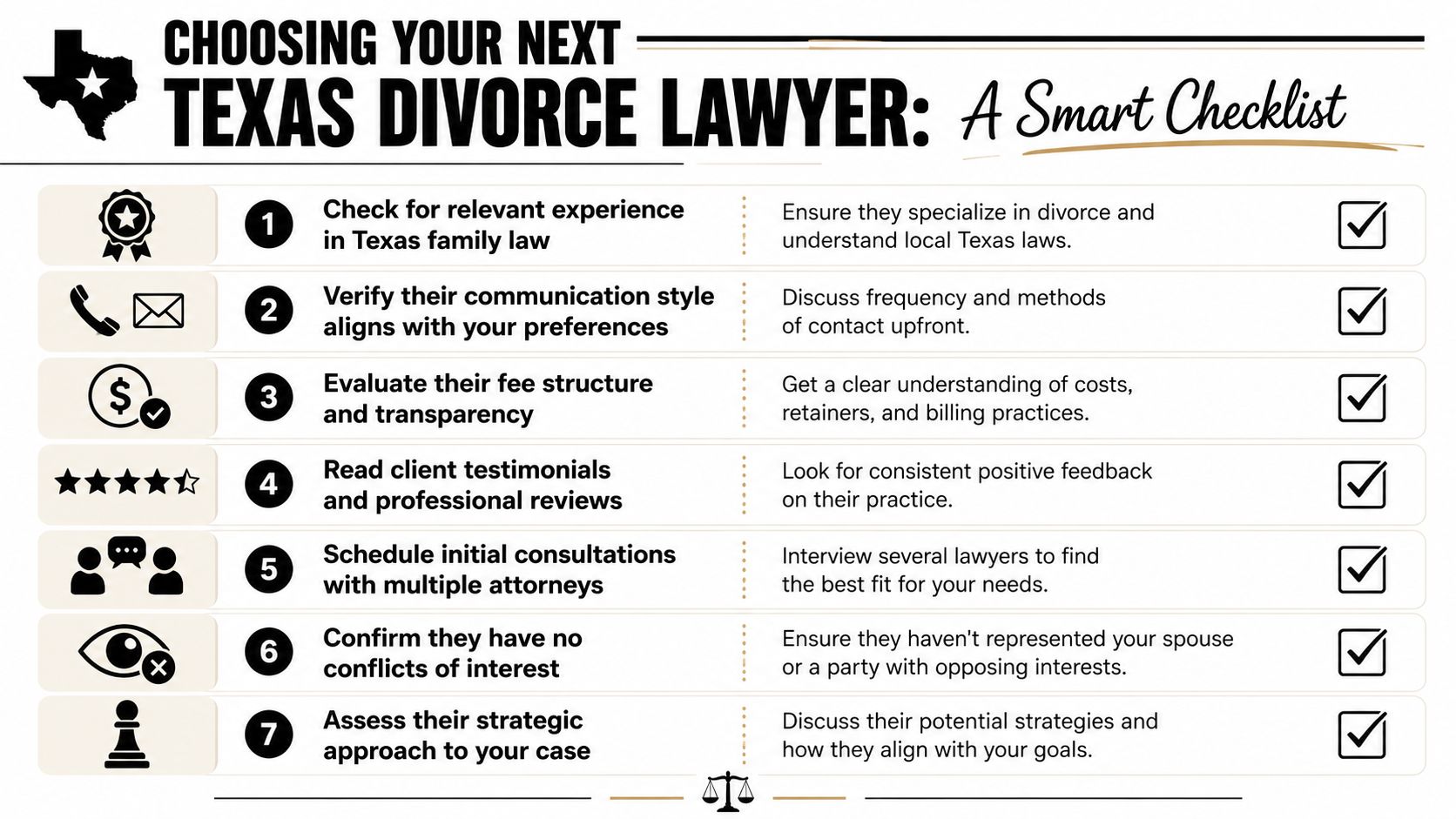
Start with the question that matters most. Is this lawyer a better fit for the case you have, not just a more appealing personality in a one-hour meeting?
A strong replacement lawyer should be able to do three things early. Assess the current posture of the case. Explain what can and cannot be fixed quickly. Give you a realistic plan for the next phase, whether that means settlement work, mediation prep, temporary orders, or trial preparation.
Questions worth asking in a consultation
Use the meeting to test judgment, not charm. Good questions usually sound like this:
- How do you assess the current posture of my case? You want to hear where the pressure points are, not a generic promise to "fight for you."
- What would you need from prior counsel in the first week? A lawyer who has handled substitutions before should know which records matter first.
- How do you communicate with clients during active stages of a case? Ask who returns calls, how urgent issues are handled, and how often you should expect updates.
- What is your approach to mediation, settlement review, and trial preparation? The answer should reflect an actual process.
- How have you handled cases with facts like mine? That may mean a custody dispute, a business interest, tracing separate property, support issues, or missing financial records.
- How do you bill for transition work? New counsel often needs time to review the file, identify gaps, and get up to speed. You should know how that work is charged.
The goal is not to find someone who says everything your last lawyer did wrong. The goal is to find someone who can explain what happens next with discipline and specificity.
Look for fit, judgment, and case-control
Credentials matter, but they are not enough. A lawyer can be experienced and still be wrong for your case if the communication style, pace, or strategy does not match what your situation requires.
Here is a practical way to evaluate fit:
| What to look for | Why it matters |
|---|---|
| Clear communication | You need to understand options, risks, and likely outcomes before making decisions |
| Case-control | A good lawyer should be able to identify immediate priorities and keep the matter organized |
| Honest expectations | Early overpromising usually creates fee disputes, disappointment, or poor settlement decisions |
| Relevant experience | Your case may call for custody litigation, business valuation work, tracing, or enforcement knowledge |
For a closer look at screening attorneys, review this guide on how to choose the right divorce lawyer in Texas and spot red flags.
One sign the meeting is going well
The best consultations are usually calm and specific.
A capable Texas family lawyer should be able to tell you, in plain language, where the case stands, what decisions need to be made soon, and what facts still need verification. That matters more than a dramatic style or broad promises. In contested divorces, especially those involving children, property disputes, retirement accounts, business interests, or separate property claims, disciplined case assessment usually beats theatrics.
If you are considering firms, the Law Office of Bryan Fagan, PLLC handles Texas divorce and family law matters, including contested cases, custody disputes, mediation, and property division. Whether you speak with that office or another Texas family law firm, ask the same question every time: can this lawyer step into the file, protect the case posture, and give me a plan I can evaluate?
What to do next
Before you hire anyone, compare at least two lawyers if time allows. Bring your current pleadings, recent orders, the fee agreement, and a short timeline of what has happened so far. That gives you a better basis for judging who understands the file.
Changing lawyers can help. Choosing carefully is what makes the change worthwhile.