Skip to content
Yes, you can switch divorce lawyers in Texas, even after your case has already started. In practice, the change usually happens through a substitution-of-counsel process, so your divorce keeps moving instead of starting over.
If you're reading this, you're probably already feeling the strain. Maybe your calls aren't returned. Maybe you don't understand the strategy. Maybe every hearing feels closer, but your confidence in your lawyer keeps getting weaker.
That feeling matters. Divorce is hard enough when you're dealing with property division, parenting schedules, temporary orders, mediation, and the pressure of making decisions that affect your future. If you no longer trust the person guiding you through it, the problem usually doesn't fix itself.
Texas law generally gives you the right to end the attorney-client relationship and hire someone else. The primary issue isn't whether you can switch. It's how to do it without creating new problems for yourself. That means understanding the court paperwork, the timing, the file transfer, and the trade-offs that come with bringing in a new lawyer mid-case.
Texas divorces also don't stop being Texas divorces because counsel changes. Your case still follows the same family-law framework. One spouse files the petition. The other spouse answers. The court may enter temporary orders about use of property, support, or parenting while the case is pending. Many cases go through mediation before final trial. If children are involved, conservatorship, possession, and support remain central issues. If you own a business, real estate, retirement accounts, or other substantial assets, changing lawyers has to be handled with even more care so your new attorney can quickly understand the financial record and existing strategy.
Recognizing When It Is Time for a New Attorney
Feeling frustrated with your lawyer doesn't always mean you need a new one. Divorce creates pressure, delay, and uncertainty even in well-managed cases. But some patterns point to a real breakdown.
Recent profession-wide reporting discussed by a Texas family-law source notes that lawyer-client communication remains a persistent problem, with many clients reporting confusion about strategy, responsiveness, and expectations in the attorney-client relationship, as summarized in this discussion of communication problems and switching counsel. That matters because many people first think, 'My lawyer is failing me,' when the immediate issue may be poor communication.
Normal divorce stress versus a real red flag
Some dissatisfaction is normal. Your lawyer may tell you things you don't want to hear. A judge may move slowly. Your spouse may refuse to cooperate. Mediation may not produce a settlement the first time. None of that automatically means your representation is bad.
A stronger reason to consider changing lawyers usually looks more concrete:
- You don't understand the plan. Your lawyer gives conclusions but not reasoning, so you still don't know why a hearing matters, why a proposal was rejected, or what the next month should look like.
- You can't get timely responses. No lawyer can answer every message instantly, but a pattern of silence creates risk when deadlines, discovery, or parenting disputes are active.
- Your strategy is badly misaligned. You want a settlement-focused path and your lawyer seems to push every dispute toward a fight, or the opposite.
- Billing feels unclear. If you can't tell what work was done or why costs are increasing, trust erodes quickly.
- The case feels stalled without explanation. Delay is sometimes unavoidable, but you should still know what is happening and why.
Practical rule: Before you fire your lawyer, ask yourself one direct question. "If this same lawyer handled my next hearing tomorrow, would I feel informed and protected?" If the honest answer is no, take that seriously.
A short self-check before you make the move
Write down the last three things that bothered you. Then sort them into two buckets.
| Concern | Could this be fixed with one direct meeting | Is this a reason to change counsel |
|---|---|---|
| Slow response to routine questions | Often yes | Sometimes |
| No explanation of strategy | Sometimes | Often |
| Disagreement about goals | Rarely | Often |
| One bad hearing result | Sometimes | Not by itself |
| Ongoing confusion about bills or deadlines | Sometimes | Often |
If your divorce also involves hidden accounts, business valuation issues, or possible misconduct by a financial professional, you may need a lawyer who can coordinate with outside specialists. In that setting, a resource on investment fraud attorneys can help you understand the financial-misconduct side of a broader dispute.
For a more focused list of warning signs, review signs it might be time to change your divorce lawyer in Texas.
When a conversation comes before a switch
Sometimes the right move is one candid meeting, not a replacement.
Tell your lawyer exactly what isn't working. Ask how often you should expect updates, who on the team handles communications, what deadlines are coming, and what the settlement or trial strategy is. If the answers are clear and the follow-through improves, the relationship may still be repairable.
If you still leave that conversation feeling unheard or uncertain, changing counsel may be the more responsible choice.
The Formal Legal Process for Changing Lawyers in Texas
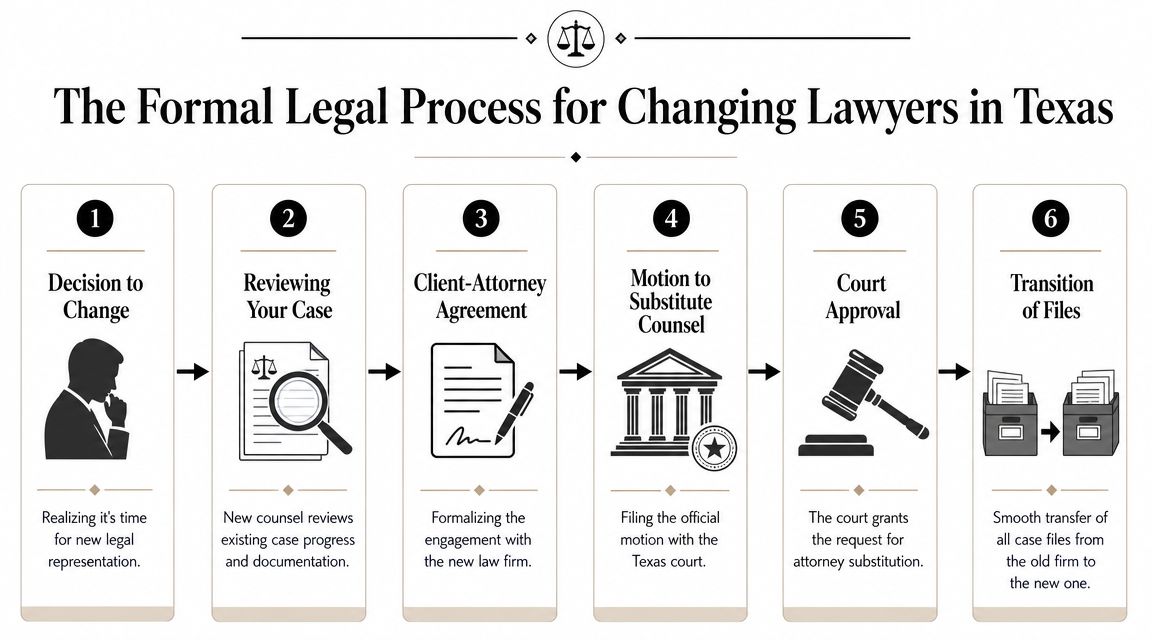
The legal mechanics are simpler than commonly believed. You aren't throwing away your case and starting from day one. In Texas, a client can generally terminate the attorney-client relationship at any time, and the transition is usually handled through a substitution-of-counsel process in which the new lawyer files a notice of appearance and a motion to substitute counsel, allowing the case to continue rather than restart, as explained in this Texas discussion of changing divorce counsel.
What the court paperwork actually does
Your new lawyer usually handles the formal transition. Two common pieces of paperwork matter most.
Notice of appearance tells the court and the other side that your new attorney now represents you.
Motion to substitute counsel asks the court to recognize the change in representation and remove prior counsel through the proper process.
That sounds technical, but the purpose is straightforward. The court needs a clear record of who speaks for you, who receives notices, and who is responsible for appearances and filings.
What usually happens step by step
A typical transition looks like this:
- You hire new counsel. This should happen first whenever possible.
- Your new lawyer reviews the current posture of the case. That includes hearings, mediation dates, discovery deadlines, temporary orders, and pending disputes.
- The new lawyer prepares and files the necessary appearance and substitution paperwork.
- The prior attorney is formally withdrawn or replaced through the court process.
- The file transfers from the old office to the new one.
- Your case continues under the new lawyer's direction.
The goal is continuity. Courts want to know who represents you, not force you to restart your divorce.
Why timing matters more than people realize
Switching lawyers becomes more delicate once a case is already active. Texas family cases often move through a series of hearings, temporary orders, discovery exchanges, mediation efforts, and final trial settings. The closer you are to a major event, the more carefully the court may examine the change.
If your divorce includes children, your new attorney also needs to understand existing conservatorship terms, possession schedules, child support positions, and any temporary restrictions already in place. If your case involves community property disputes, separate-property claims, reimbursement issues, or a closely held business, the new lawyer must get up to speed fast enough to protect your position.
Plain-English family law context
Texas divorce cases still rest on the same core legal issues after the switch:
- Grounds for divorce may be no-fault or fault-based, depending on the pleadings.
- Community property must still be identified, valued, and divided under Texas law.
- Children's issues still turn on conservatorship, possession, decision-making rights, and support.
- Temporary orders remain in effect unless changed by the court.
- Final decree negotiations or trial preparation continue from the current point in the case.
Changing lawyers changes the advocate. It doesn't erase the case history.
Your Practical Checklist After Hiring New Counsel
After you hire replacement counsel, the goal is simple. Get your new lawyer ready to act without paying them to chase basic information.
The handoff usually goes better when the new attorney receives the prior file quickly and can review the case history in one pass, as explained in this discussion of the handoff process in a Texas divorce case. In practice, that means treating the first week with new counsel like an organized transfer of an active file, not a fresh start.

What to collect right away
Your new lawyer needs the paper trail before they can make smart decisions about strategy, settlement, or emergency action.
Send what you already have, even if the prior attorney's office is also sending the formal file:
- Court filings such as the petition, answer, counterpetition, motions, and signed orders
- Discovery materials including requests, responses, inventories, and document production
- Hearing information like notices, reset dates, coordinator emails, and court settings
- Settlement documents including proposals, mediation summaries, and draft decrees
- Client communications that show advice given, unresolved questions, or strategy disputes
- Financial records if property division, business interests, retirement, or support are contested
If your file is incomplete, start with the documents in your possession and build from there. This guide on what documents you should gather before filing for divorce is still useful mid-case because the same bank records, tax returns, debt statements, and property records often drive the disputed issues after the case is already on file.
Treat the file transfer and the billing review as two separate jobs
Clients often blend these together. They should be handled separately.
First, request the full client file. Ask for pleadings, discovery, correspondence, exhibits, draft settlement documents, attorney notes that are part of the client file, and copies of anything filed or exchanged with the other side. Your new lawyer may send that request for you, which often reduces delay and confusion.
Second, ask for a final billing statement and compare it to your fee agreement. Look for three things: unpaid balances, charges you do not understand, and whether any portion of the retainer should be returned. A fee dispute does not always stop the transfer of the file, but it can slow cooperation between offices, so it helps to identify the problem early.
Give your new lawyer a case briefing they can use
A takeover meeting works best when the client explains the case in a form the lawyer can act on. Long stories about the marriage are less helpful than a clear summary of what has happened, what is coming up, and what result you want.
Use a short written outline like this:
| Topic | What your new lawyer needs to know |
|---|---|
| Immediate deadlines | Next hearing, mediation, discovery due dates |
| Children's issues | Current schedule, conflicts, safety concerns, school issues |
| Property issues | House, debt, business, retirement, separate-property claims |
| Prior strategy | What the old lawyer was trying to do |
| Your goals | Settlement, trial readiness, parenting priorities, budget concerns |
One more point matters here. Tell the new attorney what is not working, but also tell them what should stay the same. If temporary orders are serving you well, if a settlement framework is close, or if a particular expert has already done useful work, say that early. A lawyer changing the direction of a case without a reason can cost you time and money.
A prepared client gives new counsel a faster path to competent decisions. That is how you reduce duplicated work, protect deadlines, and make the switch worth it.
Potential Consequences and How to Manage Them
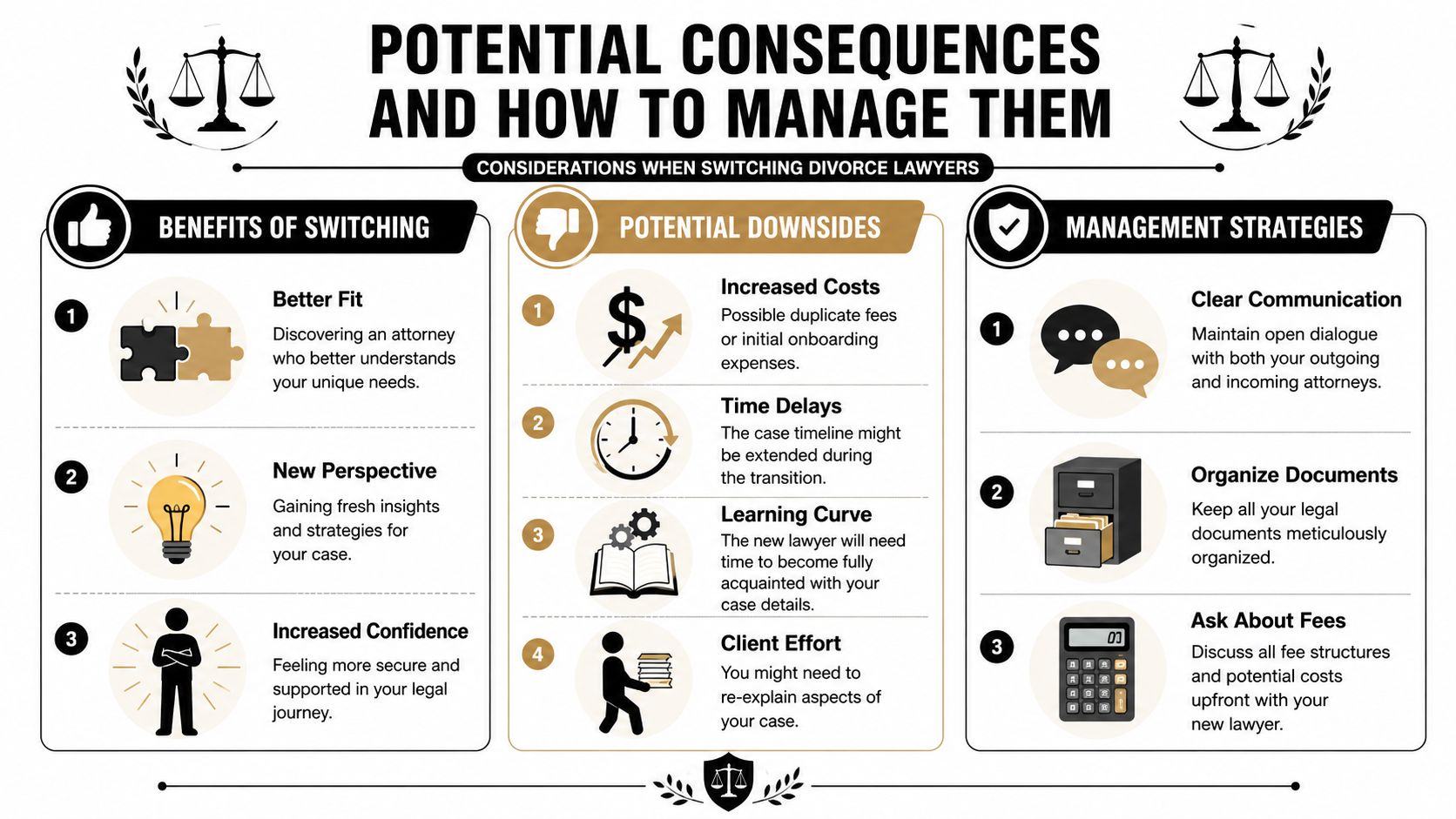
Switching lawyers can solve a serious problem. It can also create short-term friction. You should expect both possibilities and plan for them.
If a hearing or trial is close, a court may look closely at the request to switch attorneys to make sure the change isn't just a delay tactic, and the safer sequence is usually to retain new counsel before prior counsel exits the case, as discussed in this Texas guidance on switching lawyers during an active divorce.
The main risks
The first risk is delay. A new lawyer needs time to review the file, understand the personalities involved, and decide whether the existing strategy should continue or change. If a mediation, temporary-orders hearing, or trial setting is near, that review period matters.
The second risk is duplicated legal work. Your new lawyer will need to read pleadings, review evidence, and evaluate issues that prior counsel already touched. That's not wasted work if the switch improves your case, but it is still work you may pay for.
A third risk is less obvious. You may unintentionally create a representation gap if you fire the old lawyer before the new one is ready to step in. That can leave you exposed to court notices, discovery deadlines, or appearances you aren't prepared to handle alone.
What works and what doesn't
Here is the honest comparison.
| What tends to work | What tends to create problems |
|---|---|
| Hiring new counsel before the old lawyer is out | Firing first and searching later |
| Giving the new lawyer a complete document set | Assuming the firms will sort everything out without your help |
| Switching earlier in the case if possible | Waiting until the eve of trial unless absolutely necessary |
| Asking direct fee and strategy questions up front | Hoping your concerns will disappear on their own |
Don't judge the switch by whether it feels inconvenient in the first week. Judge it by whether it improves clarity, preparation, and trust for the rest of the case.
Special concerns in parenting and high-asset cases
If children are involved, continuity matters because temporary possession schedules, school logistics, medical decision-making, and communication restrictions may already be in place. Your new lawyer must know exactly what orders exist before advising you to take or avoid a particular action.
If you own a business or have substantial assets, the transition can be more demanding. Your incoming attorney may need to review entity records, tracing material, appraisals, inventory schedules, and existing settlement positions. That doesn't mean you shouldn't switch. It means you should do it carefully and with enough time for serious review.
Mediation can also be affected. In many Texas divorces, mediation is the point where property and parenting issues either narrow or resolve. A new lawyer may want to revisit your prior offers before you attend another session, especially if the earlier approach didn't match your goals.
How to Choose Your Next Divorce Lawyer
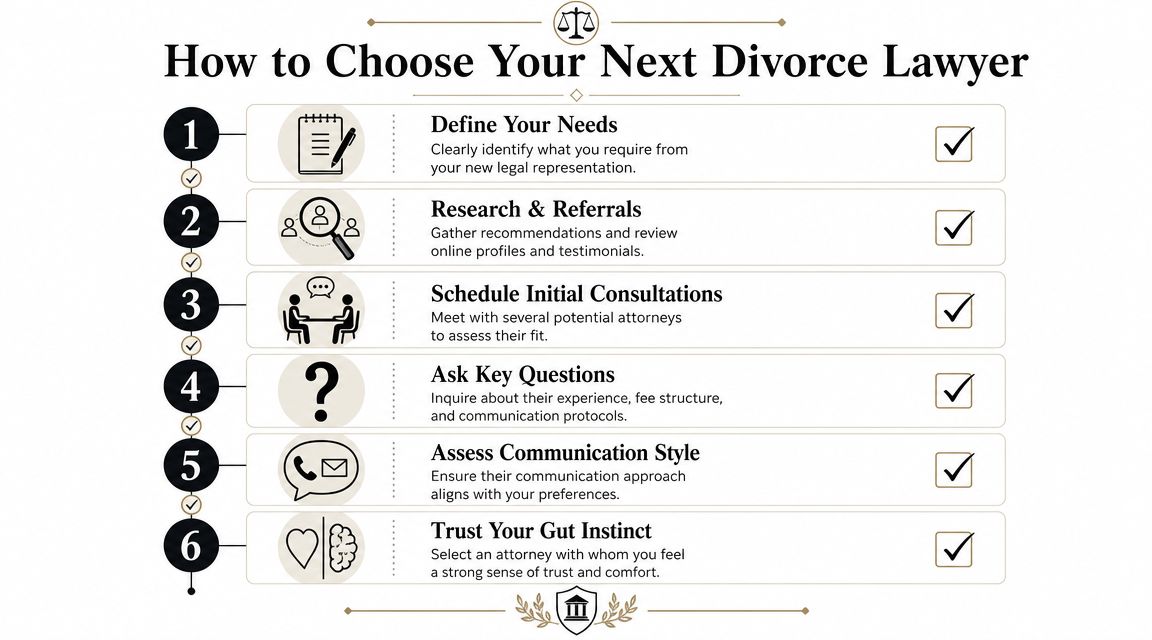
A second hire should be more deliberate than the first. You're not just shopping for credentials. You're choosing the person who will speak for you in negotiations, mediation, and, if necessary, in court.
It's also worth remembering that changing lawyers mid-divorce isn't unusual. Some Texas family-law firms report that replacement clients make up a substantial share of new matters, with one Dallas-Fort Worth firm estimating that 40% to 50% of its new clients are people hiring the firm to take over an existing case, according to this Texas family-law article on attorney changes during divorce.
Ask questions that reveal how the lawyer actually works
The right consultation questions are practical.
- How do you handle communication? Ask who returns calls, how often you'll receive updates, and whether communication goes through the lawyer, a paralegal, or both.
- What is your initial view of my case posture? A good lawyer won't promise an outcome, but they should be able to identify pressure points quickly.
- How do you approach settlement and trial preparation? You need to know whether they are negotiation-focused, litigation-ready, or both.
- What do you need from me in the first two weeks? The answer will tell you how organized the intake process is.
- Have you handled takeovers in cases like mine? That matters in cases involving custody fights, business interests, separate-property claims, or emergency temporary issues.
For a deeper screening guide, review how to choose the right divorce lawyer in Texas, red flags included.
This short video may also help frame what to look for in new representation.
What to listen for in the answers
You want a lawyer who explains things clearly, not dramatically. You want someone who can discuss judges, procedure, temporary orders, mediation, and final-decree drafting in plain English.
You should also listen for honesty. A strong family lawyer won't tell you that every problem is your spouse's fault, every issue is worth a fight, or every case should settle fast. They should tell you where your case is strong, where it's exposed, and what a sensible next step looks like.
Key Takeaways and Your Next Move
If you're asking, Can you switch divorce lawyers in Texas? What happens next, the answer is straightforward. Yes, you can usually change lawyers, and the case normally continues through a formal substitution process rather than restarting.
That said, the legal right to switch and the smart way to switch aren't always the same thing. The best transitions happen when you make the decision early enough, retain new counsel before the old lawyer steps out, and get the full file moving immediately. They also happen when you're honest with yourself about why you're changing lawyers in the first place.
Keep these points in mind:
- Trust matters. If you don't understand the strategy or can't get clear communication, the relationship may no longer be workable.
- Procedure matters. Your new lawyer usually handles the notice of appearance and motion to substitute counsel so the court record stays clean.
- Timing matters. The closer you are to hearing or trial, the more careful the transition needs to be.
- Preparation matters. Organized files, billing questions, and a concise case summary can save time and reduce avoidable cost.
- Fit matters. Your next lawyer should match your goals, communication needs, and the complexity of your case.
Texas divorce already asks a lot from you. If children are involved, you need a plan that protects your parenting rights and keeps temporary arrangements stable. If your case includes a business, professional practice, retirement accounts, or substantial property, you need a lawyer who can step in without losing sight of the financial details. If mediation is approaching, you need someone who can assess whether settlement is still realistic and what terms are worth fighting for.
You don't have to stay in a legal relationship that no longer works just because the case is underway.
If you're considering a change in representation, the Law Office of Bryan Fagan, PLLC offers free consultations for Texans facing divorce, custody, support, property division, mediation, and enforcement issues. You can talk through where your case stands, what a substitution of counsel would involve, and what steps may help you move forward with more clarity and confidence.