Skip to content
You may be lying awake trying to decide whether your divorce should end at a conference table or in a courtroom.
Individuals initiating a Texas divorce often start by thinking the biggest question is whether they'll “win.” In practice, the more important question is often how your case should be resolved. Should you push toward a negotiated settlement, or should you prepare for trial and let a judge decide the disputed issues?
That choice affects more than the legal paperwork. It shapes how much control you keep, how much conflict your children will absorb, how much of your private life becomes part of the court record, and how your relationship with your co-parent may function long after the divorce is over.
A lot of Texans are surprised to learn that trial is not the usual ending. DivorceNet reports that roughly 90% to 95% of divorce cases settle out of court. Even contested cases often resolve before a judge hears evidence. That matters because many spouses assume that once papers are filed and emotions rise, a courtroom battle is unavoidable. It usually isn't.
The Most Important Decision in Your Divorce You Haven't Made Yet
If you're in the middle of a divorce, you're probably already making dozens of decisions at once. Who stays in the house. How parenting time will work. What happens to retirement accounts. Whether your spouse is being honest. Whether you can trust the next proposal that comes across your attorney's desk.
Under all of that sits one strategic decision that changes everything else. Are you trying to resolve this case by agreement, or are you building it for trial?
Those are not just different endings. They are different processes with different pressures. Settlement usually means negotiation, mediation, and compromise. Trial means formal discovery, witness testimony, exhibits, and a judge making decisions when the two of you cannot.
Here's the practical reality I want clients to understand early. A contested divorce is not automatically a trial divorce. You can file, disagree sharply, conduct discovery, attend temporary orders hearings, and still settle before the final hearing. In fact, many people do.
Practical rule: You don't go to trial because the case is emotional. You go to trial because there are issues that cannot be resolved safely, fairly, or credibly any other way.
Texas law gives you both paths. It also imposes some structure on both. A divorce filed on insupportability falls under Texas Family Code Section 6.001, and there is generally a 60-day waiting period under Texas Family Code Section 6.702 before a divorce can be finalized. That waiting period often becomes the first window for negotiation, document gathering, and early strategy.
If you have children, property concerns, or a spouse who changes positions from week to week, the settle-or-trial decision won't always be obvious at the start. But it becomes clearer when you look at the trade-offs in plain English.
Understanding the Two Paths in a Texas Divorce
Here is the simplest way to think about it. Settlement is a guided agreement. Trial is a forced decision.
| Issue | Settlement | Trial |
|---|---|---|
| Who decides | You and your spouse, usually with attorneys and often a mediator | A judge decides disputed issues |
| Process style | Negotiation and problem-solving | Adversarial presentation of evidence |
| Typical finish | Written agreement and prove-up | Court ruling and final decree |
| Flexibility | High | Limited to what the court can order |
| Impact on relationship | Often less damaging if both sides participate in good faith | Often more combative |
What settlement usually looks like
Settlement can happen in several ways. Your attorneys may negotiate directly. You may attend mediation. In some cases, a collaborative process makes sense, where both sides commit to resolving the case without trial and use professionals to move the process forward.
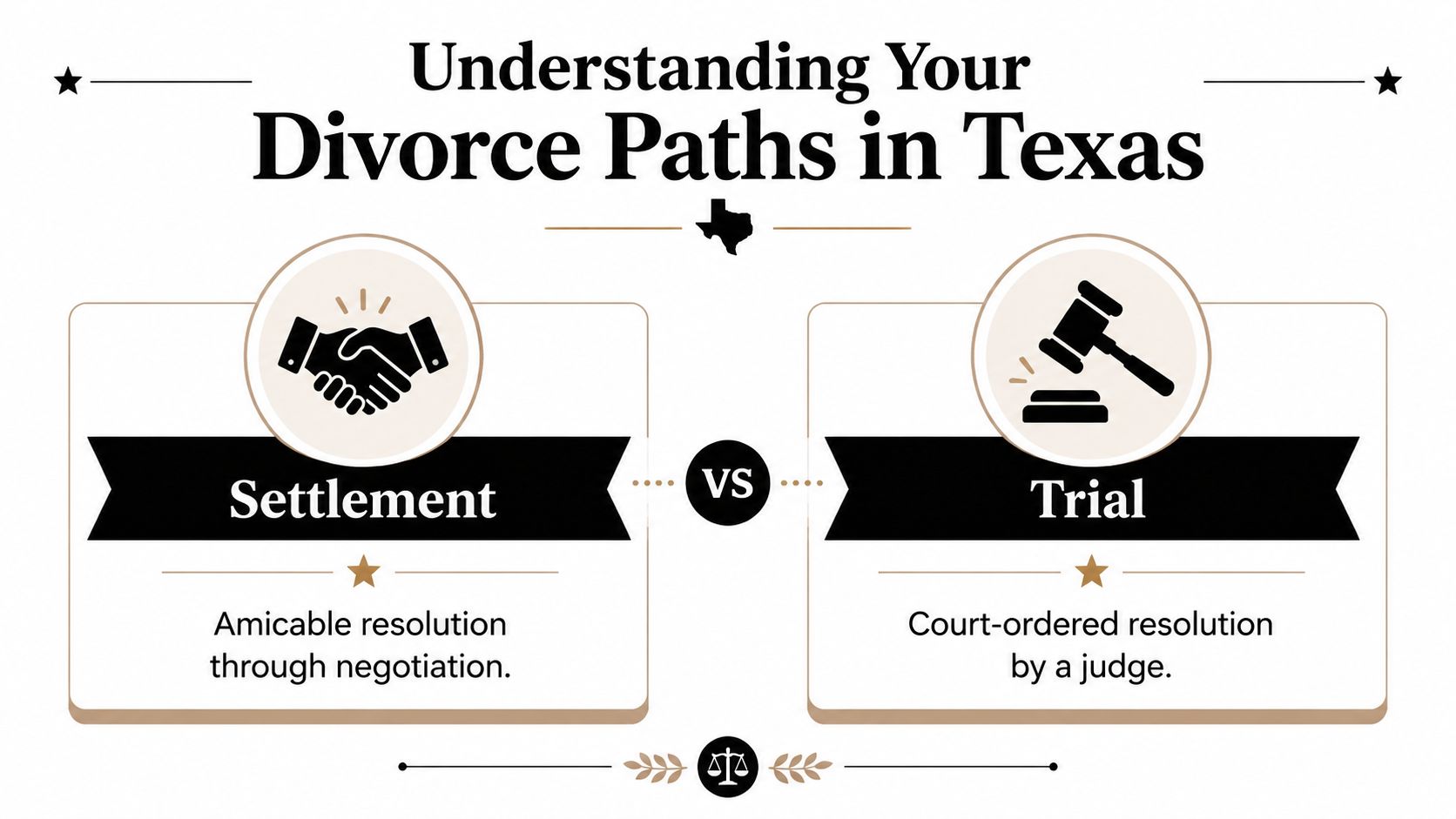
Mediation is often where progress becomes real. A neutral mediator works with both sides to help narrow disputes and test possible solutions. If you want a closer look at that process, this guide on mediation in a Texas divorce is a good place to start.
When a full agreement is reached, the terms are put into writing and then incorporated into the final decree. In many settled cases, the court appearance at the end is brief. The judge reviews the agreement, confirms the legal requirements are met, and signs the decree.
What trial actually involves
Trial is not one dramatic day that appears out of nowhere. It is the result of a case that could not be resolved through reasonable negotiation. Along the way, you may deal with:
- Discovery, where each side requests records and information
- Inventories and appraisals, especially for property issues
- Depositions, where witnesses answer questions under oath
- Temporary hearings, when immediate rules are needed
- Expert preparation, if valuation, tracing, or parenting issues are disputed
- Pretrial exchange of exhibits and witness lists
- Final trial, where the judge hears evidence and decides the remaining issues
Texas divorces are also shaped by core Family Code standards. Section 7.001 directs the court to divide community property in a “just and right” manner. Section 3.003 creates the presumption that property possessed during marriage is community property unless proven otherwise. For children, Section 153.002 makes the child's best interest the court's primary consideration.
Settlement feels more like designing a plan. Trial feels more like proving a case.
That difference matters because some families need a design problem solved, while others need a credibility problem decided.
A Head-to-Head Comparison Cost Timeline Control and Privacy
The right path usually comes into focus when you stop asking which option sounds stronger and start asking which option fits your facts.
Cost
Settlement usually costs less because it narrows the work. Fewer hearings, fewer contested motions, fewer witnesses, and less trial preparation generally mean a more efficient process.
Trial adds layers. Attorneys must prepare exhibits, testimony, cross-examination, objections, and post-hearing drafting. If financial or custody issues are complex, expert work can also become necessary. Even when a case settles late, the closer you get to trial, the more expensive the process usually becomes.
What doesn't work is refusing a reasonable settlement just to “make a point.” If the legal and factual gap between the two sides is small, that decision can consume resources without improving the final outcome in any meaningful way.
Timeline
Settlement gives you more ability to move when both sides are ready. Trial depends on court availability, the pace of discovery, and how quickly disputes can be prepared for hearing.
Local court realities matter here. Texas county divorce rates vary from about 25% to over 56%, and large counties such as Harris County at 33.7% and Dallas County at 35.7% have their own court tendencies. In real life, that means the timing and unpredictability of trial can vary significantly by county.
If timing is one of your biggest concerns, you should also understand the basic pacing issues in how long it takes to process a divorce in Texas.
A short visual can help make those trade-offs concrete.
Control
Settlement gives you the greatest degree of control. You can agree to timing, structure, practical exchanges, and terms that fit your real life. If one spouse keeps the house for a limited period so the children can finish a school year, that kind of specific arrangement is often easier to build in a negotiated decree.
Trial transfers control to the court. The judge must apply the law to the evidence presented. That may produce a fair ruling, but it may not produce the arrangement either spouse would have chosen.
This matters most when both parties can live with a solution but cannot draft it alone. In that situation, mediation often succeeds because it gives structure to compromise without taking the decision completely out of your hands.
Privacy
Settlement is generally more private. Sensitive financial details, parenting concerns, and settlement discussions can stay more contained within the negotiation process and final documents.
Trial is more exposed. Testimony, filings, exhibits, and allegations can become part of the court process in a much more public way. For business owners, professionals, and families dealing with personal mental health or addiction concerns, that difference can be substantial.
If privacy matters to you, don't wait until the week before trial to care about it. By then, much of the record may already be built.
How Your Choice Impacts Your Final Divorce Decree
The process you choose shapes the decree you live under. This is especially true for property division and parenting terms, which are often the two areas clients care about most.

Property terms are often more flexible in settlement
A judge can divide community property under the just-and-right standard, but a negotiated decree often allows for more creativity. You may be able to trade one asset for another, structure deadlines around liquidity, account for tax concerns in practical ways, or create a transition plan for a family business that a court would not design on its own.
That flexibility becomes important when the estate includes:
- A closely held business
- Retirement accounts that need careful division
- Real estate with refinancing concerns
- Claims of separate property and reimbursement
- Compensation structures that are hard to value cleanly
If you settle, you can often build terms that preserve value. If you try those same issues to the court, the decree may be cleaner on paper but rougher in application.
Children often bear the emotional cost of trial
This is the part many people underestimate. A trial does not end when the judge signs the decree. If you share children, you still have birthdays, exchanges, school events, extracurricular activities, and years of communication ahead of you.
High-conflict litigation can escalate hostility and make future co-parenting more difficult, and Texas courts must focus on the child's best interest when deciding custody issues. That is not an abstract concern. Parents who spend months preparing to attack each other's judgment, credibility, and motives often struggle to switch back into healthy communication afterward.
A custody trial can solve a legal dispute and still leave a parenting relationship badly damaged.
That doesn't mean settlement is always right in child-related cases. It means you should ask a harder question than “Can I win?” Ask whether the path you choose helps your child live in a more stable post-divorce home.
The decree is a long-term operating manual
Think of your final decree as the rulebook that governs what happens after the emotions cool down. A settlement-based decree often works better when the parties have built the terms themselves. They understand the wording, the deadlines, and the compromises behind it.
A trial-based decree may be necessary, but it can also leave both sides feeling unheard. That frustration tends to resurface later in modification or enforcement disputes.
If your goal is not just to finish the divorce but to reduce the chance of future conflict, the process matters as much as the outcome.
When Going to Trial Is the Right and Necessary Choice
Settlement is common. It is not always wise.
Some cases should go to trial because agreement would require one spouse to accept something dangerous, unfair, or impossible to verify. In those cases, pressing for settlement at all costs can do real harm.
Safety and serious parenting concerns
If there is family violence, coercive control, substance abuse that affects parenting, serious mental health instability, or credible evidence that a child is at risk, trial may be necessary. A parent should not feel pressured to “co-parent nicely” around conduct that threatens the child's safety or emotional health.
The same is true when one parent manipulates the process itself. Repeated violations of temporary orders, refusal to return the child, or deliberate attempts to interfere with the parent-child relationship can make a courtroom decision necessary.
Hidden assets and bad-faith negotiation
Settlement only works when both sides exchange meaningful information and negotiate fairly. If your spouse is hiding records, moving money, understating income, or using delay as a strategy, trial preparation may be the only way to force accountability.
Watch for patterns like these:
- Document resistance: bank statements, business records, or tax returns never seem to arrive
- Shifting stories: your spouse changes the explanation for an asset or debt repeatedly
- Last-minute pressure: they demand major concessions right before a deadline
- False urgency: they insist you sign now, before the facts are clear
A trial threat alone won't fix those problems. But disciplined discovery, motions to compel, subpoenas, and formal evidence often will.
Complex business and valuation disputes
Some property disputes cannot be resolved by intuition or owner opinion. Texas guidance on financial experts explains that in divorces involving a closely held business or other complex assets, expert evidence can be a decisive trial variable, and an owner's opinion alone usually carries less weight than formal valuation testimony.
That means trial may be the right choice when the case turns on competing numbers, tracing claims, or disputed business value. If you own a company, have deferred compensation, or suspect your spouse's business interest is being undervalued, you may need a courtroom record built with expert support.
If your case appears headed in that direction, this overview of a contested divorce trial in Texas can help you understand what that process involves.
Good trial strategy is not about being aggressive for its own sake. It is about being ready when the facts require proof, not compromise.
Your Decision Checklist Settle or Go to Trial
The decision often becomes clearer when you stop asking, "What feels fair today?" and start asking, "What can I live with six months and six years from now?"
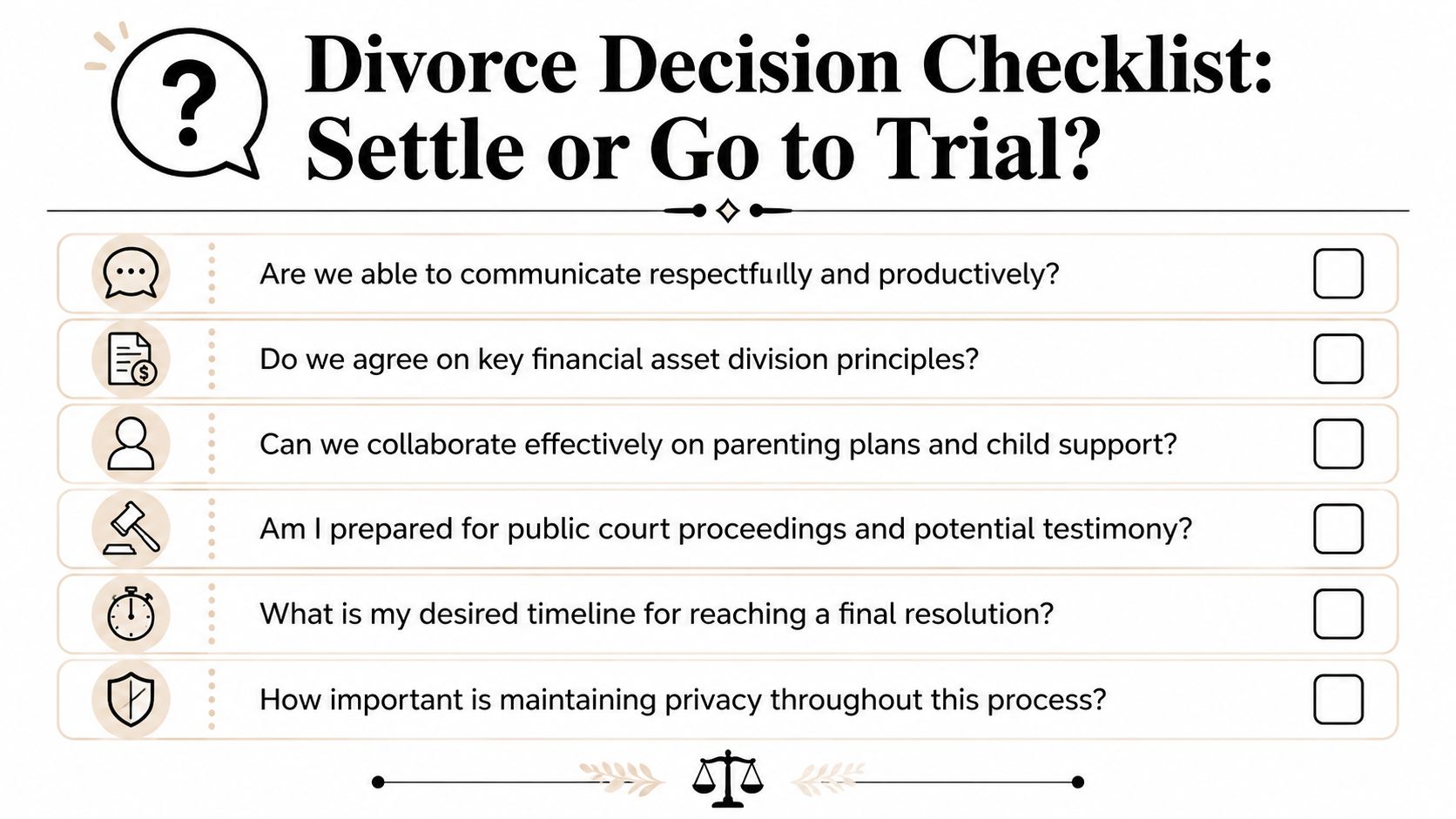
Go through these questions carefully with your attorney. Honest answers usually point to the right path faster than anger, pressure, or the desire to win.
Questions about your goals
What do you need from this divorce?
Separate the issues that affect your safety, parenting time, housing, cash flow, or long-term property rights from the issues that mainly reflect frustration.Which terms are necessary, and which ones are preferences?
That distinction matters. Trial is sometimes justified to protect a child, preserve a major asset, or stop an unfair result. It is rarely worth it just to prove a point.Can you accept a stable outcome that is good enough?
Settlement often means choosing certainty and flexibility over the chance that a judge sees every issue your way.
Questions about your spouse and the process
- Is your spouse giving full and reliable financial information? If the facts keep shifting, settlement becomes harder to trust.
- Are negotiations productive, or does every discussion turn into delay, pressure, or blame? A signed agreement is only useful if it is built on real disclosure and real consent.
- Would mediation likely produce movement? In many cases, it does. In others, it only adds another round of expense before the same fight lands in court.
Questions about your children and life after divorce
This is the part many people underestimate.
- Will a trial make it harder to co-parent after the decree is signed?
- Are you about to present evidence, text messages, recordings, or accusations that may be legally relevant but still damage the working relationship you will need as parents?
- Do your children need a faster, more private resolution, or do they need a judge to step in because the conflict is no longer manageable?
I tell clients this often. You can win a hearing and still make next year's school decisions, exchanges, and holiday planning much harder. If you will be tied to your spouse as a co-parent for years, that cost belongs in the analysis.
Questions about your resources and tolerance for conflict
- Do you have the money and emotional stamina for a contested case that may take longer than expected?
- Can your work, your business, and your daily parenting responsibilities absorb the demands of trial preparation?
- Would privacy matter to you if financial records, family conflict, or parenting allegations are discussed in open court?
- Do you need expert opinions, formal discovery, or third-party records to prove your position?
A practical way to make the call
If several answers point toward cooperation, reliable disclosure, and a workable parenting relationship, settlement deserves serious effort.
If the answers point toward concealment, safety concerns, repeated bad-faith tactics, or a dispute that cannot be resolved without evidence, trial preparation may be the responsible choice.
The goal is not to avoid conflict at all costs. The goal is to choose the process that protects your children, your finances, and your ability to live with the result after the divorce is over.
What To Do Next Your Path Forward with Bryan Fagan
It is 10:30 at night. Your children are asleep, your phone still has unanswered texts from your spouse, and you are trying to decide whether pushing this case toward settlement is wise or whether you need a judge to decide it. That choice affects more than legal fees. It can shape how your children experience the next year, how school events feel, and whether simple co-parenting conversations become harder after the divorce is over.
You do not need to make that call based on fear or exhaustion.
Some cases should settle quickly. Others should settle only after financial documents are produced, custody facts are examined closely, and both sides have tested their positions in mediation. Some cases belong in trial because one spouse is hiding information, refusing reasonable terms, or putting a child in the middle of the conflict.
What clients often miss at this stage is the long tail of a courtroom fight. Trial can be necessary, but it can also harden positions, increase public conflict, and make future co-parenting more tense than it already is. If you will still be dealing with each other at exchanges, school meetings, medical decisions, and holidays, that matters.
The next step is simple. Meet with a Texas divorce attorney who is willing to assess both paths thoroughly. You need clear advice about what can be resolved by agreement, what needs evidence, what risks are worth taking, and what kind of decree will practically work in daily life once the case is finished.
If you are asking whether to settle or go to trial, you are asking the right question. The answer turns on your facts, your spouse's conduct, your children's needs, and your ability to live with the outcome six months and six years from now.
Key takeaway
Settle when a fair agreement protects your children, your finances, and your peace. Go to trial when the truth has to be proven, the other side will not act in good faith, or court involvement is needed to protect your child.
If you are weighing those options, schedule a free consultation with Law Office of Bryan Fagan, PLLC. A careful case review can show you where settlement makes sense, where preparation for trial is necessary, and how to protect your family without creating damage you will be dealing with long after the final decree is signed.