Skip to content
Facing a divorce often feels like standing at the edge of a great unknown, and one of your first questions is likely, "How long will this take?" It's a natural question to ask when you're seeking clarity and a path forward during a deeply uncertain time.
The short answer is that in Texas, every divorce is subject to a mandatory 60-day waiting period. This means the absolute fastest your divorce can be finalized is just over two months from the day your petition is filed. However, that’s just the legal minimum. The real timeline for your divorce depends almost entirely on one crucial factor: whether you and your spouse can reach an agreement on all the issues.
Your Texas Divorce Timeline Explained
Every divorce is unique, but they all follow one of two main paths that determine how long the process will last. Understanding which path your divorce is likely to take is the first step toward setting realistic expectations for the road ahead.
An uncontested divorce is the most direct route. This is where you and your spouse are on the same page about all the big issues—like how to divide your property, manage debts, and co-parent your children. These straightforward cases often wrap up shortly after the 60-day waiting period required by the Texas Family Code.
On the other hand, a contested divorce is where disagreements arise. If you and your spouse cannot agree on high-value assets, child custody arrangements, or spousal support, the timeline gets much longer. These cases often take 6 to 18 months, and sometimes even longer, especially in the busy court systems of major Texas counties.
Understanding the Key Timelines
To give you a clearer picture, it helps to see the timelines laid out side-by-side. The path your divorce takes will be the single biggest factor influencing not just how long it takes, but also the emotional and financial cost.
Here's a quick reference table to help you estimate how long it might take to get from filing your petition to receiving your final decree.
| Divorce Type | Minimum Timeframe | Average Timeframe |
|---|---|---|
| Uncontested Divorce | 60-90 Days | 3-4 Months |
| Contested Divorce | 6+ Months | 9-18+ Months |
| High-Asset/Complex Divorce | 9+ Months | 12-24+ Months |
The 60-day rule, found in the Texas Family Code, serves as a "cooling-off" period. The law provides this time to give couples a moment to pause, ensure all legal requirements are met without feeling rushed, and even consider the possibility of reconciliation. This clock starts ticking the day after the Original Petition for Divorce is filed. For a more detailed breakdown, you can read our guide on the Texas divorce waiting period.
Whether you're expecting a smooth, uncontested process or preparing for a more complicated contested case, having an experienced attorney in your corner is invaluable. A good lawyer can help you navigate the system, protect what's important to you, and work toward the most efficient and fair resolution possible.
Navigating the Step-by-Step Divorce Process
Going through a divorce is tough enough without feeling lost in the legal system. When you understand the road ahead, it’s much easier to navigate. Knowing what comes next turns confusion into a clear plan and empowers you to move forward with confidence.
Every divorce in Texas follows a specific set of legal steps. While the timeline can shift depending on your circumstances, the core stages are always the same. Getting a handle on this process is the first step toward taking control of your future.
The Initial Filing and Service
The process officially kicks off when one spouse, known as the Petitioner, files an Original Petition for Divorce with the court. This document starts the legal process and outlines what that spouse is requesting regarding property, children, and other key issues.
After the petition is filed, the other spouse, now the Respondent, must be formally notified. This is called service of process. It’s a necessary step to ensure both people are legally aware the divorce has started. Usually, a sheriff, constable, or private process server delivers the paperwork.
The infographic below shows just how much the timeline can change depending on whether your divorce is uncontested or contested.
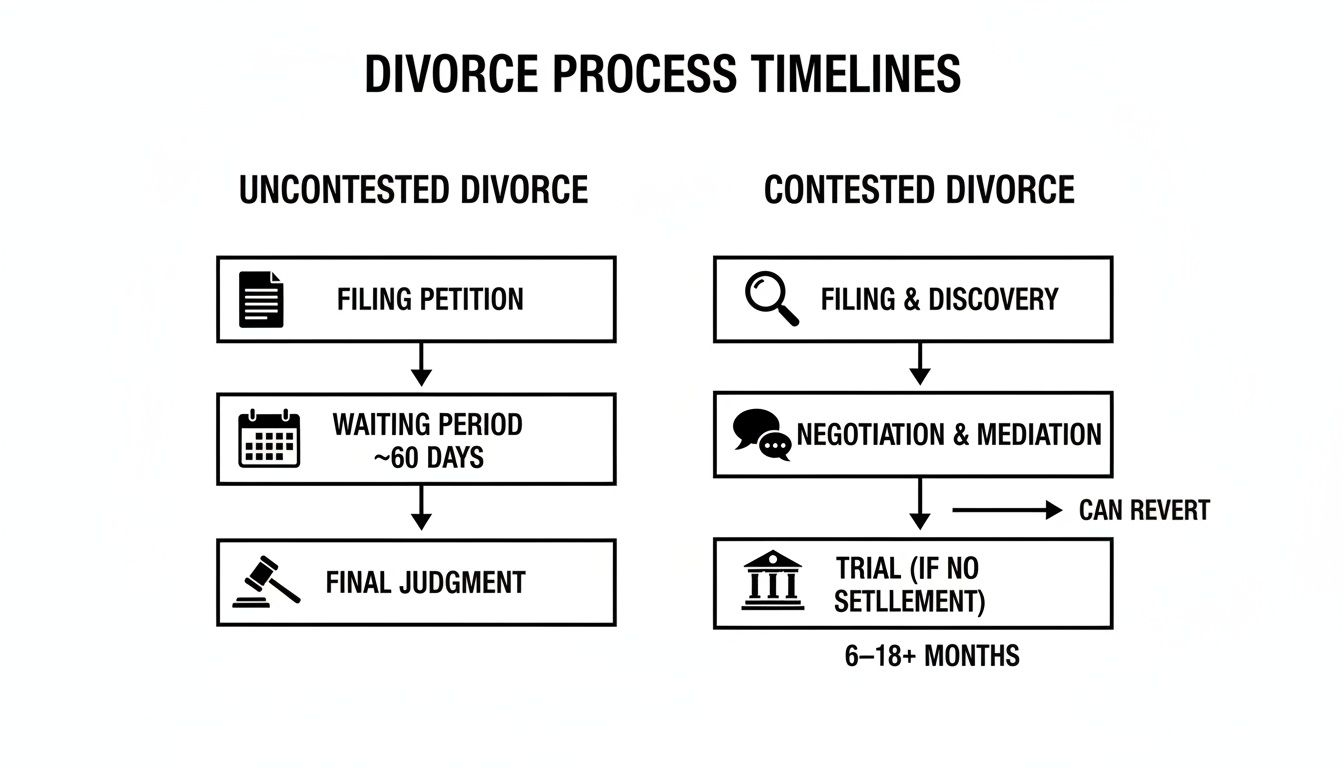
As you can see, cooperation is what drives an efficient timeline. Conflict, on the other hand, can stretch the process out for many months—or even more than a year.
The Heart of the Process: Discovery and Temporary Orders
Once service is complete, the case moves into the discovery phase. This is the formal process where you and your spouse exchange information, primarily financial records. It’s absolutely crucial for ensuring property is divided fairly under Texas law. This stage often includes tools like:
- Requests for Production: Formal requests for documents like bank statements, tax returns, and property deeds.
- Interrogatories: Written questions that the other party must answer under oath.
- Depositions: Out-of-court testimony where a person answers questions under oath in front of a court reporter.
While discovery is ongoing, you’ll likely need temporary orders. These are short-term court rulings that set the rules for managing your finances and parenting schedules while the divorce is pending. A temporary orders hearing establishes who stays in the house, who pays which bills, and what the temporary child custody schedule looks like until the divorce is final.
Reaching a Resolution: Mediation and Finalization
Most Texas courts will require you and your spouse to attend mediation before you can go to trial. This is a confidential meeting where a neutral, third-party mediator helps you negotiate a settlement on any issues you still disagree on. It is by far the most effective way to resolve a case while saving time, money, and a tremendous amount of stress.
If you reach an agreement on everything, your attorneys will draft a Final Decree of Divorce. This is the official, legally binding document that lays out all the final terms of your divorce. For a deeper dive into each of these stages, be sure to check out our complete guide to the Texas divorce process from filing to finalization.
The very last step is a short, informal court hearing where you "prove up" the divorce. The judge signs the decree, and your divorce becomes official. If you cannot agree in mediation, your case will be set for trial, and a judge will make the final decisions for you.
Uncontested vs. Contested Timelines: What to Expect
When clients ask how long their divorce will take, my first question is always, "Is it contested?" The answer to that question is the single most important factor in your divorce timeline. It's the difference between a straightforward sprint and a long, unpredictable marathon.
Understanding which path you're on is crucial for setting realistic expectations, planning your next steps, and feeling a sense of control over your future.
An uncontested divorce is the most direct route. It means you and your spouse have managed to sit down and agree on every single issue—from who gets the house to how you'll co-parent.

The Uncontested Divorce Timeline
In an uncontested case, the timeline is driven by cooperation, not conflict. Because every term is settled upfront, the court’s role is minimal. You aren't stuck waiting on a judge’s crowded calendar for hearings or a trial.
Once you have an agreement, your attorney drafts a Final Decree of Divorce that puts it all in writing. After the state’s mandatory 60-day waiting period ends, your lawyer can schedule a quick, informal court appearance to make it official. Most uncontested divorces in Texas wrap up within 60 to 90 days from the filing date, making it the fastest and least expensive way to finalize a divorce.
A truly uncontested divorce requires 100% agreement. If you agree on 99% of the issues, you still have a contested divorce. Even one unresolved point can force you into the court system and lead to major delays.
The Contested Divorce Timeline
A contested divorce is what happens when you and your spouse can't agree on one or more key issues. It could be child custody, property division, or spousal support. This disagreement transforms your divorce from a paperwork process into a legal dispute that has to be resolved through negotiation, mediation, or, as a last resort, a trial.
These disagreements add significant time and complexity. A contested divorce typically takes anywhere from six months to over a year, and sometimes much longer. Why the huge difference? The delays come from a series of legal steps that are necessary when you can't see eye to eye.
- Extensive Discovery: When you don't agree on what things are worth, both sides engage in "discovery" to gather information. This involves sending formal written questions and requests for financial documents, a process that can easily take months.
- Hearings and Motions: Disagreements often require multiple court hearings for temporary orders, to force the other side to hand over documents, or to settle other disputes that pop up along the way. Each hearing must be scheduled with the court, which can add weeks or even months to the clock, depending on how backed up the judge is.
- Expert Involvement: If you're fighting over the value of a business, a house, or complex investments, you’ll probably need to hire experts like forensic accountants or property appraisers. Their analysis and reports add another layer of time and expense.
- Lengthy Negotiations and Mediation: Just reaching a settlement takes time. While most contested divorces do settle before trial, the back-and-forth between attorneys can be a long, drawn-out process. If you want to dive deeper, our article explaining why contested divorces take longer in Texas offers some key insights.
- Trial Preparation: If all else fails, your case gets set for trial. Preparing for a trial is an intensive process for any legal team, and simply waiting for an open spot on a judge's busy docket can add many more months to your case.
Knowing this distinction from the start is vital. It allows you to work with your attorney to build a smart strategy—one that either encourages agreement to get things done faster or prepares you for the realities of a tough legal fight.
Common Roadblocks That Can Delay Your Divorce
Even if you and your spouse start on the same page, certain issues can throw a wrench in the works and bring your divorce to a screeching halt. Knowing what these common roadblocks are ahead of time is the best way to prepare for them, helping you avoid the emotional and financial drain of unexpected delays.
Getting blindsided by a major disagreement is what turns a straightforward divorce into a long, drawn-out battle. Let's walk through the most common hurdles so you can see them coming.
Disputes Over Children
In a divorce, nothing is more personal or emotionally charged than decisions about your children. When parents can’t agree on custody, visitation schedules, or who gets to make important decisions, the process can slow down dramatically.
A fight over who will be the primary parent or what the possession schedule should look like can quickly escalate. These disputes often introduce new, time-consuming steps into your case:
- Custody Evaluations: The court might appoint a mental health professional to evaluate the family and recommend a custody arrangement that’s in the children's best interest. This process alone can take several months to complete.
- Amicus Attorney: In highly contested cases, the judge may appoint an attorney just to represent the children. This adds another lawyer and more legal work to the case.
- Multiple Hearings: Every point of disagreement might need its own separate court hearing, forcing you to wait for an open spot on a busy judge’s calendar.
Conflicts Over Property and Assets
Right behind kids, arguments over money and property are the next biggest cause of divorce delays. This is especially true if you have complex assets like a family business, multiple real estate properties, or large retirement accounts.
Think of your marital estate as a giant puzzle. In a smooth, uncontested case, you and your spouse have already agreed on where every piece goes. But in a contested divorce, every single piece is up for grabs, and arguing over each one can add months to your timeline.
A common misconception is that a 50/50 split is simple. But first, you have to agree on what everything is worth and whether it’s even part of the community estate to begin with. That's where the real delays happen.
For instance, just getting a valuation for a family-owned business can require bringing in forensic accountants and valuation experts. That process can easily add 3-6 months as they pour over financial records, write detailed reports, and prepare to testify in court. Tracing separate property—assets you owned before the marriage or received as a gift or inheritance—is another meticulous process that demands a deep dive into financial histories.
Sometimes, the conflict isn't just about the assets themselves but is driven by underlying relationship issues. When one spouse has a hard time communicating or engaging in negotiations, reaching any kind of agreement becomes incredibly difficult. In these situations, learning more about Understanding Avoidant Personality Disorder relationships can provide valuable insight into the challenging dynamics at play.
Divorce is rarely simple, and many moving parts can contribute to how long it takes. Here are some of the most frequent sources of delay and what you can do about them.
Common Divorce Delays and Their Impact
| Source of Delay | Potential Time Added | How to Mitigate |
|---|---|---|
| Child Custody Disputes | 3-12+ months | Attend mediation early; consider hiring a parenting coordinator or facilitator to help negotiate a parenting plan. |
| Complex Asset Division | 3-6+ months | Hire financial experts (forensic accountants, valuators) early in the process to get accurate numbers from the start. |
| High-Conflict Personalities | 4-18+ months | Set firm boundaries, communicate through attorneys, and document everything. Avoid direct, unproductive arguments. |
| Locating a Missing Spouse | 2-4 months | Hire a private investigator or use a "service by posting/publication" if they cannot be found. |
| Busy Court Dockets | 1-3 months | Work with an attorney who knows the local court system. Aim to settle out of court to avoid waiting for hearing dates. |
These timelines are estimates, but they show how quickly a single unresolved issue can stretch a divorce from months into a year or more. The key is to be proactive and address these potential problems before they spiral.
External Factors You Cannot Control
Finally, some delays are just built into the system and are completely out of your hands. The courts themselves can be a major source of slow-downs, especially in large metropolitan areas like Harris, Dallas, and Travis counties, where dockets are packed.
This means that even if you and your attorney are ready to go, you might face a long wait for a hearing date or for a judge to sign your final order. You can't control a judge's schedule, but you can work with an experienced attorney who knows the local court system inside and out. They know the clerks, understand the procedures, and can help make sure your case doesn’t get lost in the shuffle.
Special Timelines for Military and High-Asset Divorces
Not every divorce fits into a simple, standard box. If you're part of a military family or have built up a high-net-worth estate, your path to a final decree will have its own unique set of rules and complexities. Knowing about these challenges from the get-go helps you set realistic expectations for a process that will almost certainly take longer than the average case.
For military members, a mix of Texas and federal laws creates a unique legal playing field. Similarly, for couples with significant wealth, the financial detective work needed to get a fair result adds necessary—and time-consuming—layers to the process.
Navigating Military Divorce Timelines
When a divorce involves a service member, specific federal rules can change the timeline dramatically. The most significant of these is the Servicemembers Civil Relief Act (SCRA), a law designed to protect active-duty military personnel from being put at a disadvantage in civil court cases, including divorce.
Under the SCRA, a service member on active duty can request a "stay," which is essentially a temporary pause on the divorce proceedings. This stay is automatically granted for at least 90 days. The goal is to give the service member a fair chance to respond to the divorce petition without their military duties interfering.
This stay can be extended if the service member is deployed or otherwise cannot participate in the case. This isn't a loophole to dodge the divorce, but a legal protection to make sure the process is fair for everyone involved.
On top of the SCRA, figuring out how to divide military benefits adds another layer of time and effort. The division of assets like a military pension, Tricare health benefits, or a Thrift Savings Plan (TSP) is controlled by the Uniformed Services Former Spouses’ Protection Act (USFSPA). Correctly calculating and dividing these benefits requires a deep understanding of the law and very precise language in the final decree, which means more time for attorneys to negotiate and draft the documents.
The Realities of a High-Asset Divorce
When a divorce involves a lot of money and property, the timeline naturally stretches out. The financial stakes are higher, and the details are far more complicated than just splitting a checking account. A high-net-worth divorce requires a deep, investigative dive into the couple's entire financial history.
This process takes longer for a few key reasons:
- Business Valuation: If you or your spouse owns a business, figuring out its real value is a major undertaking. It almost always means hiring a neutral forensic accountant or business valuation expert, and their detailed analysis can easily take several months.
- Tracing Separate Property: In Texas, any assets you owned before the marriage—or received as a gift or inheritance during it—are considered your separate property and can't be divided. But the burden is on you to prove it with "clear and convincing evidence." This often means digging through old bank statements and financial records to meticulously trace where the money came from, which is a slow and painstaking task.
- Uncovering Hidden Assets: Unfortunately, it’s not unheard of for one spouse to try and hide money or property. Finding these hidden assets requires a full-blown discovery process, which can include depositions, subpoenas sent to banks and other financial institutions, and detailed forensic analysis.
These investigative steps aren’t just for show; they're absolutely critical to ensuring a just and right division of your community estate. While it definitely adds time to the divorce, that thoroughness is what protects your financial future. An experienced attorney knows how to manage these moving parts efficiently, keeping your case moving forward without cutting any corners.
Actionable Steps to Speed Up Your Divorce
Watching the calendar pages turn while your divorce stalls can be incredibly frustrating. While some delays are just part of the legal system, you have more control over the timeline than you might think. By taking a few proactive steps, you can move things forward, saving yourself time, money, and a whole lot of emotional energy.
The key is to focus on what you can actually control. When you’re organized, communicative, and strategic, you can sidestep the common roadblocks and work toward a much faster resolution. Let’s walk through the practical solutions that put you back in charge of the process.

Embrace Mediation as Your First Option
Before you ever see the inside of a courtroom for a trial, Texas courts will almost always require you to try mediation. Don't just see this as another box to check—it’s your single best opportunity to speed up your divorce. Mediation is a confidential process where you and your spouse meet with a neutral third-party mediator to hammer out a settlement.
This collaborative setting allows you to find creative solutions that fit your family’s unique needs—solutions a judge might not even have the authority to order. By resolving disputes in mediation, you avoid waiting months for a court date and keep control over the final outcome. A successful mediation can easily shave months or even a year off a contested divorce timeline.
Prepare and Organize Your Financial Documents Early
One of the biggest time-sucks in any divorce is the "discovery" phase, where both sides exchange financial information. You can get way ahead of this by gathering all your documents right from the start. Don't wait for your attorney to send you a long list.
Start a file—digital or physical—and begin collecting these items:
- Income Verification: At least two years of tax returns, plus recent pay stubs for both you and your spouse.
- Property Records: Deeds to any real estate, vehicle titles, and recent property tax statements.
- Account Statements: At least 12 months of statements for all bank accounts, credit cards, investment accounts, and retirement plans (like 401(k)s and IRAs).
- Debt Information: Statements for mortgages, car loans, student loans, and any other outstanding debts you have.
Having these documents organized and ready makes the discovery process faster and smoother. This simple act of preparation shows you’re serious about moving forward and cuts down on the back-and-forth between attorneys that causes so many delays.
Define Your Goals and Communicate Strategically
Walk into this process with a clear idea of what you actually want. Before you even file, sit down and think about your ideal outcome for property, debts, and—if they’re involved—your children. What are your non-negotiables? And where are you willing to compromise?
Share these goals with your attorney right away. This allows them to build a focused strategy from day one instead of just reacting to every new development.
If you can still communicate with your spouse without it turning into a fight, use that ability strategically. Keep any discussions focused on logistics and information gathering. However, if your conversations consistently turn into arguments, it’s best to let your attorneys handle everything. The goal is productive dialogue, not emotional battles that only push a resolution further away.
Key Takeaway: What to Do Next
You now have a clearer picture of the road ahead. You know about the mandatory 60-day waiting period, why an uncontested divorce moves faster, and what common roadblocks can drag the process out. Just understanding the timeline is a huge step, but what you do next is what truly matters.
It's easy to feel overwhelmed, but remember, you don't have to navigate this alone. We've talked about how being prepared, organized, and willing to find common ground can make a world of difference. However, the most powerful tool at your disposal is getting expert legal advice tailored to your specific situation.
Taking the First Real Step
The information in this guide gives you a solid foundation. Now, it’s time to build on it. A skilled family law attorney can take these general timelines and apply them directly to your life, whether you’re heading for a simple uncontested divorce or a more complicated fight over assets and custody.
This is the moment where uncertainty gives way to a clear plan. Seeking legal advice isn't about starting a fight—it’s about protecting your rights, your family, and your future with confidence. Every decision you make from here on out will shape your new beginning.
Don't Forget Your Well-Being
The legal process is just one piece of the puzzle. The emotional stress of a divorce is immense, and taking care of your mental health is every bit as important as protecting your legal rights. As you move forward, resources like Penticton counselling can offer the emotional support needed to get through this difficult time. Building a strong support system helps you make clear-headed decisions for yourself and your family.
Knowledge is only powerful when you use it. Your next step should be a consultation with a compassionate family law attorney. They can provide clarity on your specific circumstances and give you a personalized strategy to protect what matters most. You have more control over this process than you might have realized. Now is the time to use it.
Navigating the complexities of a Texas divorce requires a team that understands both the law and the human element. The Law Office of Bryan Fagan, PLLC is here to listen to your story, answer your questions, and create a plan to protect your family and your future. We invite you to schedule a free, confidential consultation with our compassionate team today by visiting us at https://texasdivorcelawyer.us.