Skip to content
When your home feels tense, sleeping somewhere else can sound like the fastest way to breathe again.
That instinct is understandable. But in Texas, moving out before you file for divorce is rarely just a housing decision. It can affect how a judge sees your parenting role, how bills get paid, and how the early phase of your case unfolds.
You usually can move out before filing. The better question is whether you should. For many people, the answer is no, at least not until there's a plan in place. For others, especially when safety is an issue, leaving quickly may be the right move. What matters is doing it in a way that protects your rights, your finances, and your children.
The Most Common Question Before a Texas Divorce
A lot of people ask this in a whisper: Should You Move Out Before Filing for Divorce in Texas?
They ask because the house has become unbearable. Arguments keep repeating. One spouse is sleeping on the couch. The children feel the tension. You may be thinking that if you leave now, things will calm down and the legal process will be easier later.
Sometimes distance does reduce conflict. But Texas divorce cases are shaped early by real-life facts on the ground. Who stayed with the children. Who paid the bills. Who kept the routine going. Who left first, and under what circumstances.
Texas doesn't require spouses to live separately before filing for divorce, and Texas doesn't offer legal separation in the way some states do. That means your marriage, your property issues, and many of your financial responsibilities remain legally connected until the court signs a final decree. If you move out without a strategy, you may create problems that are hard and expensive to fix later.
Practical rule: Don’t treat moving out like an emotional reset button. Treat it like a legal decision with custody, support, and property consequences.
The right answer depends on your facts. A parent with young children faces different risks than a spouse in a short marriage with no kids. A business owner has concerns that look different from a military family. A spouse dealing with intimidation or violence needs a safety plan first, not generic divorce advice.
Before you pack a bag, you need to know how Texas courts look at stability, what temporary orders can do, and what judges often want to preserve in the first stage of a case.
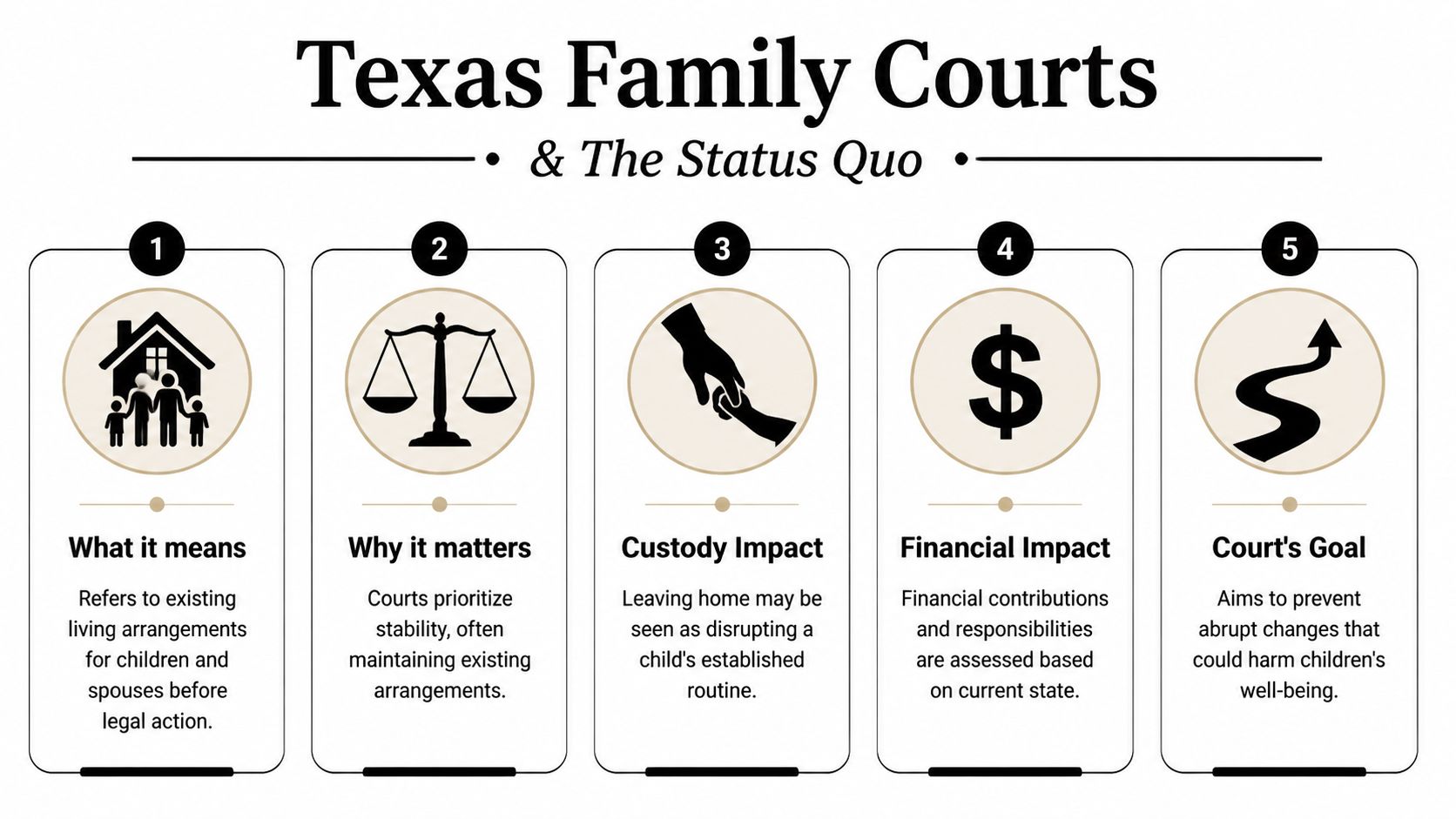
Understanding the Status Quo in Texas Family Courts
Texas family courts often focus on one practical question at the start of a case: What has this family’s day-to-day life looked like up to now?
Think of it as a snapshot. The judge looks at where the children have been living, who has been getting them to school, who handles bedtime, who pays which bills, and what arrangement seems most stable while the divorce is pending. Courts do this because Texas law puts the child’s best interest first. Under Texas Family Code §153.002 and the discussion summarized here, judges prioritize the child’s best interest and frequent contact with both parents. That same source states that family law practitioners have observed that, in contested custody cases involving young children, parents who remain in the family home secure primary conservatorship in approximately 60 to 70 percent of instances.
Why judges care about stability
A judge usually doesn't want to create unnecessary disruption in the first hearing. If your children have always lived in one home, attended the same school, and followed the same routines, the court may try to preserve that pattern until more evidence is presented.
That is why a voluntary move-out can matter so much. Even if your reason was peace, not abandonment, the court may still focus on what happened after you left. If your parenting time became irregular, if the children stayed mostly with the other parent, or if your new living setup made overnights difficult, that new pattern can start to look like the new normal.
How the snapshot can work against you
The danger isn't just that you moved. The danger is that your move may help create a record that favors the other side.
A judge may see facts like these as important:
- School and routine: Which parent kept daily life consistent.
- Availability: Which parent was physically present for homework, meals, and bedtime.
- Housing continuity: Whether the children stayed in the same home they already knew.
- Decision-making pattern: Which parent was acting as the go-to parent after separation.
Courts often preserve what already appears to be working for the children, even if that arrangement began by accident after one parent moved out.
What this means before filing
If you're still under the same roof, you have a chance to be intentional. That may mean filing first, requesting temporary orders, and asking the court to decide who stays in the home, how parenting time will work, and who pays what while the case is pending.
It may also mean staying in the home but living separately within it for a short period while your lawyer prepares the filing. That isn't pleasant. But from a strategy standpoint, it can be far safer than moving out first and trying to rebuild your position later.
How Moving Out Can Impact Child Custody and Support
Parents usually worry about one thing first. Will leaving the house cost me time with my children?
That concern is real. Once one parent moves out, the custody conversation often stops being theoretical. It becomes about logistics, schedules, bedrooms, school nights, transportation, and who is already doing the parenting day after day.

The move-out can change your custody leverage
If you leave before there is a written agreement or court order, you may hand the other parent an argument they didn't have before. They can say the children stayed in the home with them, that they became the parent handling most of the daily needs, and that keeping that arrangement is in the children's best interest.
That doesn't mean you're a bad parent. It means the facts may start developing in a way that weakens your request for equal time.
Under this discussion of how moving out affects divorce in Texas, if a relocating spouse moves into a place that lacks adequate overnight accommodation for the children, courts can use that as evidence to deny equal custody arrangements. The same source notes that without a pre-existing custody order, courts may impose child support obligations immediately once one parent has moved out.
Housing matters more than many parents expect
A temporary apartment may solve your short-term stress, but it can create a court problem if it isn't practical for the children. Judges look at whether children can safely and comfortably stay overnight. If the answer is unclear, your argument for substantial possession time gets weaker.
People frequently make avoidable mistakes. They assume they can sort out the parenting schedule later. By then, the other parent may already be arguing that the children have settled into a different arrangement.
For a closer look at early court orders in these situations, review how temporary custody during divorce in Texas can shape the case before final orders are entered.
What often works better
If you're considering a move, these steps usually protect you better than leaving first and hoping for the best:
- Get a temporary parenting plan in writing. It should cover overnights, school exchanges, holidays, and communication.
- Secure child-appropriate housing first. If your children can't comfortably stay with you, the other side will notice.
- Keep your daily involvement visible. School pickups, medical appointments, homework, meals, and extracurriculars all matter.
- File promptly when necessary. Delay gives informal arrangements more time to harden into the status quo.
A short explanation from a family law attorney can help if you're weighing that decision now:
If you move out, stay active. Parents hurt their cases most when they disappear from the ordinary rhythm of the children’s lives.
The Financial Traps of Leaving the Marital Home
A lot of spouses believe moving out will create a clean break. In Texas, it usually doesn't.
Texas is a community property state. That means the house, debts, and ongoing household obligations may still matter to both spouses until the court divides property in the final decree. Leaving the house doesn't automatically take your name off the mortgage, stop your exposure to missed payments, or end disputes over who should cover living costs during the case.
According to this analysis of moving out during a Texas divorce, departing spouses often face court-mandated continuation of the pre-divorce financial status quo. That can mean paying marital home bills while also funding a new residence, estimated at an additional $2,000 to $4,000 monthly in major Texas markets like Austin and San Antonio.
Two households on one income
That financial squeeze hits fast. Rent, deposits, furniture, utilities, groceries, and transportation don't wait for your divorce to be finalized. If one spouse remains in the marital home and the court expects the historical bill-paying pattern to continue, the spouse who moved out may suddenly be carrying two sets of costs.
Here is where people get trapped:
| Issue | Why it matters |
|---|---|
| Mortgage and utilities | You may still be expected to help preserve the marital home while the case is pending |
| New housing costs | A second lease can strain cash flow before property division is decided |
| Credit exposure | If joint bills go unpaid, your credit may suffer even if you no longer live there |
| Negotiation pressure | Financial stress can push you to settle too early or on poor terms |
High-asset and business-owner concerns
If you own a business, hold investment accounts, or have a high-value estate, moving out can create extra friction. Practical access to records may change. Household spending may become harder to monitor. You may also be at a disadvantage when temporary orders are being negotiated because you're now trying to solve both a divorce and a housing crisis at the same time.
For homeowners, it's also worth understanding how the property is treated while the case is pending, including issues tied to the Texas homestead exemption.
What tends to work better financially
- Ask for temporary orders early: Courts can assign who pays the mortgage, utilities, insurance, and other recurring expenses.
- Inventory your accounts and debts first: Gather statements, loan details, tax returns, and business records before access gets harder.
- Avoid impulsive spending after the move: Large purchases, luxury rent, or aggressive cash withdrawals may be framed as misuse of marital funds.
- Build a short-term budget: You need a realistic picture of what you can carry while the case is open.
Leaving the home doesn't end the math. It often makes the math worse.
The Critical Exception When Your Safety Is at Risk
General advice against moving out does not apply the same way when you're dealing with abuse, threats, stalking, or conduct that puts you or your children at risk.
In those cases, safety comes first. The legal goal shifts from preserving an advantage to protecting people. Texas courts recognize that difference.

Leaving for safety is not the same as walking away
When domestic violence exists, Texas courts can issue exclusive possession orders that let one spouse remain in the home and can enter protective orders requiring 500-foot separation distances, which legally override the usual advice against moving out before filing. That rule is summarized in this Texas family law discussion of moving out and protective remedies.
The key difference is documentation and legal framing. If you leave because you're in danger, your move should be tied to protective action, not left looking like an unexplained departure.
What to do if you need to leave now
If you're in immediate danger, call law enforcement or seek emergency help first. Then move quickly to protect your legal position.
A safer process usually looks like this:
- Preserve evidence: Save threatening texts, emails, voicemails, photos, and incident reports.
- Take essential items: Identification, medications, children's records, keys, and financial documents.
- Seek legal protection fast: A protective order or related emergency relief can establish why the move was necessary.
- Create a child-focused record: If children are involved, document why the move protects them too.
Your safety is not a strategy mistake. Courts understand the difference between conflict and danger.
Why legal timing still matters
Even in emergency situations, getting legal help quickly matters. The court can address possession of the home, temporary parenting arrangements, no-contact rules, and practical protections that reduce future disputes.
If you're wondering whether to stay and file first or leave immediately, the answer depends on risk. When there's credible danger, leaving may be the right decision. The priority is making that move with evidence, support, and a plan for immediate court action.
Strategic Alternatives to Moving Out Immediately
If the home is tense but not unsafe, you may have better options than walking out first.
The strongest move is often the most controlled one. Instead of creating a new reality on your own, you ask the court or a mediator to help define the rules before anyone changes homes.

Better options than a sudden exit
Here are several approaches that often work better than leaving without a plan:
Temporary orders
A judge can decide who stays in the house, who pays which bills, and how parenting time works while the divorce is pending. This is often the cleanest solution when spouses can't agree.
Mediation before the move
In some families, a short mediation session can produce a written move-out plan. That agreement can cover possession schedules, access to property, bill sharing, and communication rules.
In-house separation
Sometimes spouses remain under the same roof temporarily while using separate bedrooms, separate routines, and clear boundaries. It isn't comfortable, but it can preserve parenting consistency while legal papers are prepared.
Agreed parenting structure first
If one spouse will move, build the parenting calendar before the move happens. School nights, weekends, transportation, and holiday exchanges should be clear from day one.
Special situations need tailored planning
Military families need to think about more than the house itself. A service member or military spouse may need to coordinate the move with civilian counsel and, where appropriate, military legal resources such as JAG. Housing allowances, parenting logistics, and scheduling can become more complicated if the move happens informally.
High-asset spouses and business owners should focus on records and access. Before any move, gather account statements, business documents, tax returns, and proof of household expenses. Once physical separation happens, information often becomes harder to retrieve.
A simple decision test
Use this quick comparison before you act:
| If this is true | The safer approach |
|---|---|
| You have children and no written schedule | Get temporary orders or a written parenting agreement first |
| You’re the primary bill payer | Clarify expense responsibility before taking on a second household |
| You own a business or complex assets | Secure records and strategy before changing residences |
| You fear for your safety | Leave safely and seek immediate court protection |
The goal isn't to stay miserable. It's to avoid turning a difficult marriage into a harder divorce.
What to Do Next A Checklist Before You Act
If you're standing at the edge of a decision, keep it simple. Don't let stress make the choice for you.
Your pre-move checklist
Assess safety first
If there's violence, threats, stalking, or intimidation, focus on protection and emergency planning right away.
Gather key documents
Collect tax returns, pay stubs, bank statements, mortgage information, insurance records, retirement statements, business records, and your children's school and medical information.
Document your parenting role
Save calendars, messages, school communications, pickup logs, activity schedules, and anything else showing your day-to-day involvement with your children.
Review your housing plan
If you decide to move, evaluate whether the new residence works for overnight parenting, privacy, school transportation, and stability.
Map your monthly obligations
List every recurring expense. Include the mortgage or rent, utilities, insurance, debt payments, child-related costs, and likely expenses if two households are operating.
The divorce process in plain English
If you're ready to file, the early path usually looks like this:
Filing the petition
One spouse files the divorce case in the proper Texas county.Service or waiver
The other spouse is formally notified or signs a waiver.Temporary orders stage
The court can address custody, support, use of the home, and bills while the case is pending.Information exchange and negotiation
Spouses gather records and try to resolve issues through negotiation or mediation.Final decree
The court signs a final order covering property division, conservatorship, possession, child support, and any other required terms.
The earliest decisions in a divorce often shape the final outcome more than people expect.
Key takeaway
If you're asking whether you should move out before filing for divorce in Texas, slow down long enough to make a legal decision instead of an emotional one. Moving out may be necessary. It may also weaken your position if you do it without a written plan, temporary orders, or a clear safety reason.
The smartest next step is private legal advice based on your facts, your county, your finances, and your children.
If you're weighing whether to leave the marital home, schedule a free consultation with Law Office of Bryan Fagan, PLLC. You can get clear guidance on custody, temporary orders, property division, mediation, protective orders, and the steps from filing through final decree, so you can protect your rights and move forward with confidence.