Skip to content
You may be staring at a stack of account statements, a school calendar, and a house payment, wondering how a marriage can end without your whole life falling apart.
Your Roadmap Through Divorce An Introduction
When you and your spouse both want a respectful divorce, the legal process can still feel heavy. You may agree that the marriage is over, but you probably still have hard questions. Who keeps the house? How do you handle retirement? What happens with the kids on holidays? What goes into the final paperwork?
In Texas, a settlement agreement gives you a way to answer those questions yourselves instead of handing every decision to a judge. That matters because the terms of your divorce will shape your daily life long after the case is over. A good agreement doesn't just end a lawsuit. It creates a practical plan for money, parenting, and future responsibilities.
Texas courts favor private resolution of divorce issues, and that approach has become more common over time. Texas divorce rates fell from 5.5 divorces per 1,000 people in 1990 to around 1.4 per 1,000 as of 2021, and settlement agreements help streamline the process for more than 70% of divorces that avoid trial, according to Texas divorce statistics and settlement trends.
Practical rule: The more you and your spouse can clearly resolve in writing, the less uncertainty you'll carry into court and into life after divorce.
If you're searching for settlement agreement divorce texas, you're probably not looking for abstract legal theory. You're looking for a way through. You want to understand how the agreement works, what it needs to include, how mediation fits in, and how to avoid signing something that causes problems later.
That roadmap starts with one basic idea. In Texas divorce cases, the paperwork matters because the wording becomes your future.
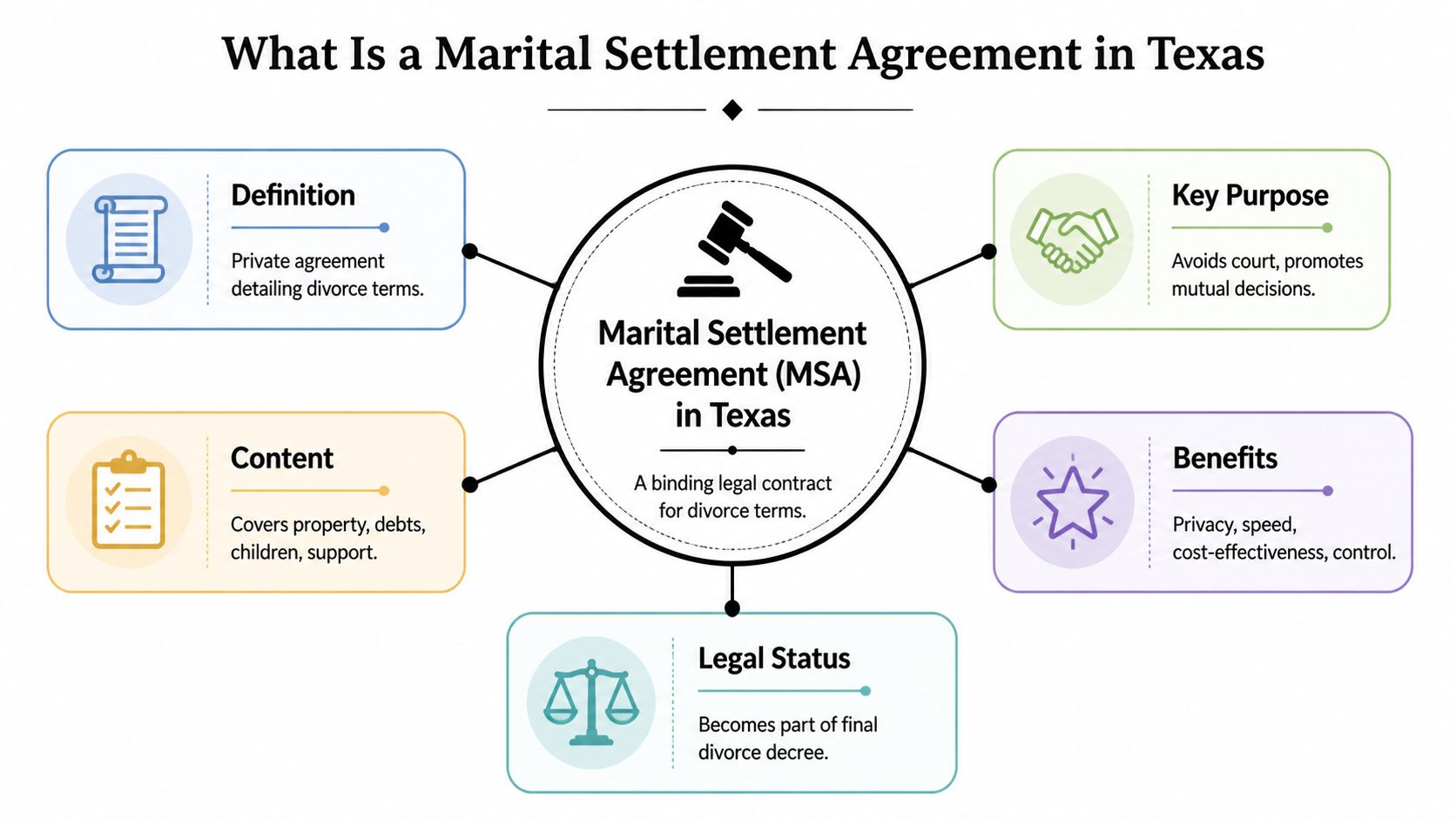
What Is a Marital Settlement Agreement in Texas
A Marital Settlement Agreement, often shortened to MSA, is a written agreement between you and your spouse that resolves the issues in your divorce. Think of it as the blueprint for your post-divorce life. It spells out who gets what, who pays what, and how parenting will work if you share children.
The MSA is not just a side note to the divorce. It's the heart of an agreed resolution. When it's done correctly, it tells the court, "We've worked this out. Here's the plan."
The MSA and the Final Decree are not the same thing
This point confuses many people.
Your MSA is the detailed agreement. Your Final Decree of Divorce is the court order that officially ends the marriage and puts those agreed terms into enforceable form. One is the plan. The other is the judge-signed order that carries the force of law.
Under Texas Family Code §§6.701–6.711, the agreement must be drafted with language that allows it to be incorporated into the Final Decree. If that technical requirement is missed, the court can refuse to approve it, as explained in this guide to enforceable Texas divorce agreement drafting.
Why drafting matters so much
Many spouses assume that if they both sign a document, that's enough. It isn't.
A Texas divorce agreement has to fit into the way courts enter final orders. That means details matter. If real estate is being awarded, the legal description needs to be accurate. If a vehicle is changing hands, identifying information must be correct. If support is being paid, the payment language needs to work inside a court order.
Here is the practical difference:
| Document | What it does | Why it matters |
|---|---|---|
| Marital Settlement Agreement | Records the deal you and your spouse reached | Gives structure to the outcome you want |
| Final Decree of Divorce | Becomes the judge's final order | Makes the agreement enforceable through the court |
A strong MSA doesn't leave the judge guessing what you meant.
Why people choose this route
An MSA gives you control. A trial gives that control to the court. When families have specific needs, that difference is huge.
For example, you may want a holiday schedule that fits your child's sports calendar, a plan for selling the house after the school year ends, or a debt payoff arrangement that protects both credit histories. A carefully prepared agreement can address those concerns directly.
That is why the phrase settlement agreement divorce texas is about more than paperwork. You're building a written roadmap for the next chapter of your life. If it's clear, complete, and court-ready, it can reduce conflict and help you move forward with confidence.
The Essential Components of Your Texas MSA
A useful MSA is thorough. If a major topic is left out, the agreement may not solve the underlying problems in your divorce. That is one reason agreed settlements resolve over 95% of Texas divorce cases, and courts expect a complete agreement to cover conservatorship, possession schedules, child support, medical support, property division, debt allocation, and spousal maintenance, according to this overview of what a Texas divorce settlement agreement must cover.

Property and debt terms
Your agreement should identify every major asset and every significant debt. That includes the obvious items, like the house and cars, and the less obvious ones, like brokerage accounts, restricted stock, retirement plans, tax refunds, and business interests.
Vague language causes trouble. "Husband keeps retirement" is weak. A much better provision identifies the specific account, the portion awarded, and how the transfer will happen if a later order is needed.
Debt terms matter just as much as asset terms. If one spouse is keeping a credit card balance or loan, the agreement should clearly assign responsibility. It should also address what happens if the named spouse doesn't pay.
Terms involving children
If you have children, your MSA must do more than say you will "share custody." Texas uses more precise terms, and your agreement needs to reflect them in plain, workable language.
A complete parenting section often addresses:
- Conservatorship rights: Who makes decisions about education, medical care, counseling, and activities.
- Possession schedule: Weekday and weekend time, holiday rotation, summer periods, and exchange details.
- Geographic restrictions: Whether the child must live in a certain county or area.
- Travel issues: Passport handling, notice requirements, and travel consent.
- Child support and medical support: Payment obligations and health coverage terms.
Support and ongoing obligations
Some divorces also involve spousal maintenance or contractual support. If that's part of your agreement, the language should state the amount, payment schedule, duration, and what events end the obligation.
Medical and dental support for children should be clear too. The agreement should say who carries insurance, how unreimbursed costs are shared, and how receipts and repayment requests will be handled.
Checklist mindset: If a future disagreement could arise over a topic, your MSA should address it now.
The details that prevent future conflict
A well-drafted MSA doesn't stop at categories. It includes the identifying details that make enforcement possible.
Consider how much stronger these terms become when they include specifics:
- Real estate: Full legal description, address, refinance or sale terms, possession date.
- Vehicles: Make, model, year, and VIN.
- Bank and investment accounts: Institution name and account identification.
- Retirement assets: Exact plan name and division language.
- Personal property: Clear lists for furniture, tools, jewelry, collectibles, or pets.
Shortcuts at this stage often create expensive arguments later. If your agreement leaves room for two meanings, you may both believe you won. That usually means neither side did.
Dividing Your Property and Debts Fairly
For many spouses, property division is where the emotions rise. The house may hold memories. A retirement account may represent decades of work. A family business may support both households. Texas law approaches this through the framework of community property, which generally means property and income acquired during the marriage are part of the marital estate and must be divided in a manner the court considers just and right.

Community property and separate property
A simple way to think about it is this. What you and your spouse built during the marriage is usually divided. What one spouse owned before the marriage, or received separately in limited circumstances, may stay separate if it can be clearly traced.
That sounds simple until real life gets involved.
If separate funds were used toward a marital home, or a business existed before marriage but grew during marriage, the analysis gets more complicated. The same is true when one spouse used bonuses, stock awards, or deferred compensation over many years.
A practical comparison
| Situation | What needs attention in the MSA |
|---|---|
| Family home | Who keeps it, who refinances, who pays until transfer, and what happens if refinance fails |
| 401(k) or retirement plan | Which account is divided, what share each spouse receives, and whether additional transfer orders are needed |
| Credit card debt | Who pays it, by when, and how missed payments are handled |
| Small business or professional practice | Valuation method, ownership transfer, and how future income or buyout terms are handled |
When the house is the central issue
A common example is the house. One spouse wants to stay because the children are in school nearby. The other spouse wants their share of the equity. Your agreement should answer the practical questions, not just the ownership question.
That may include refinance deadlines, listing requirements if refinance doesn't happen, temporary payment responsibility, and how repairs or sale proceeds are handled. If you're sorting out the loan side of the equation, a practical primer on transferring a mortgage can help you understand why deed transfer and mortgage liability are not always the same thing.
For a broader discussion of what Texas courts consider when dividing marital property, this guide on division of marital assets in Texas is a helpful companion.
High-asset and business-owner concerns
If you own a company, have stock options, or hold executive compensation, generic language can create major risk. "Wife receives half of business value" isn't enough. Half of which value, measured when, and by what method? Is the spouse receiving cash, equity, or an offset with other assets?
Business owners should focus on issues like:
- Valuation date: Whether the business is being measured as of separation, mediation, or another agreed point.
- Control after divorce: Who keeps management authority and decision-making power.
- Future distributions: Whether later profits or pending receivables are included or excluded.
- Tax impact: Whether one division option creates a heavier tax burden than another.
The fairest agreement is usually the one that describes the asset so clearly that a stranger could read it and understand exactly what happens next.
Property division is not just a spreadsheet exercise. It is a long-term stability issue. A thoughtful settlement can preserve liquidity, reduce future disputes, and keep one side from carrying obligations the other side controls.
Creating a Stable Future for Your Children
If you're a parent, the child-related parts of your agreement will probably matter more to you than anything else. The legal terms can sound stiff, but its purpose is simple. Your children need stability, predictability, and less conflict.
Conservatorship in plain English
Texas uses the word conservatorship for parental rights and duties. In daily life, that means decision-making. Who can speak with the school? Who consents to medical care? Who makes choices about counseling or educational support?
Many parents share these rights in some form, but not always in exactly the same way. Your settlement agreement should say which rights are shared, which are independent, and which require joint agreement.
That level of detail can prevent a lot of future stress. If your child needs tutoring, therapy, or a school transfer later, you don't want to discover that the decree is unclear.
The possession schedule is your parenting calendar
Texas also uses the term possession order for the parenting time schedule. What matters to you is whether the schedule works in real life.
A strong parenting section addresses more than alternating weekends. It should cover:
- School weeks: Pickup and drop-off times, transportation duties, and what happens if school is closed.
- Holidays: Thanksgiving, winter break, spring break, Mother's Day, Father's Day, and birthdays.
- Summer planning: Extended vacation periods and notice deadlines.
- Special activities: Sports, church, camps, and family traditions.
- Communication: Phone or video contact when the child is with the other parent.
Children do better when the adults around them don't have to argue about logistics every few weeks.
Child support and medical support
Child support is not just a money term. It is part of your child's housing, food, school, and daily routine. Your settlement should clearly state who pays support, when it is paid, and how medical and dental coverage will work.
Medical support deserves its own attention. The agreement should identify who maintains insurance and how out-of-pocket expenses are handled. If you leave that vague, even ordinary issues like prescriptions, urgent care visits, or orthodontic work can trigger conflict.
A parent-focused way to test your agreement
Before you sign, ask yourself these questions:
- If school closes early, do we know who picks up the children?
- If one child has a recital and the other has a game, does the agreement leave room for practical cooperation?
- If a holiday falls on a regular possession day, which rule controls?
- If medical costs come up, is there a clear reimbursement process?
- Could someone outside the family read this and understand the schedule?
A parenting plan should reduce surprises. Your children don't need perfection. They need a structure both parents can follow without turning every handoff into a legal argument.
How to Negotiate Your Settlement Agreement
You are sitting in mediation with a yellow pad full of notes. One spouse wants to keep the house. The other wants more retirement funds. Both of you want the divorce finished, but neither of you wants to sign something that creates new problems six months from now.
That is what negotiation is really about in a Texas divorce. It is not just reaching a deal. It is building a written plan you can live with after the case is over. A well-negotiated MSA works like a roadmap. It tells each person what happens next, who is responsible for what, and how future conflict can be avoided before it starts.

Cost is one reason many Texas families choose to settle. As explained in this discussion of Texas divorce costs and private settlement options, a contested divorce can become expensive quickly, especially when the disagreement spreads across property, support, and parenting issues. Settlement gives you more control over those costs and over the final terms.
Why mediation often helps
Mediation gives structure to a conversation that may be hard to have on your own. The mediator is a neutral professional who helps both spouses identify disagreements, test options, and work toward terms they can accept. The mediator does not decide the outcome. The spouses do.
That difference matters. Direct talks often drift back to old arguments. Mediation keeps bringing the discussion back to practical questions such as who keeps which account, how a refinance will happen, or what language needs to be added so the agreement can be enforced. If you want a clearer picture of that process, this guide to mediators for divorce in Texas explains what usually happens.
How to prepare before you negotiate
Preparation usually shapes the outcome more than the mediation session itself. Walking in with incomplete information is like trying to divide a pie before anyone knows how big it is.
Start with three areas:
- Your full financial picture: Gather bank statements, retirement account balances, mortgage information, credit card balances, tax returns, deeds, and any business records that apply.
- Your priorities: Separate what matters most from what feels emotional in the moment. For example, keeping the house may sound appealing until you compare the mortgage payment, repairs, taxes, and refinance deadline.
- Your drafting concerns: Write down the details that could cause confusion later. Dates, deadlines, account numbers, sale procedures, reimbursement methods, and possession exchange terms all matter.
Some spouses also choose to have a lawyer review proposals before mediation, attend mediation, or draft the final language after a deal is reached. The Law Office of Bryan Fagan, PLLC handles divorce, mediation, property, and parenting issues for Texas families who want help reviewing and drafting settlement terms.
Here is a short video that may help you better understand how this process can unfold in practice.
Negotiation tips that protect your future
A good negotiation focuses on clarity as much as compromise. Many post-divorce disputes start because a term sounded acceptable in the room but was never pinned down on paper.
Use these questions while you negotiate:
- What am I giving up, and what am I receiving in return? A trade should be intentional.
- What does this choice cost after the divorce? An asset may come with taxes, upkeep, insurance, or debt.
- Who does what, and by when? If a term has no deadline or process, disagreement often follows.
- Could a stranger read this and know what it means? If not, the wording probably needs work.
- What happens if one person does not follow through? Good drafting reduces guesswork and makes enforcement easier.
One more point is easy to miss. Fatigue leads to bad decisions. By the end of a long mediation day, many people are tempted to accept vague wording just to be done. That is often the moment to slow down, read carefully, and make sure the agreement reflects the deal you thought you made.
A settlement agreement should do more than end the case. It should lower the chance that you end up back in court arguing over what a sentence was supposed to mean.
From Signed Agreement to Final Decree
Reaching a signed agreement is a major milestone. It isn't the final legal step.
Texas requires a 60-day waiting period from the date the divorce petition is filed before a final decree can be entered. Even if you sign a settlement agreement on day 10, you still must wait until day 61 to finalize the divorce at a prove-up hearing, as explained in this article on the difference between a mediated settlement agreement and a divorce decree.
What happens during the waiting period
That waiting period often frustrates people, especially when both spouses have already settled. But you can use the time well.
Common tasks during this period include:
- Drafting the Final Decree: The signed agreement is turned into the formal order the judge will sign.
- Reviewing for accuracy: Names, account references, legal descriptions, and parenting terms should be checked carefully.
- Preparing transfer documents: Deeds, retirement division documents, and title paperwork may need to be drafted.
- Planning next steps: Budget changes, moving arrangements, and parenting transitions often start here.
The prove-up hearing is usually brief
A prove-up hearing is typically a short court appearance where the judge confirms the legal basics. This is not a trial. You are not re-arguing the whole case.
The judge usually wants to know whether the marriage has become insupportable, whether the required waiting period has passed, and whether the proposed decree reflects a voluntary agreement. In many cases, the hearing is simple and focused.
If you'd like a clearer picture of that final appearance, this guide to the Texas divorce prove-up hearing explains what many spouses can expect.
By the time you reach prove-up, the hard decision-making should already be behind you. The hearing is often just the court's confirmation that your paperwork is ready to become a final order.
Why the decree deserves one last careful read
Many people relax once the agreement is signed and skim the decree. That is a mistake.
The decree is the document banks, title companies, employers, and courts may rely on later. If a term was agreed to in mediation but drafted incorrectly into the decree, fixing it later can become far harder than catching it before the judge signs.
Avoiding Common Mistakes and Future Disputes
A signed agreement can feel like the finish line. Legally, it may be binding. Practically, though, a poorly drafted agreement can create a second round of conflict after the divorce is over.
The enforceability gap
One of the biggest hidden problems in a Texas divorce settlement is ambiguity. If a provision is unclear, the court may clarify it, but it cannot rewrite the deal you made. That means bad language doesn't always get rescued later.
Texas courts can revise mediated agreements only for clarification purposes, not to change the terms. That creates an enforceability gap when an agreement is vague, especially around complex assets, as discussed in this analysis of mediated settlement agreements and post-divorce ambiguity.
Where people get into trouble
These are common examples of language that looks acceptable until real life tests it:
- Business division terms: "Spouse receives fair share of company" leaves open too many questions.
- Retirement language: "Half the retirement account" may not say which account, what valuation date applies, or how gains and losses are handled.
- House provisions: "Home will be refinanced soon" does not create a reliable deadline or backup plan.
- Parenting clauses: "Parents will cooperate on holidays" sounds nice but often fails when schedules conflict.
Full disclosure matters
Another problem is incomplete financial disclosure. If one spouse does not fully identify assets, debts, or income sources, the agreement may rest on a false picture of the estate. That is especially risky when the family owns a business, has investment accounts, or receives compensation that doesn't show up as simple salary.
A settlement agreement should be specific enough that enforcement does not depend on memory, assumptions, or goodwill.
A better standard before you sign
Test each important clause with one question. If a neutral third party had to enforce this term a year from now, would that person know exactly what the clause requires?
If the answer is no, the wording needs more work.
That is why careful drafting is not a luxury for high-asset families, business owners, or parents with detailed schedules. It is the difference between a stable post-divorce plan and a new legal fight over what the old agreement was supposed to mean.
What to Do Next Your Path to a Secure Future
A thoughtful settlement agreement can give you something many divorcing spouses feel they've lost. Direction.
Keep these points in mind as you move forward:
- Treat the agreement like a roadmap: It should tell you exactly how property, support, and parenting will work after the divorce.
- Push for precision: General promises often create specific problems later.
- Use the waiting period wisely: Final review matters just as much as negotiation.
- Protect your emotional health too: Legal closure and emotional recovery don't always happen on the same timeline.
If you need support beyond the legal side, this coping with divorce grief guide offers helpful perspective on what many people experience during and after divorce.
You don't have to solve every issue alone. The right legal guidance can help you evaluate options, reduce uncertainty, and build an agreement that protects your family's future.
If you're facing divorce and want clear answers about your settlement options, schedule a free consultation with Law Office of Bryan Fagan, PLLC. You can talk through property division, parenting terms, mediation, decree drafting, and the steps needed to turn an agreement into a secure plan for the next chapter of your life.