Skip to content
Facing a divorce can feel like you're standing at a crossroads, with one path leading to a public, drawn-out court battle. But there’s another way—one that’s calmer, more private, and keeps you in control of the outcome. Mediators for divorce are neutral professionals trained to help you and your spouse make the critical decisions that will shape your family's future, ensuring it's decided by you, not a judge.
Why Choose Mediation for Your Texas Divorce
Deciding to divorce is hard enough; the process of finalizing it shouldn't add to the stress. For many Texas families, the thought of a courtroom fight is emotionally and financially exhausting. Mediation offers a respectful, efficient alternative where you and your spouse can negotiate your own agreements in a private setting, guided by a professional.

Unlike a judge who imposes decisions from the bench, a mediator’s job is to facilitate a productive conversation. Think of them as a guide, helping you and your spouse find common ground on difficult topics like dividing property and creating a parenting plan. This collaborative approach keeps you in the driver’s seat.
The Core Benefits of Mediation
Mediation isn’t just about avoiding a courtroom; it’s about building a better, more stable future for your family. The primary advantages really boil down to control, confidentiality, and cost.
- You Retain Control: Instead of a judge issuing orders about your finances, property, and children, you and your spouse create a settlement that you can both live with. This is especially vital when making long-term decisions about your kids.
- Your Privacy is Protected: Court proceedings are public records, accessible to anyone. Mediation sessions are completely confidential, meaning what you discuss stays behind closed doors and cannot be used against you if you do end up in court later.
- It Saves Time and Money: A litigated divorce can drag on for months or even years, racking up huge legal bills. Mediation is almost always faster and less expensive, preserving your financial resources for your new beginning. You can discover why divorce mediation is a cost-effective choice in our detailed guide.
To give you a clearer picture, let's compare mediation and litigation side-by-side.
Mediation vs. Litigation at a Glance
| Aspect | Divorce Mediation | Court Litigation |
|---|---|---|
| Decision-Maker | You and your spouse | A judge |
| Privacy | Confidential and private | Public record |
| Pace | Faster; scheduled by the parties | Slower; dictated by the court's calendar |
| Cost | Typically lower | Significantly higher |
| Atmosphere | Collaborative and informal | Adversarial and formal |
| Outcome | Mutually-agreed settlement | Judge's ruling, which may favor one side |
| Control | High degree of control over the final agreement | Little to no control over the final outcome |
As you can see, the differences are stark. Mediation is designed to empower you, while litigation takes that power away and hands it to the court.
A Proven Path to Resolution
The success of mediation isn't just a talking point; the numbers back it up. Statistics consistently show that mediation is successful in 70-80% of cases. Couples who mediate often spend 50-70% less than those who go to trial, saving thousands in legal fees. The structured, less adversarial process is also shown to reduce the emotional strain by an estimated 60%, helping families move forward with less conflict. If you're interested in the data behind divorce trends, you can explore the comprehensive analysis on divorce statistics.
The Texas legal system itself recognizes the power of this approach.
Under the Texas Family Code Section 6.602, courts have the authority to refer a divorce case to mediation. In fact, many Texas counties, including Harris County, have local rules that require couples to attempt mediation before they can get a date for a final trial.
This legal emphasis shows just how effective mediation is at producing fair and lasting resolutions. It gives you a state-supported opportunity to finalize your divorce with dignity and on your own terms.
Understanding the Role of a Divorce Mediator
When communication with your spouse has broken down, the idea of divorce mediation can seem confusing. It helps to think of a mediator as a skilled guide—someone who steps in when you and your spouse are no longer speaking the same language. Their job isn’t to pick sides or declare a winner. They are neutral professionals whose entire focus is on helping you have productive conversations, not making decisions for you.
A mediator creates a structured, safe space where you can finally tackle the tough issues head-on. They steer the discussion, help manage the high emotions that come with divorce, and make sure both of you feel heard.
Your Guide Through Difficult Conversations
Let’s face it: communication often breaks down completely during a divorce. A mediator gets things back on track. They are trained professionals who know how to de-escalate conflict and turn heated arguments into practical, problem-solving sessions.
For example, if a conversation about who gets the house explodes into an argument, the mediator will hit pause. They might reframe the discussion to focus on each person’s underlying needs—like financial security for one spouse and a stable home for the children for the other. This keeps the process moving forward instead of getting stuck in a cycle of blame.
The mediator’s role is to ensure the process is fair, not to decide what a "fair" outcome looks like. They empower you to create your own solutions while making sure the conversation stays balanced and one person doesn’t overpower the other.
Ultimately, they are there to help you build a bridge toward an agreement you both had a hand in creating.
Clarifying the Law and Focusing on the Future
While a mediator won't give you legal advice—that’s your attorney’s job—they do help clarify the legal world you’re operating in. An experienced mediator, especially one who is also a family law attorney, will know the Texas Family Code inside and out.
They can offer important information about how Texas courts usually handle key issues, such as:
- Property Division: Explaining what "community property" means and how assets and debts from the marriage are typically divided.
- Child Custody: Outlining the "best interest of the child" standard that guides all possession orders (visitation schedules).
- Child Support: Clarifying how Texas calculates support based on its official guidelines.
This information gives you a realistic starting point for your negotiations. By keeping the discussion grounded in what a judge is likely to approve, a mediator helps you avoid wasting time and energy on proposals that would never fly in a courtroom. For a deeper dive, you can read more about what mediators do in a divorce in our detailed article.
Choosing the Right Type of Mediator in Texas
Not all mediators come from the same professional background, and finding the right fit for your situation can make all the difference. In Texas, you'll generally find three types of professionals offering mediation services.
- Attorney-Mediators: These are often practicing or former family law attorneys with specific mediation training. Their deep knowledge of Texas law makes them ideal for complex cases involving businesses, high-value assets, or difficult custody battles.
- Retired Judges: Bringing years of courtroom experience, a retired judge can offer powerful insights into how a court might rule on a specific issue. This perspective can be incredibly valuable when negotiations hit a roadblock.
- Non-Attorney Mediators: These professionals might have backgrounds in counseling, finance, or social work. They often excel at managing the emotional side of divorce and can be a great choice for couples whose main obstacle is communication, not complex legal issues.
Modern families need flexible solutions. With about one in six adults having experienced divorce, according to research from Barna, the demand for effective and adaptable resolution methods is clear. Today's virtual tools even allow for complex asset divisions to be handled remotely, and specialized mediators can help Texas military families navigate their unique rules. To learn more about these evolving family structures, you can find additional details on modern divorce trends. Your attorney is the best person to help you choose a mediator whose experience and style are the right match for your specific situation.
The Texas Divorce Mediation Process Step by Step
Walking into your first mediation session can feel like stepping into the unknown. But knowing the road ahead can make all the difference, turning anxiety into a sense of control. The Texas divorce mediation process is a series of manageable stages designed to help you and your spouse find common ground.
Think of it as a guided conversation with a clear destination: a fair agreement. Understanding each step helps you show up prepared, confident, and ready to work toward a resolution that protects your family's future.
Step 1: Selecting Your Mediator
The journey begins when you and your spouse, along with your attorneys, agree on a neutral third-party mediator. This is a critical decision. As we’ve covered, mediators come from different professional backgrounds—some are experienced family law attorneys, while others are retired judges.
Your attorney at The Law Office of Bryan Fagan will guide you in choosing a professional whose expertise and style fit your case. Whether you're a business owner, have a high-value estate, or are focused on sensitive child custody issues, getting the right mediator is the first step toward a successful outcome.
Step 2: Pre-Mediation Strategy with Your Attorney
Success in mediation rarely happens by accident; it's the result of solid preparation. Before the big day, you’ll sit down with your attorney to map out a clear strategy. This is where you lay the groundwork.
This critical meeting will cover:
- Defining Your Goals: You’ll pinpoint your non-negotiables and identify the areas where you have some flexibility.
- Gathering Your Documents: This means getting all your financial records, property inventories, and any proposed parenting plans organized and ready.
- Understanding Your Legal Position: Your attorney will walk you through the strengths and weaknesses of your case based on the Texas Family Code, giving you a realistic picture of what a judge might order if you went to trial.
This prep work ensures you walk into the mediation room with a plan, not a sense of panic. You'll know exactly what you need to move forward.
The infographic below offers a simple look at the mediator’s core functions during the session.
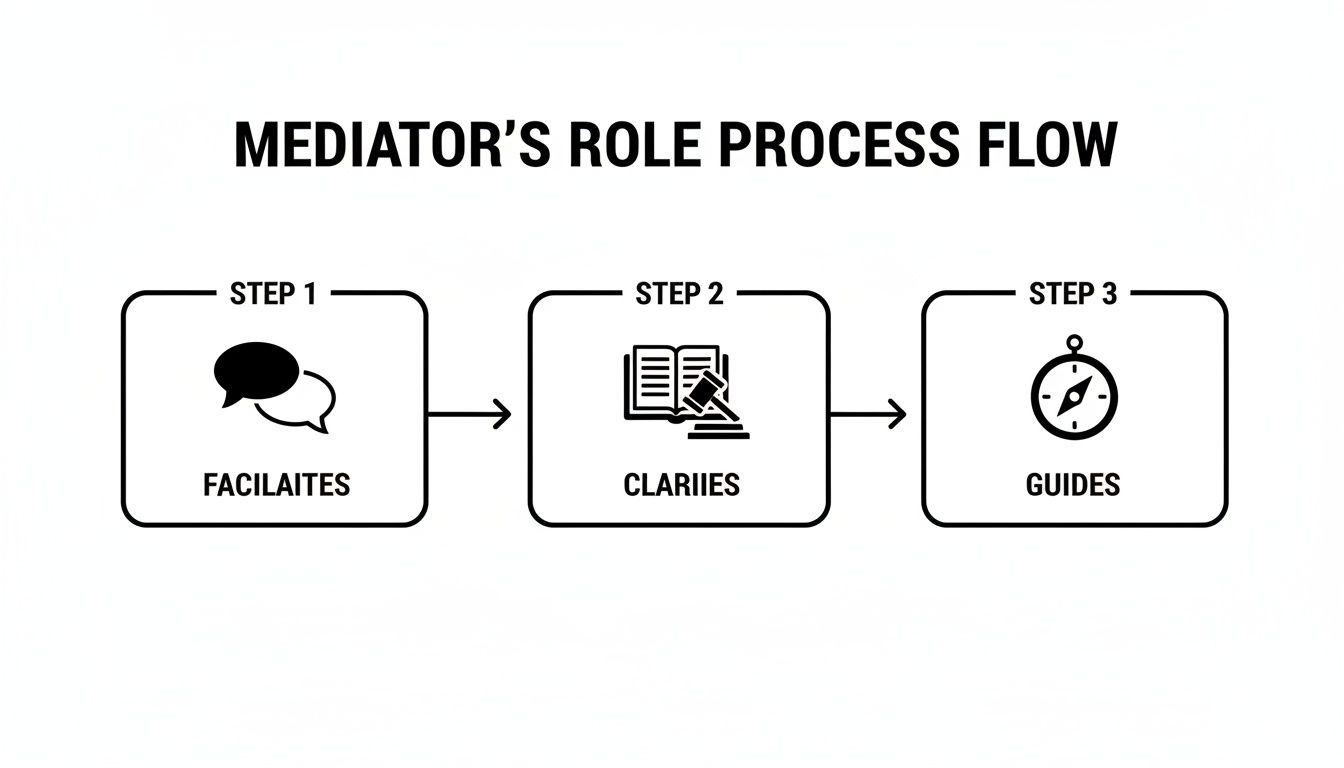
The mediator is there to keep the conversation moving, clarify points of law, and guide both sides toward a resolution without ever taking a side.
Step 3: The Mediation Session
On the day of mediation, you and your attorney will typically be placed in one conference room, while your spouse and their attorney are in another. This "caucus" style is the standard in Texas because it works. It keeps direct conflict to a minimum and gives you the space to speak freely with your lawyer.
The mediator moves back and forth between the two rooms, carrying offers, explaining positions, and helping bridge the gaps. They'll start by laying out the ground rules and goals for the day, then listen to each side before the negotiations begin.
Step 4: Brainstorming and Negotiating Solutions
This is where the real work happens. Instead of being stuck with the limited options a judge can impose, mediation allows you to get creative. The mediator will help you and your spouse explore solutions that are custom-fit for your family.
You might brainstorm unique property division scenarios for a high-value estate, flexible possession schedules for your children, or child support structures that a court simply couldn't order. It’s a shift from an all-or-nothing battle to a problem-solving discussion.
Your attorney’s role here is crucial. They will analyze every offer and counter-offer, advising you on the long-term legal and financial consequences to make sure you don't agree to a deal that undermines your future.
It can be a long day of back-and-forth, but the aim is to find a compromise both of you can live with.
Step 5: Drafting the Mediated Settlement Agreement (MSA)
Once you reach a verbal agreement on every issue, the work isn't quite done. The mediator will immediately draft a Mediated Settlement Agreement (MSA). This document puts every single detail of your settlement in writing, from who gets the house to the specifics of your parenting plan.
You and your attorney will review this document with a fine-tooth comb to confirm it perfectly matches the terms you agreed to. This is because under Texas Family Code Section 6.602, a signed MSA is irrevocable. Once you and your spouse sign on the dotted line, the deal is binding, and you can't change your mind. This finality is powerful—it locks in your progress and prevents the case from going backward.
Step 6: Finalizing Your Divorce Decree
The signed MSA serves as the official blueprint for your Final Decree of Divorce. Your attorney takes the MSA and drafts the formal court order that a judge will sign.
Because you've already resolved all the issues, this last step is usually just a formality. The judge's job is to review the agreement to ensure it complies with Texas law and then sign the decree. This is often done in a very brief court appearance, officially ending your marriage without the pain, expense, and uncertainty of a contested trial.
How to Prepare for a Successful Mediation
Walking into mediation can feel like stepping into the unknown, but success doesn't happen by chance. It starts long before you ever sit down at the negotiating table. The key to turning anxiety into empowerment is preparation. By doing the homework upfront, you can walk into that room with a clear head, a solid game plan, and the confidence to advocate for a fair outcome.

Think of it this way: you wouldn't start a road trip without a map and a full tank of gas. Preparing for mediation is the exact same principle. It's about gathering your resources and charting your course toward a successful settlement.
Gathering Your Essential Documents
Solid negotiations are built on a foundation of facts, not feelings. You and your spouse simply can't divide what you don't fully understand. Your attorney will be your guide in compiling all the necessary documents to paint a crystal-clear picture of your marital estate.
This isn't just busywork. It's about grounding your case in reality. When all the financial cards are on the table, the conversation can shift from arguing over what exists to finding practical solutions.
Your attorney will give you a specific checklist, but you can expect it to include items like these:
- Financial Records: Recent tax returns, pay stubs, bank statements, and a summary of credit card bills.
- Property Information: Deeds to your home, vehicle titles, and up-to-date mortgage statements.
- Retirement and Investment Accounts: The latest statements for any 401(k)s, IRAs, pensions, or brokerage accounts.
- Business Records: If you're a business owner, you'll need profit and loss statements, balance sheets, and other key financials.
- Debt Information: A full list of what you both owe, from car loans and student debt to personal loans.
- Proposed Parenting Plan: A draft of your ideal custody schedule, decision-making rights, and holiday calendar.
As you gather these records, you'll also be looking at potential settlement agreements and other legal paperwork. An AI Legal Contract Analyzer can sometimes be a helpful starting point for understanding complex language, but it's no substitute for the detailed advice you'll get from your attorney.
Developing Your Negotiation Strategy
With your documents organized, it’s time to sit down with your attorney and map out a negotiation strategy. This isn’t about gearing up for a fight; it’s about defining your goals and figuring out where you can be flexible. The goal is to shift your mindset from "winning" to "problem-solving."
A huge part of this is separating your non-negotiables from your "nice-to-haves."
Think of your goals in two columns. One column is for your absolute must-haves—things like ensuring the kids stay in their current school district or securing enough assets for a down payment on a new place. The other is for things you'd like but are willing to trade or compromise on.
This simple exercise brings incredible clarity. It helps you stand firm on what matters most while remaining open to creative deals on everything else. This approach is fundamental to a good outcome, and you can learn more by reading our guide on how to prepare for divorce mediation in Texas.
The Vital Role of Your Attorney
While the mediator for your divorce is a neutral third party, your attorney from The Law Office of Bryan Fagan is 100% on your side. Their role during mediation is absolutely crucial. They aren't there to pick fights, but to protect your rights and make sure any deal you sign is fair, legally sound, and actually works for you in the long run.
Before mediation, your attorney gets you ready. During the session, they act as your private advisor, helping you analyze offers and craft smart counter-offers. Afterward, they make sure the final Mediated Settlement Agreement (MSA) perfectly matches what you agreed to and becomes a legally binding court order. With our experienced team in your corner, you’ll feel prepared and empowered to reach a fair and lasting resolution.
Choosing the Right Mediator for Your Divorce
Picking the person who will guide you through one of life's most challenging negotiations is a decision that shouldn't be taken lightly. The right mediator can help turn conflict into compromise. The wrong one can leave you feeling frustrated, stuck in a stalemate, and no closer to a resolution. Finding a professional who fits your unique situation is the first step toward a successful outcome.
Just like any other major decision in your divorce, this one demands careful thought. You aren't just hiring a referee; you're choosing a facilitator whose personality, experience, and style will directly shape the entire negotiation.
Vetting Potential Mediators
Before you agree to work with anyone, you and your attorney need to vet them properly. This isn't the time to just pick the first name on a court-provided list. You have to ask the right questions to make sure their skills line up with the specific challenges of your case.
The process can feel a lot like finding other kinds of professional support. In fact, some of the same principles of checking for compatibility and expertise in guides on how to choose a therapist apply here, too. You're looking for the right fit.
Key Questions to Ask a Potential Mediator
Your attorney will help you screen candidates, but you should walk into those conversations with your own questions ready. Treat it like you're conducting an important job interview—because you are. Here are the critical questions to ask:
- Training and Credentials: What is your specific mediation training? Are you a practicing attorney, a retired judge, or do you have another professional background?
- Experience with Your Issues: How many cases have you handled with issues similar to ours? (e.g., complex assets, business ownership, children with special needs, or high-conflict personalities).
- Mediation Style: Do you tend to be more facilitative, where you guide the conversation, or more evaluative, where you offer opinions on what a court might do? How do you manage situations where one person is more powerful or emotional than the other?
- Process and Logistics: What does your mediation process actually look like? Do you use a caucus model where we're in separate rooms? What is your fee structure, and what’s a realistic estimate for the total cost?
- Success Rate: What percentage of your mediations end with a full settlement? In your experience, what are the biggest roadblocks to reaching an agreement?
The answers you get will tell you a lot about a mediator’s professional approach and whether their temperament is a good match for you and your spouse.
You are looking for a professional who is not only skilled in the law but also adept at managing human emotion. The best mediators for divorce are calm, patient, and persistent, capable of steering the conversation back to productive ground when tensions rise.
Your attorney at The Law Office of Bryan Fagan, PLLC, has worked with countless mediators across Texas. We know who gets results, who is respected by judges, and whose style works best for different types of cases. Leaning on our experience takes the guesswork out of this crucial decision, giving you confidence that you are choosing a mediator who can truly help you build a bridge to a fair resolution.
What to Do Next
You've learned that mediation offers a saner, more collaborative way to handle your divorce. We've covered how mediators for divorce help you and your spouse stay in the driver's seat, making critical decisions in a private, respectful setting. But even though mediation is a world away from a courtroom fight, it's not a path you should walk alone.
Here are your immediate action steps:
- Acknowledge Your Progress: You’ve taken the initiative to get educated on your options. That’s a huge step toward taking control of your divorce.
- Get Expert Legal Guidance: Before you hire a mediator or step into a session, get advice from a seasoned family law attorney. Your lawyer is your advocate, your guide, and your safety net.
- Schedule a Consultation: The best way to understand how these principles apply to your specific situation is to talk with an expert.
The real goal of mediation isn't just to get a deal done—it's to get a good deal done. A good settlement protects your financial future, secures your rights as a parent, and lets you start your next chapter with confidence and stability.
A strong, empathetic attorney is your best asset in this process. If you are ready to move forward with clarity and confidence, schedule a free consultation with The Law Office of Bryan Fagan today. We are here to protect your interests and guide you toward a better future.
Frequently Asked Questions About Divorce Mediation
When you're facing a divorce, the word "mediation" comes up a lot. But what does it really mean for you and your family? It’s completely natural to have questions about how it works, whether it’s required, and what happens if you can’t agree.
We've put together answers to the most common questions we hear from Texas families. Our goal is to clear up the confusion so you can feel more confident about your path forward.
Is Mediation Required for Divorce in Texas?
This is one of the most common questions we get, and the short answer is: almost always, yes. The Texas Family Code Section 6.602 technically gives judges the choice to order mediation, but as a practical matter, it's become standard procedure.
Most courts in major counties like Harris have local rules that require couples in a contested divorce to at least try mediation before a judge will even give them a date for a final trial. Judges understand that mediation is highly effective, and they want to give you every opportunity to settle your case yourselves—before a stranger in a black robe has to make those decisions for you.
What Happens If We Can't Reach an Agreement in Mediation?
It's a valid concern—what if you spend the time and money on mediation, only to walk away without a deal? First, you haven't lost anything by trying. If you and your spouse reach an impasse on one or more issues, your case simply continues on the path toward trial.
But even a so-called "failed" mediation is rarely a total loss. Often, couples are able to resolve some of their disputes, which narrows the focus of a potential trial. This saves you time and money by reducing the number of issues the attorneys have to prepare and argue in court. The process also forces both sides to lay their cards on the table, giving your legal team a much clearer picture of the other side’s priorities and arguments.
Is a Mediated Agreement Legally Binding?
Yes, and this is one of its most powerful features. Once you and your spouse have hammered out a deal, the mediator will draft a document called a Mediated Settlement Agreement (MSA).
The moment you, your spouse, and your attorneys sign that MSA, it becomes legally binding and irrevocable under Texas law.
This finality is a huge benefit of mediation. Once the MSA is signed, the deal is done. Neither you nor your spouse can simply change your mind or back out later. This gives you the certainty and security to know the conflict is resolved, allowing you to finally start moving forward.
From there, your attorney takes the signed MSA and drafts the Final Decree of Divorce, which is the official court order the judge will sign to finalize your divorce.
Can I Attend Mediation Without an Attorney?
While you technically can go to mediation without a lawyer, it is a very risky idea that we strongly advise against. The mediator’s job is to be a neutral third party. They cannot give you legal advice, tell you if a proposed settlement is fair, or advocate for your best interests. Their only goal is to help you and your spouse reach an agreement—any agreement.
Having your own attorney from The Law Office of Bryan Fagan in the room with you is your ultimate protection. We are there for one reason: to protect you. We act as your private advisor, your advocate, and your strategist, ensuring you understand the real-world, long-term consequences of any offer on the table. We help you negotiate from a position of strength, not of fear or uncertainty.
The path through divorce can feel overwhelming, but you do not have to find the answers by yourself. The experienced attorneys at The Law Office of Bryan Fagan, PLLC are here to provide the strategic legal advice and unwavering support needed to protect your family and your future. We invite you to take the next step by scheduling a free, no-obligation consultation at https://texasdivorcelawyer.us to discuss your unique situation and discover how we can help you achieve a better outcome.