Skip to content
You thought the hard part was deciding to file. Then mediation ends, your spouse won’t budge, and your lawyer says the words you were hoping not to hear: your divorce is likely headed to trial.
That moment can feel heavy. Maybe you’re worried about your kids. Maybe you’re losing sleep over the house, retirement accounts, a business, or whether a judge will understand what daily life in your family really looks like. Many people come into this stage thinking trial means chaos. It doesn’t. A contested divorce trial in Texas is serious, but it is also structured. There are rules, deadlines, standards, and a process for presenting your side clearly.
A lot of fear comes from not knowing what happens next. You don’t know what the judge cares about, what evidence matters, what you should be doing this week, or whether one bad day in court could undo months of work. Those are reasonable concerns. They’re also concerns you can prepare for.
If you’re facing a contested divorce trial texas case, your job isn’t to become a lawyer overnight. Your job is to become a steady, informed partner in your own case. That means understanding why your case is contested, how the trial path works, what the judge must decide under Texas law, and how your daily choices before court can help or hurt your position.
Trial is not just something that happens to you. With preparation, it becomes something you move through with purpose.
Introduction When You Realize Your Divorce Is Going to Trial
One client once described the shift this way: “I thought we were arguing. I didn’t realize we were building a court case.”
That’s often the turning point. At first, you may assume the disagreements are temporary. You think a few more emails, one more meeting, or one more mediation session will fix things. Then the issues harden. Your spouse wants a possession schedule that doesn’t fit the children’s lives. You believe certain assets are separate property, but your spouse says they belong in the marital estate. Support, decision-making, and who keeps what all stay unresolved.
What changes at that moment is not just the legal track. Your mindset has to change too.
Fear is normal, but confusion doesn’t have to stay
When a case moves toward trial, people often imagine a dramatic courtroom scene. Real family court is less theatrical and more detailed. Judges focus on evidence, credibility, documents, and whether your requested outcome fits Texas law. The process can feel demanding, but it is not random.
Practical rule: Trial preparation starts long before the trial date. The strongest courtroom moments usually come from organized choices you made weeks or months earlier.
That’s why this stage matters so much. If you understand the process, you can stop reacting and start preparing. You can gather records, tighten your testimony, identify weak spots, and work with your attorney on what the judge needs to hear.
You still have agency
Going to trial doesn’t mean you’ve failed. It means some issues need a judge’s decision. In many Texas divorces, that happens because the stakes are personal and the facts are disputed. Parents disagree about what serves a child best. Spouses disagree about money, fairness, and history. A courtroom exists for exactly those situations.
You may not control your spouse’s behavior. You can control how ready you are.
What Exactly Is a Contested Divorce Trial in Texas
A divorce is contested when you and your spouse don’t agree on one or more important issues, and the court must step in to decide them. It’s not about who is angrier. It’s about whether there are unresolved legal questions that prevent the case from finishing by agreement.
In Texas, those disputes usually involve children, property, support, or all three. The court doesn’t conduct a trial because a marriage ended badly. The court conducts a trial because the parties need a binding decision.
What makes a case “contested”
A case becomes contested when there is no full agreement on terms such as:
- Child-related issues like conservatorship, parenting time, decision-making rights, or child support
- Property questions such as whether something is community property or separate property
- Financial disputes involving spousal maintenance, reimbursement claims, debts, or business interests
- Fault allegations that may affect how property should be divided
Texas sees a high volume of family law matters. In Fiscal Year 2021, Texas courts handled nearly 305,000 new family law cases, and divorce cases made up 38% of that total, according to the Texas courts annual statistical report. If your case has reached this point, you are not unusual, and you are not alone.
Common reasons settlement breaks down
Many contested cases don’t begin as all-out fights. They become contested because one issue drives everything else.
A few examples help:
| Dispute | What one spouse says | What the other spouse says |
|---|---|---|
| Parenting schedule | “The kids need one stable school-week routine.” | “I want a broader schedule and equal say on decisions.” |
| House or business | “We built this together, so it should be shared.” | “Part of this came from my separate funds.” |
| Spending during marriage | “Money was used recklessly.” | “Those were ordinary family expenses.” |
In each example, the argument is really about proof. Who has records? Who has credible testimony? Which version fits the law?
Trial is a decision-making tool
A contested divorce trial in Texas is the formal hearing where each side presents evidence and legal arguments to a judge. The judge then resolves the issues the parties could not settle.
That matters because trial isn’t just the end of negotiations. It changes how you and your attorney should think. You stop asking only, “What feels fair to me?” You start asking, “What can we prove, and how does that connect to what Texas law requires?”
The court does not reward the louder story. It responds to the clearer, better-supported one.
That shift often reduces anxiety. Once you understand that trial is a structured way to resolve a deadlock, the process becomes easier to prepare for.
The Texas Contested Divorce Trial Timeline from Filing to Verdict
A contested divorce trial doesn’t begin in the courtroom. It begins with paperwork, deadlines, and strategic choices that shape the final hearing long before anyone takes the witness stand.
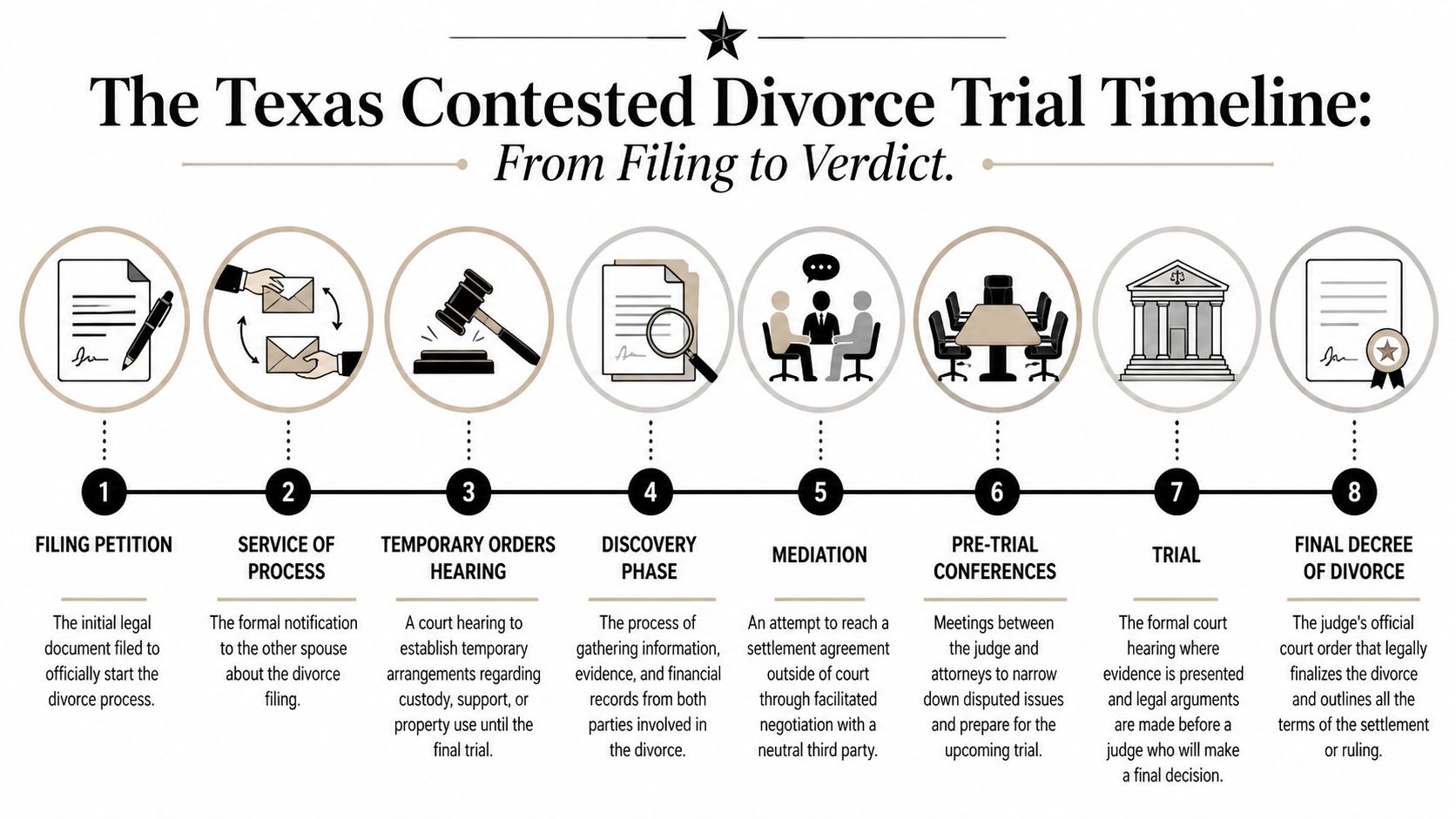
If children are involved, contested divorces in Texas often take 9 months to 2 years, while uncontested cases may finish 60 to 90 days after the mandatory waiting period, according to this discussion of contested versus uncontested divorce in Texas. The extra time usually comes from discovery, temporary orders, mediation, and court scheduling.
Step one starts the clock
One spouse files an Original Petition for Divorce. Texas also has baseline filing rules that matter before you ever reach trial. A court generally requires at least six months of residency in Texas and 90 days in the county where the case is filed. Texas law also includes a 60-day waiting period after filing before a divorce can be finalized, except in limited situations.
At this point, you are not proving your whole case. You are opening it.
Service and response shape the case early
After filing, the other spouse must be formally served unless service is waived properly. Then the responding spouse files an answer, and often a counterpetition. This stage can feel routine, but it has consequences. The claims and requests in these pleadings tell the court what each side is asking for.
Temporary orders create short-term stability
In many contested cases, the family can’t wait until trial for basic rules. The court may need to decide who stays in the house, who pays which bills, what the parenting schedule will be for now, and whether temporary child support should be paid.
Why temporary orders matter so much
Temporary orders often become the practical status quo. If your children have been following one schedule for months, that pattern can influence how the judge views stability later. If one spouse has controlled business records or access to accounts during the case, that may affect trial preparation.
This is one reason early strategy matters. “Temporary” does not mean “unimportant.”
Discovery is where cases are built
Discovery is the formal exchange of information and evidence. In plain English, each side asks for documents, records, and sworn answers.
You may deal with:
- Requests for production for bank statements, tax returns, account records, emails, or business documents
- Interrogatories that require written sworn answers
- Depositions where lawyers ask questions under oath before trial
- Inventories and appraisements that list property, debts, and claims
What discovery is really doing
Discovery isn’t busywork. It tells your attorney what can be proved, what needs more support, and where the other side may be vulnerable. In a property dispute, records can show whether money was inherited, gifted, mixed, or spent. In a parenting dispute, school records, calendars, and communications can reveal who handled daily responsibilities and how conflict has affected the children.
Mediation comes before trial in many cases
Texas courts often require mediation before trial in contested family cases. Mediation gives both sides one more chance to settle with the help of a neutral third party. If some issues resolve and others don’t, the trial may narrow to the remaining disputes.
A strong trial lawyer also prepares for settlement. Good preparation does both jobs at once.
Pre-trial conferences narrow the fight
As trial approaches, the court may hold hearings or conferences about exhibits, witnesses, time limits, and remaining issues. These are not formalities. They force both sides to define what the judge will need to decide.
Trial and final ruling
At trial, each side presents evidence, testimony, and argument. In Texas family cases, bench trials are far more common than jury trials. The judge may announce rulings in court or take the matter under advisement and rule later. The written final decree comes after that.
A long timeline can feel discouraging. It also gives you opportunities. Every stage before trial can strengthen your position if you use it well.
Understanding the Legal Standards a Judge Must Follow
Judges in Texas family court don’t decide cases based on who seems more upset or who tells the most dramatic story. They must apply legal standards. If you know those standards, your case starts to make more sense.

For most contested divorce trial texas cases, the two biggest standards involve property division and the best interests of the child.
Property is not always split straight down the middle
Texas is a community property state, but that doesn’t mean every divorce ends with an exact equal division. Texas law uses a “just and right” standard for dividing community property. According to this explanation of dividing assets in a Texas divorce, courts can consider multiple factors, including marital fault, and while many divisions are near equal, documented misconduct can support a disproportionate award.
That phrase, “just and right,” gives the judge discretion. It also creates confusion for many people.
What “just and right” means in real life
A judge may look at things like the nature of the property, the spouses’ circumstances, and evidence of fault or financial misconduct. So if one spouse wasted marital funds or engaged in misconduct that affected the marriage, that can matter. The key word is documented. Judges need evidence.
Separate property requires proof
Another major issue in contested cases is whether an asset is community or separate property. Texas law starts from a strong presumption that property acquired during marriage is community property. If you claim something is separate, you must prove it by clear and convincing evidence, as explained in this discussion of Texas divorce property division and tracing.
That standard is important because testimony alone often isn’t enough.
Why records matter more than memory
Suppose you received an inheritance during marriage. You may know it was yours alone. But if the money went into a joint account and then mixed with ordinary family spending, tracing becomes harder. The court may still presume the property is community unless your records clearly show otherwise.
For business owners and high-asset families, this can become one of the central trial issues. Account statements, titles, ledgers, and forensic tracing can carry more weight than personal certainty.
A courtroom lesson: If you can’t trace it, the judge may not be able to separate it.
Custody decisions turn on the child’s best interests
When children are involved, the judge’s focus changes. Texas courts prioritize the best interests of the child, and Texas Family Code Section 153.131 is a central part of that framework. The question is not which parent feels more wronged by the divorce. The question is what arrangement serves the child’s welfare, stability, and development.
A short guide helps:
| Issue | What the judge wants to know |
|---|---|
| Stability | Which parent can provide consistent routines, school support, and reliable care |
| Decision-making | Whether each parent can make sound choices and support the child’s needs |
| Co-parenting | Whether a parent can encourage the child’s relationship with the other parent when appropriate |
| Evidence | What records, messages, school documents, and witness testimony support each claim |
This is why trial strategy has to connect facts to legal standards. You are not just telling the judge what happened. You are showing why the law supports the outcome you’re requesting.
Your Pre-Trial Preparation Checklist What You Need to Do Now
The weeks before trial usually decide more than the hours inside the courtroom. Good preparation lowers stress because it turns vague fear into specific tasks.

Parents often feel this pressure most intensely. Effective preparation can reduce the emotional toll and influence outcomes, especially when custody is disputed. Texas courts focus on the child’s best interests under Section 153.131, and parents who present organized proof of stability, such as parenting logs and school records, are better positioned, as noted in this discussion of contested divorce preparation.
Gather documents like you are building a timeline
Don’t collect papers in random piles. Organize them by issue.
For example:
- Parenting records might include calendars, school notices, report cards, attendance information, medical records, and communication logs.
- Financial records may include bank statements, tax returns, pay stubs, credit card statements, retirement documents, loan information, and business records.
- Property records can include deeds, titles, closing statements, appraisals, inheritance paperwork, and account histories.
If your case involves formal document exchange, learn what that process requires by reviewing the discovery phase of divorce.
Respond carefully, not emotionally
Discovery responses, depositions, and written statements are not the place to vent. They are the place to be accurate.
A few practical habits help:
- Answer what is asked: Don’t guess, don’t exaggerate, and don’t volunteer extra arguments in a factual response.
- Correct errors quickly: If you discover a mistake in records or responses, tell your lawyer promptly.
- Preserve messages and files: Don’t delete texts, emails, calendar entries, or digital records that may matter.
Prepare your testimony before you need it
It is often believed that testimony means “tell the truth and it will work out.” Truth matters, but presentation matters too. Nervous witnesses often talk too much, answer a different question than the one asked, or become defensive on cross-examination.
Here is a useful way to think about your testimony:
| Situation | Better approach |
|---|---|
| You’re asked a yes-or-no question | Answer yes or no first, then explain if needed |
| You don’t understand a question | Ask for clarification |
| You don’t remember exactly | Say you don’t remember, if that’s true |
| You feel attacked | Stay calm and return to facts |
A short video can help you start visualizing that preparation process.
Build a witness plan with your attorney
Not every witness helps. A good witness adds facts the judge needs. A weak witness repeats your opinion, carries personal bias, or creates side issues.
Useful witnesses may include someone who can speak to parenting involvement, business records, asset history, or the condition of disputed property. Your attorney can help decide who should testify live, who might provide records, and what foundation is needed to admit exhibits properly.
Think like a judge, not just like a spouse
This mindset shift matters. The judge is asking:
- What facts are supported?
- Which records are reliable?
- Which parent seems steady and child-focused?
- Which property claims are traceable?
- Which requests are realistic and lawful?
That’s why some people choose structured trial preparation with experienced family law counsel. One option Texans use for divorce and custody litigation support is Law Office of Bryan Fagan, PLLC, which handles contested family cases and related preparation across Texas.
You don’t need a perfect performance. You need a credible, organized, legally supported presentation.
Navigating the Courtroom A Day at Trial Explained
Many individuals often struggle with sleep the night before a trial, imagining an unfamiliar courtroom. The actual day is usually quieter and more procedural than anticipated.
You arrive early. You meet your lawyer. You review exhibits, witness order, and any last-minute developments. Your spouse and their lawyer are there too. There may be waiting. Family court often involves starts and stops, short conferences, and changes in timing.
The day usually begins before anyone testifies
Sometimes the lawyers speak with the judge first about logistics, exhibits, or unresolved procedural issues. You may hear terms like objections, stipulations, or admitted exhibits. That doesn’t mean something has gone wrong. It means the court is managing what evidence will come in and how the hearing will proceed.
If you want a broader orientation to that setting, this guide on what to expect in divorce court can help you understand the environment.
Opening statements frame the dispute
Each side may give an opening statement. This is not evidence. It is a roadmap. Your lawyer tells the judge what the case is about, what the evidence will show, and what orders you are requesting.
A good opening is focused. If the key issue is parenting stability, your attorney may center the case there. If the key issue is tracing separate property, the opening may signal the documents and testimony that matter most.
Testimony is where your preparation shows
When witnesses testify, the lawyer who called them asks questions first. That is direct examination. Then the other side may cross-examine.
This is often the most stressful part for clients, but it becomes manageable when you know your role. Listen carefully. Answer the question asked. Pause before responding. Let your lawyer object when needed.
The judge is watching more than your words. The judge is also watching whether you stay composed, responsive, and grounded in facts.
Exhibits have to be introduced properly
Documents don’t become evidence just because you brought them to court. Your lawyer usually has to offer them, lay the right foundation, and address objections. That is why preparation beforehand matters so much. Organized records are easier to use. Confusing stacks of paper are harder to trust.
Closing arguments tie law to facts
At the end, each side explains why the evidence supports the orders requested. At this stage, legal standards matter. Your lawyer connects facts to the child’s best interests, property characterization, or a just and right division.
The judge may rule from the bench that day, or may take time to review the evidence and issue rulings later. Either way, the courtroom phase is only part of the story. The quality of what happened before trial often determines how that day unfolds.
After the Verdict Finalizing the Decree and Understanding Your Options
The judge’s ruling is a major moment, but it is not the last task in your case. After trial, the orders still need to be turned into a written Final Decree of Divorce.
That document matters more than many people realize. It doesn’t just say you are divorced. It spells out the enforceable details about property division, debts, conservatorship, possession, support, and any other rulings the judge made. If retirement accounts, real property transfers, or later enforcement issues are involved, precision in the written language is critical.
The decree needs to match the ruling
Your attorney will usually prepare or review the decree language based on the court’s decision. This is not a clerical formality. If the wording is vague, incomplete, or inconsistent with the ruling, it can create future conflict.
For example, parents may later disagree over pickup times, holiday terms, or decision-making language if the decree is poorly drafted. Property disputes can also continue if transfer steps are missing or unclear.
Appeals exist, but they are difficult
If you believe the judge made a legal error, you may have the right to appeal. But appeal is not just a second chance to argue the facts. It focuses on whether the trial court made reversible legal mistakes.
Appeals in Texas family cases are hard to win. Success rates are estimated at around 15% statewide, and one major reason is an insufficient trial record, as discussed in this article about appealing a Texas family court decision and supported by this analysis of a Texas divorce appeals decision. That is why trial objections, admitted evidence, and a clear record matter so much before the case ever reaches appeal.
Modification may be the better path in some cases
Not every bad outcome calls for an appeal. Sometimes life changes after divorce, especially where children are involved. A later job change, relocation issue, school need, or shift in finances may support a modification of custody, support, or possession orders if Texas law allows it.
That is an important distinction. An appeal challenges whether the judge got the law wrong then. A modification asks the court to address changed circumstances later.
What to Do Next Protecting Your Family and Future
If your case is moving toward trial, you don’t need more panic. You need a plan.
A contested divorce trial texas case puts pressure on every part of your life. It asks you to make legal decisions while you’re carrying emotional weight. But preparation changes the experience. When you understand the standards, organize your evidence, and work closely with your attorney, the process becomes more manageable and far less mysterious.
Keep your focus where it belongs. Protect your children. Protect your financial future. Protect your credibility. Those are not abstract goals. They come from specific actions, taken early and taken consistently.
If you’re facing disputes over custody, child support, mediation, business assets, separate property, or post-decree enforcement, now is the time to get clear advice. Waiting rarely makes a contested case easier.
The right legal guidance can help you make calm, strategic choices at a time when every choice matters.
If you’re preparing for a contested divorce or think trial may be unavoidable, schedule a free consultation with Law Office of Bryan Fagan, PLLC. You can talk through your facts, your priorities, and the next steps with a Texas family law team that helps clients understand the process and prepare for what’s ahead.