Skip to content
Receiving a family court decision that feels fundamentally wrong can leave you feeling powerless and defeated. Your next step might be learning how to appeal a family court decision, but it’s crucial to understand that this is not a second chance to argue your case; it's a specific legal challenge to prove the judge made a significant legal mistake.
Is It Worth Appealing Your Family Court Decision?
That sinking feeling after a judge issues a ruling you disagree with is difficult to process. Before you jump back into a legal battle, it's important to take a clear-eyed look at what the appeals process in Texas actually involves. Let’s be clear: an appeal is not a new trial. You cannot introduce new evidence or bring up arguments you forgot to mention the first time. It is a formal request for a higher court to review the original trial's records, searching for serious legal errors.

The High Standard for an Appeal
The bar for winning an appeal is incredibly high. In Texas, appellate courts give a great deal of deference to the trial judge, starting with the presumption that the original decision was correct. This is especially true in child custody cases, where the court's primary duty under the Texas Family Code is to maintain stability for the children.
Simply disagreeing with the judge over how property was divided or who has the final say on your child's medical decisions is not enough. To succeed, you must prove a specific, reversible error of law. For instance, did the judge completely misinterpret a section of the Texas Family Code? Or was there an "abuse of discretion," meaning the ruling was so arbitrary and unreasonable that it defies logic and the facts presented?
The Reality of Success Rates
Let's be blunt: the odds are often stacked against the person filing the appeal. This isn't just a Texas phenomenon; it's a pattern seen worldwide. Appellate attorneys will often tell you that for every one appeal that succeeds, 10 to 20 fail. Those numbers show just how heavy the burden of proof is on you. You can find more insights on judicial review success rates to see how this plays out elsewhere.
An appeal is not about arguing the facts again. It is about arguing the law. Your focus must shift from telling your story to showing how the judge made a legal mistake in hearing it.
Deciding whether to appeal is a serious cost-benefit analysis. The process is almost always long, expensive, and emotionally exhausting. Before you dive in, you need to step back with your attorney and determine if your case truly has the kind of specific legal error that gives you a fighting chance.
Key Factors in Deciding to Appeal
| Consideration | Why It Matters | What You Need to Do |
|---|---|---|
| Grounds for Appeal | You must have a clear legal error, not just disagreement with the outcome. Appeals are won on law, not emotion. | Consult with an appellate attorney to review your case for a reversible error or an "abuse of discretion." |
| Financial Cost | Appeals are expensive, involving legal fees, court costs, and transcript preparation. | Get a realistic cost estimate from a lawyer. Determine if the potential outcome is worth the financial investment. |
| Emotional Toll | The process is lengthy and stressful, prolonging the conflict and uncertainty for you and your family. | Honestly assess your emotional and mental readiness for another round of legal battles. |
| Likelihood of Success | Success rates for appeals are notoriously low. You need to have a very strong case to overcome the presumption that the trial court was correct. | Ask your attorney for a frank assessment of your chances. Review statistics and similar case outcomes. |
Ultimately, a thorough review of these factors will help you make an informed decision rather than an emotional one. This isn't just about fighting—it's about fighting smart.
Finding Grounds for a Texas Family Law Appeal
When a judge’s final order just feels wrong, it's tempting to want a do-over. But in the world of Texas family law, an appeal isn't granted simply because you're unhappy with the result. To have any shot at success, you must be able to show the appellate court that the trial judge made a specific, reversible legal error. Simply disagreeing with their decision, unfortunately, won't cut it.
The real challenge is learning to see the difference between a ruling you don't like and one that's legally broken. For example, let's say the judge awarded your ex-spouse 60% of the community property after carefully considering all the evidence and testimony. That’s likely a judgment call and is very difficult to appeal.
But what if the judge mistakenly classified your separate property (like an inheritance you received) as community property and divided it? That’s a clear misapplication of the Texas Family Code—and exactly the kind of mistake that can form the basis of a strong appeal.
Common Grounds for an Appeal
Your appellate attorney will go through the trial record with a fine-tooth comb—every page of the transcript, every exhibit, and every objection made—searching for these critical errors. Most of them fall into a few key categories:
- Error of Law: This is when the judge gets the law wrong. A classic example is miscalculating child support because they failed to follow the specific guidelines laid out in the Texas Family Code § 154.125. That’s not a judgment call; it's a direct legal mistake.
- Improper Evidence: Sometimes, a case turns on what the judge heard or refused to hear. The court might have wrongly allowed evidence that should have been excluded, or vice-versa. If your ex's lawyer introduced hearsay that clearly swayed the judge’s custody decision, that could be grounds for an appeal.
- Abuse of Discretion: This is the toughest standard to meet. It means the judge’s decision was so arbitrary and unreasonable that it defies all logic and the facts of the case. Think of a judge who completely ignores well-documented evidence of family violence when deciding custody—a direct contradiction of the "best interest of the child" standard mandated by Texas law.
It's crucial to understand that an appeal doesn't re-try the facts of your case. Instead, it challenges the legal process and the decisions the judge made based on those facts.
Finding these errors can feel like searching for a needle in a haystack. It requires a deep understanding of both trial procedure and the highly specialized field of appellate law. This is exactly why getting a fresh, experienced legal eye on your case is the most important first step in figuring out if you have a real chance to challenge the court's decision.
Navigating the Strict Deadlines for Filing an Appeal
That sinking feeling after a bad court ruling can make you want to act immediately, but in the world of appeals, speed has to be balanced with precision. The entire appeals process is rigid, and it's especially unforgiving when it comes to deadlines. If you miss a single date—even by one day—you could lose your right to appeal forever, no matter how strong your case is.
The clock starts ticking the second the judge signs the final order. In Texas, you usually have just 30 days to file your official Notice of Appeal. This is an incredibly tight window to process the court’s decision, find and consult with an appellate attorney, and formally kick off the process. Acting fast isn't just a good idea; it's a mandatory first step to protect your rights.
The Critical Timeline for Your Appeal
Once that Notice of Appeal is filed, a whole new set of deadlines immediately comes into play. You’ll need to arrange for the official record from your trial to be prepared. This has two key parts:
- The clerk’s record: This includes all the documents, motions, and orders filed in your case.
- The reporter’s record: This is the word-for-word transcript of everything said during the trial.
There are specific, non-negotiable deadlines for requesting and paying for these records. If you fail to order these documents correctly and on time, you could jeopardize your entire appeal before it even gets off the ground. The appellate court can only review what’s in that official record.
Timing is everything in family law. You can get a better sense of how crucial it is in our guide to understanding the timelines of divorce in Texas.
This infographic gives a quick visual of the common legal grounds you might build your appeal on, like a misapplication of the law, errors in evidence, or an abuse of discretion by the judge.
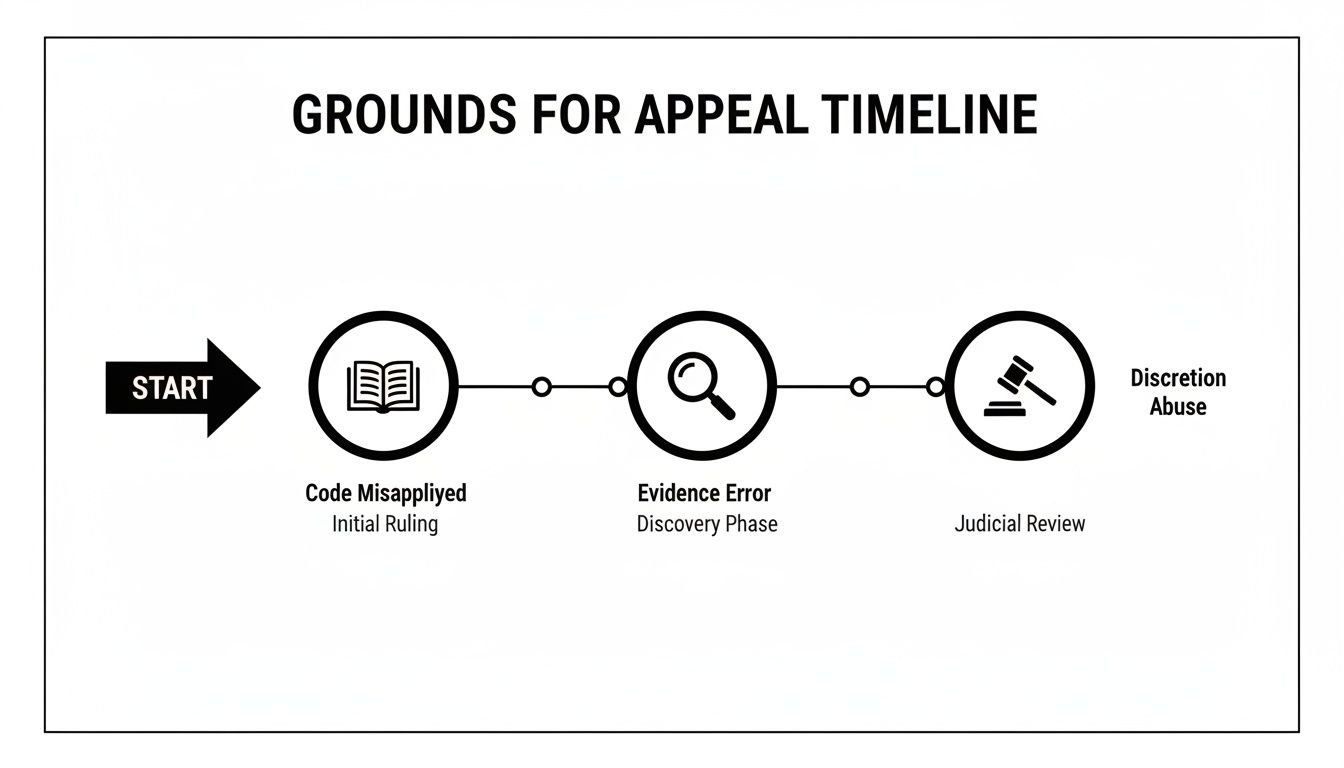
Each of these arguments requires a painstaking review of the trial record, which is exactly why meeting every single deadline is so critical.
Why Every Day Counts
Let's be realistic: success rates for appeals can be tough. The court isn't going to re-try the facts of your case. Instead, the review is focused only on legal errors made by the trial judge. The appellate court actually starts with the assumption that the trial judge got it right.
This is especially true in custody disputes, where courts are very reluctant to disrupt a child's stability. Because of this high bar, the odds are stacked against the person appealing from the very beginning.
Because the process is so complex and the timeline is so unforgiving, it's vital to speak with an attorney who truly understands the appellate system the moment you start considering an appeal. An experienced lawyer can take immediate action to meet the deadlines, preserve your rights, and begin the critical work of combing through your case to find a reversible error.
Building Your Case from the Trial Record
When you decide to appeal a family court decision, your entire strategy has to be built on what's already happened. The trial record—which is the official collection of every document, exhibit, and word spoken in your original case—becomes the single most important element. You can't introduce new evidence or call new witnesses; your case is completely locked into the moments that already occurred in that courtroom.

This completely shifts your attorney's job. Instead of presenting a story, they become more like a detective, meticulously combing through transcripts and exhibits to find a critical legal error that could change everything. The scope of what you can argue is limited entirely to what's inside that record.
The Role of the Appellate Brief
Once a potential error is flagged, the next move is to draft the appellate brief. This isn't just a summary of what happened. It’s a detailed, persuasive legal argument written specifically for the judges on the court of appeals, connecting the dots between the facts in the trial record and established Texas law. If your record includes audio from depositions or hearings, using professional legal transcription services is often a must to get those spoken words into accurate text for review.
A compelling brief has to do more than just point out a mistake. It must convince the appellate judges that the trial court's error was significant enough to have actually changed the final outcome of your case.
The goal of the appellate brief is to show the higher court why the trial judge’s mistake mattered. It's about demonstrating that the error wasn't minor but was fundamental to the unjust result you received.
For instance, let's say the trial judge completely ignored key financial documents when dividing a high-value estate or business assets. The brief would highlight those exact exhibits from the record, then cite the specific Texas Family Code sections on property division to argue that this oversight led directly to an unfair result. This painstaking work is where appeals are either won or lost.
Preparing for this level of scrutiny starts long before a trial even begins. The discovery process for divorce is what lays the groundwork for the trial record itself.
Alternatives to a Full Appeal: What Are Your Options?
That gut-wrenching feeling after an unfavorable ruling can make you want to fight back immediately. But a full-blown appeal isn't always the best or only path forward. Given the high costs, emotional drain, and challenging odds of winning, it's wise to consider other legal avenues that might be a better fit for your family's situation.
The reality is that appellate courts are reluctant to overturn a trial judge's decision, especially in custody matters. This isn't just a local trend; it's a global one. Data from Hague Convention cases, for instance, shows that 81% of return applications had the same outcome on appeal as in the initial trial. You can read more about these findings on international custody appeals to get a sense of how this principle of judicial deference plays out worldwide.
Motion for New Trial
Before you even think about launching a full appeal, you might consider filing a Motion for New Trial. This is a request made to the very same judge who made the initial ruling, asking them to reconsider their decision.
You have to act fast on this one. The motion must be filed within 30 days of the final judgment, so time is absolutely of the essence. A judge might grant a new trial if there was a clear legal error or if new, crucial evidence has been discovered that simply wasn't available at the time of the original hearing.
Seeking a Post-Divorce Modification
Another powerful tool in your legal toolkit is a post-divorce modification. It's important to understand that this is not an appeal. Instead, it's a brand new legal action asking the court to change an existing order for custody, visitation, or child support.
You can pursue a modification if there has been a material and substantial change in circumstances since the original order was made. This could be anything from a job loss, a necessary relocation, or a significant change in a child's needs.
This approach is all about focusing on the present and future rather than trying to re-litigate the past. For many families, it’s a much more practical and effective way to achieve their goals without facing the high bar of an appeal.
Of course, if the issue is that your ex-spouse is simply not following the current order, you might need to explore filing a motion for contempt to enforce your rights.
Key Takeaway: What to Do Next
When a court order goes against you, it's easy to feel defeated. But this isn't the end of the road. A successful appeal isn't won on emotion—it's built by identifying a clear legal mistake, hitting every deadline, and building a solid argument from the existing trial record. Your focus has to shift from the trial that just ended to the legal strategy that comes next.
Here’s your immediate action plan:
- Preserve the Record: Don’t touch, alter, or lose a single document from your original trial. Every email, exhibit, and piece of paper is part of the trial record, and that’s the only evidence the appellate court will look at.
- Do Not Delay: The clock is already ticking. You have a very small window to act—often just 30 days from the date of the final order—to file your Notice of Appeal. Miss that deadline, and you lose your chance.
- Consult an Appellate Attorney: The appeals process is a highly specialized field of law. It's not the same as a trial. You need a lawyer who lives and breathes this complex area of law, someone who knows how to spot reversible errors and navigate the maze of procedural rules.
The most critical decision you can make right now is to seek expert legal guidance. An appeal is not a DIY project; it's a precise legal challenge where every detail matters.
If you genuinely believe the court made a significant error in your case, don't just wait and hope. The time to act is now. Schedule a free consultation with The Law Office of Bryan Fagan, PLLC today. Our experienced team will review your case with compassion, explain your options clearly, and help you map out the best path forward to protect your family's future.
Frequently Asked Questions About Texas Family Court Appeals
Heading into the appeals process can feel like stepping into the unknown. It’s natural to have a lot of questions and feel uncertain about what comes next. Getting some clear answers can help you make confident decisions for your family's future.
How Long Does the Appeal Process Take in Texas?
Patience is a must here—the appellate process is definitely not a quick one. From the day you file the Notice of Appeal to the moment you get a final decision, the entire process can easily stretch to a year or even longer. The exact timeline depends on the complexity of your case, the court's current caseload, and whether oral arguments are required. The best approach is to be prepared for a lengthy wait while your case is under careful review.
Can I Stop Following the Court Order During an Appeal?
Absolutely not. This is a critical point: you must continue to follow the trial court's order exactly as it was written, even while your appeal is moving forward. The only exception is if the court grants a specific request called a stay, which essentially pauses the enforcement of the order. But a stay isn't automatic; it has to be specifically requested and then approved by a judge. For example, if you're appealing a child support order, you are still legally required to make every single payment on time. Violating the original order can trigger serious enforcement actions against you.
What Happens If I Win My Appeal?
Winning an appeal rarely means you get the outcome you wanted right away. A victory usually means the appellate court found a "reversible error" in how the original trial was handled. In most situations, the court will reverse and remand the case. This means they send it back down to the original trial court with specific instructions to correct the legal mistake, usually through a new hearing or trial. While it’s possible for the appellate court to reverse and render a brand new judgment, that’s much less common. More often than not, a successful appeal gives you another chance to argue your case correctly at the trial court level.
Feeling overwhelmed by a court's decision is completely understandable, but you don't have to figure out the next steps by yourself. If you believe a legal error wrongly impacted your case, the experienced team at The Law Office of Bryan Fagan, PLLC is here to help. We can review what happened, explain your options with clarity and empathy, and guide you toward the best path for your family.
Schedule your free, no-obligation consultation by visiting us at https://texasdivorcelawyer.us.