Skip to content
It's a sinking feeling, isn't it? That moment you realize a child support payment hasn't arrived.
When the financial support your child depends on suddenly stops, it’s more than just frustrating—it’s a direct hit to your family's stability and your peace of mind. You might feel overwhelmed or even powerless, but you need to know that you are not alone, and you have powerful legal options.
In Texas, a child support order is a legal command from a judge, not a suggestion. When that order is ignored, the law provides you with strong tools to enforce it. This guide will walk you through the practical, step-by-step process of how to enforce child support in Texas, so you can move from a place of uncertainty to one of confident action.
What Happens When Child Support Payments Stop?
That pit in your stomach when a payment is late or missing is completely understandable. You're not just dealing with a financial gap; you're carrying the stress of providing for your child without the support they are legally owed. This uncertainty can feel overwhelming, but the Texas Family Code offers a clear path forward to protect your child.

Texas Has Your Back with Powerful Enforcement Tools
It's easy to feel powerless in this situation, but you're not. The state has built robust systems specifically designed to make sure court-ordered child support gets paid. These aren't just suggestions; they are legally binding actions a judge can order to compel a non-paying parent to comply.
The state's commitment here is huge. The Office of the Attorney General's Child Support Division in Texas manages an incredible 1.5 million cases for 1.7 million children.
What's really impressive is its effectiveness. The division recovers $11.34 for every single dollar spent on the program, making it one of the most successful systems in the entire country.
This guide is designed to move you from uncertainty to action. Think of it as your roadmap for understanding what happens if you stop paying child support too soon in Texas and how to confidently handle the enforcement process.
Your First Moves When a Payment Is Missed
When a child support payment doesn't show up, it’s easy to feel a rush of panic or anger. But before taking legal action, your first and most important move is documentation. To successfully enforce a child support order in Texas, you need a clear, undeniable record of non-payment. This isn't about looking for a fight; it's about building a solid foundation for your case so you can present clear facts to a judge.
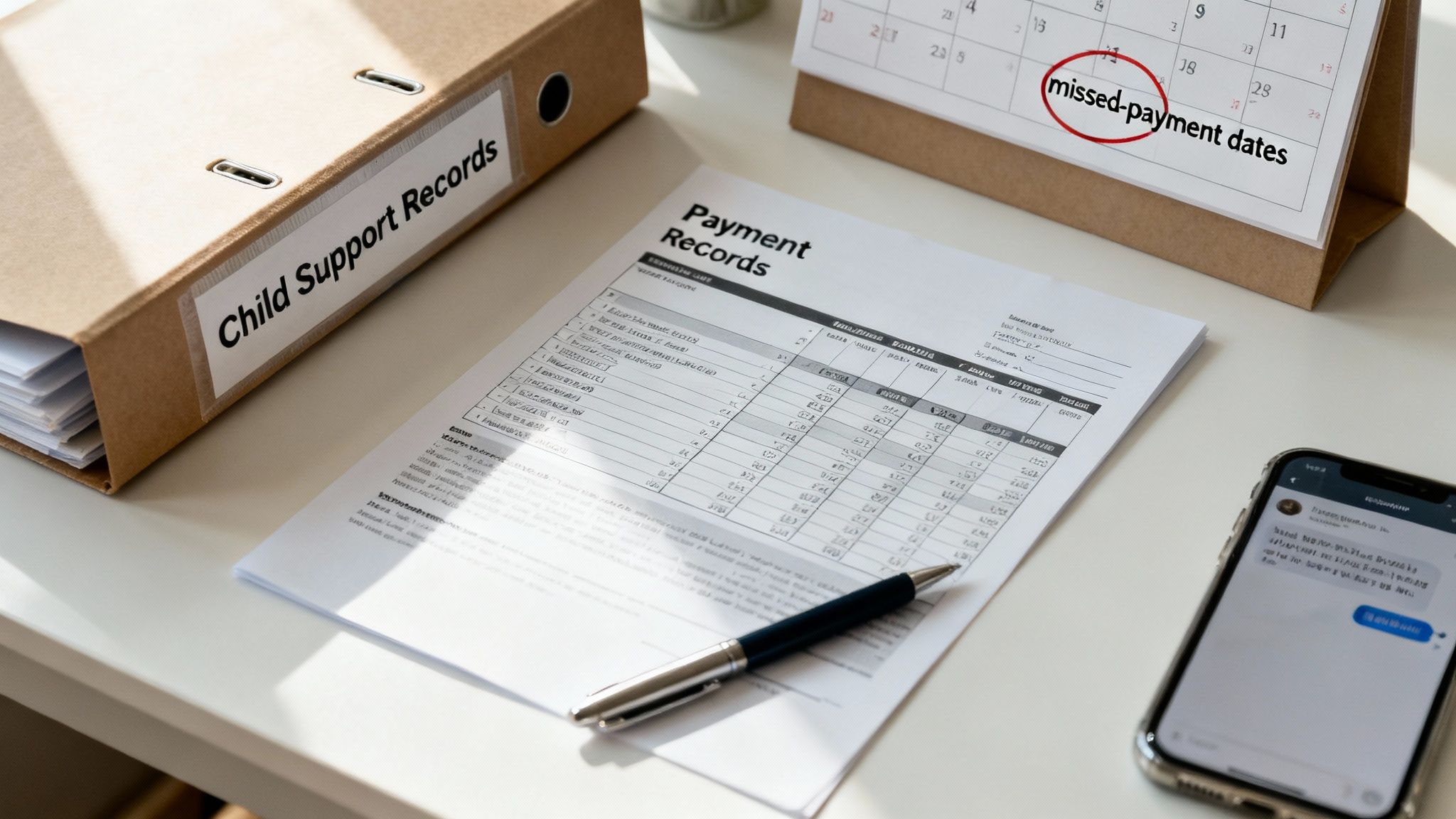
Step 1: Start Your Documentation Immediately
The moment a payment is missed, start keeping a detailed log. It sounds simple, but this step can transform a messy "he-said, she-said" argument into a factual timeline that a judge can easily follow.
Your record should track:
- Payment Due Date: The exact date the payment was supposed to be made per your court order.
- Amount Owed: The specific amount listed in your court order.
- Amount Paid (if any): Make a note if you only received a partial payment.
- Running Tally: Keep a cumulative total of the arrears (the total amount of unpaid support).
By maintaining a clear and consistent record from day one, you provide the court with the most powerful evidence possible—a factual history of non-compliance.
Step 2: Communicate Professionally and In Writing
It’s tempting to call and demand an explanation, but written communication is far more valuable for enforcement. Send a calm, professional text message or email acknowledging the missed payment.
For instance, you could write something simple like: “Hi [Parent's Name], I’m checking in because the child support payment of $[Amount] due on [Date] hasn’t been received yet. Please let me know when I can expect it. Thanks.”
This creates a digital paper trail. It proves you made a reasonable attempt to sort things out and confirms the other parent was aware they were behind. Keep your messages brief and stick to the facts about the payment.
Step 3: Get Official Payment Records
Your personal log is a fantastic start, but pairing it with official records makes your case virtually airtight. If your payments are processed through the state, you can contact the Texas Child Support Disbursement Unit (SDU) and request an official payment history.
This third-party verification from the state is incredibly compelling to a judge. It documents precisely what the state has received and paid out, leaving very little room for debate. Taking these methodical first steps is the key to successfully preparing to enforce your child support order in Texas.
Choosing Your Path: The Attorney General vs. a Private Attorney
When your own attempts to collect missed child support payments have hit a wall, you're faced with a big decision. Do you go through the Texas Office of the Attorney General (OAG), or is it time to hire a private family law attorney? Both are legitimate options, but they lead to vastly different experiences and often, different results.
The biggest draw for the OAG is the cost—its services are free. For parents already struggling with a tight budget, this is a huge relief. However, the trade-off is that the OAG is dealing with a massive number of cases statewide. This overwhelming caseload usually means a much slower process, and you’ll likely have very little direct contact with the actual attorney handling your case.
Taking Control of Your Case
Hiring a private attorney is an investment, but what you’re paying for is direct control and dedicated attention. A private attorney works for you, and only you. This relationship means you’re in the driver’s seat—you help shape the legal strategy, you get regular updates, and you have a direct line to someone whose only job is to fight for your family’s specific goals.
This personalized service almost always gets you a faster resolution. The OAG's process can drag on for months, sometimes even longer. In contrast, a private attorney can file an enforcement motion and get a court hearing on the calendar much more quickly, putting immediate legal pressure on the non-paying parent. If you're considering this route, understanding the focus of specialized Family Law Firms is a great first step.
A private attorney's loyalty is exclusively to you and your child's best interests. This allows for a tailored legal strategy that the high-volume OAG system simply cannot provide.
To make the choice clearer, it helps to see the key differences side-by-side.
Comparing Child Support Enforcement Options in Texas
This table breaks down the fundamental differences between using the Office of the Attorney General and hiring a private family law attorney to enforce your child support order.
| Feature | Office of the Attorney General (OAG) | Private Family Law Attorney |
|---|---|---|
| Cost | Free to use their services. | Requires a retainer and hourly fees. |
| Case Speed | Often slower due to high caseloads. | Typically faster and more direct path to court. |
| Control | Little to no control over legal strategy. | You have direct input and final say on strategy. |
| Communication | Communication can be limited and impersonal. | Direct, consistent communication with your attorney. |
| Best For | Parents with straightforward cases and limited funds. | Parents needing a fast, aggressive, or customized approach. |
Ultimately, the right choice depends on your specific situation. If your case is simple and your budget is the top priority, the OAG is a viable option. But if speed, communication, and a customized strategy are important to you, investing in a private attorney is often the most effective path forward.
The Legal Tools a Judge Can Use to Compel Payment
It’s incredibly disheartening when a parent simply ignores a court order meant to support your child. But you need to know that Texas family court judges don’t take non-payment lightly. They have a powerful set of legal tools, all laid out in the Texas Family Code, that they can use to force a parent to comply with their financial duty.
These aren't just suggestions; they are serious, real-world consequences designed to get your child the support they're owed.
The most direct and common method is a wage withholding order. It’s exactly what it sounds like: the judge orders the non-paying parent's employer to deduct child support directly from their paycheck before they ever see it. You can learn more about how a judge can garnish wages in Texas for child support in our detailed article. This tool is often the most effective because it takes the other parent out of the process entirely.
Stepping Up the Pressure
When wage withholding isn't an option or just isn't working, a judge has several other powerful moves. These methods are designed to make it very difficult for someone to keep ignoring their responsibility to their child.
A judge can authorize the interception of money from different sources, including:
- Federal Tax Refunds: If the non-paying parent is expecting a tax refund, the state can seize it and redirect it to you to cover the past-due support.
- Lottery Winnings: Any significant lottery winnings can also be intercepted before they ever reach the parent.
- Other Federal Payments: Certain other federal payments can be targeted to satisfy the child support debt.
When a parent willfully dodges their responsibility, the court's main goal is to make sure your child gets the support they are legally owed. Intercepting these funds is a powerful way to do that, turning a potential windfall for the other parent into a certainty for your child.
Severe Consequences for Continued Non-Compliance
For the most stubborn cases of non-payment, the consequences get significantly more severe. A judge can place a lien on the other parent's property. This means if they try to sell their car, house, or other major assets, the unpaid child support must be paid from the sale before they can get any money.
On top of that, a judge has the authority to suspend various state-issued licenses—a measure that can bring a person’s daily life to a grinding halt. This includes their:
- Driver’s license
- Professional licenses (like for a doctor, lawyer, or plumber)
- Even hunting and fishing licenses
In the most extreme cases where a parent shows a blatant disregard for the court's order, a judge can find them in contempt of court. This can lead to community supervision (probation) or even jail time. Knowing these tools are available shows you just how seriously the Texas legal system takes your child's right to support.
The Legal Process: Taking Your Fight to Court
The thought of filing a lawsuit can be intimidating, but understanding the procedure gives you back a sense of control. When you hire a private attorney to go after unpaid child support, the legal process begins with filing a Motion for Enforcement with the court.
This isn't just a simple form. It's a detailed legal document that lays out every single violation of the child support order—each missed payment, the date it was due, and the total amount now in arrears. We break this down even further in our guide on the Motion to Enforce in Texas.
Once filed, the motion has to be legally "served" on the other parent. This is a formal legal step that kicks off the court's timeline and officially notifies them of the lawsuit. From there, your attorney will begin what's called the "discovery" phase, gathering critical evidence like the other parent's bank statements and employment records to build an airtight case.
Getting Ready for Your Day in Court
Your preparation is what will make or break your case at the hearing. This is where all those detailed records of missed payments become your most powerful tool. You and your attorney will work together to organize all your documentation—things like your bank statements showing the missing deposits and any receipts for child-related expenses you've had to shoulder alone. The goal is to paint a clear, undeniable picture for the judge.
This diagram shows just how serious the consequences can get for a parent who refuses to pay.

As you can see, a judge has the power to start with wage withholding and escalate all the way to more severe penalties like suspending their driver's license or even ordering jail time for contempt of court.
It's also important to know that the state is constantly adjusting support guidelines to keep up with the real cost of raising a child. As of September 1, 2025, the net resources cap used to calculate child support is set to increase by a significant 27%. An enforcement hearing is also an opportunity for the judge to modify future support payments, especially if the non-paying parent's income has gone up. You could walk out with an order for higher payments based on these updated standards.
If your case goes all the way to a contested hearing, you need to know how to prepare for trial and win your case by presenting your evidence in the most effective way. The whole point is to walk into that courtroom feeling prepared and confident, not scared.
Common Questions About Child Support Enforcement
When you're trying to enforce a child support order, a lot of questions pop up. It's a stressful situation, and it's easy to feel lost in the legal jargon. We've heard these same questions from countless parents, so let's clear up a few of the most common ones.
Can We Just Make a Private Agreement?
No. I see this happen all the time, and it almost always leads to trouble. An informal, handshake agreement you make with the other parent to change the child support amount is not legally enforceable. It doesn't matter if you have it in a text message or an email—it won't hold up in court.
The only way to officially change your child support order is to go back to court and have a judge sign a new one. Until that happens, the original court order is the only one that matters, and that's the amount that can be enforced.
How Long Do I Have to Collect Unpaid Support?
Fortunately, Texas gives parents a very long time to collect what they're owed. The statute of limitations is quite generous.
You generally have until 10 years after your child’s 18th birthday to file an enforcement action and collect any unpaid child support arrears. This extended window gives you a significant opportunity to pursue the support your child was rightfully owed, even if years have passed.
Can I Stop Visitation if Support Isn't Paid?
It's one of the biggest frustrations for parents, but the answer is a firm no. Under the Texas Family Code, child custody (what the law calls "possession and access") and child support are treated as completely separate legal issues.
Withholding visitation because you haven't received a support check could put you in violation of the court order, creating legal problems for you. You have to keep following the possession schedule while you pursue a separate legal action to get the money you're owed.
Key Takeaway: What to Do Next
You’ve done the hard work of understanding the process, the options available to you, and the powerful legal tools you can use in Texas. Now, it’s time to move from waiting and worrying to taking clear, decisive action.
Enforcing a child support order is all about securing the stability and well-being your child is legally entitled to. This isn't just about paperwork; it's your opportunity to make sure a legal promise is kept.
You don’t have to figure this out alone. At the Law Office of Bryan Fagan, PLLC, we're dedicated to giving Texas families the assertive representation and compassionate support they need. Our goal is to empower you with the right knowledge and a solid strategy to protect your child’s financial security.
Your child's future is too important to leave to chance. Taking legal action isn't about creating conflict; it's about upholding a court's promise to your child.
The most important step is always the first one. By reaching out for professional guidance, you can get answers tailored to your specific situation and start building a real plan for moving forward.
Schedule a free, confidential consultation with our experienced family law attorneys today. We’ll listen to your story, explain your rights, and outline the best path forward to enforce your child support order and get the results you need. Visit our Texas divorce and family law website to get started.