Skip to content
Worrying about unpaid child support can keep you up at night, wondering how you'll provide for your family's needs. In Texas, the law is unique—it fiercely protects your paycheck from most debts, but it carves out a critical, non-negotiable exception for court-ordered family support. This means that while creditors for things like credit cards or medical bills can't touch your wages, the system is built to ensure your children receive consistent financial support.
Understanding Wage Garnishment in a Texas Divorce

When you're navigating a divorce, the term "wage garnishment" can sound intimidating, often bringing to mind aggressive debt collectors. In the world of Texas family law, however, it’s better to think of it as a reliable tool for financial stability. Texas has some of the strongest paycheck protections in the country, but those protections were intentionally written not to apply to family obligations.
Getting your head around this distinction is fundamental. The Texas legal system prioritizes the well-being of children above almost everything else, which is why it provides a direct and effective method for enforcing support orders.
The Constitutional Shield and Its Key Exception
The foundation for this protection comes straight from the state's highest law. Texas has a unique constitutional shield that protects most of your current wages from being seized. Article XVI, Section 28 of the Texas Constitution is crystal clear: "no current wages for personal service shall ever be subject to garnishment, except for the enforcement of court-ordered child support payments."
Unlike in many other states where creditors can take a hefty slice of your earnings, common debts simply can't touch your paycheck here. This special status for child support isn't a loophole; it's a deliberate feature of Texas law designed to prevent financial squabbles from disrupting a child's life.
What This Means for You
Understanding this core principle is the first step toward getting a handle on your financial situation during and after a divorce. It sets the stage for everything that follows, from negotiating your initial support order to ensuring it's enforced correctly.
Here’s the step-by-step breakdown of what this means for you:
- If you are owed child support: The law gives you a powerful, built-in mechanism to ensure you receive payments directly and on time. You don't have to chase down payments each month.
- If you are paying child support: An income withholding order is a standard part of the process, not a sign of failure. It actually simplifies payments by making them automatic and creates a clear, official record for both you and your co-parent.
Knowing these rules helps you anticipate what’s next and tackle any issues proactively. For instance, if payments stop coming in, it’s important to know what happens if you stop paying child support too soon in Texas.
How Child Support Withholding Works in Texas

While it might be a relief to know your wages are mostly safe from creditors in Texas, the rules take a sharp turn when it comes to child support. This isn't some obscure legal loophole; it's a powerful and intentional mechanism designed to protect children.
Once a judge signs a child support order, income withholding isn't just a possibility—it's standard procedure. The Texas Family Code actually requires courts to include an income withholding provision in nearly every order. It creates a direct pipeline from the paying parent's employer to the receiving parent, ensuring payments are consistent. The whole process is automatic and designed to prevent missed payments before they even start.
The Journey of a Withholding Order
So, what does this look like in the real world? It all starts the moment your divorce decree or child support order is finalized. The court issues a specific document, often called an "Order/Notice to Withhold Income for Child Support," which is a standardized form used across the country.
This legal notice is then sent straight to the paying parent's employer. It makes no difference if you work for a small local business or a massive corporation—the employer is legally required to comply. Once they receive it, their payroll department processes the order, calculates the correct amount based on the court's instructions, and starts taking it out of your paychecks.
The withheld money doesn't go directly to the other parent. Instead, it’s routed through the Texas Child Support Disbursement Unit in San Antonio. This state agency officially records the payment before sending it on, creating a crucial payment history for both parties. This is part of the standard Texas court process and helps avoid disputes over whether a payment was made.
Understanding the Financial Limits
One of the biggest concerns for any parent is, "How much can they actually take?" Texas law is very clear on this, setting boundaries to ensure children are supported while leaving the paying parent with enough to live on.
- The 50% Rule: For most child support cases, an employer can withhold up to 50% of your disposable earnings. That's the maximum allowed under state law.
- Calculating Disposable Earnings: This isn't your gross pay. "Disposable earnings" is the amount left over after mandatory deductions are taken out. Think federal income tax, Social Security, and Medicare.
- What Doesn't Count: Voluntary deductions like 401(k) contributions, health insurance premiums, or union dues are not subtracted when calculating your disposable income for child support purposes.
It’s essential to understand these calculations to double-check that the amount being withheld is correct. You can find detailed guidelines on how these figures are determined in our guide on how to calculate child support.
What Happens With Past-Due Support
If you’ve fallen behind on payments—what the court calls being in "arrears"—the rules can get even stricter. Child support garnishment is the most common and aggressive type of wage seizure in the country.
Even though Texas has a constitutional ban on garnishing current wages for most debts, child support completely bypasses this protection. When arrears are involved, the withholding limit can jump significantly. While Texas has its own specific guidelines, understanding the broader principles governing child support calculations in family law can provide helpful context. The fundamental principle is always the same: ensuring financial support for children is the top legal priority.
Enforcing Spousal Maintenance and Other Financial Orders
Watching that first child support payment come out of your ex's paycheck can be a huge relief. But what about the other money you're owed from the divorce? Your final decree might have awarded you spousal maintenance or a chunk of a savings account, but a piece of paper doesn't automatically put that cash in your hand. If your ex is refusing to pay up, you'll need a completely different game plan, because the rules for these debts aren't the same as for child support.
Your first move is to turn that divorce decree into a real enforcement tool. Unlike child support, which has a built-in withholding system, other financial awards require you to go back to court and get a formal judgment that spells out the exact amount you're owed. This judgment becomes the legal foundation for everything that comes next.
The Limits of Garnishing Wages for Other Debts
This is where a lot of people hit a frustrating wall in Texas law. While the state makes it easy to take child support directly from a paycheck, the same isn't true for spousal maintenance or property awards. The Texas Constitution fiercely protects "current wages," shielding paychecks from being garnished for most family law debts.
That means you can't just send a notice to your ex's boss to collect unpaid alimony. But this isn't a dead end. It just means you have to shift your focus from their ongoing income to the other assets they own.
Legal Tools to Collect What You Are Owed
Once you have a judgment in hand stating the precise amount your ex owes, you can unleash some powerful legal tools to collect. The goal is to legally identify and seize assets to pay off what's yours. This is where having an experienced attorney in your corner is absolutely invaluable.
Common enforcement methods we use for clients include:
- Bank Levies: We can get a court order to freeze your ex's bank account and have the funds turned over to you to cover the debt. It's a surprisingly fast and effective move.
- Property Liens: A lien can be placed on any real estate your ex owns, like a house or a piece of land. This means they can't sell or refinance the property without paying you off first.
- Writs of Execution: This is a court order that directs a sheriff or constable to seize non-exempt personal property—think a second car, a boat, or valuable collectibles—and sell it at auction to pay you back.
Strategies for Business Owners and Complex Estates
Things get a lot more complicated when your ex is a business owner or has a high-value estate. Their assets aren't as simple as a regular paycheck or a savings account. In these situations, meticulous documentation and a strategic legal attack are everything.
You may need to use legal discovery to uncover hidden assets or income streams. This could mean demanding business records, bank statements, and other financial documents to paint a clear picture of what's available to satisfy the debt. For anyone facing these challenges, understanding how to file a motion to enforce is the critical first step toward securing the assets you were rightfully awarded. Remember, your divorce decree isn't just an agreement; it's a court order, and we can help you make sure it's upheld.
The Texas Wage Withholding Order Process Explained
Knowing the system is supposed to work is one thing; seeing how it actually unfolds is another. When you're depending on child support, the legal process can feel frustratingly slow and confusing. But there is a clear, practical roadmap for how wage withholding gets done. Let's cut through the legalese and show you exactly how this system ensures your child is financially supported.
The whole process kicks off with an official document called the "Order/Notice to Withhold Income for Child Support." This isn’t just a casual request. It’s a legally binding directive sent straight to the paying parent’s employer, and it’s the engine that drives the entire system of automatic child support payments in Texas.
This graphic shows the basic flow from getting a court judgment to securing the funds your family needs.
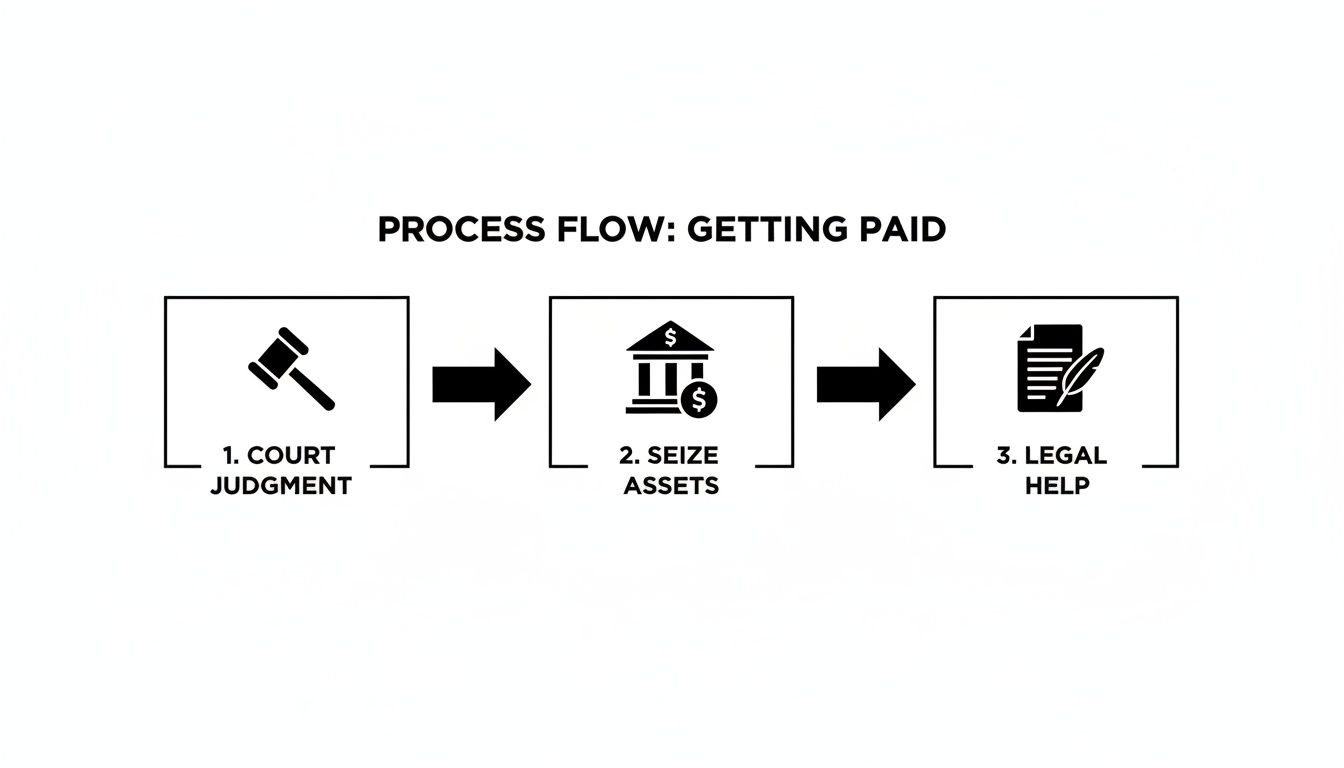
As you can see, the court's judgment is the starting line. It gives you the power to seize assets or, in this case, income, with the help of a legal professional.
Who Initiates the Withholding Order?
You might be wondering who is responsible for getting this crucial document into the right hands. Thankfully, it’s not something you are expected to handle on your own. The responsibility for sending the withholding order to the employer typically falls to one of three parties:
- The Court: In many cases, the court clerk will send the order directly to the employer as a standard part of finalizing your divorce or custody case.
- Your Attorney: Our firm makes sure this step is completed promptly and correctly. We follow up to confirm the employer has received and is processing the order.
- The Office of the Attorney General (OAG): If the OAG is involved in your case, they will manage the entire enforcement process, including sending out the income withholding notice.
Regardless of who sends it, the outcome is the same. The employer receives a legal mandate to begin withholding child support from the employee's paycheck.
The Employer’s Legal Duties and Timelines
Once an employer gets that Order/Notice to Withhold, they are legally bound to act. They can’t just ignore it or refuse to comply. The Texas Family Code, Chapter 158, lays out their specific obligations and very strict timelines.
The employer must start withholding funds from the employee's very first paycheck that occurs after they receive the notice. From there, they are required to send the payment to the Texas Child Support Disbursement Unit (SDU) on each payday. This creates a reliable, predictable flow of support that you can count on.
It's important to recognize just how common this process is. Wage garnishment rates in the U.S. have surged over the past decade, especially for child support. The highest-risk group for garnishment are workers aged 35-44, a demographic that frequently overlaps with parents involved in Texas child custody disputes. In these cases, courts can order up to 50% of a parent's net resources for support, all enforced through this direct withholding system. You can explore more about these national trends by reading the full research on wage garnishment trends.
How Payments Are Calculated and Sent
The employer’s job is not to interpret the court order but to follow its instructions to the letter. The order will specify the exact amount to be withheld for current child support, medical support, and any past-due amounts (known as arrears).
The payroll department will calculate the employee’s disposable earnings—that's gross pay minus mandatory deductions like federal taxes—and then apply the withholding amount, making sure it doesn't exceed the legal 50% limit. The money is then sent to a central state processing center, which records the payment and forwards it on to you.
This centralized system is fantastic because it creates an official, undeniable record of every single payment made, which is invaluable for preventing future disputes.
To help clarify who does what, this table breaks down the specific roles and duties of everyone involved in the child support withholding process.
Who Does What in a Texas Wage Withholding Case
| Party Involved | Their Primary Role | Key Responsibility |
|---|---|---|
| The Court | Issues the legal order | Establishes the child support amount and signs the official Withholding Order. |
| Sending Party | Initiates the process | Can be the court clerk, an attorney, or the OAG; sends the order to the employer. |
| The Employer | Implements the order | Receives the legal notice, withholds the specified funds from payroll, and remits them. |
| Paying Parent (Obligor) | Fulfills the obligation | Has child support automatically deducted from their wages. |
| Receiving Parent (Obligee) | Receives the funds | Receives payments through the Texas Child Support Disbursement Unit. |
| State Disbursement Unit (SDU) | Processes payments | Acts as the central clearinghouse, recording all payments and distributing them. |
Each person and entity has a specific function designed to make the system as automatic and reliable as possible, ensuring that child support gets where it needs to go.
Your Rights When Facing a Withholding Order
Watching a chunk of your paycheck vanish before you even see it can feel unfair and overwhelming. It’s a stressful situation, but if you’re the paying parent, you need to know you still have rights. The wage withholding system is designed to be accurate, not to punish you, and you have every right to make sure it's working correctly.
Reacting out of panic or anger is the worst thing you can do. It solves nothing and can easily make a tense co-parenting relationship even worse. Your power comes from understanding the rules and taking calm, strategic action through the proper legal channels. This approach protects your finances while ensuring the support amount is both accurate and fair.
Verifying the Withholding Amount Is Correct
First things first: check the math. Never assume the amount being taken from your paycheck is automatically correct. A simple clerical error by your employer's payroll department could be causing you serious financial strain.
You have the right to double-check their calculations. To do that, you need to understand the term "disposable earnings." This isn't your total gross pay; it's the amount left over after all legally required deductions are taken out.
These deductions include:
- Federal and state income taxes
- Social Security and Medicare (FICA)
- State unemployment insurance
Things like 401(k) contributions or health insurance premiums are voluntary, so they don't count. Under Texas law, the total withholding for child support can't be more than 50% of your disposable earnings. If you run the numbers and find they're taking more than that legal limit, you have a solid reason to challenge the order.
When Can You Legally Challenge a Withholding Order?
You can't stop a valid child support order just because you don't like it. But if there’s a genuine mistake in how it's being enforced, the law gives you a way to fix it without looking like you're trying to dodge your responsibilities.
Legitimate grounds for contesting a withholding order usually fall into a few key categories:
- Mistake of Fact: This is the most common reason. Maybe the amount of past-due support is wrong, the monthly calculation is off, or they've got the wrong person entirely (mistaken identity).
- Improper Service: You were never properly notified of the legal action that resulted in the withholding order in the first place.
- Previous Payment: You have proof of payments that were never credited to your account, which means the "past-due" balance is incorrect.
If any of these situations sound familiar, you can file a "Motion to Stay" with the court that issued the order. This motion formally asks a judge to pause the withholding until the error can be investigated and fixed. For a deeper dive into the specific steps you can take, it's worth exploring expert resources on how to stop wage garnishment in Texas.
The Best Long-Term Solution Is a Modification
But what if the withholding amount is correct, and you just can't afford it anymore? Life happens. Maybe you lost your job, your hours were slashed, or you’re dealing with a serious medical issue that has completely changed your financial picture.
In that case, fighting the withholding order is the wrong move. The best and most legally sound solution is to file a Petition to Modify the original child support order. This is a formal request for the court to review your new circumstances and adjust your monthly obligation to an amount you can actually manage.
Taking this proactive step shows the court you're being responsible. Ignoring the problem will only lead to arrears piling up and more aggressive enforcement actions down the road, making a tough situation much, much harder.
What to Do Next
Trying to make sense of Texas family law can leave you feeling lost and overwhelmed, but getting clarity and taking back control is absolutely possible. Whether you're fighting to get the support your family is owed or you're the one trying to manage your payments, letting things slide is the worst thing you can do.
Here's the most important thing to remember: while Texas law generally protects your wages from most creditors, it has a very strong, built-in system to make sure child support gets paid. This isn't about punishment; it's about protecting the financial well-being of children. Knowing how to use this system—or making sure it's being applied to you fairly—is absolutely critical.
Taking clear, decisive action with an experienced family law attorney is the single best step you can take to protect your finances and bring some stability back to your family. You don't have to figure all this out on your own. Every single day, our firm helps parents in your exact situation turn court orders into reliable financial support. We're here to listen, map out a strategy, and fight for you.
We invite you to schedule a free, confidential consultation with the Law Office of Bryan Fagan, PLLC. Let our team hear your story, answer your questions about how to garnish wages in Texas for child support, and give you a straightforward plan to get the financial security you and your children deserve. Your path forward starts with a simple conversation.
Common Questions About Texas Wage Garnishment
When you're dealing with a family law issue, the idea of wage garnishment can be confusing and frankly, a little scary. It’s one of those topics that brings up a lot of questions about your rights, your money, and what happens next. Let's clear up some of the most common concerns we hear from Texas families.
Can My Paycheck Be Garnished for Credit Card Debt in Texas?
In a word, no. Texas offers some of the strongest paycheck protections in the entire country. The Texas Constitution is very clear on this: creditors cannot garnish your current wages for common consumer debts. This includes things like credit card bills, personal loans, or medical expenses.
This protection is a big deal and a cornerstone of our state's laws, but it’s not a complete shield. There are a few very specific exceptions.
So, What Debts Can Actually Lead to Wage Garnishment?
While your paycheck is safe from most private creditors, the law does allow garnishment for a few high-priority obligations. These are the debts that the government has decided must be paid, even if it means taking money directly from your earnings.
In Texas, your wages can be garnished for:
- Court-ordered child support and spousal maintenance
- Federal income taxes owed to the IRS
- Federally backed student loans that have gone into default
For just about everything else, a creditor will have to find other ways to collect. Your ongoing income from your job is off-limits.
What’s the Maximum Amount They Can Take for Child Support?
Texas law tries to strike a balance. It ensures children get the financial support they need while also making sure the paying parent has enough left over to live on. The rule is pretty straightforward: an employer can withhold up to 50% of your disposable earnings for child support.
What are "disposable earnings"? Think of it as your take-home pay after the legally required deductions are made, like federal income tax and Social Security.
What if I Think the Withholding Amount is Wrong?
Don't ignore it. If you look at your paystub and feel the amount being withheld is incorrect, you need to act quickly. Your first and most important move should be to speak with an experienced family law attorney right away.
There could be a simple clerical error that you can fix by filing a motion with the court. But if your financial situation has changed dramatically since the order was put in place—maybe you lost your job or took a pay cut—your best bet is likely to file a Petition to Modify the child support order. This asks the court to adjust the amount to reflect your current reality.
Can My Boss Fire Me Because of a Withholding Order?
Absolutely not. Texas law is crystal clear on this point. An employer is legally forbidden from firing you, disciplining you, or even refusing to hire you just because they received a wage withholding order for child support.
Your employer is legally required to follow the court's order, and you are fully protected from any kind of retaliation.
Navigating the complexities of wage garnishment requires clear guidance and a strong advocate on your side. The attorneys at the Law Office of Bryan Fagan, PLLC are here to protect your rights and help you find financial stability. Schedule a free, confidential consultation today by visiting us at https://texasdivorcelawyer.us to discuss your case and create a path forward.