Skip to content
Yes, you can cancel a divorce after filing in Texas, but you usually need to do it before the judge signs the final decree, and whether it's simple or complicated depends heavily on timing and whether your spouse has responded. In many cases, the main legal tool is a Notice of Nonsuit, which the filing spouse uses to ask the court to dismiss the case.
If you're reading this right after filing, or right after a hard conversation with your spouse, you may feel pulled in two directions at once. Part of you wants to stop the case. Another part wants to protect yourself in case the reconciliation doesn't hold. Both feelings are normal, and both deserve a careful legal plan.
A Texas divorce filing starts a lawsuit. It does not automatically end your marriage. That difference matters. It gives you room to reassess, but it also means you can't just “take it back” informally by deciding not to move forward. If you want to stop the process, you need to do it the right way, in the right court, and with a clear understanding of what your spouse has already filed.
Is It Too Late to Change Your Mind
The answer is often no. If your divorce is still pending, there may still be a path to stop it.
Texas builds in a pause before a divorce can be finalized. Under Family Code § 6.702, there is a 60-day statutory waiting period before a divorce can be finalized, which creates real space for reconciliation or reconsideration before a final order is entered, as discussed in this explanation of calling off a divorce in Texas. That waiting period doesn't cancel the case by itself, but it does mean filing isn't the same as finishing.
For many people, that is the first relief they feel. You're not locked in just because paperwork was filed.

Why the early stage matters
The easiest time to stop a divorce is usually early, before the case has developed momentum. If your spouse hasn't filed much of anything yet, the filing spouse can often ask to dismiss the case with fewer complications.
Once hearings are set, temporary arrangements are made, or your spouse files their own requests, the case becomes harder to unwind. That doesn't always mean you can't stop it. It means the process becomes more formal and more strategic.
If you want a broader sense of what happens after a petition is filed, this guide on what happens after filing for divorce gives helpful context about the sequence of a Texas divorce case.
Practical rule: The sooner you act after deciding to stop the divorce, the more options you usually have.
The key document you need to know
If you filed the divorce, the document you'll hear about most often is a Notice of Nonsuit. In plain English, that is a filing asking the court to dismiss your claims.
That sounds simple, but it only works cleanly in the right posture. If the other spouse has already asked the court for their own relief, your nonsuit may not end the whole case.
There's also an emotional side to this. Some couples reconcile quickly and want the case gone right away. Others are reconnecting, but they are not ready to give up the legal protections that came with filing. Those are not the same situation, and they should not be handled the same way.
After finalization is a different world
Once a judge signs the final decree, you cannot undo the divorce by merely changing your mind. As noted in the same discussion of Texas divorce procedure, the parties would need to remarry, and Texas also applies a 31-day post-divorce remarriage restriction unless the court waives it.
That's why the question isn't just “Can you cancel a divorce after filing in Texas?” The better question is, “Where exactly is my case today, and what has already happened in court?”
The Legal Ways to Stop a Divorce Proceeding
There are two common legal paths, and they are not interchangeable. One depends mostly on what the filing spouse has done. The other depends on both spouses agreeing.
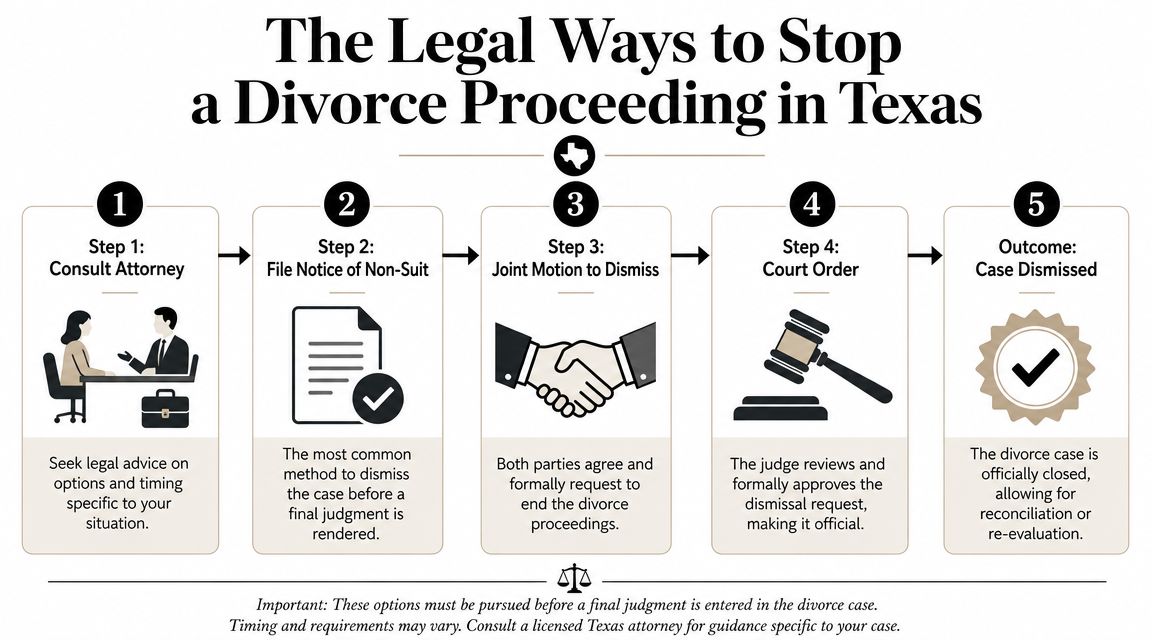
Filing a Notice of Nonsuit
In Texas, a divorce can often be stopped by filing a nonsuit in the same court where the petition was filed, and the case must generally remain on file for at least 60 days before a final hearing, which creates a window where dismissal may still be possible, as explained in this discussion of withdrawing a Texas divorce petition.
A nonsuit is usually the filing spouse's tool. If you started the case, you ask the court to dismiss your own claims. In straightforward situations, that may be enough to close the matter.
But here is the catch. A divorce case is not only about who filed first. It also depends on what the other spouse has done since then.
When a nonsuit is not enough
If your spouse has filed an answer, things can become more involved. If your spouse has filed a counter-petition, the issue becomes much more serious. A counter-petition means your spouse is also asking the court for relief.
That changes control of the case.
Under Texas Rule of Civil Procedure 162, the filing spouse may take a nonsuit, but if the other spouse has filed a counter-petition seeking their own relief, the case can continue unless that counterclaim is also dismissed, as outlined in this explanation of canceling a divorce petition in Texas.
If both sides have asked the court for relief, one side usually can't make the whole case disappear alone.
That is why reviewing the docket matters. Before anyone files dismissal paperwork, you need to know whether there is only one live petition or whether both sides have active claims.
Here's a practical video overview many people find useful before making that decision:
Dismissal by agreement
When both spouses want to stop the divorce, an agreed dismissal is often the cleaner path. The exact paperwork can vary by county and case posture, but the core idea is the same. Both parties put the agreement in writing and ask the court to dismiss the case.
This route is especially useful when:
- Both spouses reconciled: There is no dispute about ending the case.
- A response was already filed: You want to avoid arguing over whether one side can dismiss alone.
- Temporary arrangements exist: You want clarity about what ends and when.
If you're gathering records connected to a marriage or prior divorce from another country, language issues can complicate filing and follow-up paperwork. In that situation, a resource like this Guide for divorce decree translation requirements can help you understand what courts and agencies often require.
If your spouse has already responded, it also helps to understand the procedural posture from both sides. This article on how to respond to a divorce petition explains why a filed answer or counterclaim changes the strategic position and the paperwork.
When Timing Is Everything in Canceling a Divorce
Timing controls almost everything about how difficult cancellation will be. Filing starts the lawsuit, but different stages of the case create very different risks.
While Texas law requires a divorce case to stay open at least 60 days, one Texas practitioner source says trial dates are often set about 9–12 months after filing in uncontested cases, and once a counter-petition is filed the case can't usually be ended unilaterally, as described in this Texas divorce timing discussion.

Before your spouse answers
This is usually the cleanest stage.
If you filed and your spouse has not filed an answer or counter-petition, dismissal is often more direct. There are fewer moving parts, fewer procedural objections, and less chance that the case will continue without your cooperation.
At this point, the main concern is speed. If you've decided to stop the divorce, waiting can create problems that weren't there a week earlier.
After your spouse files an answer or counter-petition
Many people are often surprised. They assume, “I filed it, so I can dismiss it.” Sometimes yes. Sometimes not.
A basic answer may complicate the process. A counter-petition changes it much more. Once your spouse asks the court for their own divorce-related relief, your filing is no longer the only claim in the case.
That means your spouse may still want the divorce even if you've changed your mind.
The legal system treats filing as the start of a lawsuit, not an emotional placeholder.
After temporary orders are in place
By this stage, the case has usually moved from idea to active litigation. Temporary orders may address parenting schedules, support, possession of the house, bill payment, or limits on how property can be handled while the case is pending.
If you dismiss the case at this point, you need to think beyond the relief of “stopping the divorce.” You need to ask what happens the next morning when there is no pending case holding those arrangements together.
That question matters most for:
- Parents: If there is a temporary custody schedule, you need clarity on what you are both agreeing to follow after dismissal.
- Business owners: Informal peace today can turn into a records dispute tomorrow if financial boundaries disappear.
- High-asset spouses: A pending case often creates urgency and structure around disclosure, negotiation, and property protection.
For readers trying to understand the broader role of the statutory pause in a Texas case, this article on navigating the Texas divorce 60-day waiting period adds helpful background.
Right before the final decree
This is the danger zone for second thoughts.
If the case is settled, set for prove-up, or waiting for the judge's signature, you need immediate legal guidance. At that point, one missed hearing, one signed order, or one misunderstanding about what was submitted can close the window.
The practical lesson is simple. If you want to stop the divorce, don't assume you can do it later.
Complications Involving Children Property and Military Service
Some divorces are easy to dismiss on paper and difficult to unwind in real life. That is especially true when children, significant property, or military issues are involved.
Children change the stakes
If you and your spouse have children, a dismissed divorce case doesn't automatically solve parenting conflict. It only ends that divorce lawsuit. If you had temporary routines in place for exchanges, school decisions, medical care, or financial support, those routines may become uncertain unless you both clearly agree on what happens next.
That's why parents should think in practical terms, not just legal terms:
- School and pickup plans: Know who is handling the week ahead before you dismiss.
- Money for the children: If one parent has been paying support voluntarily, confirm whether that continues.
- Medical and emergency decisions: Reconciliation does not always mean instant trust or clear communication.
If your concern is really about parenting stability rather than the marriage itself, you may need legal advice about custody-related options even if the divorce slows down. The same is true for support and enforcement issues if one spouse stops following temporary agreements.
Property issues don't disappear because the case does
A lot of couples dismiss a divorce after making some progress on property. They may have discussed who stays in the house, who uses which account, or how business income will be handled during a trial reconciliation.
Those discussions can help. They can also create false confidence.
If the case is dismissed and the reconciliation fails later, you may be starting over without the benefit of the structure the court case created. Informal understandings about retirement funds, credit card use, or separate management of business revenue can become disputed quickly.
A short written agreement can sometimes reduce confusion, but it does not replace individualized legal advice about community property, reimbursement claims, tracing issues, or future division disputes.
Military families need an extra layer of planning
Military divorces often involve moving parts that civilian families don't face. Service schedules, deployments, out-of-state logistics, and benefit questions can all affect how wise it is to dismiss a case now versus pause it carefully.
If one spouse is in the military, think through:
- Housing and relocation: Where will each spouse live if reconciliation stalls again?
- Children across state lines: Parenting plans can become unstable fast when duty assignments change.
- Documentation: Military families often need organized records, quick communication, and consistent follow-through.
For military families and high-value estates alike, the smart question isn't only whether you can stop the case. It's whether stopping it now protects you if the situation changes again.
Reconciliation vs A Temporary Pause
You may have had a good week together. The arguments slowed down, the kids seem calmer, and dismissing the case starts to feel like the hopeful choice. Before you do that, separate two very different decisions. Are you rebuilding the marriage with enough stability to close the case, or do you need time without giving up the protections that come with an active lawsuit?
That difference shapes risk.
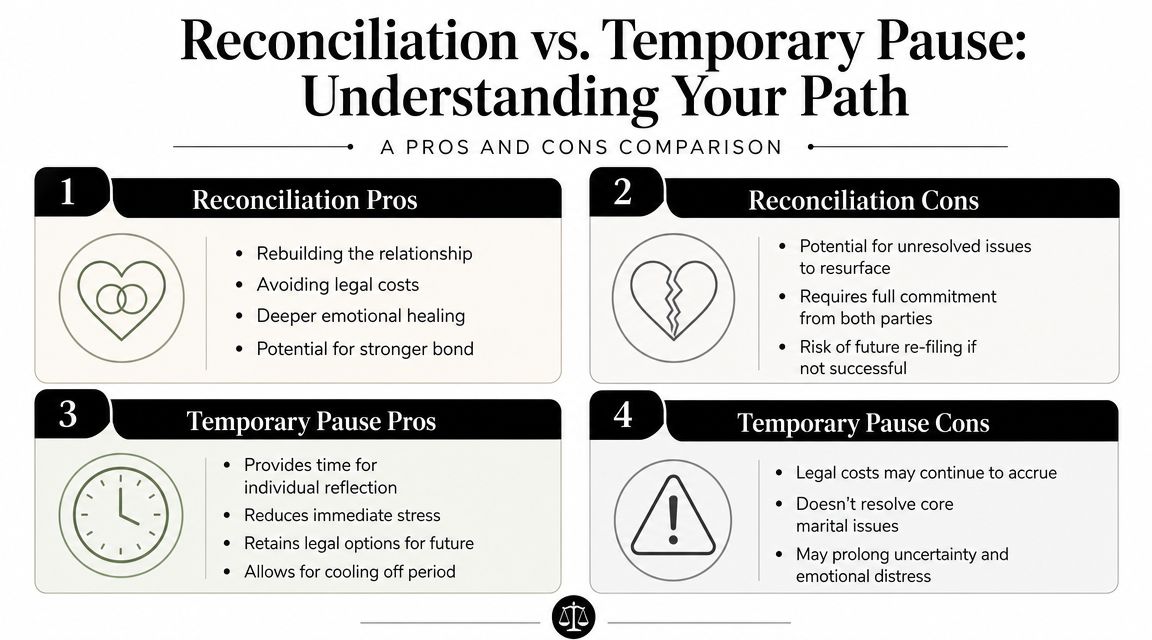
When dismissal makes sense
Dismissal usually fits couples who have done more than calm down after a hard stretch. They have a shared plan, steady communication, and no active fight over money, access to records, or parenting decisions. The household is stable enough that neither spouse needs the court case as a backstop.
There is real value in ending the litigation if the marriage is back on track. You may reduce stress, legal expense, and the day-to-day pressure that comes with a pending divorce.
But dismissal is a final procedural choice, not a symbolic gesture. Once the case is closed, the structure of that case is gone with it.
When a pause may be the smarter move
A pause is often the better answer when the relationship is improving, but trust has not caught up yet. In practice, that may mean requesting more time, slowing deadlines, or discussing abatement with your lawyer and the court.
That option makes sense in situations like these:
- You are reconciling in stages: The marriage may recover, but you need time to see whether the change lasts.
- The family needs stability right now: Temporary routines may still be keeping the household functional.
- One spouse still controls key information: Business records, major accounts, debt activity, or spending patterns are still concerns.
A pause keeps your options open. A dismissal closes the file.
Use counseling to test readiness, not just hope for it
Counseling can help answer the question couples often avoid: are you reconciling, or are you postponing a decision because the conflict briefly cooled off? For some spouses, structured support makes it easier to measure progress in communication, accountability, and problem-solving before they ask the court to end the case. This overview of marriage counselling for Vernon couples is one example of the kind of relationship work couples often explore when they want to make a careful decision.
The legal case should match the facts of your marriage as they stand today, not the outcome you are hoping to reach a month from now.
One careful middle path
If you are unsure, treat that uncertainty as useful information. In my experience, clients make better decisions when they ask a narrower question first: "What do I lose if we dismiss today, and what do I gain if we wait?" That is often the point where strategy matters more than emotion.
The Law Office of Bryan Fagan, PLLC handles Texas family law matters involving divorce, custody, support, property division, and related court procedures, and can provide guidance on whether dismissal, a pause, mediation, or waiting on final action makes the most sense in your situation.
Common Questions About Stopping a Texas Divorce
Do I get my filing fees back if I cancel?
Usually not. Filing fees, service fees, and other case costs are generally spent once the case is opened. If there is a real chance you may need to file again, dismissing too quickly can mean paying those costs twice.
What happens to a protective order if we dismiss the divorce?
Do not assume a protective order disappears with the divorce case, or stays in place on the same terms, without checking the actual order. Protective orders often follow their own rules and timelines. If family violence or threats are part of the history, review that issue before you agree to dismiss anything.
Safety first. Reconciliation should never require giving up legal protection without a clear plan.
Can my spouse force the divorce to continue?
Yes, that can happen. If your spouse has filed a counter-petition, your decision to dismiss your own filing may not end the case. The court can still have an active divorce in front of it even after one side changes course.
That is why I tell clients to look at the full court file, not just their own paperwork. The practical question is not only, "Do I want to stop?" It is also, "Is there anything pending that lets my spouse keep going anyway?"
If we cancel now and split up later, do we start over?
Usually, yes. A dismissed case is closed. If the marriage breaks down again later, one spouse usually has to file a new divorce and start the process from the beginning.
That restart can affect strategy. You may lose temporary protections, have to pay new filing costs, and end up recreating work that was already done in the first case.
What if we already settled some issues informally?
Be careful with handshake deals and text-message agreements. If an agreement was never made part of an enforceable court order, it may be difficult to rely on later, especially with parenting time, bill payment, use of the house, or access to bank accounts.
I have seen couples dismiss a case because things felt better for a few weeks, only to end up arguing later about what each person supposedly agreed to. Clear orders reduce that risk.
Before you dismiss, separate what is legally enforceable from what depends entirely on goodwill.
What To Do Next Your Path Forward
If you and your spouse both agree that the marriage should continue, act promptly and carefully. Confirm what has been filed in the case, make sure there is no counterclaim still pending, and file the right dismissal paperwork in the correct court. Don't rely on a verbal understanding alone.
If you want to stop the divorce but your spouse doesn't, slow down. In such situations, legal posture matters more than emotion. You need to know whether your spouse has filed an answer, a counter-petition, requested temporary orders, or taken other steps that keep the case alive.
If you're unsure whether this is real reconciliation or just a break from conflict, don't rush into dismissal. Consider whether a pause, mediation, or counseling would better protect you, your children, and your finances. Parents should think about consistency for the children. Business owners should think about records and control of income. Anyone with significant property should think about what protections disappear when the case ends.
A good next-step checklist looks like this:
- Check the court file: Find out exactly what pleadings are active.
- List current protections: Include temporary schedules, support arrangements, property limits, and possession of the home.
- Decide your goal: Full reconciliation, temporary pause, or strategic delay.
- Get advice before filing anything: Small procedural mistakes can create large consequences.
You don't have to make this call in a panic. The right move depends on your case posture, your spouse's position, and whether ending the lawsuit makes your life safer and more stable.
If you're trying to decide whether to dismiss your divorce, pause it, or protect yourself while you sort things out, schedule a free consultation with Law Office of Bryan Fagan, PLLC. You can get clear guidance about your options, your court posture, and the next step that fits your family, your finances, and your future.