Skip to content
You may be staring at a stack of papers, a calendar full of deadlines, and the awful feeling that one judge will decide everything important in your life.
That fear is real. It also gets smaller when you understand what Texas judges look for in a divorce case. Judges aren't there to reward the louder spouse or punish the more emotional one. They look for proof, credibility, workable plans, and facts they can turn into orders.
If you're asking what do judges look for in a Texas divorce case, the short answer is this: they want organized evidence about your property, your children, your finances, and your ability to follow through. They also pay close attention to what happens early, especially at temporary orders, because those first rulings often shape the rest of the case.
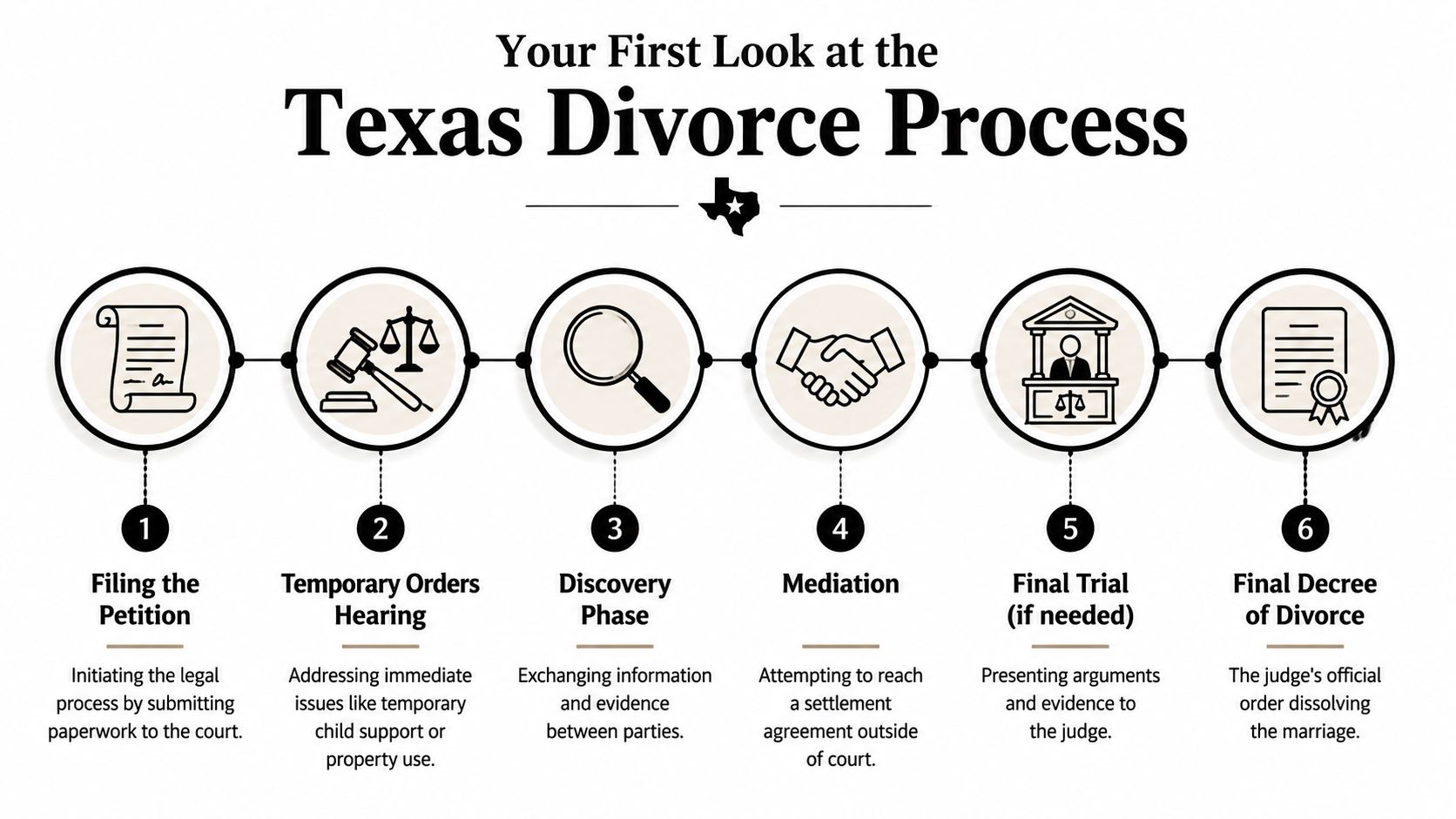
Your First Look at the Texas Divorce Process
A Texas divorce case feels personal to you because it is. To the court, it is a legal process with a sequence, deadlines, and standards. That's good news. It means the process is more predictable than is often assumed.
Texas is a no-fault divorce state. You don't have to prove your spouse did something wrong to get divorced. Once the court has jurisdiction, the judge's attention turns to the issues that can be decided: property division, children, support, and final orders. Under Texas Law Help's overview of divorce in Texas, you can file after 6 months of Texas residency and 90 days in the filing county, and except in domestic-violence cases, there is a minimum 60-day waiting period before the divorce can be finalized. The same source notes that most cases take 6 months to a year.
What the judge wants at the start
Early in the case, the court wants basic clarity:
- Proper filing: The petition has to be filed in the right court and county.
- A real dispute the court can decide: Property, children, support, or all three.
- Immediate issues identified clearly: Who stays in the house, who pays which bills, and what should happen with the children while the case is pending.
If you walk in focused on blaming your spouse for the breakup, you may feel unheard. If you walk in focused on what orders are needed and why, you're speaking the court's language.
Practical rule: Judges respond better to specific requests than broad complaints.
The usual path from filing to final decree
Most cases move through a familiar pattern:
- Filing the petition
- Service or waiver
- Temporary orders, if needed
- Discovery and document exchange
- Negotiation or mediation
- Final trial or agreed decree
You don't need to master courtroom procedure overnight. You do need to understand that each step builds the record the judge will rely on later. A weak start often creates problems that are expensive to fix.
Dividing Your Property on Just and Right Terms
Property division is where many people expect a simple half-and-half result. Texas law doesn't work that way in practice. The court divides the marital estate in a just and right manner, which means the judge is trying to reach a fair result based on the evidence in front of the court.
The first property question is classification. Community property generally means property acquired during the marriage. Separate property generally means property owned before marriage or received by gift or inheritance. The label matters because separate property is usually not divided, but you still have to prove it.

What works in property disputes
Think of property proof like a paper trail, not a personal story. If you claim an account, business interest, or piece of real estate is separate property, the judge needs documents that trace where it came from and what happened to it over time.
Helpful evidence often includes:
- Bank records: Statements that show deposits, transfers, and balances over time.
- Tax returns: Useful for income, business activity, and asset-related issues.
- Business records: Profit and loss statements, general ledgers, ownership documents, and related records if one spouse owns a company.
- Title documents: Deeds, vehicle titles, account statements, and closing paperwork.
- Gift or inheritance records: Documents showing how the asset was received and by whom.
What hurts your position
Property cases go sideways when one spouse guesses, rounds numbers, or produces records at the last minute. Texas family-law discovery is designed to identify all property and debt, and judges rely on full financial records for a just and right division. Public guidance on discovery in Texas family-law cases explains that incomplete or inconsistent disclosures can hurt your credibility and your result.
That matters even more if your spouse controls the accounts, uses cash apps, or runs a closely held business. In those cases, the judge often has to decide not only what exists, but whether the evidence is reliable enough to value it.
When the records are incomplete, the court can't divide property cleanly. Someone usually pays for that uncertainty.
If you own a business or have a high-value estate
Complex estates require discipline. Don't treat your business like a side issue if it supports your household. Judges want to see the difference between taxable income, available cash flow, retained earnings, and legitimate business expenses. They also want consistency across your testimony, your bank records, and your tax filings.
If your estate includes multiple accounts, real estate, restricted assets, or family contributions, organize them before the first serious hearing. A neat binder, a clean digital folder, and a timeline of major transactions can do more for your case than a dramatic courtroom speech.
Putting Your Children First in Custody Decisions
For parents, custody is usually the part of the case that keeps them awake at night. In Texas, judges decide conservatorship and possession based on the best interests of the child. That standard sounds broad because it is, but courts don't apply it blindly.
Texas judges often use the Holley factors to evaluate what arrangement best serves a child. According to the State Bar of Texas discussion of best-interest factors, courts look at issues such as the child's physical and emotional needs, the stability of the home, danger to the child, each parent's abilities, available support programs, and the plans proposed for the child. The same guidance emphasizes that the most persuasive evidence is concrete and tied to actual caregiving.
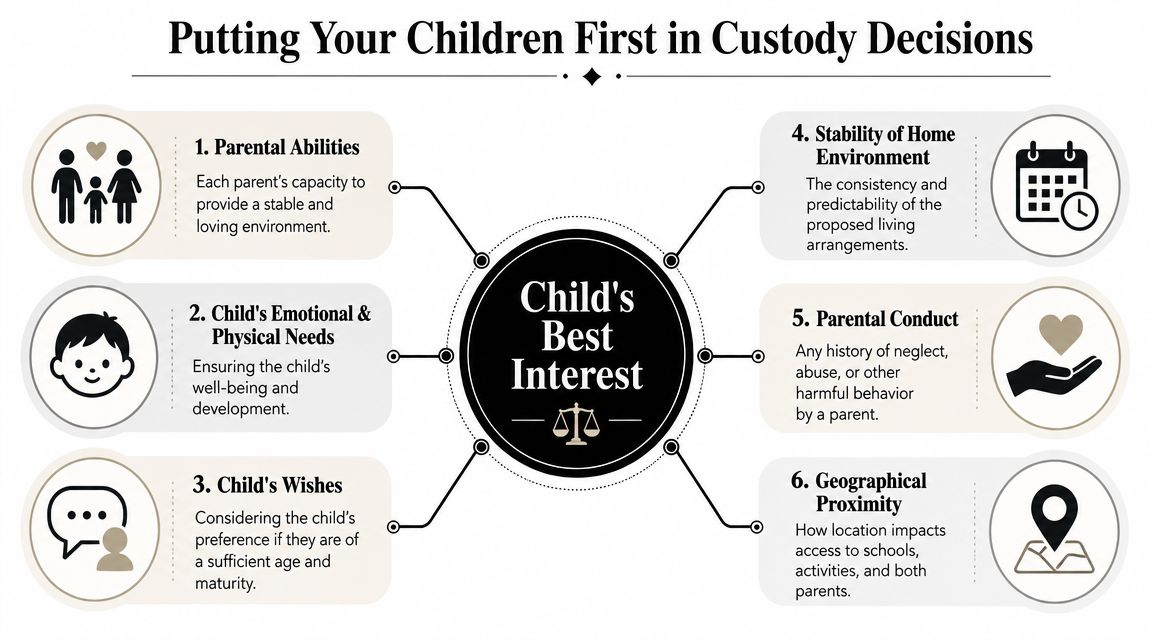
What stability looks like to a judge
A parent often says, “I love my child more than anything.” That may be true, but it doesn't decide a custody case. Judges look for evidence that answers practical questions:
- Who gets the child up for school?
- Who schedules and attends doctor visits?
- Who helps with homework?
- Who knows the teachers, medications, routines, and triggers?
- Which home can provide consistency?
A stable home doesn't have to be perfect. It does have to be predictable, safe, and appropriate for the child's needs.
Strong custody evidence is ordinary evidence
The best custody proof is often boring. That's because ordinary routines show real parenting.
Use documents and records such as:
- School records: Attendance, grades, teacher communication, and behavior notes.
- Medical records: Appointment history, prescriptions, therapy compliance, and who attends visits.
- Parenting calendars: Actual overnights, exchanges, missed visits, and schedule changes.
- Messages between parents: Especially if they show cooperation, refusal, or repeated instability.
- Third-party observations: Coaches, counselors, relatives, or caregivers with firsthand knowledge.
For a deeper look at how courts apply this standard, review best interest of the child in Texas custody decisions.
This video also helps explain what parents should keep in mind as custody issues develop:
What judges tend to distrust
Judges are cautious when a parent builds a case around labels instead of facts. Saying your spouse is “unstable,” “selfish,” or “never there” won't carry much weight without specifics. If substance abuse, mental health concerns, or safety issues are involved, the court needs dates, incidents, records, and testimony that connect the concern to the child's well-being.
The parent who presents the clearest daily picture of the child's life usually has the stronger custody presentation.
Calculating Child Support and Spousal Maintenance
Support issues often feel unfair because people compare outcomes before they compare facts. Judges don't start with feelings. They start with income, expenses, eligibility, and proof.
Child support in Texas is generally guideline-driven. Spousal maintenance is different. It is more limited, more contested, and more dependent on the full financial picture. In both situations, the court needs reliable records before it can enter an order that will hold up.
Financial proof matters more than opinions
If you say your spouse earns more than reported, you need records that support that claim. If your spouse says you can afford more support, the court will want documents, not assumptions.
Public guidance for divorce preparation from a Texas family-law practitioner discussing what judges want to see stresses complete financial transparency. You should be prepared to provide at least six months of pay stubs, three years of tax returns, and relevant bank and investment statements. That documentation helps the court verify income and expenses for support decisions.
Child support is usually more mechanical
In many cases, child support is the easier issue because the court can work from income records and apply the guideline structure. The fight is often about what income should count, whether a parent is underreporting earnings, or whether the parent's records are trustworthy.
That is common when someone is self-employed, receives irregular pay, mixes business and personal spending, or gets paid through multiple channels.
Spousal maintenance requires a narrower showing
Spousal maintenance is not automatic just because one spouse earns less. Judges want to know whether the requesting spouse qualifies under Texas law, whether there is a genuine need, and whether the other spouse has the ability to pay.
That means the court will look closely at:
- Your monthly needs
- Your current earning ability
- Your work history and employability
- The other spouse's actual available income
- Whether the requested amount is realistic and supportable
If you're seeking support, prepare a grounded monthly budget and documents that match it. If you're contesting support, expect the judge to compare your testimony against the paper trail.
The Power of Evidence What a Judge Needs to See
You tell the judge your spouse hid money, denied parenting time, or wasted community funds. Your spouse denies it. At that point, the court is not deciding which story sounds more upsetting. The court is deciding which story is supported by records, dates, and testimony that holds together.
That is the practical difference between a position and a case. In Texas divorce court, evidence drives outcomes. It shapes how a judge views disputed property, parenting allegations, reimbursement claims, requests for exclusive use of property, and your credibility on every issue that follows.
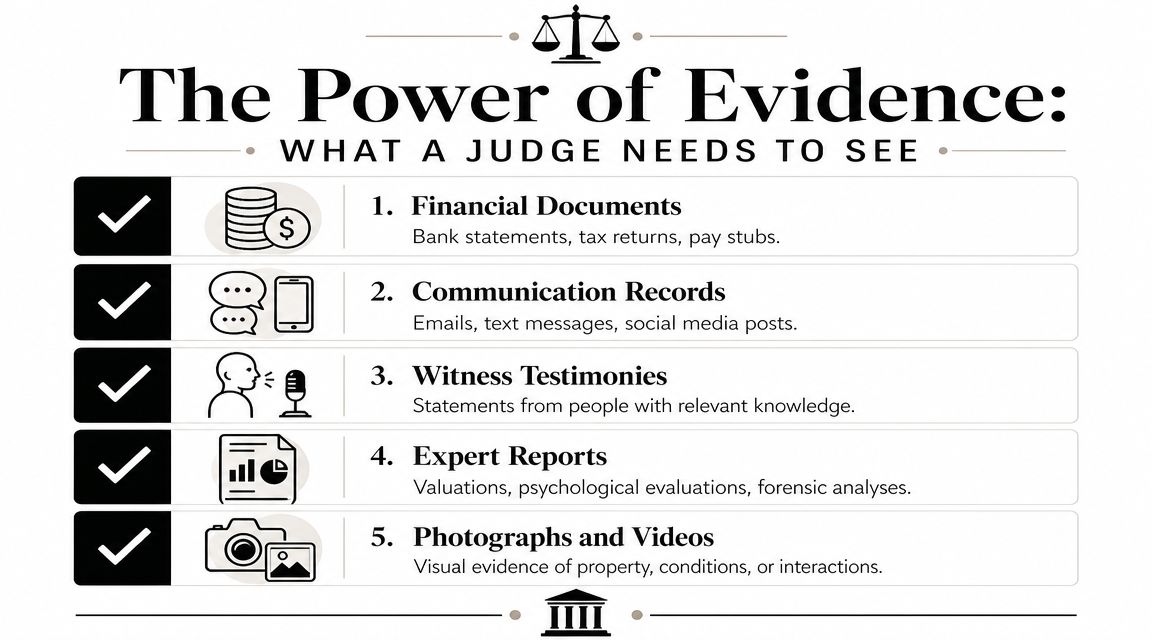
The proof judges usually rely on
The best evidence is specific, organized, and tied to a legal issue the court has to decide.
| Evidence type | Why it matters |
|---|---|
| Financial documents | Shows income, account balances, debt, spending patterns, and ownership claims |
| Texts and emails | Preserves timing, requests, refusals, admissions, and the actual wording used |
| Calendars and logs | Helps prove parenting involvement, missed exchanges, school routines, and who handled what |
| Photos and videos | Can show property condition, living conditions, injuries, or relevant events |
| Expert reports | Helps with business valuation, tracing separate property, mental health issues, or employability disputes |
A common mistake is bringing a large volume of material that proves very little. Judges do not need 200 screenshots if 12 clear exhibits establish the pattern. They need evidence that answers a concrete question. Who paid the mortgage? When did the child miss school? What account received the bonus? Which property was owned before marriage?
Digital records often decide the hard disputes
A lot of the best evidence in divorce cases now lives on phones, apps, and online account portals. That includes account exports, payment histories, GPS-linked calendars, shared-photo metadata, bookkeeping files, and message threads that show what happened and when it happened.
Digital evidence can be powerful, especially where one spouse handled the money or controlled access to records. It can also backfire if it was gathered carelessly.
Use caution. Do not log into accounts you are not authorized to access. Do not edit screenshots. Do not cut off the sender, timestamp, or surrounding messages if context matters. Save the record as you found it, preserve the date, and label it by issue so your lawyer can use it efficiently.
Credibility is built before you testify
Close cases often turn on whether the judge believes your version of events. Credibility does not come from sounding emotional or confident. It comes from consistency.
If your inventory, bank records, texts, affidavit, and testimony line up, the judge has a clear path to follow your argument. If your story shifts from one document to the next, the court may question your claims even where you are partly right.
That is why I tell clients to prepare for cross-checking, not just storytelling. Review your timeline. Match your numbers to your records. If there is a bad fact, address it directly and explain it truthfully. Trying to hide a weak spot usually causes more damage than the weak spot itself.
If you suspect your spouse is making false statements or hiding information, read more about what happens if your spouse lies in divorce court. The court can deal with dishonesty, but only if it is shown with proof.
Good evidence does more than support your final hearing. It affects settlement pressure, temporary positions, and how seriously the court takes your requests from the start. That is why early collection and careful organization matter.
Navigating the Courtroom Temporary Orders and Final Hearings
Temporary orders deserve far more attention than they typically receive. These are early court orders that can address who lives where, who pays which bills, where the children stay, and what the schedule looks like while the divorce is pending.
That first hearing often creates momentum. Once a temporary schedule is in place and everyone starts living under it, changing course later can be difficult unless the evidence strongly supports a change.
Why temporary orders matter so much
Texas courts have substantial discretion in family-law cases, especially in custody questions and temporary rulings. Guidance from a Texas family-law discussion of judicial discretion in divorce notes that temporary orders on possession and support can heavily influence negotiating power and the final decree.
In real terms, that means early preparation matters for reasons beyond the hearing itself. Temporary orders can affect:
- Your time with your children
- Who pays ongoing household expenses
- Who stays in the marital residence
- How the case is valued during settlement talks
- What the judge becomes used to seeing as the status quo
For a focused look at first appearances, review what judges look for on the first court date for divorce in Texas.
How to act in court
Courtroom behavior won't replace evidence, but it can affect how your evidence is received.
A few rules matter every time:
- Answer the question asked: Don't volunteer speeches.
- Stay calm under pressure: Judges notice who can remain measured.
- Bring organized documents: Loose papers send the wrong message.
- Dress respectfully: You don't need to impress the court. You need to show respect for it.
- Avoid side arguments with your spouse: Nothing good comes from that in a courthouse hallway.
Final hearings are about proof and practicality
By the time you reach a final hearing or trial, the judge usually wants a workable order. The court is looking for details that can be enforced later, not vague promises.
That means your requests should be specific. A parenting plan should address exchanges, school concerns, and decision-making. A property proposal should identify assets and debts clearly. A support request should be backed by records that show it can be paid.
Judges favor orders they can sign and enforce. They resist proposals that sound fair but aren't specific enough to work in real life.
What to Do Next Your Path to a Confident Resolution
If you remember only one thing, remember this: judges don't decide Texas divorce cases based on who is more upset. They decide them based on what is documented, what is credible, and what can be turned into enforceable orders.
That changes how you should approach your case.
Your strongest next steps
Start with a short, disciplined checklist:
Gather your records early
Pull financial statements, tax returns, pay records, and account access information before deadlines pile up.Document parenting facts
Keep a calendar of exchanges, school involvement, medical care, and major concerns involving your children.Stop using emotional shorthand
Replace “my spouse is impossible” with specific examples, dates, and supporting documents.Prepare for temporary orders like they matter
They often do. A strong early presentation can shape the rest of the case.Choose a legal strategy that fits your facts
Some cases should settle in mediation. Others require formal discovery, valuation work, or a contested hearing.
Key takeaway
The answer to what do judges look for in a Texas divorce case is simpler than it seems. They look for reliable facts, complete financial disclosure, credible testimony, stable parenting evidence, and practical proposed orders. If you give the court that, you put yourself in a much stronger position.
You don't have to figure this out alone. If you're facing divorce, custody litigation, business valuation issues, or a fight over temporary orders, informed guidance can help you avoid mistakes that are hard to undo later.
If you're ready to protect your children, your finances, and your future, schedule a free consultation with Law Office of Bryan Fagan, PLLC. You can talk through your situation confidentially, understand your options under Texas law, and build a plan for the next step with clarity and confidence.