Skip to content
You read a financial statement, hear testimony in court, or compare one sworn document to another, and your stomach drops because the story doesn't match.
If that's where you are, you're not overreacting. In a Texas divorce, dishonesty can affect property division, support, temporary orders, and even the court's view of parenting judgment. The good news is that family court gives you tools to deal with it. The better news is that you don't have to prove everything by instinct. You prove it with records, procedure, and timing.
That Sinking Feeling When You Realize Your Spouse Is Lying
While parties entering divorce do not typically expect perfect behavior, a fundamental level of honesty is still anticipated. Then they see income left off a sworn inventory, a custody allegation that never happened, or testimony that conflicts with bank records. That moment changes the case.
The first problem is emotional. You feel betrayed, angry, and anxious about what else may be hidden. The second problem is strategic. If you react too fast, accuse too broadly, or confront your spouse without a plan, you can give them time to move money, clean up messages, or shape a more careful version of the lie.
Texas courts expect parties to tell the truth in pleadings, sworn inventories, affidavits, discovery responses, and live testimony. When that doesn't happen, the court can respond inside the divorce case itself. That often matters more than whether a separate criminal case is ever filed.
Practical rule: Don't make your case with outrage. Make it with documents.
A useful way to think about this is simple. Your job isn't to prove that your spouse is a bad person. Your job is to show the judge that a false statement affected a real issue the court must decide, such as property, support, possession, or parental rights.
That shift matters because it changes your next move. Instead of arguing in circles, you start collecting the right evidence, preserving communications, and using court procedures that force disclosure.
If you're asking what happens if your spouse lies in divorce court, the answer usually comes down to three things:
- How serious the lie is: A small mistake is different from a hidden account or a fabricated accusation.
- Whether you can prove it: Judges act on evidence, not suspicion.
- Whether the lie affected the case: Courts care most about false statements tied to money, children, or court orders.
The strongest response is calm, organized, and specific. That's what gets results in Texas family court.
When a Lie Becomes a Crime Understanding Perjury in Texas

Not every wrong statement is perjury. People forget dates, estimate balances, and misunderstand paperwork. Courts know that. What matters is whether a person knowingly makes a false statement under oath about something important to the case.
In divorce, “under oath” reaches further than many people realize. It can include courtroom testimony, deposition answers, sworn affidavits, and signed financial disclosures submitted as verified documents. If your spouse signs something sworn and the contents are intentionally false, the problem is much bigger than a casual exaggeration.
What counts as a material lie
A helpful comparison is this. If someone rounds a bank balance incorrectly, that may be sloppiness. If someone leaves an account off the disclosure entirely, that looks very different. One is an error. The other can change how the court divides property or sets support.
In the United States, perjury is a felony-level crime, and federal perjury can carry up to 5 years in prison under 18 U.S.C. § 1621 as discussed by Nolo. In divorce cases, criminal prosecution is less common, but courts often address the lie directly in the family case through remedies such as attorney's fees, disregarding false financial disclosures, or setting support based on imputed income when reported earnings aren't credible.
That distinction matters in practice. Many clients assume that if the district attorney doesn't get involved, the lie has no consequence. That isn't how family court works. A Texas judge can still penalize dishonest conduct in ways that affect money, advantage, and final orders.
Where perjury issues show up in a Texas divorce
Common pressure points include:
- Sworn inventories and appraisements: These forms shape property division.
- Affidavits for temporary orders: Judges often rely on them early in the case.
- Depositions: A spouse gets locked into answers under oath.
- Support testimony: Income claims are often tested against documents.
- Custody allegations: False claims can distort temporary possession decisions.
Before watching the court process in action, keep one point in mind. Judges don't need drama to see dishonesty. They need contradictions they can trust.
What works and what doesn't
What works is tying the false statement to a concrete issue. Show the omitted account. Show the pay records that don't match the claimed income. Show the message that contradicts the sworn statement.
What doesn't work is calling every inconsistency “perjury.” If you overstate weak points, you can dilute strong ones. In court, precision wins.
A judge may forgive confusion. A judge is much less forgiving when the records show a deliberate effort to mislead.
The Immediate Consequences How Judges Address Dishonesty in Court
When a judge believes a party is being dishonest, the damage often starts before the final trial. The court's confidence changes. That shift can influence hearings, discovery disputes, and temporary rulings.
Credibility can collapse fast
Family judges listen for patterns. One false statement may not just hurt that single issue. It can make the judge question everything that follows.
That's why cross-examination matters. If your spouse says one thing in a sworn inventory, another in a deposition, and a third in the courtroom, your attorney can line those statements up side by side. Once the contradiction is clear, the court may give less weight to your spouse's testimony and rely more heavily on records, account statements, business documents, and third-party evidence.
This is especially important in temporary orders hearings. Those hearings often happen early, when the court is still deciding who appears organized, reasonable, and believable.
Sanctions can hit the dishonest spouse financially
Judges also have tools to penalize the misconduct itself. In the divorce case, that may include requiring the dishonest spouse to pay attorney's fees related to uncovering the lie, redoing defective disclosures, or absorbing other costs caused by noncompliance.
Examples of conduct that often trigger sanctions include:
- Hiding documents: Refusing to produce statements, ledgers, or tax records after proper requests.
- Providing misleading disclosures: Listing incomplete assets or inaccurate debts in sworn filings.
- Forcing unnecessary hearings: Making the other side spend time and money proving what should have been disclosed accurately from the start.
A judge can also draw adverse conclusions from missing or evasive evidence. If records should exist and your spouse can't explain why they don't, that can matter.
Contempt is different from a credibility problem
Sometimes the issue isn't just lying. It's violating a court order. If the court ordered your spouse to produce documents, appear for a deposition, or follow temporary financial restraints, and they intentionally failed to comply, contempt may come into play.
Contempt usually focuses on disobeying a court command. Credibility focuses on whether the judge trusts the person's word. The two often overlap, but they are not the same.
Consider the practical difference:
| Court concern | What it targets | Why it matters |
|---|---|---|
| Credibility | False or inconsistent statements | The judge may discount future testimony |
| Sanctions | Litigation misconduct | The court may shift fees or impose penalties |
| Contempt | Violation of a court order | The court may enforce compliance and punish disobedience |
If you suspect dishonesty, don't assume the answer is to rush into a contempt motion. Sometimes the better first move is a targeted discovery request, then a motion to compel, then sanctions if your spouse still resists. Procedure matters.
The fastest path isn't always the strongest one. Courts respond best when you show the lie, the harm it caused, and the exact remedy you're asking for.
How Lies Can Reshape Your Final Divorce Decree
A lie in divorce court doesn't just create a bad impression. It can change the final result. In Texas, that shows up most clearly in property division and child-related orders.
Property division in Texas is not automatically equal
Texas courts divide community property in a manner the judge considers just and right. That doesn't guarantee a clean half-and-half split. If one spouse engaged in fraud, concealment, or intentional financial deception, the court may use that conduct as part of the reason for a disproportionate award.
When a spouse is caught hiding assets, a judge may award the innocent spouse a larger share of the marital assets and order the dishonest spouse to pay attorney's fees, as noted in this discussion of divorce dishonesty and its consequences.
Texas lawyers often talk about a reconstituted estate in fraud-on-the-community situations. In plain English, that means the court tries to account for property that should have been part of the marital estate but was wasted, concealed, transferred, or diverted. If the facts support it, the judge can effectively rebuild that missing value for division purposes.
For business owners, professionals, and families with high-value estates, that issue can become central. Money may move through company accounts, deferred compensation, side entities, reimbursements, or informal transfers to relatives. Those cases usually require more than a hunch. They require records and often expert review.
If hidden assets are part of your case, this guide on what happens if your spouse is hiding money in a divorce is a useful next step.
Child custody lies can backfire badly
Texas courts decide conservatorship and possession based on the best interest of the child. A parent's honesty matters because co-parenting requires judgment, reliability, and respect for the court process.
False allegations can be especially damaging. If one parent fabricates abuse, neglect, or danger to gain an advantage, that may affect how the court evaluates that parent's motives and future decision-making. In severe situations, a parent who makes fabricated accusations may be limited to supervised visitation if the court finds the claims were made in bad faith, as described in the source above.
That doesn't mean every disputed allegation is fabricated. Family cases are messy, and parents often see events differently. But when a judge concludes that a parent knowingly lied about a child-related issue, the credibility damage can spread across the rest of the parenting case.
Common lies in divorce and their legal remedies in Texas
| Type of Lie | Potential Legal Consequence / Remedy |
|---|---|
| Undisclosed bank or investment account | Larger share of marital assets to the innocent spouse, fee shifting, or use of a reconstituted estate analysis |
| Underreported income | Support based on imputed income if reported earnings aren't credible |
| False debt claim | Court may disregard the claimed debt and adjust the property division |
| Fabricated abuse allegation | Restricted parenting terms, credibility damage, or supervised visitation in severe cases |
| False statement in sworn disclosure | Sanctions, impeachment at trial, and reduced trust in future testimony |
| Ignoring an order to produce records | Motion to compel, sanctions, or contempt proceedings |
Why the final decree often turns on proof, not outrage
Judges care about fairness, but they also need a legal path to fix the problem. That path usually comes from a documented record: incomplete disclosures, contradictory testimony, account statements, metadata, business records, or proof that a transfer was not legitimate.
The stronger your proof, the more options the court has when shaping the decree.
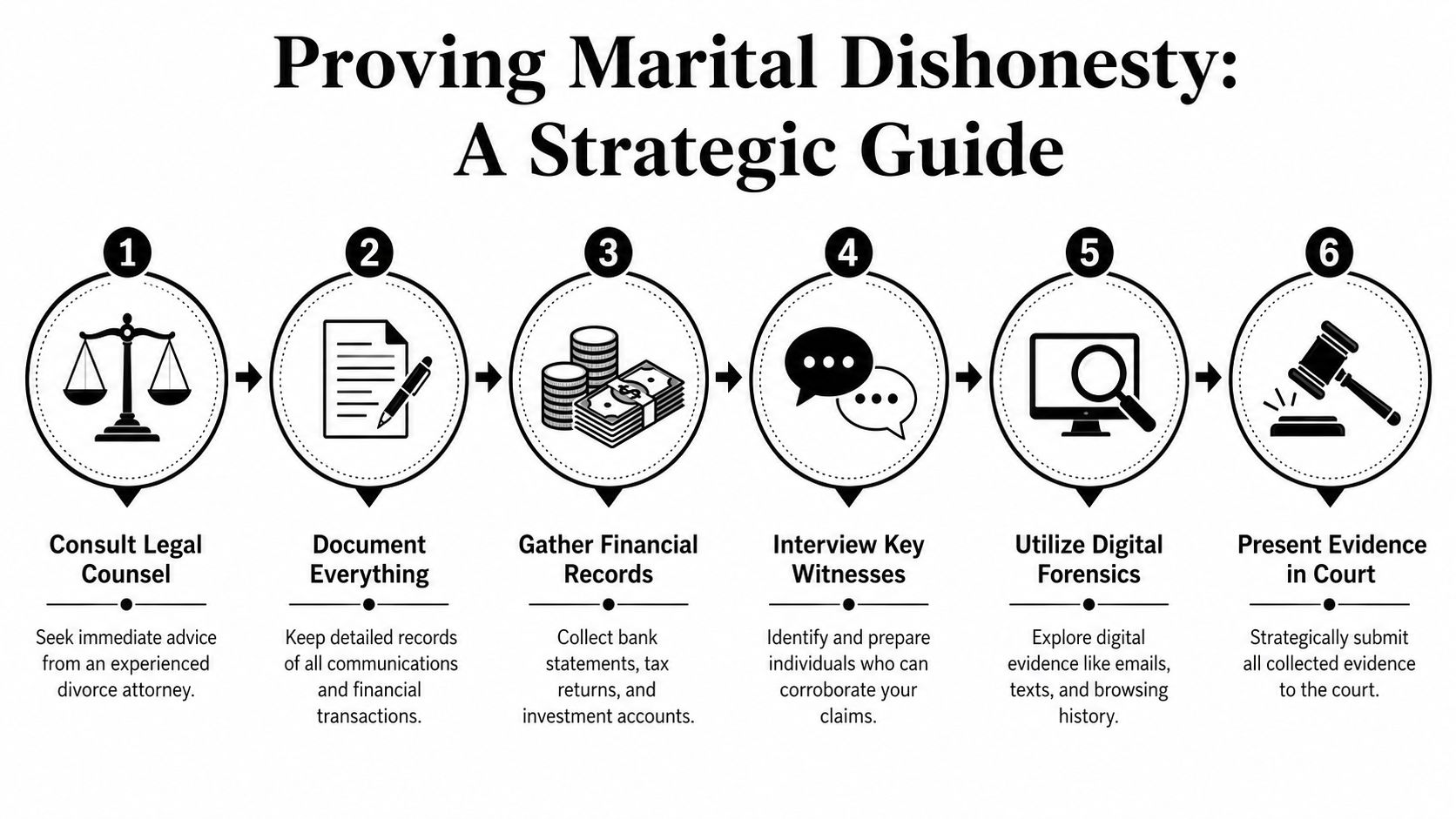
A Strategic Guide to Uncovering and Proving a Lie
Suspecting dishonesty is common. Proving it takes structure. In Texas divorce cases, the winning approach is usually methodical rather than dramatic.
Step one starts at home
Begin with what you already have access to legally. That may include tax returns, monthly statements, payroll records, loan applications, emails, text messages, online account notices, and prior versions of financial records. Build a timeline.
A simple working file often helps more than a stack of accusations. Organize by issue:
- Income issues: Pay stubs, deposits, bonus history, invoices, business distributions
- Asset issues: Bank statements, brokerage records, retirement statements, property tax notices
- Debt issues: Credit card statements, promissory notes, unusual transfers
- Parenting issues: School messages, medical records, calendars, police reports if they exist, co-parent communications
What you are looking for is inconsistency. If a sworn statement says one thing and ordinary records show another, you may have the beginning of a proof chain.
Use discovery to force the details
Discovery is where many lies start to break apart. Texas divorce discovery can include interrogatories, requests for production, requests for disclosure, subpoenas, and depositions. Each serves a different purpose.
Interrogatories make your spouse commit to written answers. Requests for production force document turnover. Depositions test the story under oath in real time, where evasive answers are harder to maintain.
If you want a fuller overview of the process, review this explanation of discovery in a Texas divorce case.
A practical sequence often looks like this:
- Identify the weak point: Hidden income, missing account, false custody claim, fake debt.
- Request the core documents: Statements, ledgers, tax records, supporting attachments.
- Compare the response to prior filings: Look for omissions and contradictions.
- Depose the spouse if needed: Lock in testimony before trial.
- Bring the issue to the judge: If the spouse refuses to comply or the lie is clear.
Case-building tip: The best evidence usually comes from neutral records, not emotional exchanges.
Know when to file a motion
If your spouse dodges discovery, a Motion to Compel may be the next move. That asks the court to order compliance. If the dishonesty is established or the noncompliance is serious, a Motion for Sanctions may be appropriate. That asks the court to impose a consequence for the conduct.
These motions are not just paperwork. They frame the issue for the judge. A good motion identifies the false statement or missing production, shows why it matters, documents efforts to resolve it, and asks for a precise remedy.
Possible remedies may include:
- Compelled production: A deadline to produce missing records
- Attorney's fees: Reimbursement for the work required to uncover the problem
- Exclusion of evidence: Preventing a spouse from using late-produced or withheld material
- Adverse inference arguments: Asking the court to view the missing information skeptically
Expert help can change the case
Some lies are too technical to prove with ordinary records alone. A forensic accountant may trace diverted funds, analyze business cash flow, or test whether reported income matches lifestyle and account activity. A business valuation expert may help if ownership interests, goodwill, or manipulated company books are in play.
For parenting disputes, the needed evidence may be different. Phone records, school records, counselor records when properly obtained, and neutral witness testimony often carry more weight than repeated denials.
Digital evidence can matter too, but you have to gather it legally. If recordings are part of your question, read this overview on whether you can record your spouse in Texas and whether you should. The legal answer depends on the facts, and mistakes here can create new problems.
One practical option for Texans dealing with hidden asset or disclosure disputes is working with a firm that handles Texas family law discovery and contested divorce litigation, such as Law Office of Bryan Fagan, PLLC, along with any other qualified Texas family law attorney you choose.
What usually does not work
Some tactics feel satisfying but weaken your position:
- Direct confrontation too early: It gives your spouse time to cover tracks.
- Broad accusations without proof: It can make you look reactive instead of credible.
- Self-help discovery that crosses legal lines: Accessing accounts or devices improperly can backfire.
- Saving the issue for trial: If you can expose the lie earlier, you often should.
The strongest litigants in these cases are not the loudest. They are the most organized.
What to Do Next Your Action Plan for Fighting Dishonesty
If you've uncovered a lie, your next step should be disciplined, not impulsive.

Your first moves matter
Don't rush to confront your spouse. In most cases, that only helps them refine the story or move evidence. Instead, preserve what you have and make a clean record.
Do this next:
- Save documents carefully: Keep statements, screenshots, emails, and texts in their original form when possible.
- Build a chronology: Note when the statement was made, why it was false, and what records contradict it.
- Separate suspicion from proof: Mark what you know, what you suspect, and what still needs verification.
Match the remedy to the lie
Not every false statement deserves the same response. A missing bank account may call for aggressive financial discovery and possibly a reconstituted estate analysis. A false abuse claim may require fast action tied to temporary orders and parenting evidence. A refusal to turn over records may require a motion to compel before sanctions become realistic.
That's where strategy matters more than anger. The right filing at the wrong time can be ineffective. The right filing after the record is built can be powerful.
If your case is already in discovery, focus on using the process well. This resource on discovery in a Texas divorce case can help you understand where the pressure points usually are.
Keep your own credibility clean
One of the easiest mistakes in these cases is starting to mirror the other side's behavior. Don't do that. Follow court orders. Answer discovery accurately and completely. Show up prepared. Keep your messages measured.
The judge doesn't just evaluate whether your spouse lied. The judge also evaluates whether you remained reliable when the case got difficult.
Key takeaway
If your spouse is lying in divorce court, you are not stuck. Texas procedure gives you ways to uncover the truth, force disclosure, ask for sanctions, and seek a final order that reflects what really happened. The key is to move carefully, document thoroughly, and present the issue in a way the judge can act on.
If you're dealing with hidden assets, false accusations, or sworn statements that don't add up, a confidential consultation can help you decide what to do before the problem gets bigger. The attorneys at Law Office of Bryan Fagan, PLLC help Texans build a clear strategy for discovery, temporary orders, property division, custody disputes, mediation, and trial. Schedule your free consultation to talk through your facts, protect your evidence, and take the next step with confidence.