Skip to content
When you already feel blindsided by divorce, the fear that your spouse may also be hiding money can make the ground feel even less stable.
If that's where you are right now, start with this: you are not powerless, and secrecy doesn't automatically win in a Texas divorce. Texas courts expect full honesty about income, property, debts, and financial records. If your spouse is playing games with money, there are legal tools to expose it and consequences that can be severe.
This is one of the most common questions clients ask in high-conflict and high-asset cases: what happens if your spouse is hiding money in a divorce? The short answer is that it can affect property division, support, attorney's fees, and even what happens after the divorce is final. The better answer is that you need a plan, not panic.
What Texas Law Considers Hiding Assets
Texas doesn't require you to prove some movie-style secret offshore plot before a court takes this seriously. Hiding assets can be much more ordinary, and much more common.
In plain English, hiding assets means intentionally keeping money, property, income, or debt information out of the divorce process so the division isn't fair. That can happen before the case is filed, during the divorce, in mediation, or in sworn paperwork filed with the court.
The fiduciary duty between spouses
Under Texas law, spouses have duties to each other regarding community property. A useful way to think about it is this: until the marital estate is divided, you and your spouse are managing a shared financial enterprise. You may be ending the marriage, but that doesn't give either of you the right to secretly strip value out of the estate.
Texas courts often analyze this under the concept of fraud on the community. You may also hear lawyers talk about conduct that looks like constructive fraud on the community. That usually means one spouse unfairly disposes of, conceals, misuses, or depletes community property in a way that harms the other spouse.
That isn't limited to stuffing cash in a safe.
Conduct that can cross the line
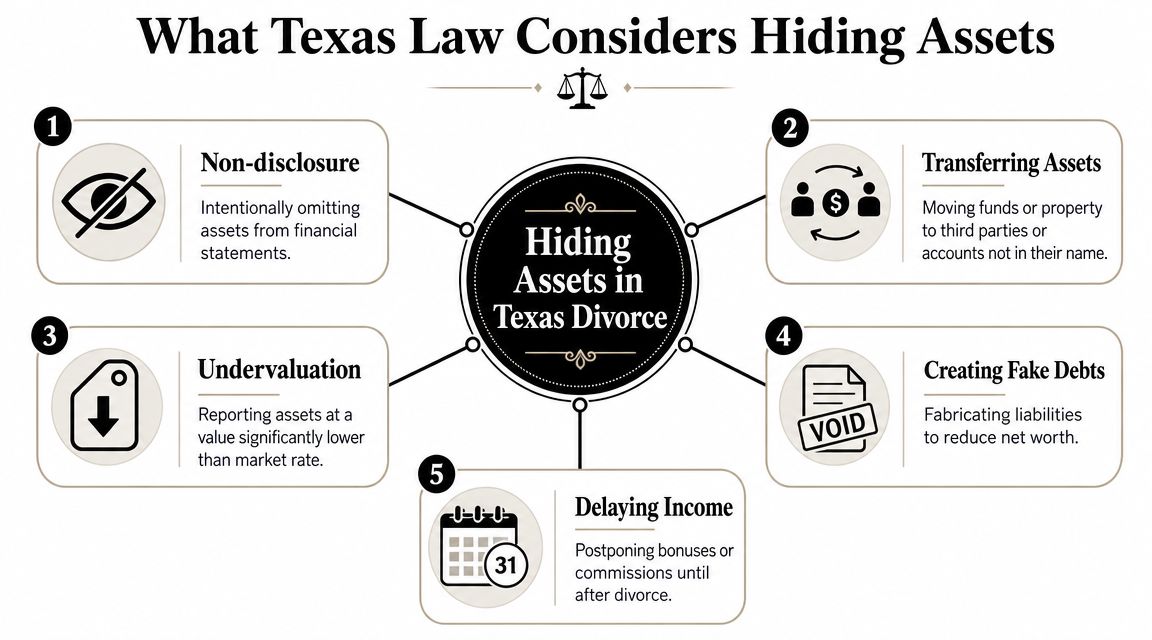
A spouse may be hiding assets if they do things like these:
- Leave accounts off financial disclosures. Retirement funds, side accounts, brokerage accounts, crypto holdings, or deferred compensation can all matter.
- Transfer property to someone else. A “temporary” transfer to a sibling, friend, or business associate can still be a problem if the goal is concealment.
- Undervalue a business interest. If your spouse owns a business and suddenly claims it's worth far less than it reasonably appears, that deserves scrutiny.
- Create fake debt. A made-up “loan” owed to a relative can make the estate look smaller on paper.
- Delay income on purpose. A spouse who usually receives commissions, distributions, or bonuses may try to push them past the divorce finish line.
Practical rule: If the financial story suddenly stops making sense, treat that as a legal issue, not just a marital one.
What Texas Family Code principles matter
Texas is a community property state. Courts divide community property in a manner that is just and right, which does not always mean a perfect split. When one spouse has concealed or wasted assets, the judge can consider that misconduct when dividing the estate.
The Texas Family Code also gives courts tools to address fraud on the community. In real cases, that can lead to a reallocation of property, a money judgment, or reimbursement claims tied to property that was wrongfully moved or hidden.
For clients, the takeaway is simple. Financial privacy is one thing. Financial deception during divorce is another. If your spouse is concealing information that affects the community estate, the court can act.
Common Red Flags of Hidden Finances
Hidden money isn't usually discovered through a spouse's sudden confession. Instead, patterns are noticed. A bank statement disappears. A tax return looks different. A spouse who never cared about bookkeeping becomes obsessively controlling overnight.
Those small shifts matter.

Behavior changes that deserve your attention
A spouse who is hiding money often changes behavior before they change documents.
You might see them become evasive about routine questions. They may insist that you “don't need to worry about the finances” or act offended when you ask where money went. Sometimes they rush settlement talks because they want the divorce finished before the paper trail catches up to them.
Other times, the shift is more subtle:
- New secrecy around devices. Passwords change, banking apps are hidden, and financial emails stop arriving where they used to.
- Unusual control over mail. Statements vanish, or a new mailing address appears.
- A sudden new professional relationship. Your spouse switches accountants, bookkeepers, or payroll providers at a suspicious time.
If you're also worried about one spouse draining liquid funds before the estate can be sorted out, this guide on emptying a bank account before divorce in Texas can help you understand where normal use ends and harmful conduct begins.
Financial clues that show up on paper
Red flags aren't always dramatic. Often, they look like paperwork that no longer matches the life you've been living.
Here are common examples I tell clients to watch for:
- Unexplained withdrawals or transfers. Large cash movements without a clear household purpose deserve a closer look.
- Missing records. Tax returns, loan documents, business ledgers, or investment statements suddenly become “unavailable.”
- Loans to friends or family. That may be a real debt. It may also be a way to park money outside the estate.
- New credit lines in one spouse's name. Hidden debt can be as damaging as hidden assets.
- Lifestyle mismatch. If the family is spending freely while your spouse claims income has collapsed, the math may not be honest.
When clients say, “I can't prove it, but something is off,” they're often noticing inconsistencies before they know how to name them.
Business-owner red flags
Business owners have more room to manipulate timing, valuation, and reporting. That doesn't mean every business owner is dishonest. It does mean the records deserve a harder look.
Watch for things like delaying new contracts, prepaying business expenses, holding receivables, inflating liabilities, or suddenly claiming the business had a terrible quarter when everything around you suggests otherwise. If your spouse controls the books, the payroll, or vendor relationships, they have more opportunities to blur the line between the business and the marital estate.
You don't need a complete case before you act. You just need enough facts to take the next step carefully.
How to Legally Uncover Hidden Assets in a Divorce
You file for divorce, ask for a fair division, and your spouse suddenly claims the money is gone, the business is struggling, or the records cannot be found. That is the point where you stop arguing and start building proof.
In Texas, hidden-asset cases are proven through lawful document gathering, formal discovery, third-party records, and, when needed, expert analysis. If you suspect money is being moved or disguised, act early. The same paper trail that helps you before the divorce can also matter later if you discover fraud after the decree is signed.
Start with what you can legally access now. Pull tax returns, bank and credit card statements, pay stubs, loan applications, retirement account statements, property records, business books, and any financial disclosures already exchanged. Organize everything by account and date. Sloppy records waste time and money. Clear records expose patterns.
A fuller explanation of the formal process appears in this guide to discovery tools in a Texas divorce case.

The discovery tools that matter
Texas discovery gives you specific ways to pin your spouse down.
Interrogatories force written answers about accounts, transfers, income sources, ownership interests, business entities, and debts. These answers matter because your spouse is committing to a story.
Requests for Production force the turnover of documents. Use them to get statements, tax returns, bookkeeping files, contracts, loan applications, emails about transfers, and backup for any claimed liability or expense.
Requests for Disclosure and sworn inventories help define what property your spouse admits exists. Once a spouse takes a position in writing, changed stories become much easier to challenge.
Depositions put your spouse under oath and let your lawyer press for details in real time. Evasive answers, sudden memory gaps, and contradictions usually show up faster in a deposition than on paper.
Subpoenas are often decisive. Banks, employers, payroll companies, accountants, business partners, and brokerage firms may have cleaner records than the spouse trying to control the flow of information.
When experts become necessary
Some cases need more than standard discovery. If money runs through a family business, cash transactions, side accounts, deferred compensation, stock grants, or layered transfers between relatives or entities, get a forensic accountant involved early.
Your lawyer uses the rules of procedure, drafts discovery, takes testimony, and presents the legal case, while a forensic accountant traces funds, compares records, tests the accuracy of reported numbers, and identifies discrepancies that matter in court.
That work does more than help with settlement. It can preserve a record for trial, and it can matter after divorce if hidden assets are uncovered later and you need to ask the court for relief based on fraud or nondisclosure.
For readers who want a broader explanation of emergency asset-freezing concepts used in financial disputes, this Mareva injunctions guide gives useful background on how courts can address asset preservation concerns in some legal systems.
Here's a practical overview of the issue in video form:
What you should and should not do
Do this:
- Preserve documents you already have lawful access to.
- Create a timeline of transfers, missing funds, new accounts, and inconsistent explanations.
- Route the investigation through your lawyer so the evidence is gathered in a form the court can effectively use.
- Ask early about temporary restraining orders or other court protections if you believe assets are being moved.
Do not do this:
- Hack accounts, guess passwords, or intercept private communications.
- Warn your spouse too soon if you believe money will disappear faster once they know you are looking.
- Accept informal explanations without records.
- Assume the problem disappears once the divorce is final. If hidden assets surface later, you may still have legal options, but your chances improve when you preserved evidence from the start.
The Severe Penalties for Hiding Assets in Texas
A spouse who hides money in a Texas divorce is not taking a clever shortcut. That spouse is handing the judge a reason to punish the misconduct.
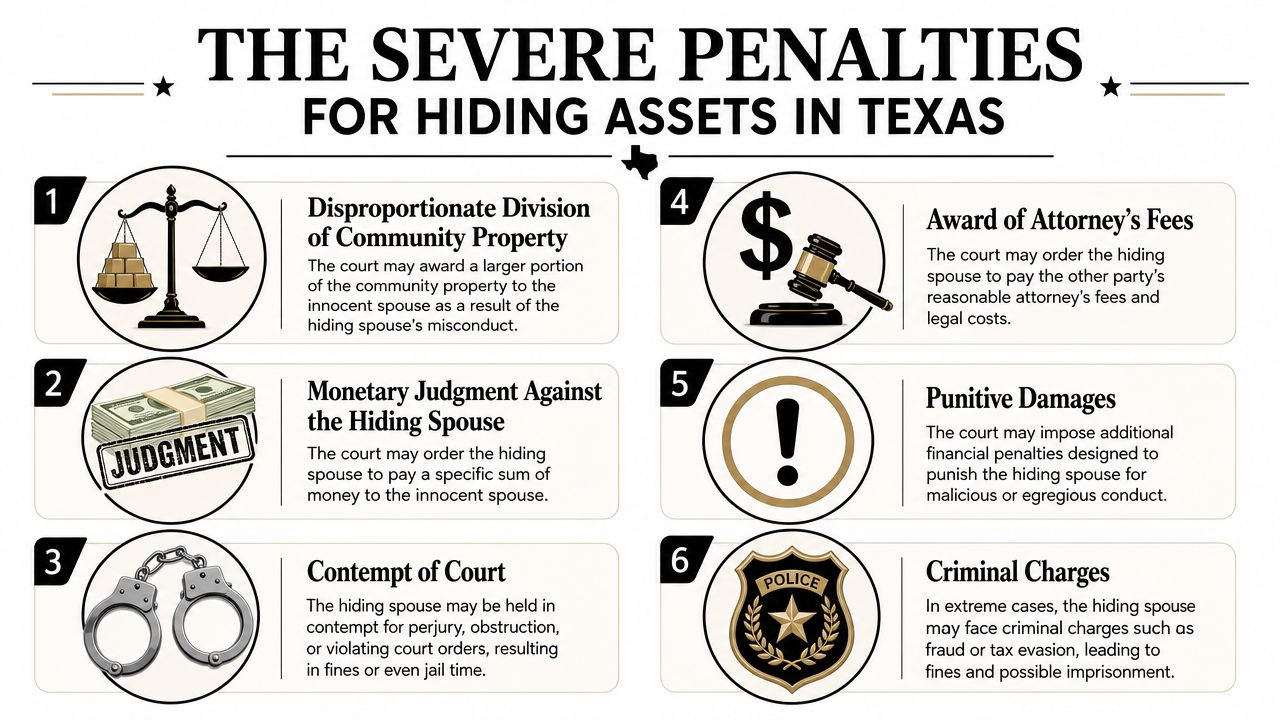
Texas courts do not have to reward deceit with a simple do-over. If a judge finds that one spouse hid, wasted, transferred, or diverted community property, the court can adjust the division of the marital estate to make the innocent spouse whole. In plain terms, the judge can give your spouse less and give you more.
Financial consequences inside the property division
This usually hits where it hurts most. Property.
Texas judges divide community property in a manner they consider just and right. If your spouse concealed assets or drained marital funds for an improper purpose, the court can award you a disproportionate share of what remains. The judge can also account for property that should have been in the estate but was wrongfully removed, then offset that loss through other assets or a money judgment.
If the misconduct involved reckless spending, unusual transfers, or deliberate waste, this guide on how to prove dissipation of assets in a Texas divorce case will help you build the right record.
Fees, sanctions, and credibility damage
Hidden money cases often become expensive for the spouse who lied.
Courts can order attorney's fees, reimbursement of forensic accounting costs, discovery sanctions, and contempt remedies when a spouse refuses to disclose financial information or lies under oath. A judge may also draw harsh conclusions from missing records, false testimony, or a paper trail that shows intentional concealment. Once that happens, settlement gets harder, trial gets uglier, and the dishonest spouse loses credibility on every disputed issue.
That credibility loss matters. A judge who decides your spouse lied about bank accounts, cash transfers, or business income is less likely to give that spouse the benefit of the doubt anywhere else in the case.
Lying under oath makes the problem worse
Financial inventories, interrogatory answers, document responses, and courtroom testimony carry legal consequences. If your spouse signs sworn disclosures and leaves out important assets on purpose, the issue stops being a property dispute and becomes deception inside a court case.
Judges take that personally, and they should.
Intentional false statements can support sanctions, contempt, and in some situations allegations tied to perjury or fraud. The exact remedy depends on the facts, but the message from the court is consistent. Hide assets, and the penalty can reach far beyond the asset itself.
That point matters even more if the truth comes out late. A spouse may think, "If I can hide it long enough, the case will be over." That is a bad strategy. Concealment discovered after the decree can still create serious legal exposure, including efforts to recover value that was never disclosed in the first place.
Your job is simple. Stay legal, stay organized, and gather proof your lawyer can use. Judges do not act on suspicion. They act on records, testimony, and clean evidence.
Can You Reopen a Divorce for Hidden Assets?
Your divorce is final. Months later, you find an account you never saw, a business interest that was never disclosed, or records showing money was moved before the decree. That does not automatically mean the case is over and you are stuck with it.
In Texas, a finalized divorce can sometimes be challenged if property was intentionally hidden and the property division was obtained through fraud. The hard truth is simple. Fixing hidden assets after the decree is harder, more technical, and more time-sensitive than dealing with them during the divorce.
The difference between nondisclosure and fraud
Start with the key question. Was this an honest mistake, or was it a deliberate scheme?
That distinction controls almost everything. A sloppy record, a valuation dispute, or an asset you could have found with ordinary effort during the case may not be enough to reopen anything. A deliberate lie under oath, a concealed account, fake debts, diverted income, or a secret transfer to keep property off the books puts you in very different territory.
Texas courts do not reopen property cases because one side is unhappy with the outcome. They act when the evidence shows the decree was procured by fraud or similar misconduct that corrupted the property division.
Texas procedure may allow a Bill of Review or another post-judgment remedy, depending on the facts and the timing. These are serious filings with strict requirements. Do not try to file one on your own and hope you can fix it later.
Deadlines can shut the door
A common misunderstanding is assuming hidden assets can be fixed whenever they are found, but that is not a safe assumption.
Post-divorce remedies are tied to deadlines, and delay can ruin an otherwise strong claim. If you wait too long, the court may never reach the merits, no matter how dishonest your former spouse was. A general consumer overview from Super Lawyers on hidden assets in divorce makes the same practical point. Once you discover facts suggesting intentional concealment, act.
If you uncover a hidden account or transfer after divorce, do not spend months trying to build the entire case yourself before calling a lawyer. Preserving your right to bring the claim matters just as much as proving it.
What this means in practice
Get organized fast. Pull the divorce decree, mediation agreement or settlement papers, sworn inventories, discovery responses, tax returns, bank records, business records, and the new documents that exposed the problem. Then build a clear timeline showing what was hidden, how you discovered it, and when you discovered it.
That timeline matters because post-divorce cases often turn on two issues. First, whether the evidence shows intentional concealment rather than confusion. Second, whether you moved quickly enough once you learned the truth.
You may still have options after the divorce is final. But this is the stage where hesitation gets expensive. If hidden assets surface after the decree, treat it as a legal emergency and get a Texas family lawyer involved immediately.
What to Do If You Suspect Your Spouse Is Hiding Money
Don't explode. Don't threaten. Don't announce that you're onto them.
Take smart steps instead.
First, collect the financial records you can lawfully access. Save statements, tax returns, payroll records, business documents, property records, loan paperwork, and screenshots of account information available to you. Keep copies somewhere secure.
Second, write down every red flag. Dates matter. Missing statements matter. Odd transfers matter. Contradictory explanations matter. A clean timeline helps your lawyer build a case that a judge can follow.
Third, stop trying to solve it through emotional confrontation. If your spouse is hiding money, a direct accusation often gives them time to move records, move funds, or rewrite the story.
Fourth, talk to a Texas divorce attorney quickly. Hidden asset cases require strategy, discovery, and sometimes emergency court intervention. Delay helps the person who controls the money.
A vital but often missed aspect of these cases is what happens after the divorce is final. Legal remedies may still exist to reopen the property division, but that usually requires proof of intentional fraud rather than simple nondisclosure, and the deadlines can be strict. That's why early legal advice matters so much.
Key Takeaway
If you suspect hidden money, your job is not to become a detective on your own. Your job is to preserve evidence, avoid mistakes, and get legal help before the trail goes cold.
If you're facing divorce in Texas and you believe your spouse is hiding money, schedule a free consultation with Law Office of Bryan Fagan, PLLC. You can get clear answers about community property, discovery, mediation, enforcement, post-divorce remedies, and the steps needed to protect your share of the marital estate.