Skip to content
You're already under enough pressure. The last thing you need is a photo, comment, or private message turning into a problem in court.
A lot of people ask the same question: can social media ruin your divorce case in Texas? In many situations, yes, it can. Not because every post is dramatic, but because divorce cases often turn on credibility. If your online activity tells a different story than your court filings, your testimony, or your parenting claims, the other side will try to use that gap against you.
Texas divorce cases move through a process that starts with filing, temporary orders, discovery, negotiation or mediation, and then either settlement or trial. At every stage, digital evidence can matter. If you have children, online conduct can affect custody arguments. If property or support is disputed, posts about spending, travel, work, or relationships can become relevant fast.
The good news is that this risk is manageable if you act early and act carefully.
That Innocent Post Could Cost You Everything
You post a smiling photo from dinner with friends on a night you were supposed to have the kids. A week later, the same photo is attached to a motion about temporary orders.
That is how social media creates damage in Texas divorce cases. A post that felt casual on your phone can become an exhibit used to challenge your judgment, your finances, or your honesty. In a Texas family case, the court is focused on the best interest of the child under Texas Family Code Section 153.002, and the other side is allowed to use relevant evidence to argue you are not telling the full story. Under Texas Rule of Evidence 401, the standard for relevance is broad. If a post makes a disputed fact more or less likely, expect the other side to try to use it.
Why ordinary posts become legal problems
The risk is rarely the caption alone. The risk is the story an opposing lawyer builds around it.
A night out may be offered as evidence of poor parental judgment. A photo of a new truck, designer bag, or weekend trip may be used to question your financial disclosures. A sarcastic rant can be presented as evidence of anger, instability, or an unwillingness to co-parent. Even a post about finally feeling "free" can be used to suggest a new relationship, hidden spending, or conduct that affected the marriage.
Judges do not read posts the way friends do.
They read them in the context of conservatorship, possession, support, reimbursement claims, and credibility. In practice, one screenshot often matters because it lines up with something else. A bank record. A text message. A missed exchange. A statement made under oath.
Practical rule: If a judge could read the post in a way that hurts your case, do not publish it.
The mistake that causes the damage
The common mistake is treating social media like a private conversation after a divorce or custody dispute is already foreseeable. It is not private in any meaningful legal sense. Privacy settings do not prevent discovery. Friends can forward posts. Family members can take screenshots. Tagged photos and comments from other people can still end up in front of the court.
That mistake gets more dangerous when children are involved. If custody is already tense, review these critical things you should not do in your Texas custody case.
Keep one point in mind. Your social media is no longer being interpreted for tone or intent. It is being examined for admissions, inconsistencies, and advantage in a Texas courtroom.
How Social Media Becomes Evidence in a Texas Courtroom
You tell the court you have been careful with money and focused on your children. The other side brings a screenshot of a weekend trip, tagged photos from a bar, and a message thread that places you somewhere different from what you said in testimony. That is how social media enters a Texas divorce case. Subtly, then all at once.

What discovery means in plain English
Discovery is the part of the case where each side can demand relevant information. In a divorce, that can include posts, photos, private messages, account data, and metadata if those items relate to a live dispute over money, parenting, fault grounds, or credibility.
Texas courts do not need your profile to be public for this to matter. If the content is relevant under Texas Rule of Evidence 401, the other side may seek it through requests for production, interrogatories, or a subpoena in a Texas divorce when records are held by someone else.
The legal point matters. Relevance is a low bar. If a post makes a fact more or less likely, it may come in. In a Texas divorce, that can connect directly to Family Code issues such as fault-based divorce under Section 6.003 for adultery, temporary support disputes, reimbursement claims, or later conservatorship arguments if the content reflects poor judgment around the children.
How lawyers get a post admitted
Finding a post is only the first step. The lawyer offering it still has to show the court that the exhibit is real and tied to you. That is authentication, and Texas Rule of Evidence 901 governs it.
In practice, Rule 901 is usually satisfied with ordinary proof, not courtroom drama. A screenshot may be matched with the account name, profile photo, date stamp, message history, phone records, geotags, or testimony from someone who saw the post appear on your account. Sometimes the post matters most because it lines up with bank records, location data, or what a party said under oath.
Here is the usual progression:
| Step | What it means for you |
|---|---|
| A post is collected | A photo, comment, reel, or direct message is saved before it disappears |
| The account is connected to you | Username, profile details, tags, device data, or witness testimony link the content to your account |
| The post is placed in context | Dates, captions, geolocation, texts, and financial records help explain what the content shows |
| The judge rules on admissibility | The court decides whether the exhibit is authenticated, relevant, and worth considering |
Private settings do not block this process. They only reduce casual viewing.
What clients get wrong
Clients often assume deleting posts, changing usernames, or asking friends to remove tags will solve the problem. Usually it does not. The better question is whether the content was already seen, saved, forwarded, or requested.
There is also a serious Texas procedure issue here. Once a divorce or custody fight is pending, or clearly about to be filed, deleting relevant content can create a spoliation problem. Judges take a dim view of parties who clean up evidence after the duty to preserve it becomes obvious.
The practical move is simple. Preserve what exists, stop posting, and let your lawyer assess the risk before you make it worse. That gives you a chance to address the evidence directly, instead of letting the other side frame it first.
Child Custody at Risk What Your Posts Say About Your Parenting
When children are involved, social media can become far more serious than an embarrassment issue. It can affect how the court views your judgment, stability, and willingness to support your child's relationship with the other parent.
Texas Family Code Section 153.002 says the child's best interest is the primary standard in custody decisions. Texas guidance also explains that digital evidence can matter if it shows instability, substance abuse, or a lifestyle inconsistent with claims, and that posts suggesting a higher lifestyle than reported income may support child support income arguments under Section 154.062, as explained in this Texas discussion of digital proof in divorce cases.
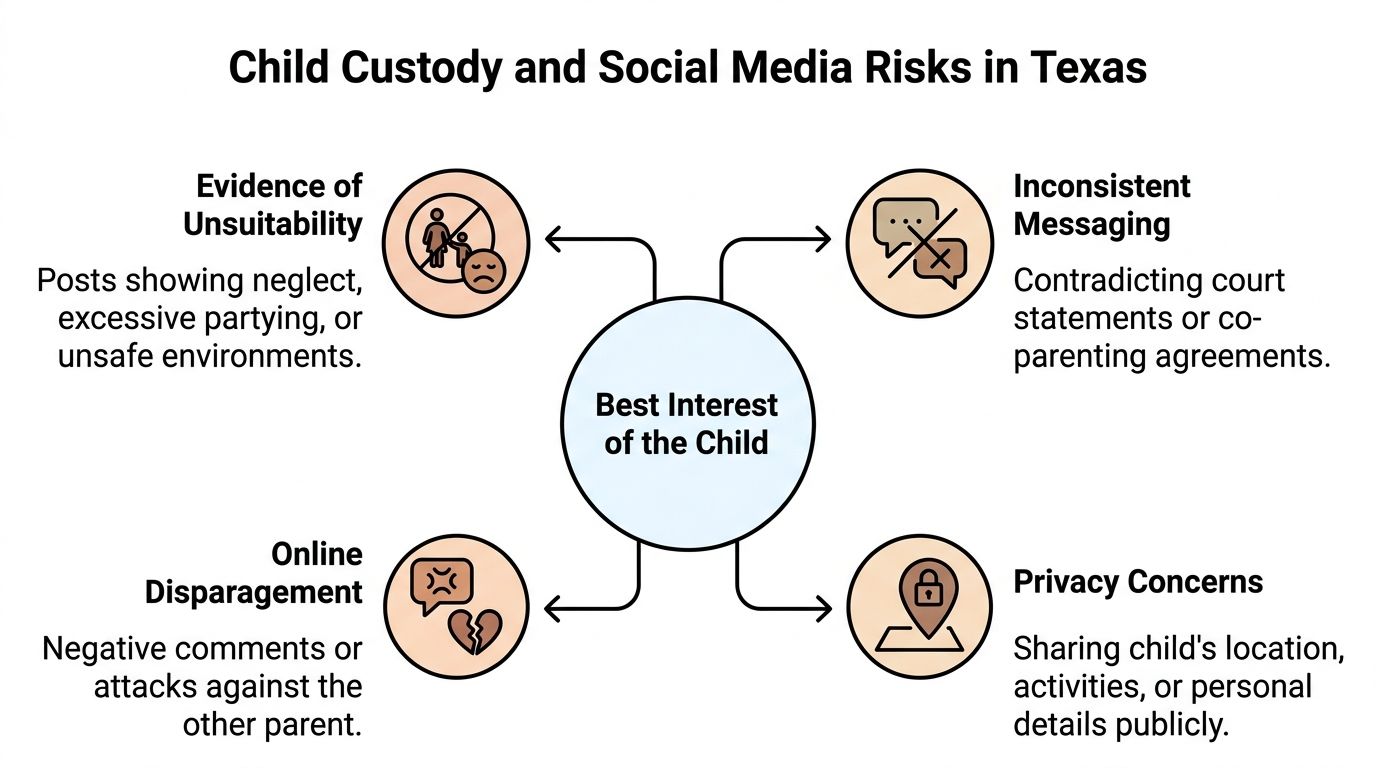
How judges may read your content
A judge usually isn't asking whether your post was fair or taken out of context. The judge is asking whether the content helps answer a custody question.
That means these categories matter:
- Posts showing risky behavior can be used to argue poor judgment or instability.
- Comments attacking the other parent can be used to argue that you won't support healthy co-parenting.
- Photos with new romantic partners around the children may lead to questions about boundaries and decision-making.
- Public details about your child's location or routine can raise privacy and safety concerns.
Here's a related issue that many parents miss. Online attacks and subtle digs at the other parent can sometimes feed a broader claim that you are damaging the parent-child relationship. If that concern exists in your case, it helps to understand how courts look at Texas parental alienation.
A visual summary helps show how these themes connect:
The posts that create the most damage
The most harmful custody posts are often the ones made in anger or relief.
Examples include:
- mocking the other parent
- complaining about visitation
- posting about being hungover, high, or out all night
- treating parenting time like an inconvenience
- sharing personal details about the child and the case
A parent doesn't have to post something illegal to create a custody problem. The post only has to cast doubt on judgment, stability, or credibility.
Where this fits in the divorce process
Custody issues can come up early, especially in temporary orders hearings. Those hearings often shape the status quo until final orders are entered. Then the case may move through discovery, mediation, and, if necessary, trial.
So if you're waiting until the final hearing to get careful online, you're waiting too long. Social media can affect temporary outcomes first, and temporary outcomes often shape the rest of the case.
Property Division and Finances Exposing Your Assets Online
A spouse tells the court money is tight, then posts a photo from a resort, a new truck in the driveway, or a caption about a big month at work. That post can turn a routine property dispute into a credibility problem.
Texas Family Code Section 7.001 requires the court to divide the community estate in a just and right manner. Judges make that decision from the evidence they see, including evidence that suggests a spouse has spent community funds recklessly, moved money, or minimized income. Social media often gives the other side a roadmap.

What financial posts can signal
A post does not have to mention bank accounts or retirement funds to matter.
Photos of trips, expensive dinners, jewelry, home upgrades, new vehicles, cash-heavy hobbies, or a sudden business push can all be compared against your inventory, sworn disclosures, and testimony. If the story online looks richer than the story in your case, expect questions. In Texas divorces, those questions often lead to requests for bank records, credit-card statements, business documents, and appraisals.
Texas Family Code Section 7.009 also matters here. It addresses fraud on the community, including certain situations involving concealment, transfer, or waste of community property. A celebratory post about a new venture, a gift, or a purchase can become a timestamp. Then lawyers start matching that timestamp to withdrawals, transfers, and missing assets.
High-asset cases and business owners face extra exposure
Business owners get scrutinized from several angles at once. A company Instagram page may show new equipment, more jobs, more staff, or expansion. A personal account may show travel, entertainment, or purchases that do not fit the income being reported to the court.
I often tell clients that social media can create an evidence trail they did not realize they were leaving. A post about being "booked out," a photo from a job site, or a launch announcement may be harmless in ordinary life. In a divorce, it can support an argument that income is higher than claimed, business value is understated, or community funds paid for personal expenses.
The same problem shows up in high-net-worth cases involving investment accounts, real estate, deferred compensation, and irregular income. One post can trigger a much broader search.
How this plays out in a Texas divorce
Property fights are usually built through document production, inventories and appraisements, depositions, expert review, settlement talks, and mediation. Social media rarely decides the case by itself. It does something more practical. It gives the other side a reason to dig deeper and a theme to use against you.
That affects settlement value. If your posts make your finances look incomplete or misleading, the other side is less likely to trust your numbers, and mediation gets harder.
Bottom line: your online image needs to match your sworn financial position. If those two versions conflict, the court may question both your credibility and your accounting.
The same issue can affect support disputes. Posts that suggest unreported income, side work, or access to more resources than disclosed can become part of the argument over earning ability and available funds.
Cautionary Tales Common Posts That Wreck Divorce Cases
A bad social media post usually hurts a divorce case in one of two ways. It either contradicts something you told the court under oath, or it gives the other side a clean exhibit to tie to a specific legal standard.
That legal link matters in Texas. A judge deciding conservatorship must focus on the child's best interest under Texas Family Code Section 153.002. A judge dividing property can weigh fraud on the community, wasting of community assets, and credibility when the evidence suggests money was spent, hidden, or described inaccurately. The post itself is rarely the whole case. It becomes the shortcut the other lawyer uses to frame the case against you.
Texas courts can also admit social media content once it is properly authenticated under the Texas Rules of Evidence. Private messages are not automatically private in litigation, as discussed in this Texas article on how social media can make or break a divorce case.
The post that turns a bad fact into a credibility problem
The most dangerous posts are not always dramatic. They are the ones that conflict with sworn filings, discovery responses, or testimony.
A parent submits a position that the child needs a stable, low-conflict routine. Then screenshots show insults, threats, or public humiliation aimed at the other parent. That gives opposing counsel an argument under Section 153.002 that your judgment and co-parenting behavior are harming the child's best interest.
A spouse denies access to extra income or says funds are tight. Then messages, tagged photos, or captions suggest recent purchases, cash business activity, or trips inconsistent with that position. At that point, the issue is no longer just appearance. It becomes impeachment. If the court believes your online conduct is more accurate than your sworn version, your credibility can collapse fast.
The new relationship post that creates multiple problems at once
New-romance content causes trouble because it rarely stays limited to one issue.
If children appear around a new partner too early, the other side may argue poor boundaries and weak judgment in a custody fight. If community money appears to be paying for gifts, travel, or living expenses tied to that relationship, the argument can shift to waste of community assets. If the relationship began before separation, the post may also support a fault-based narrative, even if fault is not the only issue being litigated.
Clients often assume the primary risk is moral judgment. In practice, the bigger risk is evidentiary use. The post gives the other side a date, a timeline, a witness list in the comments, and sometimes location data.
The joking post that reads differently in court
Sarcasm performs badly in family court.
“I finally escaped my kids for the weekend.” “Retail therapy fixed everything.” “Cash jobs hit different.” Friends may read that as a joke. A judge may read it as a statement against interest, especially if the timing lines up with possession periods, support disputes, or contested financial disclosures.
I tell clients this plainly. If a stranger could screenshot your post and use it to question your parenting, honesty, or spending, assume opposing counsel will try.
One more point. Workplace and professional accounts can create similar problems in other legal settings, which is why regulated businesses often use tighter posting rules and AI controls for HIPAA compliance. Divorce cases are different, but the lesson is the same. Once a post is public or shared with others, control over context disappears.
What these posts have in common
The pattern is usually simple:
- The post supplies a date, location, or statement that can be authenticated
- The other side compares it to your sworn position
- The conflict becomes a credibility attack tied to a Texas legal standard
- Settlement gets harder because your version of events looks less reliable
That is why careless posting causes damage out of proportion to the post itself. In Texas divorce litigation, social media is often less about proving everything and more about giving the court a reason to doubt you on the points that matter most.
Your Social Media Lockdown Plan A Step-by-Step Guide
You post a photo at a restaurant, a friend tags you in a weekend trip, and two days later your spouse's lawyer attaches both to a filing for temporary orders. That is how fast a manageable divorce turns into a credibility problem.
Once divorce is on the table, treat your accounts like potential evidence. The goal is simple. Reduce new risk, preserve what already exists, and avoid creating a spoliation fight under Texas law.
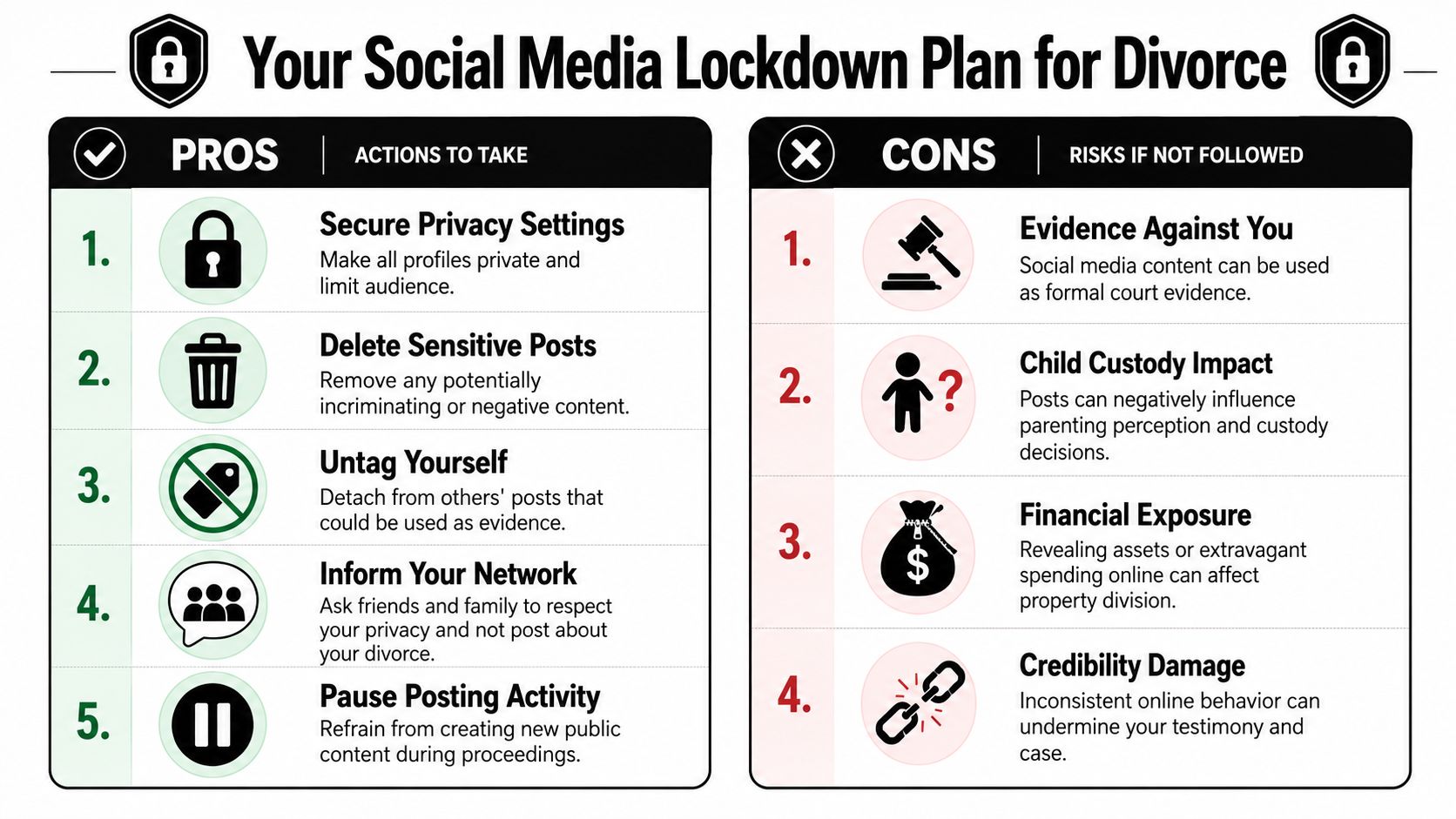
In Texas, deleting posts after litigation is reasonably anticipated can backfire. Courts address spoliation through remedies that may include limits on your evidence, fee consequences, or an adverse inference instruction that allows the factfinder to assume the missing material would have hurt you. Texas courts have framed that issue through the duty to preserve relevant evidence once a party knows or should know a claim is likely. In plain English, panic-deleting can become its own problem.
Step 1 Stop posting about your life
Pause all nonessential posting.
Do not post about the divorce, your spouse, your children, dating, travel, purchases, alcohol, late nights, work complaints, or cash issues. Even harmless-looking content can be matched to dates, locations, and claims you made in court papers, discovery responses, or testimony.
If you want a practical rule, use this one. If a judge saw it on a screen in open court, would you be comfortable explaining it under oath?
Step 2 Tighten privacy settings
Set every account to the highest privacy level available. Review old public posts, story visibility, friend lists, tagging permissions, location sharing, and who can comment or send content to your profile.
Privacy settings help with exposure. They do not block discovery. If the content is relevant, the other side may still request it, and Texas evidentiary rules do not exclude a post just because you intended a smaller audience to see it.
Step 3 Preserve first, then get legal advice
Do not start deleting posts, messages, photos, or videos because you are nervous.
Preserve what exists. Take screenshots for your lawyer if needed. Ask counsel before removing, archiving, or deactivating anything significant. That sequence matters. A careful record gives your lawyer options. An impulsive cleanup gives opposing counsel an argument.
Step 4 Control tagging and other people's content
Your account is only part of the problem. Friends, relatives, and new romantic partners can create evidence for the other side without meaning to.
Use these settings and requests right away:
- Review tagged photos and videos: Remove your tag where appropriate.
- Turn on tag approval: Require review before tagged content appears on your profile.
- Ask people close to you to stop posting you: No pictures, check-ins, jokes, or commentary about the divorce.
- Disable location sharing: Real-time location data can create unnecessary disputes.
- Be careful in group texts and DMs: Private messages can still be authenticated and offered into evidence.
Step 5 Move emotional support offline
Clients often want a place to vent. Social media is the worst place to do it.
Use a therapist, a trusted friend, a journal, or direct communication with your lawyer. Regulated professions follow the same basic principle online. Once sensitive information is shared, control over audience and context drops quickly, which is why some organizations review tools and AI controls for HIPAA compliance before publishing content that could expose private information.
Step 6 Set a review process with counsel
If you are unsure about a post, photo, video, or message, send it to your lawyer before you touch it. That is especially important if custody, reimbursement claims, separate property, business income, or temporary support is disputed.
A Texas family-law firm such as Law Office of Bryan Fagan, PLLC can review how digital content may affect temporary orders, discovery responses, mediation posture, and trial preparation. Good advice here is often about trade-offs. Sometimes leaving a post alone is safer than deleting it. Sometimes deactivation makes sense. Sometimes preservation, followed by a planned production strategy, is the better course.
Use this checklist:
| Do this | Avoid this |
|---|---|
| Pause new posting | Posting to explain your side online |
| Preserve existing content | Deleting in fear or anger |
| Restrict tags and audience | Assuming private means protected |
| Ask others not to post about you | Letting friends build your case for you |
| Send questionable content to your lawyer | Waiting until it appears in a hearing exhibit |
When to Stop Scrolling and Start Calling a Lawyer
If your divorce is uncontested, social media may never become a central issue. But the moment your case turns contested on custody, support, property, credibility, or fault-related conduct, your online record can start doing real damage.
This matters early. A Texas divorce often begins with an original petition, then moves into service, temporary orders, disclosures and discovery, negotiation, mediation, and either settlement documents or trial. Temporary hearings can shape parenting schedules, support obligations, and the tone of the case long before a final decree is signed. Waiting to get serious about social media until the end usually means you waited too long.
Signs you need legal advice now
Call a lawyer promptly if any of these are true:
- You've already posted about the separation and now regret it.
- Your spouse is saving screenshots or mentioning your online activity.
- You have children and custody is disputed.
- You own a business or have substantial assets and your lifestyle may be misunderstood.
- You deleted posts after trouble started and aren't sure what that means.
- You suspect the other side is hiding money while presenting a polished online image.
What a lawyer can help you do
A good family-law strategy isn't just about reacting to bad facts. It's about organizing the case before those facts control the narrative.
That may include:
- assessing your digital exposure
- advising on preservation and spoliation concerns
- preparing for temporary orders
- coordinating discovery responses
- using mediation effectively
- aligning your online record with your legal positions
- planning for enforcement or modification issues after divorce if online conduct continues to create conflict
You do not have to solve this by yourself, and you should not try to improvise once the other side starts using screenshots.
Key takeaway
If you're wondering whether social media can ruin your divorce case in Texas, the safest answer is this: it can absolutely weaken your case if your online behavior conflicts with what you need to prove in court.
What works:
- staying quiet online
- preserving rather than deleting
- getting legal advice early
- thinking about custody, support, and property issues together
What doesn't work:
- rage posting
- assuming privacy settings will save you
- letting friends post freely about you
- trying to clean up the record after the dispute is underway
Your next step should be simple. Stop posting. Save what exists. Get advice before you make any more digital moves.
If you're facing divorce or a custody dispute and you're worried about what your social media may already be saying about you, schedule a free consultation with Law Office of Bryan Fagan, PLLC. You can get clear guidance on the Texas divorce process, temporary orders, custody, support, mediation, property division, and the practical steps to protect your case before an online mistake becomes courtroom evidence.