Skip to content
Divorce can make you feel like your financial future is being decided behind a closed door.
If you're asking what a wife is entitled to in a divorce in Texas, you're probably trying to answer a more personal question: Will I be okay when this is over? That concern is normal. Individuals often don't walk into divorce court with a clear understanding of what belongs to them, what support might be available, or how Texas judges decide what's fair.
The good news is that Texas law does give you a framework. It doesn't promise that one spouse automatically gets the house, ongoing support, or a larger share solely because she's the wife. What it does promise is a legal process for sorting out community property, separate property, debts, child-related issues, and in some cases spousal maintenance.
A lot of confusion comes from assumptions that sound reasonable but aren't legally accurate. Many people believe a wife automatically gets alimony after a long marriage. Others assume everything is split exactly down the middle. Some think child support and spousal support are basically the same thing. In Texas, none of those shortcuts tell the full story.
You need the rules, in plain English, so you can make smart decisions early. That means understanding what a judge can divide, what a judge can't touch, when support may be available, and how to protect yourself from the day the case is filed until the final decree is signed.
Navigating the Uncertainty of Divorce in Texas
When your marriage is ending, uncertainty can feel heavier than the paperwork. You may be wondering whether you'll keep the house, how bills will get paid during the case, or whether years spent building a home and family will count for anything in court.
Texas divorce law can seem intimidating because it uses legal terms that don't always match everyday language. People say "alimony" when Texas law talks about spousal maintenance. They say "my money" or "his retirement" when the law asks whether something is community property or separate property. Those differences matter because they shape what you're entitled to receive.
The question behind the question
Most clients who ask what a wife gets in a Texas divorce aren't looking for a technical definition. They're trying to understand three practical issues:
- What property can be divided
- Whether monthly support is possible
- What steps protect their rights before the divorce is final
Those are the right questions. The answers depend on facts like when property was acquired, whether one spouse received an inheritance, how long the marriage lasted, whether children are involved, and whether one spouse can meet basic living needs after the divorce.
Practical rule: In Texas, your rights usually turn on classification and proof. You need to know what an asset is, when it was acquired, and how to document it.
Why clarity matters early
Early mistakes can become expensive ones. If you leave financial records untouched, agree to temporary terms you don't understand, or assume support will be automatic later, you can lose bargaining power that is hard to recover.
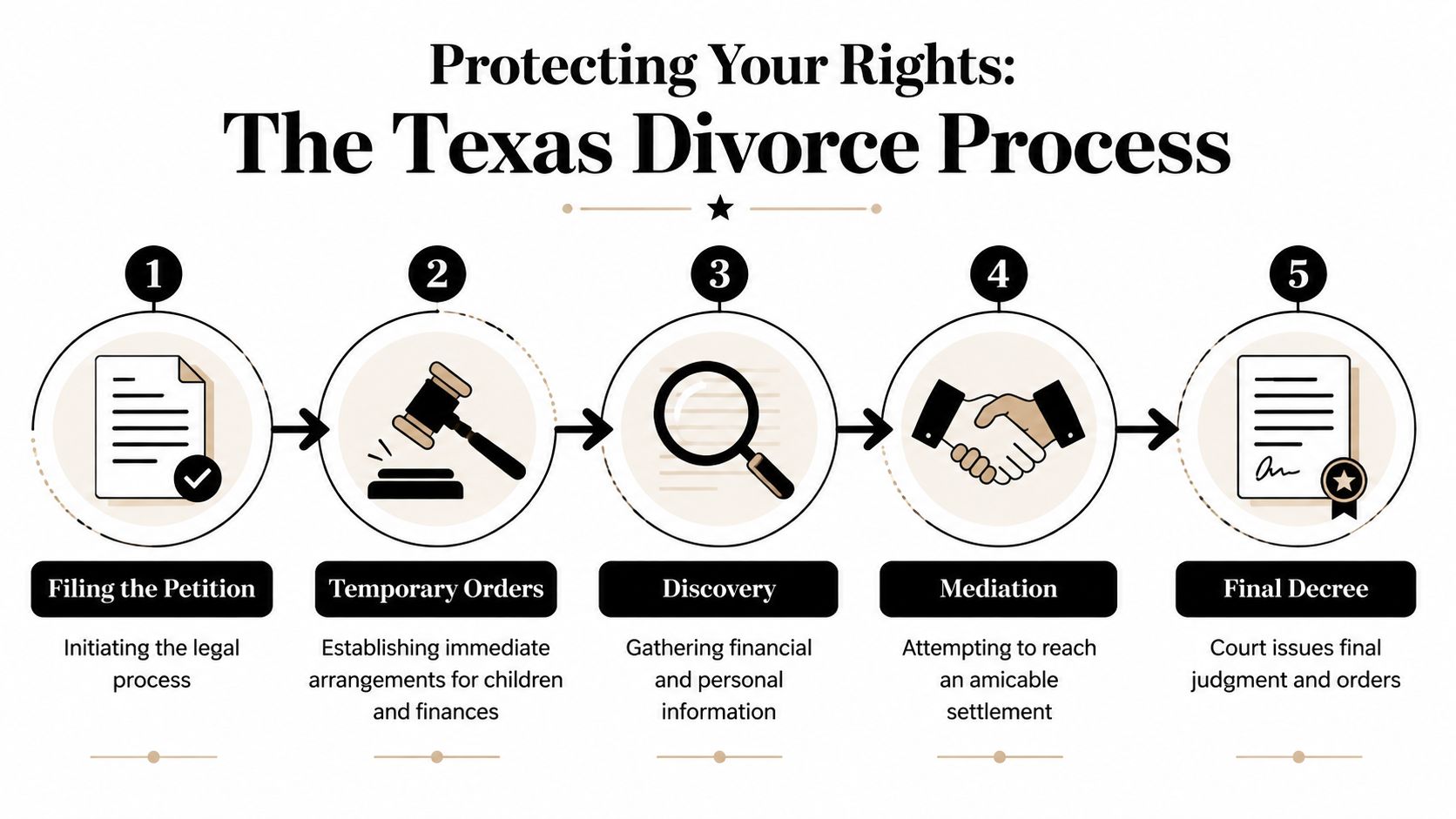
Texas courts also expect parties to move through a defined process. One spouse files the case. The other is served or waives service. Temporary orders may set short-term rules. Discovery gathers financial information. Many cases go to mediation. If no agreement is reached, a judge decides unresolved issues in the final decree.
That process can be managed. It becomes more manageable when you stop guessing and start working from the actual legal standards Texas courts use.
The Foundation Your Community Property Rights
A lot of wives start divorce assuming the court will order monthly support. In Texas, that is often the wrong place to focus first. The first and biggest financial question is usually property division, because what you are most often entitled to is your share of the community estate.
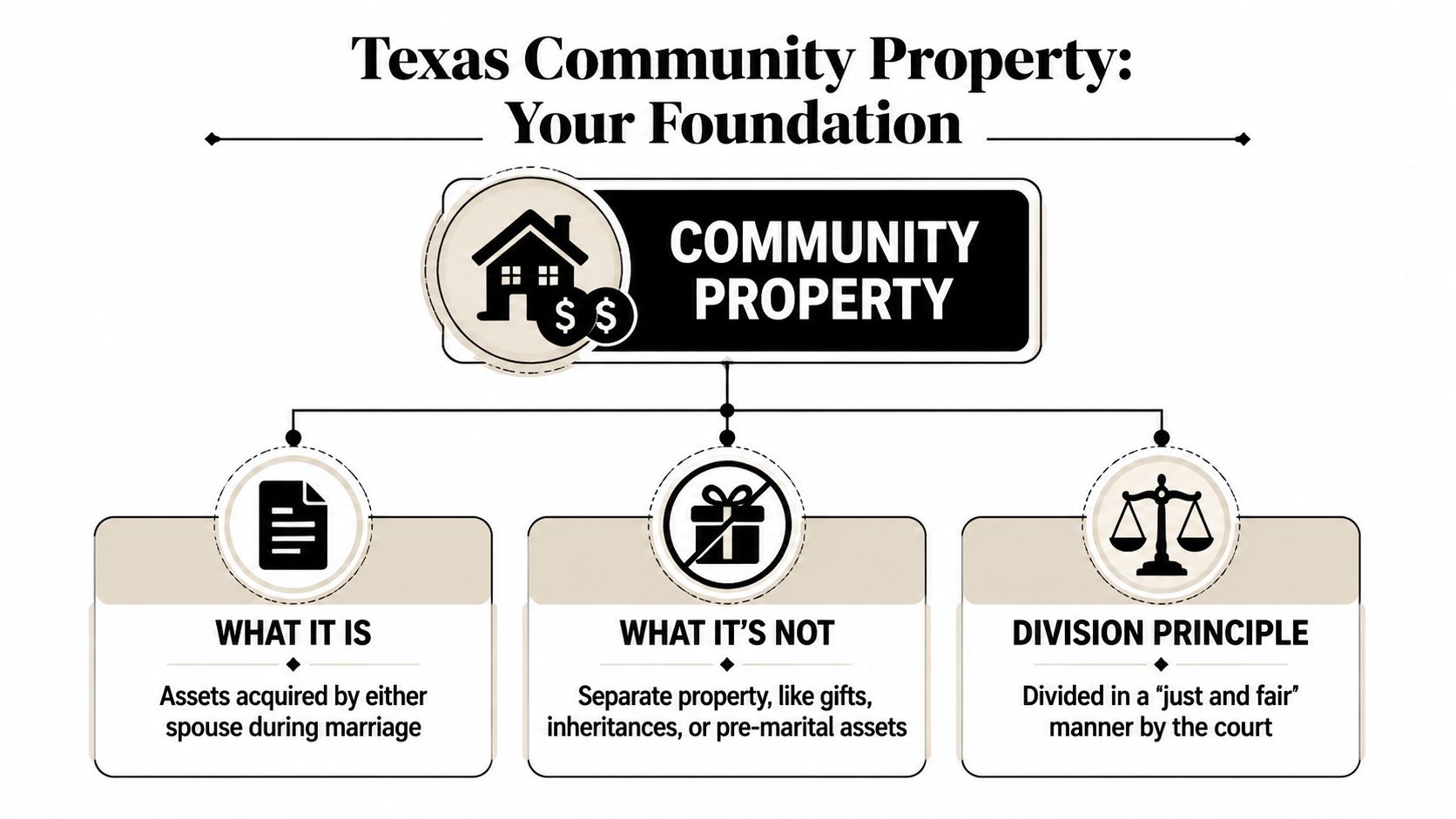
Texas follows a community property system. That means money earned during the marriage and property bought with those earnings usually belong to the marital estate, even if only one spouse handled the paycheck, signed the deed, or opened the account. Under Texas community property rules, the court looks past labels and asks a more important question: is this community property or separate property?
Community property versus separate property
A simple comparison helps here. Community property works like a shared family pot. Separate property works like items you brought with you or received personally.
The shared pot usually includes wages earned during marriage, cars purchased during marriage, household furniture, savings built from marital income, and contributions made to accounts with marital funds. Texas law generally presumes property possessed during or at the end of the marriage is community property unless someone proves otherwise.
Separate property usually includes three categories: property owned before marriage, inheritances, and gifts made to one spouse individually. Personal injury recoveries can also be separate in some situations, though parts of those claims may still be community. A court cannot award one spouse's separate property to the other spouse, which is why documentation matters so much.
What a wife is actually entitled to
A wife is entitled to a just and right share of the community estate. That is the legal standard Texas courts apply.
Sometimes that results in a division that is close to even. Sometimes it does not. The judge can consider fairness factors such as the spouses' earning power, health, education, the size of separate estates, fault in the breakup of the marriage when relevant, and who will carry more financial responsibility after the divorce.
This point matters because it corrects a very common misunderstanding. Texas law does not promise automatic spousal maintenance, and it does not promise a mechanical half of every asset either. What it does provide, in many cases, is a fair share of community property after the court sorts out what belongs in the marital estate and what does not.
Common examples that confuse people
These are the situations that often create anxiety.
- The house was bought during the marriage: It may be community property even if only one spouse's name is on the deed or mortgage.
- One spouse received an inheritance: That is usually separate property unless it was mixed with marital funds so thoroughly that tracing becomes difficult.
- An account existed before marriage and kept growing: The starting balance may be separate property, while later deposits made from marital earnings may be community property.
- A bonus was paid after separation: The answer may depend on when the work was performed and whether the bonus was earned during the marriage.
- One spouse ran a business: The business interest may be separate, community, or mixed, depending on when it was created and how it grew.
If any of those examples sounds familiar, do not guess. Classification errors can change settlement negotiating power quickly.
What to gather now
Good records often decide property disputes. Start collecting documents that show when an asset was acquired, how it was funded, and whether any part of it should be treated as separate property.
| Item | Why it matters |
|---|---|
| Bank and investment statements | Shows balances, deposits, and timing |
| Deeds and closing records | Helps classify real estate |
| Retirement account statements | Identifies the marital portion and premarital balance |
| Gift and inheritance records | Supports separate property claims |
| Business records | Helps value ownership interests and trace growth |
For many wives, this is the essential foundation of a Texas divorce case. Before the court ever reaches the harder question of support, it first identifies what can be divided and what cannot.
Beyond Property Spousal Maintenance Explained
A wife may leave a long marriage expecting monthly support, only to learn that Texas courts start with a different question. Before the court considers maintenance, it looks closely at whether she can meet her minimum reasonable needs from available property, income, and earning ability.
That misunderstanding causes real frustration. Many people use the word "alimony" as if it automatically follows divorce. In Texas, post-divorce spousal maintenance is available only in narrow circumstances, and many requests are denied. For many wives, the more reliable financial right is a just and right share of the community estate.
The high bar for eligibility
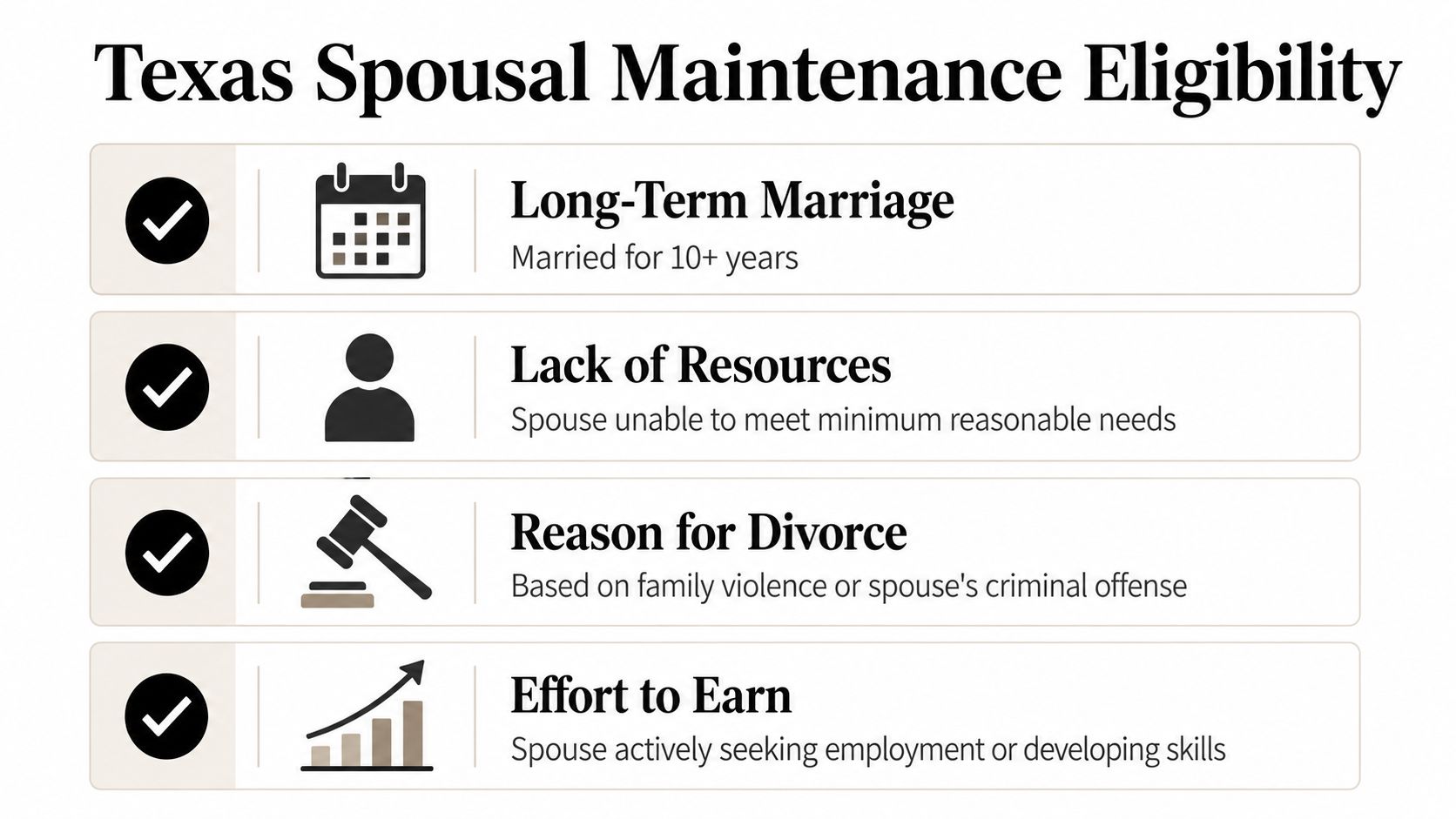
Texas law sets a gatekeeping test. A spouse asking for maintenance must usually prove that, even after receiving her share of the marital property, she still lacks enough property and income to meet her minimum reasonable needs. That phrase matters. It does not mean maintaining the same lifestyle as during the marriage. It usually means covering basic living expenses in a reasonable way.
A long marriage can help, but it does not decide the issue by itself. A wife may still be denied maintenance if the property division gives her enough resources, if she can work and earn enough to support herself, or if the court finds she did not meet the statute's specific requirements. You can review the Texas spousal maintenance eligibility rules to see how strict those requirements are.
When maintenance may be available
Courts generally look for two things at the same time. First, real financial need. Second, a qualifying legal basis under Texas law.
Maintenance may be available in cases such as these:
- The marriage lasted at least 10 years, and the spouse seeking support cannot meet minimum reasonable needs despite making reasonable efforts to earn income or develop job skills.
- The paying spouse was convicted of family violence against the other spouse or child of the marriage within the time period set by statute.
- The spouse seeking maintenance has a physical or mental disability that limits the ability to earn enough for basic needs.
- The spouse is caring for a child of the marriage with a disability, and that caregiving prevents sufficient employment.
These categories are narrower than many people expect. The court is not asking whether support would be helpful. The court is asking whether the law allows it.
How much and how long
Even when maintenance is awarded, Texas places firm limits on amount and duration. Under Texas Family Code Chapter 8, the maximum is $5,000 per month or 20% of the paying spouse's average monthly gross income, whichever is less. Courts are also directed to limit maintenance to the shortest reasonable period in many cases.
Duration usually depends on why maintenance was awarded and how long the marriage lasted. In practical terms, maintenance is often a temporary tool meant to help a spouse stabilize, find work, complete training, or adjust to post-divorce finances.
A simple way to view it is this. Community property division addresses what was built during the marriage. Spousal maintenance addresses a limited support need that remains after that division.
What a wife is actually entitled to focus on
For many wives, the better question is not, "Will I get alimony?" It is, "What is my fair share of the property and income-producing assets from the marriage?"
That shift in focus matters. A larger share of home equity, savings, investment accounts, or other community assets may offer more long-term security than a short maintenance award with a statutory cap. Maintenance can matter in the right case, but it is the exception, not the foundation.
If support may be an issue in your case, prepare to show specific facts. Monthly expenses, health limits, job history, education, efforts to find work, and the property available after division all affect the outcome. Courts decide maintenance requests based on proof, not assumptions.
Dividing Retirement Accounts and Business Assets
A wife can have strong rights in assets that never passed through the household checking account.
Retirement plans and business interests are often some of the largest pieces of the community estate. They also create more confusion than bank accounts or furniture because the value may be tied up in future benefits, tax rules, or a company one spouse still runs. In many Texas divorces, these assets matter far more to long-term financial security than a request for spousal maintenance, which is often denied unless strict legal requirements are met.

Retirement accounts require special orders
Retirement benefits earned during the marriage are usually part of the community estate, even if the account is only in one spouse's name. The key question is often not who opened the account. The key question is what portion was earned during the marriage.
For many plans, the divorce decree alone is not enough to complete the division. A separate order, often a QDRO, tells the plan administrator exactly how to divide the benefits without treating the transfer like an ordinary withdrawal. If the order is inaccurate, the transfer can be delayed, rejected, or handled in a way that creates avoidable tax problems.
A practical rule helps here. The decree says who gets what. The QDRO tells the retirement plan how to carry it out.
For a closer explanation of dividing retirement accounts in a Texas divorce, it helps to review how 401(k)s, pensions, and similar plans are split.
Business interests raise valuation and fairness issues
A business can be harder to divide because the court is often dealing with an operating company, not a pile of cash. That means two separate questions usually have to be answered. What part of the business, if any, belongs to the community estate? What is that interest worth?
If a business was started before marriage, the original ownership interest may be separate property. Even then, the analysis does not stop there. Community labor, salary decisions, reinvested profits, and growth during the marriage can all affect what the community estate may be owed. If the business began during the marriage, the community property claim is often much stronger.
Texas courts have broad authority to divide community property in a just and right manner. If property cannot be physically split, the court may award the asset to one spouse and offset that award with other property, or order a sale when appropriate. The goal is fairness in the overall division, not cutting every asset into identical pieces.
Here's a practical overview that may help:
What to gather early
Good records often shape the outcome in these cases. If you or your spouse owns a company, start collecting documents as early as possible.
- Tax returns: They can show income patterns, deductions, and how the business has been reported over time.
- Ownership documents: These help show when the business began and who holds the ownership interest.
- Profit and loss statements: These can help separate business earnings from a spouse's personal compensation.
- Loan documents: These may show whether debt is tied to business operations, personal spending, or community funds.
Business cases often require a valuation expert, careful tracing, and close review of compensation history. The court's job is not to punish success or shut down a company that supports the family. The court's job is to identify the community value and award each spouse a fair share of it. For many wives, that fair share of retirement funds or business value is the issue that deserves the closest attention.
How Debts Are Handled in a Texas Divorce
Divorce doesn't just divide what you own. It also addresses what you owe.
That includes mortgages, vehicle loans, credit card balances, tax liabilities, and other obligations connected to the marriage. In practical terms, debts are part of the same financial picture as assets. If you receive an asset with a large attached debt, the value of that award may be much smaller than it looks on paper.
Not every debt is treated the same way
Texas courts look at when the debt arose, why it was incurred, and who benefited from it. A debt taken on during the marriage for family living expenses may be treated very differently from a debt one spouse created for personal reasons unrelated to the household.
A few examples help:
- Joint credit card debt: Often becomes part of the marital division analysis.
- Mortgage on the family home: Usually gets addressed together with possession or sale of the home.
- Secret spending or hidden borrowing: May trigger serious disputes about fairness and responsibility.
Review every account, not just the ones you usually paid. Debt surprises often appear late in divorce cases.
Protect yourself before the decree is signed
You should identify every liability during discovery, not just the obvious ones. Pull statements, review credit reports, and compare balances over time. If a spouse controlled the finances, don't assume the full picture has already been disclosed.
Even when a divorce decree assigns a debt to one spouse, a lender may still pursue both spouses if both originally signed for the account. That's why refinancing, account closure, or sale of certain property may be necessary to make the court's division workable in practice.
Child Custody and Support Are Separate Issues
Many people blend financial support for a spouse with financial support for a child. Texas law treats them as different issues for a reason.
Child custody and child support are decided based on the best interest of the child. They are not rewards or penalties for either spouse. They also are not part of the property division analysis.
Child support belongs to the child
This point matters. Child support is not something a wife receives because of her marital status. It is support intended for the child, even though one parent may receive and use the payments for housing, food, school needs, and daily care.
That distinction helps avoid a common mistake. A spouse should not assume that child support will replace spousal maintenance or make up for an unfair property division. Each issue has its own legal standard.
Custody and property don't trade off cleanly
Parents sometimes ask whether one spouse can give up property in exchange for more time with the children, or whether custody affects who gets more of the estate. Courts examine parenting arrangements separately from the financial division of the marriage.
If your case involves children, you may also need guidance on related topics such as parenting plans, visitation schedules, and future enforcement. The same is true if support orders are later violated. Those issues often connect with divorce strategy, but they are still legally distinct from what a wife is entitled to receive as a spouse.
If you're sorting through several issues at once, resources on custody, support, mediation, and enforcement can help you keep those tracks separate and make better decisions in each area.
Protecting Your Rights From Start to Finish
A wife can lose ground in a Texas divorce long before the final hearing if she assumes the court will sort everything out later. That is especially risky when someone expects spousal maintenance to be automatic. In Texas, maintenance is limited and often denied. What usually matters most is protecting your claim to a just and right share of the community estate from the first filing onward.
A divorce case has stages, and each one affects what you can prove. If bank records are missing, if a spouse transfers money without explanation, or if informal text agreements replace clear court orders, it becomes harder to show what property exists and what division is fair. Rights are only as strong as the evidence supporting them.
From filing through discovery
The case usually starts with the Original Petition for Divorce. The spouse who files is the petitioner, and the other spouse is the respondent. Filing opens the case, but it does not decide who keeps the house, who pays which debt, or whether anyone qualifies for maintenance.
Early in the process, the court may enter temporary orders. These orders can decide who stays in the home for now, who pays the mortgage or utilities, how accounts are used, and how parenting time works while the case is pending. Temporary orders often set the tone for the months ahead, so they deserve close attention.
Then comes discovery. Discovery works like the document exchange and fact-checking phase of the case. It is where you request account statements, payroll records, retirement documents, business records, tax returns, and evidence supporting any separate property claim. If your husband says an asset is separate property, or says there is no money available for support, discovery is how that claim gets tested.
Mediation, trial, and the final decree
Many Texas divorces go to mediation before trial. Mediation gives both spouses a structured setting to negotiate with a neutral mediator. It can be productive, but only if you understand what you are being asked to trade and what the law is likely to allow in court.
That point matters because maintenance can distract people from the larger picture. A spouse may focus on monthly support and overlook a retirement account, business interest, reimbursement claim, or hidden debt allocation that has far greater long-term value. In many cases, the primary financial issue is the property division, not a maintenance award that may never be granted.
If the parties do not settle every issue, the remaining disputes go to court. The judge then signs the Final Decree of Divorce, which must clearly state who receives each asset, who is responsible for each debt, and whether maintenance is awarded under Texas law.
A practical roadmap looks like this:
- File the petition: Start the case and identify the property, debt, and support issues.
- Request temporary orders if needed: Create short-term rules for bills, property use, and daily stability.
- Complete discovery thoroughly: Confirm what exists, what is missing, and what each spouse is claiming.
- Prepare carefully for mediation or trial: Compare settlement options against what a court could realistically order.
- Review the final decree line by line: Make sure the written order matches the actual agreement or ruling.
Keep copies of every financial document you send or receive. Good organization gives you a real advantage if facts are later disputed.
Practical protection for difficult cases
Some divorces need a more deliberate approach from the beginning.
- If you are a parent: Keep a calendar showing school involvement, medical appointments, exchanges, and major decisions you handled.
- If a business is involved: Separate business and personal records as early as possible, and track any personal funds used for the business or business funds used at home.
- If the estate includes high-value assets: Gather deeds, loan statements, investment records, stock compensation documents, and proof of any inheritance or gift.
- If you may request maintenance: Collect evidence of your income, monthly needs, work history, health limits if any, and efforts to become self-supporting. Texas courts look closely at these details.
If you need help at this stage, Law Office of Bryan Fagan, PLLC provides Texas family law representation in divorce, custody, mediation, and enforcement matters. Early legal advice can help you protect records, avoid informal mistakes, and keep the focus where Texas law usually puts it: on securing a fair share of the community property and making any maintenance request realistic and well supported.
Key Takeaways and Your Next Steps
If you've been asking what a wife is entitled to in a divorce in Texas, the answer is more precise than many people expect. Texas law doesn't give wives automatic rights to lifelong support or guaranteed ownership of specific property. It gives you a claim to a fair division of the marital estate, subject to the facts of your case and the evidence you can present.
Keep these points in mind:
- Community property is the starting point: Property and earnings acquired during the marriage are generally part of the marital estate.
- Separate property is protected: Property owned before marriage, along with certain gifts and inheritances, usually isn't awarded to the other spouse.
- Fair doesn't always mean equal: Texas courts use a just-and-right standard, not a mandatory equal split.
- Spousal maintenance is limited: It isn't automatic, even after a long marriage, and many requests are denied.
- Retirement and business assets need careful handling: These often require extra legal and financial steps.
- Debts matter too: A divorce order must address liabilities, not just assets.
- Child support and custody are separate: Those issues are decided under standards focused on the child, not the spouse.
- Early action helps: Filing strategy, temporary orders, discovery, and mediation can all affect your outcome.
You don't need to have every answer before you take the next step. You do need reliable guidance before making decisions that affect your property, support, children, and future security. A divorce may feel overwhelming at the beginning, but it becomes easier to manage when you understand your rights and act with a plan.
If you're facing divorce and want clear answers about property division, spousal maintenance, custody, or next steps in your case, schedule a free consultation with Law Office of Bryan Fagan, PLLC. You can talk through your situation confidentially, get a practical view of what Texas law may allow, and start building a strategy that protects your future.