Skip to content
Facing a divorce is overwhelming, and one of the biggest sources of anxiety is the question of "who gets what?"
When you're facing a divorce, the thought of dividing the life you've built can be deeply unsettling. In Texas, the answer to "who gets what?" begins with a simple but powerful concept: community property. Think of it this way—from the day you get married until the day your divorce is final, the law presumes that most of the property you and your spouse acquire belongs to both of you as part of a shared "marital estate."
What Community Property Means for Your Texas Divorce
When a Texas court looks at your assets, it begins with a major legal assumption: anything you or your spouse acquired during the marriage belongs to both of you. This is the community property presumption, a rule from the Texas Family Code that sets the stage for all property division negotiations and court proceedings.
It doesn’t matter whose paycheck bought the car or whose name is on the deed to the house. If it came into your possession after you said "I do," the law presumes it’s part of the community estate and must be divided.

This shared estate, known as the "community estate," covers almost everything you can think of, including both assets and debts.
- Income & Wages: Every dollar earned by either you or your spouse during the marriage.
- Real Estate: The family home, vacation properties, or rental houses bought while you were married.
- Vehicles: Any cars, boats, or RVs purchased during the marriage.
- Retirement Accounts: The value that your 401(k)s, pensions, and IRAs gained during the marriage.
- Debts: Mortgages, car loans, credit card balances, and personal loans are also part of the community estate.
The Presumption Is Just the Starting Point
Now, this community property rule is the starting line, not the finish line. The law also recognizes that some things belong to just one spouse. This is called separate property.
Separate property generally includes assets you owned before the marriage, as well as personal gifts or inheritances you received during the marriage. However, and this is critical, the burden of proof is on you if you want to claim an asset as separate. You must provide “clear and convincing evidence” to the court. If you can't, that asset will be treated as community property and divided.
Texas Family Code § 3.003 plainly states: "Property possessed by either spouse during or on dissolution of marriage is presumed to be community property." This single sentence is one of the most powerful in Texas family law because it establishes the default rule for every asset you own.
To make this clearer, let's break down the key differences between community and separate property.
Community Property vs. Separate Property at a Glance
This table helps illustrate the fundamental distinction between what the law considers shared marital property and what it considers yours alone.
| Asset Type | Community Property Examples | Separate Property Examples |
|---|---|---|
| Real Estate | The family home purchased during the marriage. | A condo you owned before getting married. |
| Income | Your salary and your spouse's salary earned while married. | Royalties from a book you wrote before the marriage. |
| Vehicles | A car bought with a paycheck earned during the marriage. | A classic car you inherited from your uncle. |
| Gifts | A new TV you both bought each other for an anniversary. | A watch your parents gave you for your birthday. |
| Investments | A stock portfolio funded with marital earnings. | A mutual fund you owned and kept separate since before the wedding. |
Understanding these categories is the first step, but how the court actually divides the community property is where things get more complex.
A Common Misconception About Dividing Property
Many people hear "community property" and automatically assume everything will be split 50/50. That’s a huge and potentially costly mistake.
While the law presumes the assets are jointly owned, it mandates a division that is “just and right,” not necessarily equal. A judge has the power to award an unequal split. For example, they might award a larger share to you based on factors like your spouse's fault in the breakup, disparities in your earning power, or the fact that you will have primary custody of your children.
This distinction is absolutely vital because it can dramatically alter your financial future. You can discover more insights about how courts apply these principles in Texas divorce cases to get a better handle on what to expect.
Grasping this core principle is your first move toward protecting your assets and fighting for a fair outcome. With this foundation, you can start organizing your finances and preparing for what's next, knowing you’re building your case on solid legal ground.
Proving Your Separate Property in a Divorce
The thought that everything you own could be split down the middle in a divorce is a scary one. But it’s important to know that in Texas, not everything is automatically up for grabs. Assets you had before you got married, or things you received as a personal gift or inheritance during the marriage, are legally your separate property. The catch? The burden of proof is entirely on you.

Texas law starts with the assumption that everything you and your spouse own at the time of divorce is community property. It’s up to you to overcome that assumption with solid proof. You can't just tell a judge an asset is yours; you have to show them. This is where having a clear, strategic approach becomes absolutely critical.
The Clear and Convincing Evidence Standard
To prove an asset belongs only to you, Texas courts require you to meet a high legal bar known as "clear and convincing evidence." This is much tougher than the "preponderance of the evidence" standard used in most other civil cases. It means your proof must be so strong that it creates a firm belief in the judge’s mind that your claim is true.
Think of it as building a fortress around your separate assets. Each document is another stone in the wall, making your ownership undeniable. If you can't build that fortress, the court will simply treat the asset as community property and divide it.
This is exactly why good record-keeping isn't just a smart financial habit—it's a crucial legal defense in a divorce. If you want to dig deeper into these definitions, check out our guide on the differences between separate and community property.
How to Build Your Case with Financial Tracing
The main tool for proving a separate property claim is a process called tracing. This is essentially financial detective work. You have to follow an asset from its original, separate source all the way to its current form, leaving no gaps in the timeline.
Let's say you inherited $50,000 from your grandmother. If you kept that money in its own bank account and later used it for a down payment on a house, you’d need to "trace" those funds. This would mean producing bank statements from that separate account and the closing documents for the house, clearly showing the inherited money was used for the purchase.
Practical Advice: Tracing requires an unbroken paper trail. If your separate funds get mixed with community funds (a process called commingling), it becomes incredibly difficult—and sometimes impossible—to prove their separate character.
To successfully trace your assets and build a compelling case, you’ll need to start gathering specific documents. The more complete your records, the stronger your claim will be.
Essential Documents for Proving Separate Property:
- Pre-Marital Financial Records: Bank and investment account statements from right before your wedding date are perfect for establishing a baseline of what you owned.
- Deeds and Titles: Any property deeds or vehicle titles in your name alone and dated before the marriage serve as powerful evidence.
- Gift Letters and Wills: If you received a large gift or an inheritance, a letter from the giver or a copy of the will can prove it was intended only for you.
- Account Statements: You'll need a complete history of statements for any account where you held separate funds, proving that no community money was ever deposited into it.
Protecting your separate property takes diligence and a forward-thinking mindset. Starting this process as early as possible gives you the best odds of securing the assets that are rightfully yours.
Understanding the 'Just and Right' Division Standard
It’s one of the most common—and costly—assumptions in a Texas divorce: that community property means everything gets split right down the middle, 50/50. When you hear Texas is a “community property” state, it’s easy to feel like your financial future is about to be cut in half. The reality is much more flexible and personal.
In a community property divorce in Texas, judges don’t just pull out a calculator; they use their judgment to find a fair solution for your family.
The Texas Family Code requires judges to divide your marital estate not equally, but in a way that is “just and right.” This standard gives the court significant room to consider the unique circumstances of your marriage and your family. A 50/50 split is often the starting point, but it's rarely a guaranteed outcome.
What Factors Influence a 'Just and Right' Division?
So, what does a judge actually look at when deciding what’s “just and right”? They rely on a set of key considerations established over time through Texas case law, often called the “Murff factors.” These factors allow the court to look beyond the simple numbers and make a division that’s equitable and fair based on the human elements of your divorce.
A judge will weigh several key aspects of your lives and marriage, which may include:
- Disparities in Earning Capacity: The court will look at whether one of you has a much higher ability to earn income going forward. If you stayed home to raise children and have been out of the workforce for years, you might be awarded a larger share of the community estate to help you get back on your feet.
- Fault in the Breakup of the Marriage: If your spouse’s actions—like adultery, cruelty, or abandonment—directly led to the divorce, the judge has the power to award a larger portion of the assets to you as the innocent spouse.
- Your Health and Age: The physical health and age of each person can play a major role. A spouse with chronic health issues or who is nearing retirement age may receive a greater share to account for future medical needs and more limited earning potential.
- Child Custody Arrangements: As the parent who will likely have primary custody of the children, you will carry greater daily financial responsibilities. A judge may award you a larger share of the community property, or even the family home, to ensure stability for your kids.
- Benefits You Would Have Received: The court might also consider the benefits you, as the non-fault spouse, would have enjoyed if the marriage had continued.
How an Unequal Split Can Be 'Just and Right'
Understanding these factors gives you power in negotiations. It helps you see that advocating for more than 50% isn’t about being greedy—it’s about asking for what the law considers fair in your specific situation.
For example, picture a marriage where one spouse has a high-paying job, while you have been a stay-at-home parent for 15 years with limited job skills. In this scenario, a judge might find a 60/40 or even 70/30 split of the community property to be “just and right” to account for your need for financial support and retraining.
Practical Advice: A "just and right" division is about equity, not simple equality. It acknowledges that a fair outcome must reflect the real-life circumstances, contributions, and needs of each person leaving the marriage.
This is a critical concept to grasp as you prepare for your divorce. The division of your property is not a simple math problem. For a deeper look into this topic, you can read our guide on property division in a Texas divorce to better understand how these principles are applied. Knowing this allows you to build a stronger case, whether you're in mediation or in court.
How to Handle Complex Assets and Debts
Divorces are rarely a simple matter of just dividing up the furniture. When your life includes a family business, retirement accounts, or a mountain of debt, the process can feel overwhelming. You’ve put in the work to build a life, and the idea of watching it get unfairly split is more than just unsettling—it's a real threat to your financial future.
Knowing how Texas law views these complicated assets is the first step toward protecting what’s yours. When you're facing a community property divorce in Texas, the stakes are incredibly high, especially for business owners and those with high-value estates. These cases demand more than just a simple list of who owns what; they require a sharp strategy and expert guidance to ensure you walk away with a fair outcome.
Valuing and Dividing the Family Business
For many couples, a family business isn't just another asset on a spreadsheet—it’s a legacy, a dream, and a source of identity. It’s also one of the most hotly contested items in a divorce. How do you put a price on it? Is the value in the physical equipment, the cash flow it generates, or its reputation in the community?
There's no easy answer. Since any increase in the business’s value during the marriage is considered community property, getting the number right is critical. This is not a job for your regular CPA. You need a specialized business valuation expert who understands the complexities of Texas family law.
An expert will dig deep to find a fair market value by looking at factors like:
- Goodwill: The intangible value of the business's name and customer loyalty.
- Assets and Liabilities: A complete rundown of what the company owns and owes.
- Revenue and Profitability: A thorough analysis of the company's financial health and performance.
Only after a professional valuation can you decide whether to sell the business and split the money, have one spouse buy out the other, or work out another creative solution. If you own a business, you can learn more in our detailed article on divorce and business valuation.
Untangling Retirement Accounts and Investments
After the family home, retirement funds like 401(k)s, pensions, and IRAs are often the largest assets a couple owns. It doesn't matter if the account is only in one spouse's name—the portion earned or built up during the marriage belongs to the community.
But you can’t just split it down the middle. Dividing these accounts requires a very specific legal tool.
Practical Advice: A Qualified Domestic Relations Order (QDRO) is a special court order that instructs a retirement plan administrator on how to divide the funds between spouses without triggering massive tax bills or early withdrawal penalties.
Without a correctly prepared QDRO, you risk facing huge financial penalties or, worse, losing your rightful share of these essential funds. The same goes for stock options and other complex executive compensation—anything earned during the marriage is on the table and requires careful legal work to value and divide fairly.
How Marital Debts Are Divided
Just as you share assets, you also share the debts you took on during the marriage. Things like mortgages, credit card debt, car notes, and even student loans acquired while you were married are usually community debts. A judge will divide these liabilities in a "just and right" manner.
This might mean assigning a debt to the spouse who is better equipped to pay it or to the one who was primarily responsible for it. But here’s a critical warning: your divorce decree doesn’t change your contract with the lender. If your ex is ordered to pay off a joint credit card and stops making payments, the credit card company can—and will—come after you.
Uncovering Hidden Assets
It’s an unfortunate reality, but in some divorces, one spouse will try to hide assets to keep them out of the division. This is not only unethical, it’s illegal and carries severe penalties when caught.
Some of the common tactics we see include:
- "Loaning" money to a friend or relative, with a plan to get it back after the divorce.
- Intentionally overpaying the IRS to get a large refund check after the divorce is final.
- Opening secret bank or investment accounts.
- Not disclosing cash income, bonuses, or side jobs.
If you have a gut feeling that your spouse isn't being truthful, we can use legal tools like formal discovery, depositions, and subpoenas to track down the money. For high-value estates, we often bring in a forensic accountant who can follow the financial trail and ensure every last penny is accounted for in a just and right division.
The Texas Divorce Process from Start to Finish
Going through a divorce can feel like you've been dropped into a maze without a map. It’s disorienting, and the path forward seems anything but clear. But knowing the legal road ahead—from the first filing to the final signature—brings a sense of clarity and control when you need it most.
Let's walk through the entire Texas divorce process, step by step. This guide will help you anticipate each stage and work with your attorney to make informed, strategic decisions.
Step 1: Filing the Petition and Serving Your Spouse
A divorce officially kicks off when you or your spouse, who becomes the Petitioner, files an Original Petition for Divorce with the court. This is the legal document that gets the ball rolling. It formally asks the court to dissolve the marriage and lays out what you want regarding property, children, and other critical issues.
Once that petition is filed, the law requires that the other spouse, the Respondent, is formally notified. This isn't just a courtesy text or email; it’s a formal legal step called service of process. A constable or private process server will personally deliver a copy of the lawsuit to the Respondent, ensuring they are officially aware that the case has started.
After the Respondent is served, a timer starts. Texas law mandates a 60-day waiting period before a judge can finalize any divorce. This "cooling-off" period means your divorce decree can't be signed until at least day 61. It's a required step in nearly every single case, designed to give both parties time to reflect and potentially reconcile.
Step 2: Establishing Ground Rules with Temporary Orders
Just because a divorce is pending doesn't mean life hits pause. Bills are still due, the mortgage needs to be paid, and your kids need a stable routine. That's why one of the first and most critical court dates is often a Temporary Orders hearing.
During this hearing, a judge makes crucial short-term decisions that act as the law of your case until the divorce is finalized. These orders create stability and set clear boundaries. A judge can rule on:
- Who gets to live in the family home while the divorce is pending.
- A temporary custody and visitation schedule for your children.
- Who pays which bills and how much temporary child support is required.
- Rules that stop either you or your spouse from draining bank accounts, selling assets, or racking up new debt.
These orders are the bedrock of a stable divorce process, preventing chaos while the bigger issues get sorted out.
Step 3: Discovery and Information Exchange
From there, the case moves into the discovery process—a formal exchange of information. You and your spouse will be required to prepare a Sworn Inventory and Appraisement, which is a comprehensive, signed list of all community and separate property and debts. This document becomes the cornerstone of all property division negotiations, so it must be thorough and accurate.
Interestingly, while divorce is undoubtedly tough, data shows Texas divorce rates have been steadily declining. The CDC reports a rate of about 2.1 divorces per 1,000 residents, which is lower than the national average and points to shifting trends in marriage. You can learn more about these Texas divorce statistics and what they might mean for our communities.
The infographic below breaks down how we approach managing your assets during a divorce.
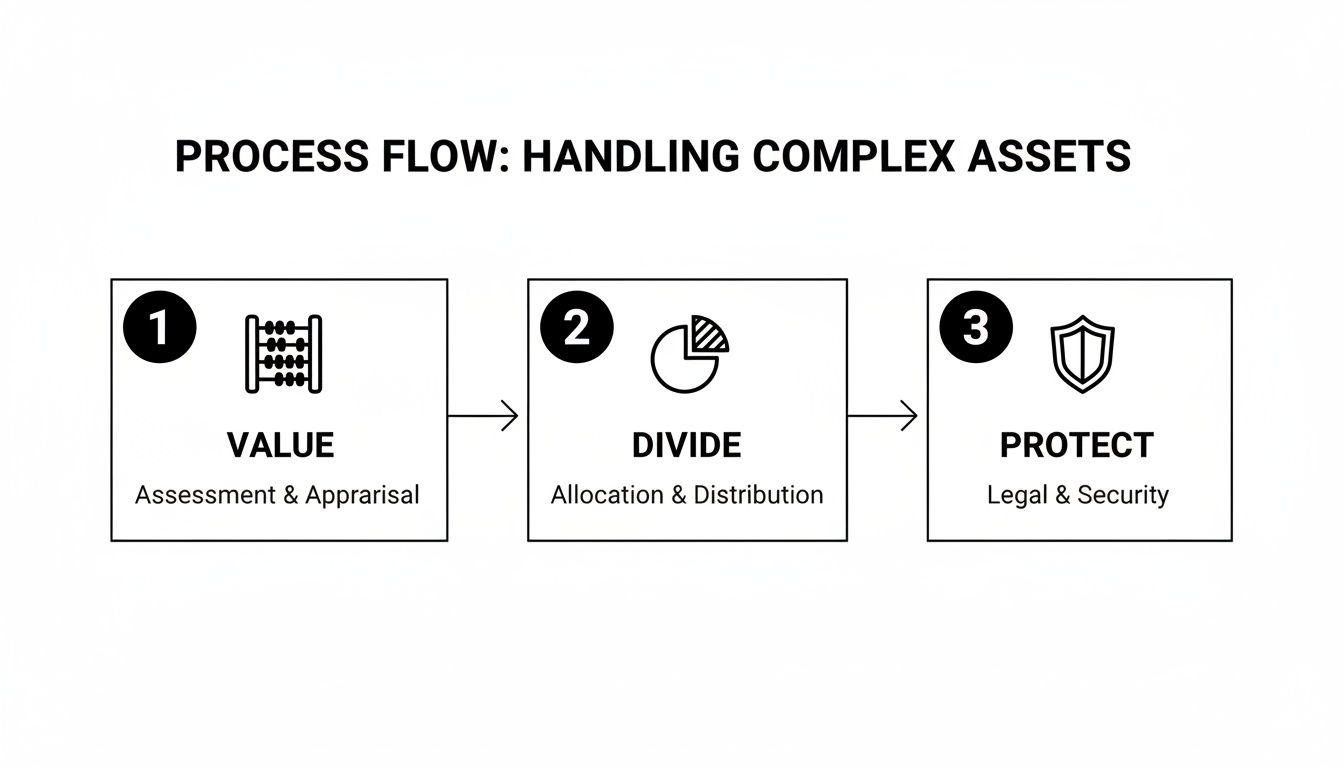
As you can see, a successful outcome depends on three key actions: getting an accurate valuation of what you own, negotiating a fair division, and putting legal protections in place for your future.
Step 4: Reaching a Final Agreement Through Mediation
The vast majority of Texas divorces don't end in a dramatic courtroom battle. Instead, they are settled out of court through mediation. Here, a neutral, third-party mediator helps you, your spouse, and your respective attorneys negotiate a settlement on every unresolved issue in a confidential setting.
If you and your spouse reach a full agreement, your lawyers will draft a Final Decree of Divorce. This is the legally binding document that details every term of your settlement, from who gets the house to the final custody schedule for your children.
Once both of you sign it, the decree is presented to a judge. After a quick review and a few questions, the judge will sign off, and your divorce will be officially finalized.
What to Do Next to Protect Your Future
Going through a divorce can feel like you're lost at sea. But understanding the rules of a community property divorce in Texas is the first step toward finding your footing and taking back control. Knowledge gives you a map, but taking the right actions is what gets you safely to shore.
This isn't a journey you should take on your own. With a clear strategy and an experienced advocate, you can protect what you’ve worked so hard to build and start laying the foundation for your new life.
Your Immediate Action Checklist
Getting organized right now will save you a tremendous amount of stress, time, and money down the road. Focus on these concrete steps to build a strong foundation for your case.
- Gather Your Financial Documents: Start collecting at least two years' worth of statements for all your financial accounts. This means everything: bank accounts, credit cards, mortgages, car loans, retirement plans like 401(k)s and IRAs, and any investment portfolios. These papers are the bedrock of your property division case.
- Avoid Major Financial Changes: Do not sell major assets, empty out joint bank accounts, or take on significant new debt. A judge will not look kindly on any action that seems designed to chip away at the marital estate, and it could seriously backfire in your final settlement.
- Create a Detailed Inventory: Begin making a list of all your assets and debts. For each item, note when you acquired it (before or during the marriage) and what you believe its value is. This list will be a huge help when you and your attorney prepare the Sworn Inventory and Appraisement required by the court.
You don't have to face this complex process alone. A single conversation with a compassionate attorney can provide the clarity and confidence you need to take the next step. Your peace of mind is our priority.
The choices you make over the next few days and weeks will shape your life for years to come. Trying to navigate the legal system without an expert guide can lead to costly mistakes and an unfair division of your property. The single most important action you can take right now is to seek professional legal advice.
Your Path to Peace of Mind Starts Here
The legal system can feel cold and impersonal, but your experience doesn’t have to. Having a strong, empathetic advocate in your corner ensures your story is heard and your rights are aggressively protected. At The Law Office of Bryan Fagan, PLLC, we help Texas families find solutions with both compassion and strength.
We invite you to schedule a free, confidential consultation with one of our experienced family law attorneys. In this meeting, we will listen to your story, answer your questions, and start building a personalized strategy for your case. You’ll leave with a clear understanding of your options and the reassurance that comes from having a dedicated team ready to fight for you.
Don’t let uncertainty dictate your future. Take action today by calling The Law Office of Bryan Fagan, PLLC. Let us help you protect your family and your assets so you can move forward with confidence.
Common Questions About Texas Community Property
The legal jargon around divorce can be overwhelming, especially when your financial future is on the line. Let’s cut through the confusion and get straight to the answers for some of the most pressing questions we hear from clients about a community property divorce in Texas.
What Happens If My Spouse and I Cannot Agree on Property Division?
If you and your spouse are truly at a dead end and can't find common ground through negotiation or even mediation, the final decision will be taken out of your hands. The matter then heads to court for a trial.
At trial, both you and your spouse will present your case—evidence, witness testimony, and legal arguments—explaining why your proposed division is the right one. A judge will listen to everything and then make the final call, dividing your community property based on what they believe is "just and right." This means you lose all direct control over the outcome, which is precisely why finding a resolution in mediation is almost always the smarter, more cost-effective route.
Can a Prenuptial Agreement Change How Our Property Is Divided?
Yes, absolutely. A properly executed prenuptial or postnuptial agreement is a powerful legal tool. Think of it as a private contract between you and your spouse that can essentially override Texas’s default community property laws. These agreements can spell out exactly how certain assets or debts are handled, or even declare that specific assets acquired during the marriage will remain separate property.
If you signed a marital agreement, it’s the very first document a judge will look at to determine how your estate should be divided. It is critical to have a skilled attorney review the agreement to ensure it's valid and to explain exactly how its terms will shape your divorce settlement.
Who Is Responsible for Debts in a Texas Divorce?
Debts are treated a lot like assets. Any liabilities you and your spouse took on during the marriage—like a mortgage, car loans, or credit card balances—are typically considered community debts. The court is tasked with dividing these debts in a way that is “just and right.”
A judge might assign a specific debt to the spouse who is in a better financial spot to pay it off. But here's a crucial point many people miss: your divorce decree doesn't cancel your original contract with the bank or credit card company. If the judge orders your ex-spouse to pay off a joint credit card and they stop making payments, the creditor can—and likely will—come after you for the full amount.
Navigating the complexities of a community property divorce in Texas requires more than just knowing the rules; it requires a strategic advocate who can apply them to your unique situation. At The Law Office of Bryan Fagan, PLLC, we provide the compassionate guidance and assertive representation you need to protect your financial future. Don't face this challenge alone. Schedule a free, confidential consultation with us today by visiting https://texasdivorcelawyer.us to get the clarity and support you deserve.