Skip to content
That feeling in the pit of your stomach when you realize your life's work is now just another asset on the table in your divorce is paralyzing. For any Texas business owner, a divorce isn't just a personal crisis—it's a direct threat to the company you've poured your blood, sweat, and tears into. This guide is designed to cut through that anxiety and give you a clear, actionable path forward, reassuring you that with the right strategy, you can protect what you've built.
How to Protect Your Business During a Divorce
Worrying about your business is completely normal, but it's time to shift from fear to strategy. The first step toward getting a handle on this is understanding a core principle of Texas law: community property.
Simply put, any business value created, grown, or accumulated during your marriage is considered a marital asset. It doesn't matter whose name is on the paperwork or who did the day-to-day work.
Now, this doesn't mean you're going to automatically lose half your company. What it does mean is that the Texas Family Code requires a "just and right" division of the community estate. And you can't get to a "just and right" outcome without first figuring out what the business is actually worth. This is where a professional divorce and business valuation becomes your most critical tool.

Why a Proper Valuation Is Non-Negotiable
A business valuation isn't just about crunching numbers; it's about protecting your future. Without an objective, detailed appraisal from a qualified expert, you're walking into a negotiation blind. You're vulnerable to two very bad outcomes:
- Overvaluation: Your spouse's expert comes in with an inflated, pie-in-the-sky number. This can force you into an unfair settlement where you have to give up other assets or agree to a buyout you simply can't afford.
- Undervaluation: While it might seem tempting to downplay your company's worth, this can backfire spectacularly. If a court suspects you're intentionally hiding or minimizing assets, you could face serious legal and financial penalties.
Under Texas law, a business started or significantly grown during the marriage is presumed to be community property. This makes a credible, defensible valuation the cornerstone of any fair property division settlement.
Moving Forward with a Clear Strategy
Getting through a divorce as a business owner demands a specialized game plan. This goes way beyond standard legal filings; it requires financial savvy and proactive planning.
When you understand how your business will be appraised, you can start gathering the right documents, anticipating points of conflict, and working with your attorney to build a rock-solid case.
The ultimate goal is to make sure the final property division is based on reality, not guesswork or aggression. This almost always involves a deep dive into your financials and relying on expert testimony. Protecting your company is just one piece of the puzzle, and our guide on how to protect assets during divorce can provide a broader look at the overall strategy.
With the right team and a solid legal approach, you can safeguard your hard-earned legacy and move forward with confidence.
Understanding Business Valuation in a Texas Divorce
Putting a single price tag on your business can feel like trying to value a piece of art. It’s about so much more than just the canvas and paint; the real value lies in its reputation, its potential, and the story it tells. In the same way, your company’s worth isn’t just what’s in the bank or the equipment in the office. It’s a complex mix of assets, goodwill, and future promise.
When you’re going through a divorce in Texas, figuring out this value isn’t just a good idea—it’s a legal necessity.
Because Texas is a community property state, any value the business gained during your marriage is considered part of the marital estate. That means it must be identified, valued, and divided in a "just and right" manner. This is where the formal process of divorce and business valuation comes into play. The whole point is to assign a fair, defensible dollar amount to the business so it can be handled equitably, just like your house or retirement accounts.
Why You Can’t Just Guess the Value
It’s tempting to pull a number out of thin air or use a simple industry rule of thumb. Maybe you think you know what your business is worth. But that approach is a recipe for disaster in a Texas divorce court. A judge won’t accept a gut-feeling valuation; they require a credible, professional opinion that can hold up under cross-examination.
Getting this number wrong—whether it’s too high or too low—can completely derail negotiations and lead to a profoundly unfair settlement.
And this isn't a rare problem. With approximately 41% of first marriages ending in divorce, there's a significant chance a successful entrepreneur will have to navigate this very process. This reality is exactly why professional, precise business valuation is so critical. You can explore more about U.S. divorce trends from the Pew Research Center.
Introducing the Three Core Valuation Methods
So, how do the experts do it? Financial professionals generally rely on three standard approaches to determine a business’s value. Think of them as different lenses for looking at your company’s financial health. We’ll dive deeper into these later, but here’s a quick overview.
- The Asset Approach: This is the most straightforward method. It’s like taking a detailed inventory of everything the business owns (cash, equipment, real estate, even intellectual property) and subtracting everything it owes (loans, accounts payable). What’s left is the net asset value.
- The Market Approach: This works a lot like appraising a house. A valuation expert looks at what similar businesses in your industry have recently sold for. By analyzing these "comps," they can determine a realistic market price for your company.
- The Income Approach: This method is all about the future. It focuses on the business's power to generate profit down the road. An expert will project future earnings or cash flow and then calculate what that future income stream is worth in today's dollars.
The ultimate goal of a valuation in a divorce is to determine the business's 'fair market value.' This is defined as the price a willing buyer would pay to a willing seller, where neither is under any pressure to make the deal. This objective standard is what Texas courts strive to achieve.
The right method really depends on the kind of business you own. For a company that mainly holds real estate, the Asset Approach makes a lot of sense. But for a popular restaurant with a strong brand and steady profits, the Income Approach might be a better fit. Often, an expert will use a combination of methods to arrive at the most accurate and defensible number possible. This isn’t a step you can skip—it’s the foundation for making sure your assets are divided fairly and your hard work is protected.
The Three Main Business Valuation Methods Explained
Figuring out what your business is worth during a divorce isn't a one-shot deal. It's more like a careful financial investigation using well-established methods. Think of a master craftsman who uses different tools for different jobs; a financial expert does the same, using specific approaches to build an accurate picture of your business's value. Getting a handle on these methods is the first step toward ensuring the final number in your divorce and business valuation is both fair and defensible.
Each method gives a unique perspective on your company's value. The right one—or, more often, a combination of them—depends entirely on the kind of business you've built.
The Asset Approach: A Look Inside
The Asset Approach is the most straightforward of the three. Imagine valuing a vintage car by adding up the worth of its engine, chassis, and every individual part. That's the asset approach in a nutshell. An expert using this method will create a detailed inventory of all your business assets—things like cash, accounts receivable, equipment, real estate, and inventory.
Next, they subtract all the liabilities—loans, debts, and accounts payable. What's left is the net asset value. This method works best for businesses where the value is tied up in physical things, such as:
- Real estate holding companies
- Manufacturing plants full of heavy machinery
- Capital-intensive businesses like trucking or construction
But this approach doesn't tell the whole story for service-based businesses. For them, the real value isn't on a balance sheet; it's in the company's reputation and its ability to keep generating revenue.
The Market Approach: Comparing to Peers
The Market Approach works a lot like valuing a home in your neighborhood. A real estate appraiser doesn't just look at your house; they look at what similar homes nearby have recently sold for. In the same way, a valuation expert will research the sale prices of comparable businesses in your industry and region.
This method gives you a real-world benchmark for what a willing buyer might actually pay for your company. The core idea is using comparative data, a principle that applies across different types of valuations. You can see how technology has shaped this concept in guides to real estate valuation software, including AI and AVMs, which rely on similar data-driven comparisons.
The diagram below breaks down the core concepts behind each valuation method.
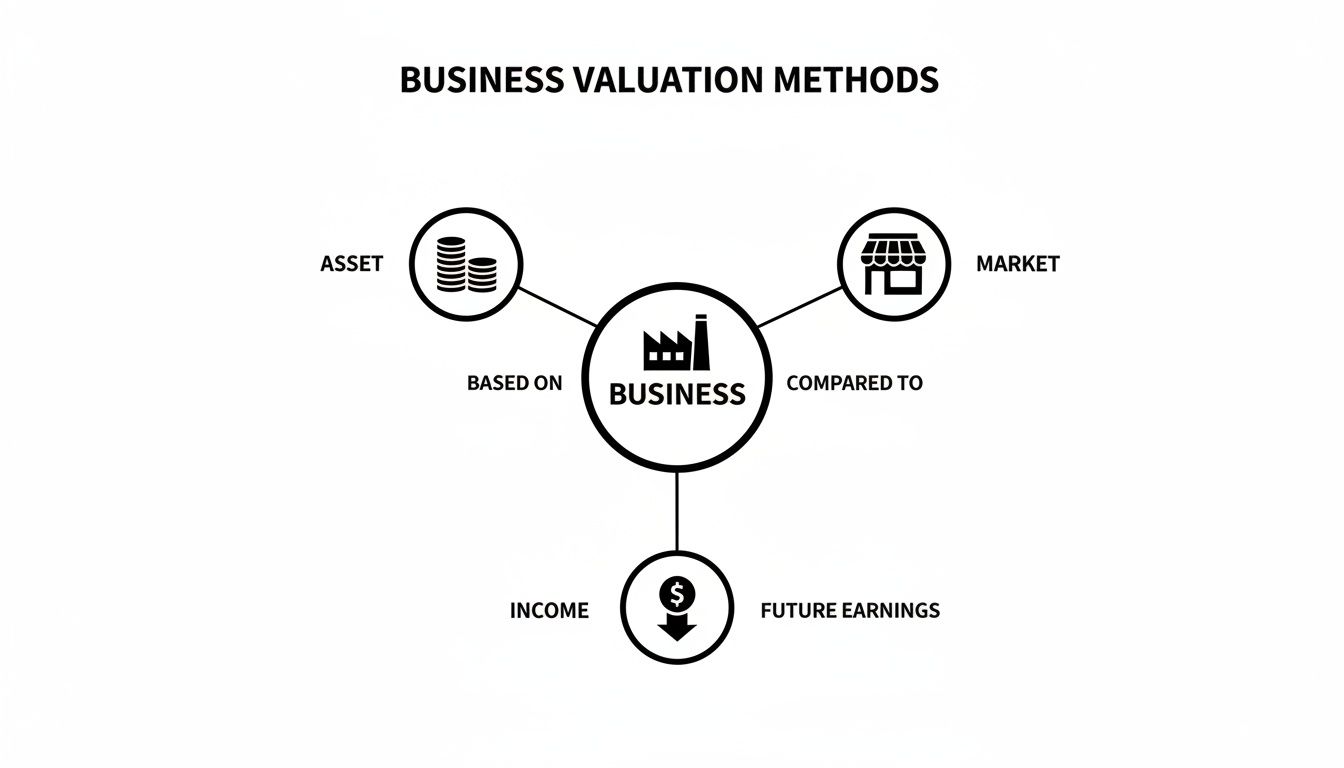
As you can see, the Asset, Market, and Income approaches each provide a different lens for viewing a company's worth. This is why relying on a single method can sometimes miss the full picture.
The Income Approach: Valuing Future Potential
Finally, there’s the Income Approach, which is all about looking ahead. Imagine you're buying a rental property. You're probably less concerned with the cost of the bricks and mortar and more interested in how much rental income it will generate for years to come. This is exactly how the Income Approach works.
An expert will analyze your business's past earnings to project its future cash flow or profits. They then use a specific calculation to figure out what that future stream of income is worth in today's dollars. This is often the go-to method for profitable, service-based businesses with a strong history of earnings, like:
- Medical or dental practices
- Law firms and consulting agencies
- Restaurants and retail stores with loyal customer bases
In Texas, one of the trickiest parts of valuation is "goodwill"—that intangible value tied to a business's reputation, customer base, and brand recognition. The court is very careful about distinguishing between personal and enterprise goodwill.
The Crucial Texas Distinction: Personal vs. Enterprise Goodwill
Under the Texas Family Code, this distinction is absolutely critical.
Personal goodwill is the value tied directly to you—your unique skills, your personal reputation, and the relationships you've built. The law considers this your separate property, meaning it is not divisible in a divorce. A great example is the loyalty of patients to a specific, well-known surgeon; that value is tied to the individual, not just the practice.
On the other hand, enterprise goodwill belongs to the business itself. It’s the value that would stick around even if you walked away tomorrow, tied to things like the company's brand, location, or established systems. This value is part of the community estate and must be divided. A skilled attorney will fight to ensure this line is drawn correctly to protect your separate property while fairly valuing the marital estate.
To make these concepts clearer, let's break down the three methods side-by-side.
Comparing Business Valuation Methods
This table offers a snapshot of the three main valuation methods, their best use cases, and key considerations for Texas business owners going through a divorce.
| Valuation Method | How It Works | Best For | Texas-Specific Consideration |
|---|---|---|---|
| Asset Approach | Calculates value by subtracting total liabilities from the total fair market value of all assets. It's a balance-sheet-focused method. | Businesses where value is primarily in tangible assets, like real estate holding companies, manufacturing, or capital-intensive industries. | Crucial for identifying and valuing physical assets that are part of the community estate, such as machinery or property purchased during the marriage. |
| Market Approach | Determines value by comparing the business to similar companies that have recently been sold. It relies on finding good "comps." | Businesses in industries with a high volume of transactions and publicly available sales data, such as restaurants, retail, or tech startups. | The availability of comparable sales data for privately-held Texas businesses can be limited, sometimes making this approach more challenging to apply accurately. |
| Income Approach | Projects future earnings or cash flow and then discounts that amount to determine its present-day value. It's a forward-looking method. | Profitable service businesses with a consistent earnings history, such as professional practices (medical, legal), consulting firms, and established service companies. | This is where the personal vs. enterprise goodwill distinction becomes critical. An expert must carefully separate the business's inherent earning power from the owner's personal reputation. |
Understanding which method (or combination of methods) is most appropriate for your business is a key strategic conversation to have with your divorce attorney and financial expert. The right approach ensures the valuation is not only accurate but also stands up to scrutiny in a Texas courtroom.
Navigating the Valuation Process Step by Step
Thinking about valuing your business during a divorce can feel overwhelming, but it's really just a structured journey with a clear roadmap. Breaking it down into manageable steps transforms it from a scary unknown into a predictable process. Knowing what’s coming will help you feel more in control and better prepared to protect your financial interests.
The whole thing kicks off with finding the right expert and then dives deep into your company's financial history.

Step 1: Selecting Your Financial Expert
Your very first decision is a big one: choosing the right valuation expert. This person is going to dig into your company's books and give a professional, defensible opinion on what it's worth. When it comes to hiring, you and your spouse have a couple of options.
- Joint Expert: You can both agree to hire a single, neutral expert. This path is usually cheaper and creates less conflict, since everyone is working from the same playbook. This is often a good route if you and your spouse are on relatively good terms.
- Separate Experts: Each of you can hire your own expert. It definitely costs more, but sometimes it’s necessary, especially if the business is complicated or if you and your spouse are already at odds. In this scenario, you'll end up with two different valuation reports that your lawyers will use to negotiate.
Don't take this choice lightly. You need a professional with credentials like a CPA (Certified Public Accountant) who also holds special valuation certifications (like ABV or CVA) and, crucially, has experience testifying in Texas family law courts.
Step 2: The Discovery and Document Gathering Phase
Once you’ve got an expert on board, it's time for the deep dive. This is the discovery phase, where the expert requests a mountain of financial documents to get a full picture of the business's health and history. Being transparent here isn't just a good idea—it's a legal requirement.
Think of this phase like a doctor gathering your medical history before making a diagnosis. Without a complete picture, any conclusion is just a guess. In a divorce, incomplete financial information can lead to inaccurate valuations and costly disputes.
The list of requested documents will be long, but it will almost certainly include things like:
- Several years of business tax returns (both federal and state)
- Detailed profit and loss statements and balance sheets
- Bank statements and any loan documents
- A comprehensive list of major assets and liabilities
- Payroll records and shareholder agreements
This financial investigation is the backbone of an accurate valuation. You can get a better handle on the formal legal process for gathering this info in our guide on the discovery process for a Texas divorce. The level of detail required is intense, often mirroring a full-blown mergers and acquisitions due diligence process, because both situations demand a thorough investigation to uncover the true value.
Step 3: Analysis and the Final Valuation Report
With all the documents in hand, the expert rolls up their sleeves and gets to work. They'll crunch the numbers, apply the right valuation methods (Asset, Market, or Income), and make adjustments for any unique factors that affect your business. This is the most time-consuming part of the whole process, easily taking weeks or even months for a complex company.
The final product is a formal, written valuation report. This document is incredibly detailed, laying out the expert’s methodology, the specific information they relied on, and their ultimate conclusion on the business's fair market value. From that point on, this report becomes a centerpiece of your property division negotiations.
What follows might include depositions, where lawyers get to question the expert on their findings, or even trial testimony if a settlement can't be reached. Having a rock-solid report from a credible expert is your best asset for defending the valuation and achieving a fair outcome under Texas law.
Common Disputes and Strategic Ways to Protect Your Assets
When it comes to divorce, the business valuation process can feel less like a financial exercise and more like a battleground. It’s often the most contentious piece of a high-asset divorce because that final number has a ripple effect across the entire property settlement.
Anticipating these common disputes is the key to building a strong defense and protecting what you’ve worked so hard to create. Knowing where disagreements are likely to pop up allows you and your attorney to build a proactive strategy instead of just reacting to conflicts as they arise.

Disagreements Over the Valuation Date
One of the first potential tripwires is the valuation date. This is the specific "as of" date the business is valued for. In Texas, the court typically wants this date to be as close to the trial date as possible, but that doesn't stop spouses from arguing for different dates.
Why does it matter so much? A business's value can swing wildly over just a few months thanks to market shifts, a big new contract, or an economic downturn. It’s common for one spouse to argue for a date when the business was at its peak, while the other will push for a date when it was less profitable.
Conflicts Over Goodwill
As we’ve touched on, the difference between personal and enterprise goodwill is a major flashpoint. Your spouse's expert will likely try to classify as much of the company's intangible value as possible as enterprise goodwill, making it community property ripe for division.
On the other hand, your team will work to demonstrate that a huge chunk of that value is directly tied to your personal reputation, skills, and relationships—making it personal goodwill, which is your separate property. This is a nuanced argument that absolutely requires a highly experienced valuation expert to win.
Arguments About "Normalizing" Income
A good valuation expert doesn't just glance at last year's tax return. They dig deep in a process called "normalizing" adjustments to get a true picture of the business’s real earning power. This means adjusting the financial statements to strip out unusual, one-time expenses and any personal perks run through the business.
This is where the gloves really come off. Common points of contention include:
- Owner's Salary: Is your salary artificially inflated or suspiciously low compared to the industry standard?
- Personal Expenses: Are car payments, family vacations, or cell phone bills for the whole family being disguised as business expenses?
- One-Time Events: Was there a single, massive sale or a huge, unusual expense that shouldn't be considered part of the normal, repeatable operations?
Every one of these adjustments can dramatically swing the final valuation number, making it a frequent source of heated debate.
Accusations of Hiding Assets or Devaluing the Business
Unfortunately, it’s not unheard of for one spouse to suspect the other is deliberately tanking the business's finances on paper. This can look like delaying customer payments, prepaying a year's worth of expenses, or even creating phony debts to make the company look less profitable than it is.
If you suspect this is happening, you need to act immediately. This is where a forensic accountant becomes essential to trace the money and uncover any hidden assets or financial misconduct. A clear and robust strategy is critical, and you can learn more by exploring our guide to protecting business assets in high-net-worth Texas divorces.
In Texas, a judge has broad discretion to award a disproportionate share of the community estate to a spouse if they find the other spouse committed "fraud on the community" by wasting or hiding assets.
The stakes in these financial disputes are especially high for business owners in second or third marriages. While about 41% of first marriages end in divorce, the rates climb to 60-67% for second marriages and 70-73% for third marriages. These numbers highlight just how vital it is to have strong asset protection strategies and clear valuation protocols in place.
The best defense against these common disputes is always meticulous record-keeping and a credible, experienced team in your corner.
Your Next Steps to Secure Your Business and Future
Navigating a divorce while protecting a business you've poured your life into can feel overwhelming. It’s easy to get lost in the details, but you can move forward with purpose by focusing on a clear, step-by-step action plan. This is about taking control of the process and building a strategy to secure both your company and your personal future.
You don’t have to figure this out alone. In fact, the single most important step you can take is to get experienced legal guidance tailored to the unique challenges of a divorce and business valuation right here in Texas.
What to Do Next
Feeling empowered starts with taking concrete steps, not just worrying about what might happen. We’ve boiled down the most critical first moves into a simple checklist to help you move forward with confidence and clarity. Think of this as your immediate "what to do next" guide.
Start by focusing on these essential tasks:
- Gather Essential Documents: Start collecting your key financial records right away. You'll want at least three to five years of business tax returns, profit and loss statements, balance sheets, and bank statements. Having these ready will save a ton of valuable time down the road.
- Consult a Family Law Attorney: Don't wait. Schedule a consultation with an attorney who has specific, proven experience handling high-asset divorces involving business ownership in Texas. Their strategic guidance from day one is priceless.
- Identify Financial Experts: Talk to your attorney about whether it makes sense to hire a joint valuation expert or if you need your own. They can connect you with qualified forensic accountants and valuation professionals who have experience testifying in Texas courts.
Why You Cannot Afford to Wait
Putting these steps off can put your business at a serious disadvantage. Over time, memories fade, documents can get misplaced or even "disappear," and a reactive strategy is always weaker than a proactive one. Taking action now allows you to build a strong case based on facts and thorough preparation, not last-minute scrambling.
You have invested too much in your business to leave its fate to chance. Taking decisive action now is the single best way to protect your legacy, your family, and your financial future.
We understand the weight on your shoulders. The complexity of dividing a business adds a massive layer of stress to an already difficult time. But you have the power to face this challenge head-on with the right support system in your corner.
The attorneys at The Law Office of Bryan Fagan, PLLC are here to provide the compassionate, experienced legal support you need. We'll help you build a comprehensive strategy to protect your business. Schedule a free, confidential consultation with us today to take the first step toward securing your future.
Frequently Asked Questions on Business Valuation
When you're facing a divorce with a business on the line, the questions can feel endless and overwhelming. Getting clear, straightforward answers is the first step toward regaining your footing and making informed decisions. Here are some of the most common questions we hear from Texas business owners just like you.
How Much Does a Business Valuation Cost in Texas?
There isn’t a single, flat fee for a business valuation because the cost is a direct reflection of the work involved. For a small, straightforward business with clean books, you might expect to pay somewhere between $5,000 and $10,000. On the other hand, for larger companies with complex assets, multiple locations, or messy financials, the cost can easily climb past $25,000.
What drives the final price? A few key factors:
- The size and revenue of your business.
- The quality and organization of your financial records.
- The level of conflict between you and your spouse. A joint, neutral expert is almost always more cost-effective than each side hiring their own.
Is My Pre-Marital Business Considered Community Property?
Under the Texas Family Code, a business you owned before your wedding is your separate property. But this is where things get tricky. Any increase in the business's value that happened during the marriage is presumed to be community property.
This means the community estate may have a right to be reimbursed for the value your separate property business gained while you were married. This almost always leads to complex financial tracing to separate the pre-marital value from the growth that occurred during the marriage. It’s a critical distinction that requires an expert legal and financial team to get right.
What Happens If We Cannot Agree on the Business Value?
Disagreement is common when it comes to divorce and business valuation. If you and your spouse can't reach an agreement on a value, even after hiring experts, the issue will likely head down one of two paths.
First, your attorneys will almost certainly recommend mediation. Here, a neutral, third-party mediator helps you and your spouse try to negotiate a compromise. More often than not, this is the most effective way to resolve the dispute without the time and expense of going to court.
If mediation fails, the decision will ultimately be left to a judge. At trial, both sides will present their expert’s valuation report and testimony. The judge will listen to both arguments and then make a final ruling on the business’s value for the purpose of dividing your property.
Will I Be Forced to Sell My Business in the Divorce?
A forced sale of a business is extremely rare and is truly a last resort in a Texas divorce. Courts understand that a business is often a primary source of income for the family and strongly prefer solutions that keep it up and running.
Instead of a sale, judges and attorneys will work to find creative alternatives. The most common solutions include:
- A Buyout: One spouse buys out the other’s interest in the business, often with a structured payment plan over time.
- Asset Trade: The business-owning spouse keeps the company, and the other spouse receives other community assets of equivalent value, like the family home or a larger share of retirement accounts.
- Co-Ownership: In rare, amicable cases, spouses might agree to continue co-owning the business after the divorce through a formal, legally-binding agreement.
You have invested too much in your business to navigate its division alone. The compassionate and experienced attorneys at The Law Office of Bryan Fagan, PLLC are here to build a strategy that protects your company and secures your future. Schedule a free, confidential consultation with us today by visiting https://texasdivorcelawyer.us.