Skip to content
You may be staring at two addresses, two counties, and one hard question: where do I even file for divorce in Texas?
That confusion is normal. When your marriage is changing, the last thing you need is a filing mistake that slows everything down before your case even starts. The good news is that venue for divorce in texas follows rules you can understand, and once you do, the process feels much less mysterious.
Starting Your Divorce The Right Way Where You File Matters
A lot of people think the first big divorce decision is whether the case will be contested. Often, it isn’t. The first big decision is where the case gets filed.
That choice is called venue. In plain English, venue means the county where your divorce should be filed and heard. It sounds procedural, but it affects daily life in very real ways. It can shape how far you drive, where hearings happen, which local court staff process your case, and whether your spouse can challenge the filing.
Texas divorces haven’t disappeared, but the broader trend has changed. Texas had a divorce rate of 1.4 divorces per 1,000 people in 2021, the lowest rate since 1990, and below the national average, according to Texas divorce statistics compiled here. That means fewer people may be going through divorce relative to population size, but for the people who are, getting the legal basics right still matters just as much.
If you’re at the beginning, start with one simple question: Which county legally makes sense for my filing? Before you answer that, make sure the basic Texas residency rules are in place. A helpful starting point is this guide to Texas divorce residency requirements.
Practical rule: The right venue doesn’t just keep your paperwork clean. It can lower stress, reduce avoidable disputes, and help your case move in a more predictable way.
Think of venue like choosing the right airport before a long trip. If you start in the wrong place, every step afterward gets harder.
Understanding Venue and Jurisdiction in Texas
Jurisdiction and venue are easy to confuse, especially early in a divorce when every legal term sounds bigger than it is. They answer two different questions, and separating them early can save you stress, delay, and avoidable fights.
Jurisdiction asks whether a Texas court has the legal authority to hear your divorce at all.
Venue asks which Texas county is the proper place to file it.
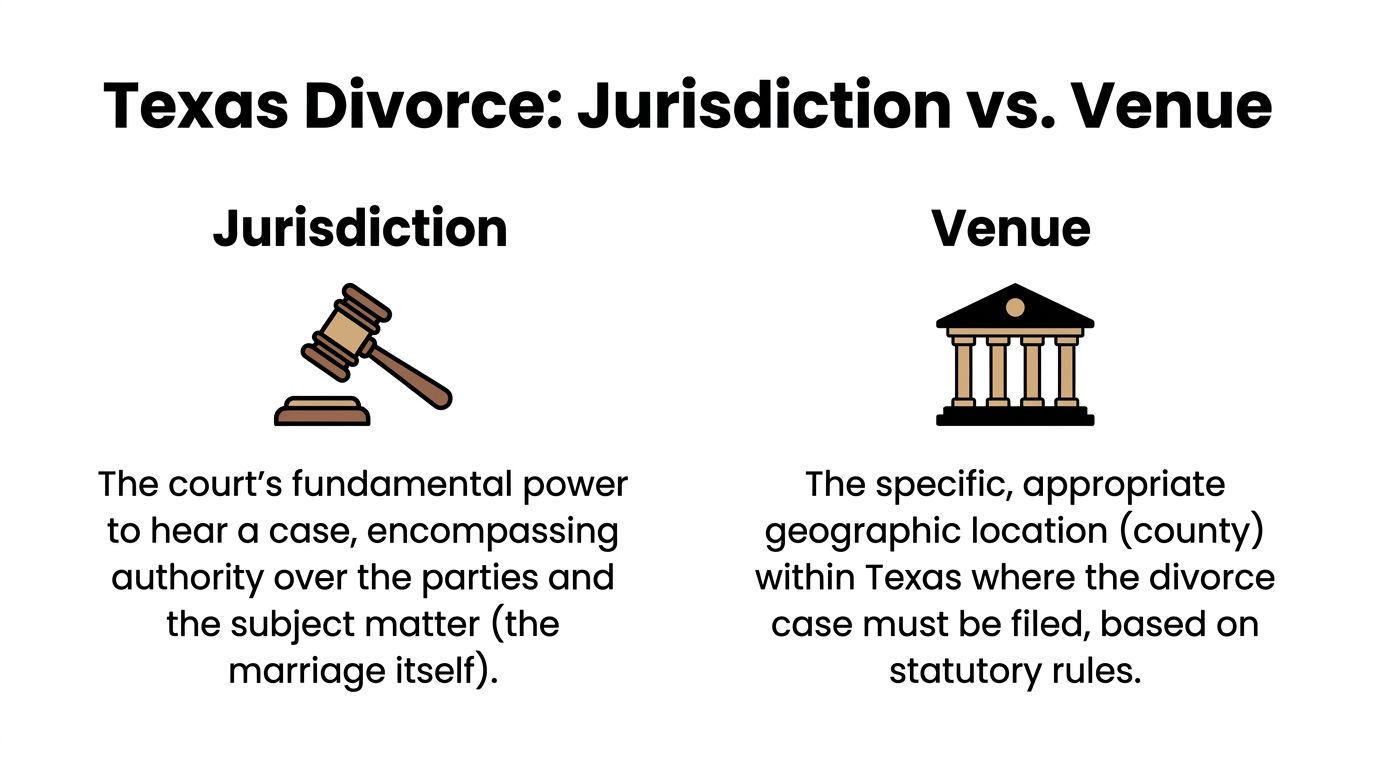
That distinction matters more than people expect. If jurisdiction is missing, the court may not be able to hear the case. If venue is wrong, the case may still exist, but it can be challenged and moved to another county. In practical terms, one question is about legal power. The other is about legal location.
A simple comparison helps here. Jurisdiction works like having permission to enter the building. Venue is being sent to the correct room once you are inside. You can have a Texas court with authority over the divorce and still choose the wrong county for filing.
What Texas Family Code Section 6.301 requires
Under Texas Family Code § 6.301, proper venue depends on residency at both the state and county level, as explained in this discussion of venue and jurisdiction in Texas divorce.
Here is the basic checklist:
| Question | What you need to confirm |
|---|---|
| Texas residency | At least one spouse has lived in Texas for the required six-month period |
| County residency | At least one spouse has lived in the filing county for the required 90-day period |
If both boxes are checked, that county may be a proper venue. If one is missing, the other side may object.
This is why venue is more than a paperwork detail. It is often the first strategic choice in a Texas divorce. The county you file in can affect travel time, hearing logistics, local court procedures, and how much friction shows up at the start of the case. In divorces involving children or complex property issues, getting that first choice right can shape how manageable the entire process feels.
Why mistakes matter
A venue mistake does not always end a case, but it can create immediate problems. A spouse may file a motion challenging the county. The court may transfer the case. Deadlines can shift, hearings can be postponed, and costs can rise while everyone argues about where the divorce should have started.
That is frustrating because it is often avoidable.
Many people assume the most convenient county is the right county. Texas law does not work that way. Convenience may matter later, but the first question is whether the county meets the legal residency rule.
A calmer way to approach this is to ask two questions in order. First, can Texas hear my divorce? Second, which county is legally proper?
Where confusion usually starts
Certain situations cause repeat problems:
- A recent move: You may already feel settled in the new county, but the law still counts time.
- Spouses in different counties: More than one county may seem connected to the marriage, but only counties that meet the residency rule are proper choices.
- A focus on convenience first: Shorter drives and familiar courthouses matter, but they do not replace the legal venue requirement.
If you keep one idea in mind, make it this one: jurisdiction gives the court authority, and venue chooses the county where the case should begin.
Common Venue Scenarios for Texas Families
You may be sleeping in one county, your spouse may be living in another, and your children may spend most school nights somewhere else. That is when venue stops feeling like a technical filing rule and starts feeling like the first strategy call in your divorce.

A good way to read these situations is to treat venue like choosing the court that will become the working home for your case. The legal rule comes first. After that, practical consequences matter. The county where a divorce begins can affect travel time, hearing logistics, access to witnesses, and how hard it is to manage a case involving children or contested property.
When spouses live in different counties
This is one of the most common situations.
Suppose you live in Harris County, and your spouse now lives in Dallas County. If each county independently meets the legal residency rule, either county may be proper. In that narrow window, filing first often matters because the first properly filed case usually sets the starting point unless the other spouse has a valid basis to object.
That does not mean racing to the courthouse without a plan. It means recognizing that more than one legally proper option can exist, and one may fit your life better than the other.
If you are weighing a Houston-area filing, this guide on filing a divorce in Harris County explains the local practical side of that decision.
When one spouse recently moved
Recent moves create confusion because daily life changes faster than residency status.
You may have a new lease, a new job, and every reason to stay. Texas venue law still cares about time. If the county residency period has not been met, filing there can invite a challenge that slows the whole case down.
In that situation, the safer county is often the one with a cleaner paper trail. Utility bills, lease dates, school records, and employment history can all matter if the other side argues the move was too recent or too temporary.
A few patterns come up again and again:
- You lived for years in the marital county, then moved after separation. The prior county may still be the stronger filing choice.
- Both spouses moved around the same time. The better venue is often the county where one spouse can show a clearer, longer residence period.
- One spouse is staying with relatives or in short-term housing. That setup can raise questions about whether the county is the right place to file.
When children live mainly in one county
Children change the venue conversation because divorce cases involving custody are about more than where the adults happen to live.
A child’s school, doctors, counselors, daycare, and daily routine often center in one county. That county may matter a great deal when conservatorship, possession, decision-making, or child support will be disputed. A judge handling those issues may need records and testimony from people tied to the child’s ordinary life.
A simple way to think about it is this: if property division looks backward at what the marriage owned, custody issues look closely at the child’s current day-to-day world.
So if you are choosing between two legally available counties, the county most connected to the children’s routines may deserve special attention. Convenience for a parent matters, but it should not be the only factor guiding the choice.
If your divorce involves child-related disputes, choose venue with the child’s daily life in mind, not just your driving distance to the courthouse.
Four common examples
These examples show how venue analysis often works in real families.
You stayed in the marital home, and your spouse moved out
If you remained in the same county and satisfy the residency rule there, that county is often the most straightforward place to file.You moved closer to family after separation
That may have been the right personal decision. Your new county still may not be available yet if you have not lived there long enough under the venue rule.Your spouse relocated for work
The new county may become proper once the residency period is met. Until then, the prior county may be the cleaner option.The children are established in one county
If custody will be contested, the county tied to school, activities, health care, and daily care may be more than a convenient choice. It may be the smarter strategic one.
Venue is a legal rule and a case-planning decision
Families often assume venue is just a box to check on the petition. In practice, it works more like selecting the room where every major conversation in the case will happen.
The right county can make the process more manageable. The wrong county can create objections, transfers, extra expense, and delays. That is why real-life venue questions deserve more than a quick guess. They deserve a careful look at residence history, the children’s routines, and how the case is likely to unfold.
Special Venue Rules for Military Divorces and Non-Residents
A spouse may be living in Oklahoma, stationed in Germany, or temporarily assigned to Fort Cavazos, while the marriage, children, house, and records still point back to Texas. These are the cases where venue stops feeling like a simple county question and starts looking more like the first strategic map of the case.
A filing that makes sense on paper can still run into trouble if residence, military status, or service rules are not lined up correctly.

When one spouse lives outside Texas
Texas law does allow some out-of-state spouses to file here. Under Texas Family Code § 6.302, a non-resident can file in Texas if the other spouse has lived in Texas for at least six months and in the county of filing for at least 90 days, as explained in the Texas State Law Library divorce filing guide.
That rule catches many people off guard. Leaving Texas does not always mean losing Texas as an option.
A simple way to view it is this. The court looks for a strong Texas anchor. If your spouse still has the required residence ties here, Texas may remain available even though you now live somewhere else.
That often matters when the marriage still has practical roots in Texas, such as:
- A spouse who stayed in Texas after separation
- Children who still live, attend school, or receive care in Texas
- A house, business, or major property interests located in Texas
Military families have an extra layer to sort out
Military life can separate physical location from legal residence. A service member may sleep in one state, be assigned to another, and still claim Texas as home for legal purposes. That is why military venue questions often require a closer look at orders, domicile, housing records, voter registration, and where the family has been living day to day.
Venue in these cases works a lot like tracing the center of gravity of the family. Temporary duty stations can shift quickly. Legal residence usually does not shift quite so easily.
Military cases can also involve timing issues that civilian families never face. Active-duty status may affect service of process, response deadlines, and whether the case can move forward on the usual schedule. If your situation overlaps with military discipline or related service issues, the UCMJ lawyers' blog offers broader military legal background.
Why these cases require a more careful filing strategy
With civilian divorces, the county choice is often obvious. In military and interstate divorces, the facts can point in several directions at once.
| Situation | Why venue gets harder to pin down |
|---|---|
| Deployment | Current location may have little connection to legal residence |
| Frequent reassignments | The family's day-to-day county may have changed more than once |
| Non-resident spouse | Texas may still be proper if the in-state spouse meets the residency rules |
| Children in Texas, parent elsewhere | Custody-related facts may be centered in a different place than the filing spouse |
Strategy matters early. If more than one place seems possible, you want to ask which county is easiest to defend if the other side objects, which county is tied to the children's routine, and which choice creates the fewest procedural problems.
Documents matter more here
Military and non-resident cases usually rise or fall on proof. Court filings become much steadier when you can show the timeline clearly with orders, leases, utility bills, school records, driver’s license information, and other residence documents.
For a closer look at service-specific issues, this guide to military divorce laws in Texas can help you sort out the rules that often overlap with venue.
In these cases, the real question is usually not just whether Texas is available. It is whether you can show, with clean facts and the right documents, why this Texas county is the right place to start.
The Strategic Side of Choosing Your Divorce Venue
Two spouses may both meet Texas filing rules, yet one county can make the case far easier to manage than another. That is why venue is not just a box to check. It is often the first strategic decision in the divorce.

A simple way to look at it is this. Jurisdiction answers, “Can Texas hear this divorce at all?” Venue answers, “Which Texas county should handle it?” If more than one county is legally proper, choosing among them can affect your time, your costs, and the practical flow of the case from the first hearing forward.
Convenience affects strategy
People sometimes treat convenience like a minor detail. In divorce, it rarely is.
A county that is closer to the children’s school, your records, your witnesses, or your workplace often makes the case easier to prepare and less expensive to maintain. That can shape settlement discussions too. A spouse who is constantly missing work, driving long distances, or scrambling to gather documents from another county is under more pressure from the process itself.
That pressure tends to hit hardest for:
- Parents working around school and exchange schedules
- Business owners dealing with records, cash flow, and valuation questions
- Spouses sorting through multiple properties or complex finances
- Professionals with limited flexibility for hearings during the workday
Venue does not change the law. It can change how hard it is to live through the case.
Local court process can change the feel of a case
Texas family law is statewide, but counties do not all operate in the same rhythm. Some have dedicated family courts with established procedures for temporary orders, discovery disputes, and parenting issues. Others may have busier dockets or different scheduling habits.
That matters early. Divorce often starts with urgent decisions about who stays in the house, how bills get paid, where the children stay, and what each spouse can or cannot do while the case is pending. A county’s scheduling pace and local procedures can influence how quickly those issues get in front of a judge.
For many families, four practical questions help separate a merely proper venue from a smart one:
| Question | Why it matters |
|---|---|
| Where will hearings cause the least disruption? | Less travel and fewer missed work hours usually mean lower stress and lower cost |
| Where is the proof easiest to gather and present? | School records, financial records, appraisals, and witnesses are simpler to manage when they are nearby |
| Where are the children’s daily lives centered? | Judges deciding parenting issues often need facts tied closely to the child’s routine |
| Where might temporary issues need fast attention? | Early access to hearings can shape the tone and momentum of the whole case |
Strategy is not gamesmanship
A good venue decision is like choosing the right starting point on a map. If you start in the wrong place, every mile after that gets harder.
That does not mean trying to outmaneuver the system. It means using lawful options carefully and with a clear goal. If one county is tied more closely to the children’s routine, the family finances, the witnesses, and the day-to-day facts, filing there may reduce friction and make the case easier for the court to understand.
For readers dealing with substantial marital estates, Law Office of Bryan Fagan, PLLC publishes resources on divorce, property division, mediation, support, and enforcement that can help you frame those decisions.
A short video can also help if you prefer to learn visually before you make a filing decision.
One filing choice can influence many later decisions, especially in cases involving children, real estate, retirement accounts, a family business, or disputed temporary orders. The law may be the same across Texas. Your experience inside the case often is not.
How to Correct a Mistake and Change Venue
If a divorce gets filed in the wrong county, you are not stuck. Texas procedure gives you a tool to challenge that problem. It’s commonly called a Motion to Transfer Venue.
This tends to matter in two situations. First, your spouse files in a county that doesn’t meet the legal rule. Second, the case starts in one place, but there is a valid legal basis to argue another county is the proper or more appropriate forum under the circumstances.
The basic idea
A motion to transfer venue asks the court to move the case to the correct county. The request has to be handled carefully, because timing matters.
If you believe venue is wrong, don’t wait and hope the issue fixes itself. Venue objections can be lost if they aren’t raised properly.
A practical step-by-step approach
Review the filing county carefully
Look at where each spouse has lived and for how long. Don’t rely on assumptions or mailing addresses alone.Gather proof of residence
Courts often look at practical evidence of residence and intent. Leases, licenses, voter registration, and similar records can matter.File the motion promptly
Venue challenges usually need to be raised early, before you take steps that suggest you accept the county.Explain why the county is improper or why transfer is justified
The court needs a legal reason, not just a personal preference.Prepare for a hearing if needed
If the other side disputes the facts, the judge may need evidence and testimony.
What readers often worry about
Many people fear that challenging venue will make them look difficult. Usually, it does not. If the county is wrong, raising the issue is part of protecting your rights.
Others worry that a bad filing ruins the whole case. Usually, it doesn’t. More often, it creates delay, extra expense, and avoidable friction.
A venue challenge is not about winning an argument for its own sake. It’s about making sure the case proceeds in the county the law requires.
When transfer issues overlap with settlement
Sometimes a venue dispute appears at the same time as early negotiation. If that happens, don’t assume settlement talks solve the venue problem automatically. You may still need to preserve your objection while discussing temporary arrangements, parenting plans, or mediation.
That’s one reason many families look at the dispute from both angles at once. They ask, “Is this the right county?” and “Can we still move toward resolution?” If mediation becomes part of your next step, it helps to understand how venue and negotiation fit together in the larger divorce timeline.
What to Do Next Your Path to a Clear Resolution
A lot of divorce stress starts before the first hearing. It starts with uncertainty about where the case belongs.
Filing in the right county sets the tone for everything that follows. It can affect how easy it is to attend hearings, how quickly temporary orders get addressed, how child-related issues fit with the children’s actual lives, and how much time and money gets spent correcting avoidable mistakes. In that sense, venue is more than a filing detail. It is one of the first strategy choices in a Texas divorce.
If the rules still feel abstract, use this simple frame: jurisdiction asks whether a Texas court has the power to hear the divorce. Venue asks which Texas county is the proper place to hear it. One decides the court’s authority. The other decides the courtroom location.
Your next step is to build a clear timeline. Write down where each spouse has lived, the dates of each move, where the children have been living, and whether military service, real property, business interests, or another pending case could affect where filing should happen. Lawyers and judges often sort venue questions the same way a doctor reviews symptoms before making a diagnosis. The small facts matter because they usually point to the right county.
A careful review now can prevent months of frustration later.
Key Takeaway
- Confirm the six-month and 90-day residency rules before filing
- Treat venue as an early strategy decision, because it can shape convenience, cost, and case management
- Review child-related facts, military status, and major assets closely before choosing a county
- Respond quickly if a case was filed in a county that does not appear proper
Divorce already asks a lot of you. Starting in the right county can reduce confusion and give you a steadier path toward workable decisions about children, property, and next steps.
If you are unsure where to file, or your spouse filed first and you have questions about whether the county is proper, the Law Office of Bryan Fagan, PLLC offers free consultations for Texans dealing with divorce, custody disputes, property division, mediation, and enforcement matters. A focused conversation about residency, county facts, children, and assets can help you make a clear decision early, before a venue problem grows into a larger one.