Skip to content
Facing a divorce while serving in the military can feel like navigating a minefield blindfolded. The world of military divorce laws in Texas is a unique blend of our state’s community property rules and specific federal protections, creating a legal landscape that’s different from any civilian divorce. Understanding where you can file, how your benefits are divided, and how to protect your relationship with your children is the first step toward taking control of a challenging situation.
Navigating Your First Steps in a Texas Military Divorce
Divorce is always a tough road, both emotionally and legally. But when you or your spouse is in the armed forces, you’ve got an extra layer of complexity to deal with. The military lifestyle—with its constant moves, deployments, and unique benefits structure—demands a specialized approach to Texas family law.
It's easy to feel overwhelmed, but getting the right information upfront can bring a sense of clarity and confidence. Think of this guide as your strategic briefing. We’ll map out the essential first moves and unique factors you’ll face, making sure you’re ready to protect your rights, your finances, and your family's future.
How is a Military Divorce Different from a Civilian One?
Unlike a standard divorce, a military divorce in Texas is governed by both state law and powerful federal regulations. Grasping these differences from the get-go is absolutely crucial for making smart decisions that protect you and your family.
Here’s what you’ll need to have on your radar:
- Jurisdiction: Deciding which state and county is the right place to file your divorce petition is the most critical first move. For military families with roots in multiple states, this is far more complicated than it is for civilians.
- Service of Process: Just getting the divorce papers delivered can be a logistical challenge, especially if your spouse is deployed or stationed somewhere remote.
- Federal Protections: Laws like the Servicemembers Civil Relief Act (SCRA) give you unique legal shields as an active-duty service member, like the power to put court proceedings on hold.
- Dividing Military Benefits: Your military pension and other perks like TRICARE are valuable marital assets. They are divided according to a specific set of federal and state rules that don't apply to a typical 401(k).
Understanding Residence and Domicile
Before you can file for divorce in Texas, you have to meet the state’s residency requirements. Texas Family Code § 6.301 is clear: at least one spouse must have lived in Texas for a minimum of six months and in a specific county for the 90 days right before filing.
For military families, this is where the legal concepts of "residence" and "domicile" become incredibly important.
- Residence is simply where you physically live right now. For example, being stationed at Fort Cavazos (formerly Fort Hood) makes you a Texas resident.
- Domicile is your legal home state—the place you consider your permanent home and the one you plan to return to.
The good news is that Texas law is flexible here. It allows service members stationed in Texas to meet the residency requirement, even if their legal domicile is somewhere else. Getting the jurisdiction right is the foundation of your entire case. A mistake here can lead to costly delays or even get your case thrown out, so it's critical to ensure your divorce starts on solid legal ground.
Establishing Jurisdiction: Where to File Your Case
Figuring out where to file for divorce can feel like choosing the battlefield, and getting it wrong can lead to expensive delays and a mountain of unnecessary stress. For military families, the question of jurisdiction—the court’s legal authority to even hear your case—is one of the most critical decisions you'll make. This isn't just about what's convenient; it's about making sure your divorce starts on solid legal ground.
At the heart of this issue is the crucial difference between your current residence and your legal domicile. Your residence is simple: it's where you live right now, like being stationed at Fort Cavazos. Your domicile, on the other hand, is the state you consider your permanent home—the one listed on your Leave and Earnings Statement (LES) and where you plan to return.
Texas Residency Requirements
The Texas Family Code lays out straightforward rules for filing a divorce. To get your petition in front of a Texas judge, at least one spouse has to meet two key requirements:
- State Residency: You or your spouse must have lived in Texas for at least six months before filing.
- County Residency: You or your spouse must have lived in the specific county where you file for at least 90 days before filing.
For military personnel, Texas law offers a significant advantage. Even if your legal domicile is somewhere else, just being stationed in Texas for that required six-month period generally allows you to meet the residency criteria. It’s a practical rule that prevents you from having to fly back to your home state just to handle your divorce.
The process of deciding where to file is more complex than it looks, as it involves a mix of state and federal laws. This decision tree helps visualize the key factors that separate a military divorce from a civilian one right from the start.
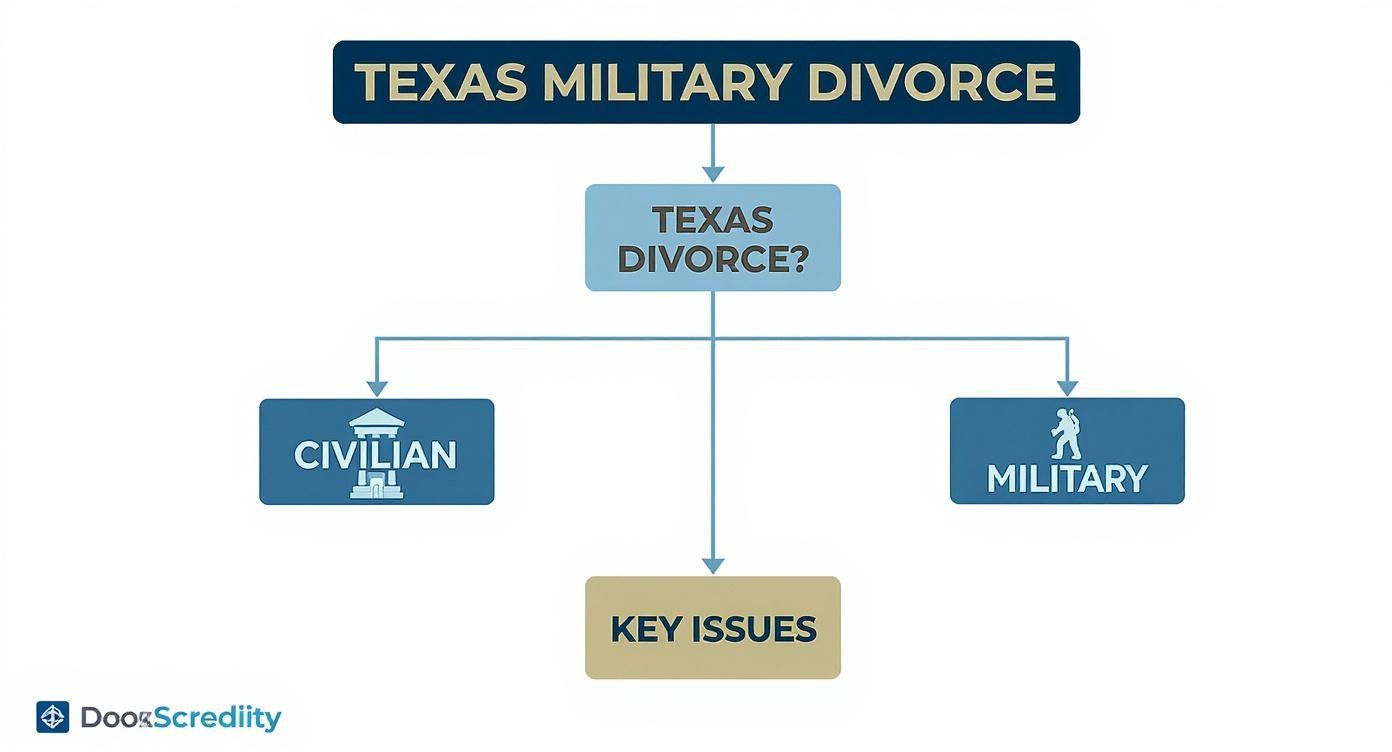
As you can see, the moment your case goes down the military divorce path, a unique set of issues immediately comes into play—jurisdiction, federal protections, and the division of military-specific benefits are just the beginning.
The Impact of Federal Law
While Texas sets the local rules, federal laws add another layer of options and protections for service members. This is where things get tricky. As a service member, you might be stationed in Texas but maintain your legal residency (domicile) in another state, which directly impacts where the divorce can legally be filed.
While the Texas Family Code requires one spouse to be a resident for six months and live in the county for 90 days, federal laws like the Servicemembers Civil Relief Act (SCRA) can sometimes impact these typical residency rules. This opens up different locations for filing that wouldn't be available to civilians.
Choosing the right jurisdiction is a strategic decision. Filing in Texas may be advantageous for its community property rules, while your spouse’s home state might have different laws regarding spousal support. This initial choice sets the stage for the entire divorce.
Where Can You File Your Military Divorce?
Because of how state and federal laws interact, you often have more than one option for filing your divorce. Understanding these choices is the first step toward taking control of the process.
Generally, you may be able to file in one of these three locations:
- The state where you are currently stationed (like Texas).
- The state you claim as your legal domicile (your home of record).
- The state where your non-military spouse resides.
Each of these options comes with its own legal quirks. For instance, for a Texas court to have the power to divide military retirement benefits, it must have personal jurisdiction over you. This means you must have enough connections to the state for the court's decision to be binding.
To help clarify this complex topic, we have a helpful resource for understanding personal jurisdiction in a Texas divorce. Making the right choice requires a careful look at your unique situation to ensure the court you choose has the full authority to resolve every aspect of your case, from property division to child custody.
The table below breaks down some common scenarios to help illustrate how these residency rules apply in real-world situations for military families.
Texas Divorce Filing Scenarios for Military Families
| Filing Scenario | Can You File in Texas? | Key Consideration |
|---|---|---|
| Service member stationed at Fort Cavazos for 8 months; spouse lives in Georgia. | Yes. | Your time stationed in Texas fulfills both the 6-month state and 90-day county residency requirements. |
| Service member stationed in Germany, but Texas is their legal domicile. | Yes. | As long as Texas is your legal domicile (home of record), you can file in Texas regardless of where you are stationed. |
| Service member has a Florida domicile and is stationed at Fort Bliss for 4 months. | No. | The 6-month state residency requirement has not been met yet. You would need to wait another two months. |
| Non-military spouse has lived in San Antonio for over a year; service member is stationed in California. | Yes. | The non-military spouse independently meets Texas's residency requirements, allowing them to file in Texas. |
Ultimately, choosing where to file is a foundational decision that impacts everything that follows. It's a choice that requires careful thought and a clear understanding of both state and federal law.
How Military Retirement and Benefits Are Divided
Your military retirement pay is often one of the most significant assets you and your spouse have built together. That makes its fair division absolutely critical for your financial future.

This process can feel confusing because it involves a mix of Texas community property laws and a federal law called the Uniformed Services Former Spouses’ Protection Act (USFSPA). These two sets of rules work together to determine how this valuable asset gets split.
Community Property Meets Federal Law
First, you need to know that Texas is a community property state. This means any assets—including retirement benefits—earned by either you or your spouse during the marriage are considered jointly owned property. When you divorce, a Texas court will divide this community property in a "just and right" manner, which usually means a 50/50 split.
The USFSPA is the federal law that gives Texas courts the green light to treat military retirement pay as community property and divide it. Without this act, state courts would have no power over this federal benefit. It's important to know that the USFSPA doesn't automatically give a former spouse a share; it simply permits the state court to divide it according to Texas law.
Demystifying the Confusing 10/10 Rule
One of the most persistent myths in military divorce is the "10/10 Rule." So many people mistakenly believe that if the marriage didn't last for 10 years that overlapped with 10 years of military service, the former spouse gets nothing. This is absolutely false.
The 10/10 Rule is not about entitlement; it's about the payment method. It only determines who sends the check to the former spouse: the government directly or the service member.
Here's what the rule actually means:
- If the 10/10 Rule is met, the Defense Finance and Accounting Service (DFAS) can pay the former spouse's share of the retirement directly to them. This is simply an administrative shortcut.
- If the 10/10 Rule is not met, the former spouse is still entitled to their court-ordered share of the retirement. The only difference is that you, the service member, must pay them directly each month after receiving your full retirement check.
A Texas court can award a portion of military retirement to a former spouse even in a marriage of only five years. The 10/10 Rule is purely an administrative convenience, not a barrier to your former spouse's rights.
How Texas Calculates Your Share
Dividing a military pension isn't as simple as splitting the total pot down the middle. A Texas court will only divide the "marital portion" of the retirement—the part that was earned from the date of marriage to the date of divorce. Any service time before the wedding or after the divorce is finalized is your separate property.
Texas courts use a specific formula to calculate this marital share. They then determine a fair percentage for the former spouse, which is typically 50% of that marital portion. This approach ensures a fair division that respects the contributions both you and your spouse made during the marriage.
To get a clearer picture of how Texas laws handle these assets, you can find valuable information by exploring how to survive the financial storm of divorce and retirement in Texas.
The Importance of the Frozen Benefit Rule
A critical piece of the puzzle in military divorce laws in Texas is the Frozen Benefit Rule. This rule, established by federal law in 2017, is a huge protection for you as the service member. It prevents you from having to share the value of your post-divorce promotions and hard work.
Essentially, the value of the retirement pay to be divided is "frozen" at the time of the divorce. The calculation is based on your rank and years of service as of the date of the divorce—not your rank when you eventually retire. Any promotions or additional years you serve after the divorce are your separate property and are not shared with your ex-spouse.
Dividing Other Key Military Benefits
Beyond retirement pay, other valuable benefits must be addressed in your divorce decree. Getting this wrong can leave you or your former spouse without critical coverage down the road.
- Survivor Benefit Plan (SBP): Think of this as an insurance policy on the retirement pay. It's an annuity that provides an ongoing income to a former spouse if the service member dies. A court can order you to elect your former spouse as the SBP beneficiary to protect their share.
- TRICARE Health Insurance: A non-military spouse might be eligible to continue TRICARE coverage after the divorce under the "20/20/20 Rule." This rule requires a 20-year marriage that overlapped with 20 years of military service and 20 years of creditable service. If you don't meet this tough standard, you may still qualify for temporary coverage.
Creating a Stable Future for Your Children
Figuring out how to co-parent effectively is one of the toughest parts of any divorce. Add military life into the mix, and you're dealing with unique challenges that civilian families never have to face.

When deployments, long training exercises, and Permanent Change of Station (PCS) moves are your reality, you need a parenting plan built for stability and predictability. Your children’s well-being is the top priority, and Texas law is designed to protect it—even across thousands of miles.
How Texas Handles Military Child Custody
In Texas, we don't use the word "custody." Instead, the law talks about conservatorship, which is the legal term for the rights and responsibilities each parent has. It usually breaks down into two main roles:
- Joint Managing Conservators (JMC): This is the most common arrangement in Texas. It means both you and your ex-spouse share the rights and duties of raising your children, like making decisions about school and healthcare. One parent is typically named the "primary" conservator, giving them the right to decide where the child lives.
- Sole Managing Conservator (SMC): This is much less common and is usually reserved for situations where one parent has a history of family violence, substance abuse, or serious neglect.
The other piece of the puzzle is possession and access. This is simply the schedule that lays out when each parent gets physical time with the kids. A standard Texas possession order works for many families, but it's often completely impractical for military life. This is where a custom-tailored plan becomes absolutely essential.
Building a Military-Specific Parenting Plan
A standard, cookie-cutter Texas parenting plan just won't cut it when one parent is an active-duty service member. You need a detailed, forward-thinking document that anticipates the unique demands of military service. A rock-solid, military-specific parenting plan should always include provisions for:
- Deployments: You need clear rules for how visitation will work when a parent is deployed. This could mean allowing a stepparent or grandparent to have visitation time on behalf of the deployed parent.
- Long-Distance Communication: Get specific about how and when the deployed parent will communicate with the children. Think scheduled video calls, phone calls, and virtual story times.
- PCS Moves: You must have a clear process for handling relocations. If the primary parent has to PCS with the child, the plan needs to spell out how the possession schedule changes and who is responsible for travel costs.
- Leave and R&R: The plan should address how your time with the children will be managed during post-deployment leave or mid-tour Rest and Recuperation (R&R).
The Texas Family Code has crucial protections built in for service members. A judge cannot use a parent's temporary absence because of military deployment as the sole reason to change a custody order. Your service to our country will not be used against you in court.
Calculating Child Support with Military Pay
Child support in Texas is calculated using a formula based on the paying parent's net monthly resources. A common question in a military divorce is what counts as income.
For child support, your income as a service member is more than just your base pay. It also includes non-taxable income sources, such as:
- Basic Allowance for Housing (BAH)
- Basic Allowance for Subsistence (BAS)
- Other special pays and allowances
Once your total income is figured out, the court applies the standard Texas child support guidelines. These guidelines set a percentage based on the number of children involved. For instance, support is 20% of net resources for one child and jumps to 25% for two children. Maintaining your child's academic stability through these changes is paramount, and a consistent support structure is a key part of that. You can learn more about how a Texas divorce can impact your children's education and find ways to lessen those effects.
To make sure payments are consistent and reliable, child support can be paid directly from your military pay. This is done through an allotment or garnishment managed by the Defense Finance and Accounting Service (DFAS), providing stability for the children and peace of mind for both parents.
Understanding Your Rights Under the SCRA
Getting served divorce papers while you're deployed or stationed far from home can feel like a devastating blow. It's an overwhelming situation, but federal law provides a critical safety net for you. This protection comes from the Servicemembers Civil Relief Act (SCRA), a law designed to prevent active-duty personnel from being put at a disadvantage in civil court cases, including divorce.
Think of the SCRA as your legal shield. It gives you the tools to manage court proceedings when your military duties make it impossible for you to participate fully. It’s not about dodging the divorce, but about making sure the process is fair, no matter where in the world you're serving.
Hitting Pause: How to Request a Stay in Your Divorce Case
The most powerful protection the SCRA offers in a Texas divorce is the ability to request a “stay.” A stay is a legal term for a temporary pause on the court proceedings. This isn't a "get-out-of-divorce-free card," but it is an essential tool that gives you the time you need to hire a lawyer and figure out your next steps.
If your military service materially affects your ability to participate in court, you can request an initial stay of at least 90 days. To get this, you’ll need to send the court a letter or another formal communication that:
- Explains exactly how your military duties are preventing you from appearing.
- Gives the court a date when you expect to be available.
- Includes a statement from your commanding officer confirming that your military duties are preventing your participation.
This 90-day pause gives you crucial breathing room to get your bearings. If you need more time, the court can grant additional stays, but you'll have to keep demonstrating how your service obligations are a genuine roadblock to moving forward with the case.
Protection Against Default Judgments
What happens if you’re deployed overseas and can't respond to a divorce petition in time? This is where another key SCRA safeguard comes in: protection against default judgments.
A default judgment is a final ruling a judge can make for one side when the other side fails to answer the lawsuit or show up in court. For civilians, ignoring a lawsuit usually means you lose automatically.
But under the SCRA, a Texas court cannot enter a default judgment against you in a divorce without first appointing an attorney to represent your interests. This is a huge deal—it ensures your rights are protected even when you’re physically unable to defend yourself.
This protection is a cornerstone of military divorce laws in Texas. It stops a divorce from being finalized on unfair terms simply because you're serving your country. It forces the process to slow down until you're actually able to participate. For the non-military spouse, it's also important to understand these rules, as they set more realistic expectations for the divorce timeline.
What to Do Next
Knowing your rights under the SCRA is the first step, but you have to assert them correctly and quickly. If you've been served with divorce papers, you must act fast to let the court know about your military status and why you can't respond right away. Ignoring the situation is the worst thing you can do.
Working with an experienced family law attorney is the best way to make sure your SCRA request is filed properly and that your rights are defended from day one. Protecting your interests from the very beginning is the key to achieving a fair outcome in your military divorce, allowing you to focus on your mission.
Key Takeaway: Your Path Forward in a Texas Military Divorce
Going through a military divorce in Texas means navigating a maze of state family law and complex federal regulations. It’s normal to feel overwhelmed, but you can get through this with a clear, strategic plan. Your mission is to protect your family, your finances, and your future.
What to Do Next
Don't try to tackle everything at once. Your immediate action plan should be simple and direct. Focus on these manageable first steps:
- Confirm Jurisdiction: Before anything else, determine if Texas is the right place to file based on the specific rules for residence and domicile. Getting this right from the start prevents expensive delays.
- Understand Benefit Division: Familiarize yourself with how Texas community property laws apply to military retirement, the Survivor Benefit Plan (SBP), and other unique assets.
- Create a Military-Specific Parenting Plan: If you have children, a standard plan won’t work. Yours must be built to handle deployments, relocations, and the realities of long-distance communication.
- Gather Your Documents: Start collecting essential paperwork, including your Leave and Earnings Statements (LES), marriage certificate, and any important financial records.
- Seek Expert Guidance: The laws are too complex to go it alone. An attorney who specializes in military divorce laws in Texas can map out a clear strategy and protect your rights from day one.
Beyond the legal steps, managing the logistics of a military move is a huge task in itself. A good checklist can be a lifesaver. You can use this ultimate PCS move checklist to make sure all the bases are covered during a relocation.
We understand this is an incredibly challenging time, both legally and emotionally. If you’re ready for expert guidance and compassionate support, we invite you to schedule a free, confidential consultation with The Law Office of Bryan Fagan, PLLC. We're here to help you move forward with confidence.
Common Questions About Texas Military Divorce
When you're facing a military divorce, rumors and well-meaning but wrong advice from friends can create a thick fog of confusion. It’s tough enough already. Let’s cut through that noise and get you some clear, straightforward answers to the questions we hear most often from service members and their spouses.
I’m Stationed in Texas, but I’m a Legal Resident of Another State. Can I Still File for Divorce Here?
Yes, in most cases, you can. The Texas Family Code requires that one spouse has lived in the state for at least six months and in the specific county where you file for at least 90 days right before filing.
The good news for military families is that being stationed here counts. Texas law recognizes the unique nature of military life and generally considers your post here as fulfilling that residency requirement, even if your legal "home of record" is somewhere else. This practical approach keeps you from having to fly across the country just to handle your divorce.
Is My Spouse Automatically Going to Get 50% of My Military Retirement?
Not automatically, and certainly not 50% of the entire amount. Texas is a community property state, meaning a court will order a "just and right" division of assets acquired during the marriage. While this often means a 50/50 split, it only applies to the portion of your retirement that you earned while you were married.
Any retirement benefits you accumulated before your marriage or after the divorce is final are your separate property. They belong to you and are not subject to division.
How Does Deployment Affect My Child Custody Case?
Texas law has specific safeguards to protect deployed parents. A judge cannot use your temporary absence due to military orders as the sole reason to change your custody rights or your role as a managing conservator.
However, it is critical that you have a Military-Specific Parenting Plan. This document should detail exactly how visitation, communication, and decision-making will work while you are deployed. It is the best tool for creating stability and predictability for your children when they need it most.
What if I Get Served Divorce Papers While I'm Deployed?
This is precisely why the Servicemembers Civil Relief Act (SCRA) exists. This federal law protects you from a "default judgment." If you're served divorce papers and cannot respond because of your military duties, the court can’t just move forward and finalize the divorce without you.
Under the SCRA, you have the right to request a "stay," which is a legal timeout. It pauses the proceedings, giving you the time you need to hire an attorney and respond properly. This ensures that your service to the country doesn't put you at a severe legal disadvantage back home.
The unique pressures of military life are well-documented. Statistically, military families experience divorce rates that often mirror or slightly exceed those in the civilian population, reflecting these distinct challenges. For instance, Pentagon data from 2017 showed the divorce rate among service members was 3.1%. You can read more about the statistics on military divorce rates to better understand these trends. These federal protections are in place because the law recognizes that your service creates circumstances civilians don't face.
Navigating the intersection of Texas family law and federal military regulations requires experience and a steady hand. At The Law Office of Bryan Fagan, PLLC, we are committed to providing the compassionate, knowledgeable guidance you need to protect your family and your future. If you are ready to move forward with clarity and confidence, schedule a free, no-obligation consultation with our team today at https://texasdivorcelawyer.us.