Skip to content
Watching your children grow can feel like the best part of being a parent, but as their needs change, the custody agreement you once relied on may no longer fit your family's reality.
If your current custody order feels out of sync with your child's life, you are not stuck. In Texas, you can formally ask a court to update your agreement by filing a Petition to Modify the Parent-Child Relationship. This is a significant legal step, and to be successful, you must prove two things to the court: first, that a "material and substantial change in circumstances" has occurred since your last order was signed, and second, that changing the order is in your child's "best interest."
When Life Changes, Your Custody Order Can Too
Life rarely stands still, and the Texas Family Code recognizes that. An order that made perfect sense for a toddler can become completely unworkable for a teenager juggling school, sports, and a social life. A new job, a sudden layoff, a remarriage, or a necessary move can flip your co-parenting dynamic on its head.
The law gives you a path to update your legal orders to match where your family is today. The ultimate goal is always to make sure the arrangement supports your child’s well-being.
However, courts prioritize stability for children, so they won't entertain a modification for every little disagreement. The system is designed to prevent constant court battles over minor issues. You have to show a real, significant shift that directly impacts your child's life.
What Counts as a Material and Substantial Change?
This legal phrase might sound complicated, but it's actually pretty straightforward. It means something significant—and likely permanent—has happened since your last court order was finalized. The change has to be big enough to make the current custody, visitation, or support arrangement unworkable or just plain wrong for your child's needs today.
Here are a few common scenarios that often clear this bar:
- A parent needs to relocate. Maybe one parent lands a fantastic job offer in another city or state, making the current possession schedule physically impossible to maintain.
- The child's needs have evolved. A child might develop a medical condition that requires specialized care closer to one parent. Or, as a teenager, they may express a strong, mature desire to live primarily with the other parent.
- A parent's lifestyle has changed dramatically. A parent’s work schedule might switch from a standard 9-to-5 to overnight shifts, making it difficult to care for a child during their assigned time.
- There are safety concerns in a parent's home. If a parent's home becomes unstable because of substance abuse, neglect, or the presence of a dangerous person, that is an urgent and critical reason to seek a modification.

It's absolutely critical to remember that courts will only look at things that have happened after your current order was signed. You can't rehash old arguments that were already settled. For a deeper dive, you can learn more about what qualifies as a material and substantial change in our detailed guide.
To help clarify, let's look at some common scenarios that come up in modification cases. The table below breaks down what Texas courts often see as a valid reason to modify an order versus what usually isn't enough to convince a judge.
Valid vs. Insufficient Reasons for Custody Modification
| Scenario | Likely a Material and Substantial Change (Why) | Likely Insufficient for a Change (Why) |
|---|---|---|
| Parent's Remarriage | The new stepparent has a history of abuse or creates an unstable, dangerous home environment. | Simply remarrying without any negative impact on the child. A new, stable relationship is often seen as a positive. |
| Child's Preference | A mature older teen (usually 12+) expresses a strong, well-reasoned desire to live with the other parent. | A young child changes their mind frequently, or the preference seems influenced by a parent or based on lenient rules. |
| Job Change | A new job requires a long-distance move, making the current possession schedule physically impossible. | A minor change in work hours or a small pay cut that doesn't impact the ability to care for the child. |
| Disagreements | Parents are completely unable to co-parent, and the constant conflict is causing the child documented emotional distress. | Normal co-parenting disagreements over things like bedtime, homework, or extracurricular activities. |
| Substance Abuse | A parent has developed a new drug or alcohol problem that endangers the child's well-being. | A parent had a substance abuse issue in the past that was already addressed in the original court order. |
This isn't an exhaustive list, of course, but it gives you a good idea of the level of seriousness judges are looking for. Minor life changes or simple disagreements just won't cut it.
The Best Interest of the Child Is the Deciding Factor
Even if you prove a material and substantial change has occurred, you're only halfway there. The second—and most important—piece of the puzzle is proving that your proposed modification is in the best interest of the child. This is the absolute guiding star of Texas family law.
The Texas Family Code lists several factors, often called the "Holcomb factors," that judges use to figure this out. They don't just focus on one thing; they look at the child's entire world from a 30,000-foot view. A judge will weigh several factors to determine what is best for your child, including their emotional and physical needs, any potential danger, the stability of each home, and the parenting skills of each parent. Your personal preferences are secondary to what will create the most positive and stable environment for your child.
This intense focus on the child's well-being is part of a larger shift in how courts view custody. Decades ago, sole custody was the norm. Now, the legal system recognizes how important it is for kids to have both parents actively involved. This trend makes it clear: the goal is to support a strong relationship with both parents whenever possible.
Proving what’s in your child’s best interest isn't about what you want—it's about presenting clear, concrete evidence showing how your requested changes will directly benefit their development, safety, and happiness. This could mean demonstrating how a new schedule reduces travel stress, provides more consistent medical care, or creates a more stable home. Your entire case hangs on showing that this change is for your child, not for you.
Navigating the Modification Court Process
Walking into a court process can be intimidating, but knowing what's coming takes a lot of the fear out of the equation. When you understand the path ahead, you can prepare effectively and move forward with confidence. Let's walk through the journey of modifying a custody order in Texas, from the first filing to the final decision.
This infographic breaks down the core legal test a Texas court uses: first, you have to show a significant change, and second, you have to prove the modification is actually in your child's best interest.
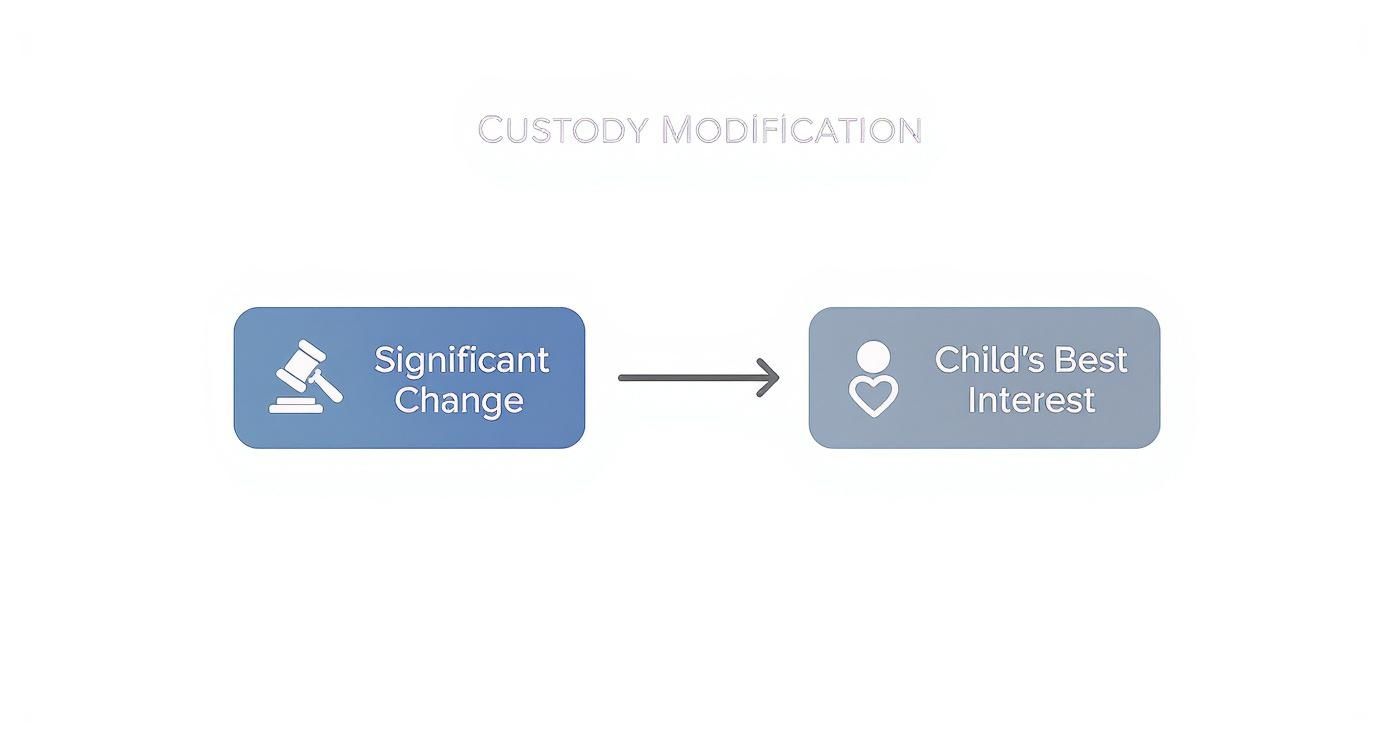
Think of these as two essential building blocks. You need both to get a modification approved; one without the other just isn't enough for a judge to grant your request.
Step 1: Filing the Petition to Modify
Your case officially starts the moment you file a Petition to Modify the Parent-Child Relationship with the court. This isn't just a simple form—it's the legal document that kicks everything off and serves as your first chance to tell the court why you're asking for a change.
Your petition needs to clearly spell out two critical things:
- The material and substantial change in circumstances that has happened since your last court order was signed.
- Why your proposed new arrangement is in the best interest of your child.
You must be specific. Vague statements like "things are different now" will get you nowhere. Instead, you need to detail the exact changes, like a parent's relocation for a new job, a significant shift in income, or a child’s evolving medical needs.
Step 2: Serving the Other Parent
Once you've filed the petition, you can't just text the other parent to let them know. Texas law is very clear: they must receive formal notice through a process called service. This is a crucial step to ensure everyone involved is aware of the legal action and gets a fair shot to respond.
Typically, a sheriff, constable, or private process server will personally hand-deliver a copy of the petition and a legal notice called a citation. This isn't optional—it’s a fundamental part of the process that protects everyone's due process rights. After being served, the other parent usually has about 20 days to file a formal answer with the court.
What If the Other Parent Agrees?
Even if you and your co-parent see eye-to-eye on the changes, you still have to get the court's stamp of approval. You can file an Agreed Petition to Modify along with a new Agreed Order. A judge still has to review and sign it to make the new agreement legally binding and enforceable.
Step 3: Attending Mediation
Long before you see the inside of a courtroom for a final trial, most Texas counties will require you to attend mediation. Don't look at this as just another box to check; it’s a powerful opportunity to resolve your case on your own terms. Mediation is a confidential process where you and the other parent sit down with a neutral third party to hash things out away from a judge.
The mediator isn't there to make decisions for you. Their job is to guide the conversation, help you find common ground, and steer you toward a solution you can both live with.
The benefits of reaching an agreement here are huge:
- You control the outcome, instead of a judge who doesn't know your family.
- It's almost always cheaper and faster than a drawn-out court battle.
- It can lower the conflict level and help you maintain a working co-parenting relationship.
A big part of the process is knowing how to prepare for custody mediation before you walk in the door. Having a clear strategy makes all the difference.
What Happens When Your Case Involves Multiple States?
In a world where people move around, it's pretty common for parents to live in different states. This can throw a wrench into modifying a custody agreement. To keep things consistent, every state has adopted the Uniform Child Custody Jurisdiction and Enforcement Act (UCCJEA).
This act creates a standard set of rules. Generally, any modification has to be filed in the child’s "home state"—which is defined as where the child has lived for the last six months. This law is designed to prevent "forum shopping," where one parent might try to find a court in another state that seems more sympathetic to their side. It keeps the case where it belongs: in the court that knows your family's history.
If you and the other parent live in different states, it’s critical to get the jurisdiction right from the start. A mistake here can cause major delays or even get your case thrown out. An experienced attorney will make sure all the jurisdictional rules are met from day one, saving you a world of time, money, and stress.
Preparing For Court When You Can't Agree
It’s the outcome nobody wants. You've tried to negotiate, maybe even gone through mediation, but you and the other parent just can't see eye to eye on a new custody arrangement. When you’re at a standstill, the final decision lands with a judge.
The thought of a contested court hearing is enough to make anyone’s stomach turn. But here’s the thing: being prepared is the best way to turn that anxiety into confidence. A hearing isn't about "winning" or "losing." It's about clearly and calmly showing the judge why the changes you're proposing are genuinely what's best for your child.

Gathering Your Evidence
To persuade a judge, your word alone isn't enough—you need proof. Your job is to paint a clear picture for the court that shows two things: there has been a material and substantial change in circumstances, and your proposed new order is in your child's best interest.
Think of yourself as a storyteller whose story must be supported by cold, hard facts. This is where your documentation becomes your most powerful asset.
Start pulling together everything relevant. This could include:
- Communication Records: Printouts of emails, text messages, or conversations from co-parenting apps. These can reveal patterns of conflict, a lack of cooperation, or other behaviors that justify the modification.
- School Records: Report cards, attendance logs, and emails from teachers can be incredibly powerful. A sudden drop in grades or new behavioral problems can often be linked directly to the current custody situation.
- Medical and Therapy Records: Documents from doctors, therapists, or counselors can highlight a child's evolving physical or emotional needs. When dealing with sensitive medical information, it's vital to handle it securely. A HIPAA-compliant faxing healthcare guide can offer insight into the proper protocols for transmitting these confidential records.
Every single piece of evidence you present should tie directly back to those two key legal standards.
The Power of Credible Witnesses
While paperwork is critical, don't underestimate the human element. Witnesses can give the court a third-party perspective, lending significant weight and credibility to your case. But choosing the right witnesses is crucial.
You need people with firsthand, unbiased knowledge of your child and your family life. The most effective witnesses are often professionals or objective observers.
Consider asking people like:
- Teachers or school counselors who can speak to your child's behavior and academic performance.
- Therapists or pediatricians who can provide professional insights into your child's well-being.
- Neutral family friends or neighbors who have personally seen your parenting and your child's day-to-day environment.
The goal isn't to find people to sling mud at the other parent. You need individuals who can provide objective, factual testimony about what they've personally seen and heard. Their job is to support your argument that a change is necessary for the child's sake.
A strong witness doesn't just offer an opinion; they provide specific examples. A teacher testifying that your child "seems happier and more focused on the weeks they are with you" is far more powerful than a relative saying you are "the better parent."
Presenting Yourself in Court
How you carry yourself in the courtroom speaks volumes. The judge isn't just listening to what you say; they're observing your demeanor, your tone, and your overall respect for the process. Your credibility is everything, and a professional attitude can make all the difference.
Here are a few practical tips for your day in court:
- Dress Professionally: Treat it like a serious job interview. Business casual attire signals that you respect the court and understand the gravity of the situation.
- Speak Clearly and Calmly: When it's your turn to speak, always address the judge as "Your Honor." State your points without getting emotional, even if the other party says something that pushes your buttons.
- Stick to the Facts: Answer only the questions you're asked. Avoid rambling or launching into personal attacks. Let your evidence and your attorney do the heavy lifting for you.
Remember, the judge is a neutral party trying to find the best solution for your child. By being prepared, presenting compelling evidence, and maintaining a calm, respectful demeanor, you give yourself the best possible shot at a positive outcome.
Handling Complex Custody Modification Scenarios
Figuring out how to change a custody agreement is complicated enough on its own. But real life often throws in curveballs that add extra layers of legal and emotional challenges. No two families are the same, and your situation might involve circumstances that demand more than just a cookie-cutter approach.
When these unique challenges come up, a generic strategy just won't cut it. You need a clear understanding of the specific rules that apply to protect your child's best interests, and that's where experienced guidance becomes non-negotiable.
When Your Child Wants to Make a Change
One of the most common and emotionally charged scenarios we see is when an older child wants to live with the other parent. Texas law definitely takes a child's preference seriously, but it’s just one piece of a much larger puzzle.
Under Texas Family Code Section 153.009, if a child is 12 years of age or older, the court can be asked to interview them privately. This isn't a courtroom grilling; it's a conversation in the judge's chambers, designed to let the child express their wishes without feeling pressured by either parent.
But it's crucial to understand this isn't a magic bullet. The judge will carefully weigh the child's maturity, their reasons for wanting the change, and all the other "best interest" factors. A kid who wants to move just because one parent has fewer rules isn't going to get the same consideration as one who has a stronger emotional bond or better educational opportunities.
Modifications Across State Lines
What happens when you or your co-parent moves out of Texas? This is where things get tricky, and a federal law called the Uniform Child Custody Jurisdiction and Enforcement Act (UCCJEA) comes into play. Texas has adopted this law to prevent parents from "forum shopping"—that is, trying to find a court in another state that might give them a better outcome.
The UCCJEA is all about establishing the child's "home state." Generally, the state where the child has lived for the last six months is the only one with the authority, or jurisdiction, to modify the custody order.
- Real-World Example: Let's say your original divorce was in Dallas, but your child has been living with your ex in Oklahoma for the past year. In that case, Oklahoma is now the home state. You would almost certainly have to file your modification case in an Oklahoma court, not back in Texas.
Trying to navigate these jurisdictional rules on your own is a minefield. Filing in the wrong state will get your case thrown out, costing you precious time and money.
Cases Involving Family Violence or Substance Abuse
When family violence or substance abuse enters the picture, the court's primary duty shifts to one thing: protecting the child from harm. A new incident of family violence or a relapse into substance abuse is almost always considered a material and substantial change in circumstances.
In these high-stakes situations, the court can put immediate protective measures in place, such as:
- Ordering that all visitation must be supervised.
- Requiring random drug testing or alcohol monitoring.
- Mandating counseling or a battering intervention program.
If the danger to your child is immediate, you may need to file an emergency petition for custody in Texas. This is a powerful legal tool that can provide instant protection.
This idea of adapting custody orders to fit a family's evolving needs isn't just a Texas thing. It's a global trend. In Europe, for example, there's a growing emphasis on joint physical custody, with about 20% of children in separated families now living in such arrangements. You can learn more about the growing phenomenon of joint physical custody in Europe. This global shift just highlights how important it is for the law to be flexible, especially when a child's safety is on the line.
Practical Steps to Modify Your Texas Custody Order
Trying to modify a custody order can feel like staring up at a mountain. But every step you take—including reading this guide—gets you closer to a better future for your family. The biggest hurdle is often just starting, and you've already done that by arming yourself with information. Now, it's about turning that knowledge into confident action. This is an emotional journey, but you don't have to carry this weight alone.
Key Takeaway
To successfully change your custody agreement in Texas, you have to prove two things: 1) a material and substantial change has occurred since the last order was signed, and 2) your proposed change is in the best interest of the child. Solid proof and a clear, fact-based argument are non-negotiable, whether you end up in mediation or in front of a judge.
Your Next Steps
Feeling empowered comes from having a clear plan. Here are the immediate, practical steps you can take right now to get moving:
- Gather Your Documents: Start getting all the relevant paperwork together. This means your current custody order, any texts or emails with the other parent, school records, and medical reports.
- Write Everything Down: Create a detailed timeline of events that led you to this point. Don't just rely on memory. Specific dates and examples are far more powerful than vague statements like "things got worse."
- Focus on Your Child: Frame every single argument around your child's well-being. How will this change actually benefit them emotionally, physically, and developmentally? That's the question the court wants answered.
Deciding to pursue a custody modification is a huge step, but it’s a move toward creating a better, more stable life for your child. It's about making sure their legal orders reflect their current reality and future needs. You are their biggest advocate, and you absolutely have the strength to see this through.
When you’re ready to talk through your options and build a clear strategy, the team at The Law Office of Bryan Fagan, PLLC is here to help. We invite you to schedule a free, no-obligation consultation to discuss your case. Let us help you find the right path forward for your family. Visit us at https://texasdivorcelawyer.us to get started.