 Skip to content
Wondering if your long-term relationship legally counts as a marriage can leave you feeling uncertain and vulnerable.
Getting married without a big ceremony or a fancy license might sound like something out of an old movie, but in Texas, it’s a real and legally binding commitment. We call it an informal or common law marriage, and it's a concept that trips many people up, especially when a relationship is ending. The biggest myth? That living with someone for a certain number of years automatically makes you married. That is completely false. A common law marriage isn't about how long you've shared an address; it's about your actions and intentions as a couple. Understanding these rules is the first step toward protecting your future.
What Is a Common Law Marriage in Texas?

Here’s what often surprises people: once you establish a common law marriage, it carries the exact same legal weight as a marriage that started with a walk down the aisle. You have the same rights and responsibilities when it comes to property, debts, and children as any other married couple in Texas. The law is simply recognizing a relationship that, for all intents and purposes, already operates like a marriage.
The challenge arises when the relationship ends. Without a marriage license to pinpoint a specific date, the situation can become messy and emotionally draining. The burden of proof falls on the person claiming the marriage existed, which can be a difficult and stressful process to navigate alone.
The Three Pillars of an Informal Marriage
The Texas Family Code is crystal clear about what it takes to form a common law marriage. It’s not about the length of your relationship but about a specific combination of actions and a shared understanding between you and your partner.
Think of it like a three-legged stool. If you're missing even one leg, the entire structure falls apart in the eyes of the law.
Here are the three essential elements you must prove:
- An Agreement to Be Married: This isn't about a future plan to get married "someday." Both of you must have a present, mutual agreement to be married, right now.
- Living Together in Texas: You have to live together under the same roof in Texas, carrying on a life as a married couple.
- Representing Yourselves as Married: You must hold yourselves out to the public—your friends, family, and community—as a married couple. This means doing things like introducing each other as "my husband" or "my wife."
It’s the combination of all three, happening at the same time, that transforms your partnership into a legally recognized marriage. Proving each of these components is where things get complicated, which is why it's so important to understand what a court will be looking for.
According to the Texas Family Code § 2.401(a)(2), a marriage may be proved by evidence that the man and woman "agreed to be married and after the agreement they lived together in this state as husband and wife and there represented to others that they were married." This statute shows that your daily actions and how you present your relationship to the world are what truly matter to the court.
The Three Pillars of a Texas Common Law Marriage
Figuring out if you have a common law marriage can feel like trying to build something solid on shifting sand. You might feel married, but how does Texas law actually see your relationship?
For a court to recognize your informal marriage, your relationship has to be built on three specific legal pillars. If even one is missing, the whole thing can collapse, potentially leaving you without the protections you deserve.
Let’s break down each requirement from the Texas Family Code into simple, practical terms so you can see where you stand.
Pillar 1: You Agreed to Be Married
The first pillar is the agreement to be married. This is often the most misunderstood part of the whole equation. It's not a promise to get married someday or a vague hope of tying the knot down the road. The law requires a present, mutual understanding between both of you that, from that moment forward, you are married.
This agreement doesn't have to be a formal conversation over dinner. It can be shown through your actions and words over time. A judge will look for evidence that you both started acting and thinking like a married couple from a specific point onward.
Pillar 2: You Lived Together in Texas
The second pillar is cohabitation. This means you must live together under the same roof in Texas as a married couple. It’s more than just being roommates; it’s about sharing a home and a life in a way that looks and feels like a marriage.
While this might seem straightforward, it’s a crucial piece that has to happen after you’ve agreed to be married. The sequence matters. You must first agree you are married and then live together in Texas as spouses.
It's a common misconception that you need to live together for a certain number of years. However, as outlined in the Texas Family Code § 2.401(a)(2), there is no specific time requirement for cohabitation. The focus is on the nature of your life together, not the calendar.
Pillar 3: You Presented Yourselves as Married
Finally, the third pillar is holding out to the public. This simply means you have to represent yourselves to others as a married couple. It’s all about the public image you project. A court will look for consistent behavior that signals to your community—friends, family, and even businesses—that you see yourselves as husband and wife.
This is often the easiest pillar to prove with real-world evidence. Here are some powerful examples of what "holding out" looks like:
- Introducing your partner as "my husband" or "my wife" at parties or family gatherings.
- Filing joint federal income tax returns as a married couple.
- Listing each other as spouses on applications for loans, apartment leases, or insurance policies.
- Wearing wedding rings and celebrating anniversaries.
- Naming each other as beneficiaries on life insurance or retirement accounts.
All three of these pillars must exist at the same time to establish a valid common law marriage in Texas. Without all three, your relationship—no matter how committed—may not have the legal protections of a marriage, which can be devastating during a separation.
How to Prove Your Common Law Marriage in Court
It’s one thing to feel married in your heart, but it’s another thing entirely to prove it to a judge, especially when your partner is denying it. When you’re facing a tough divorce or an inheritance dispute, that distinction becomes critical. Since there’s no formal marriage certificate to point to, the burden falls squarely on you to show concrete, convincing evidence that your relationship met all the legal standards of a common law marriage in Texas. A judge needs to see more than your personal conviction—they need proof.
Think of yourself as building a case, piece by piece. Your job is to paint a clear, undeniable picture that you and your partner not only lived together but also agreed to be married and held yourselves out to the world as a married couple.
The infographic below breaks down the three essential elements a Texas court will look for to determine if a common law marriage actually exists.
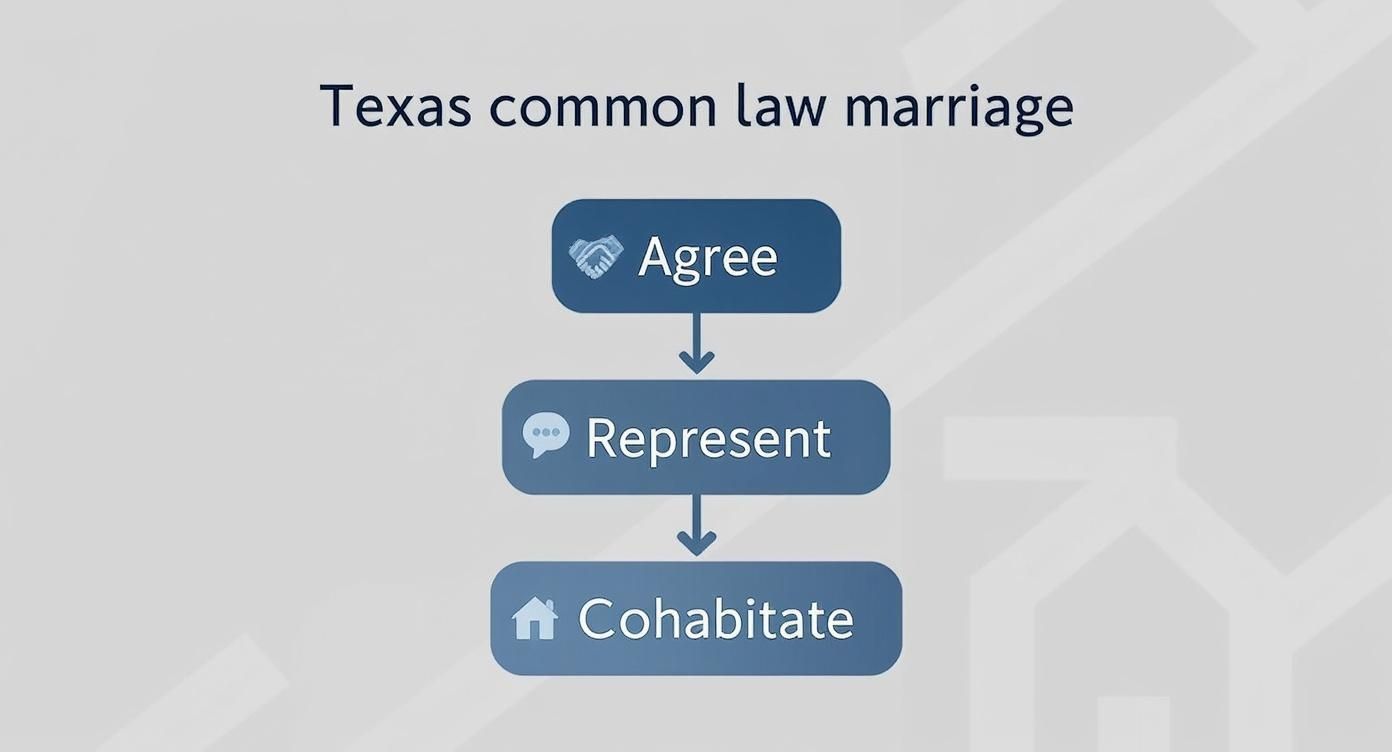
As the visual shows, all three pillars—the agreement, holding out to the public, and living together—must exist at the same time for the marriage to be legally valid. One or two out of three isn't enough.
Gathering Your Evidence
Strong evidence is the backbone of your claim and the key to securing your rights. Your attorney will help you collect and organize the proof you'll need, which usually falls into two main categories: documents and testimony.
Evidence That Supports a Common Law Marriage Claim
To successfully prove a common law marriage, you need to present evidence that demonstrates your intent and public representation as a married couple. The following table provides a checklist of documents and actions that can significantly strengthen your case in a Texas court.
| Type of Evidence | Example | Why It Matters |
|---|---|---|
| Financial Records | Joint bank account statements, shared credit cards, joint tax returns filed as "married." | Shows you intertwined your financial lives, which is a hallmark of a marital relationship. |
| Property Documents | A mortgage or lease listing both of you as "spouses" or a married couple. | Demonstrates a long-term, shared commitment to a home, a significant step married couples take. |
| Insurance Policies | Health, life, or auto insurance policies where you've named each other as a spouse. | Official documents where you publicly declared your marital status to a third party. |
| Official Forms | Loan applications, government benefit forms, or other documents where you identified as married. | These are sworn statements to institutions, making them powerful evidence of your intent. |
| Children's Records | Birth certificates for your children listing both of you as parents. | Establishes a shared parental bond, often strengthening the case for a marital relationship. |
| Witness Testimony | Sworn statements from family, friends, or coworkers who can confirm you introduced yourselves as married. | Corroborates your claim from the perspective of people who observed your relationship daily. |
Gathering these items can feel overwhelming, but each piece helps build a compelling narrative for the court, substantiating that your relationship was, in fact, a marriage in every way that matters.
Powerful Forms of Proof
Documentary Evidence: These are the official papers that show you and your partner were financially and legally connected as spouses. Some of the most compelling examples include:
- Joint bank account statements showing you shared financial duties.
- Mortgage or lease agreements where you're both listed as spouses.
- Insurance policies (health, life, or auto) that name each other as husband or wife.
- Joint tax returns filed as a married couple.
- Loan applications where you are listed as co-borrowers or spouses.
- Birth certificates of your children that list both of you as parents. Understanding the details of Texas paternity laws can be particularly important here.
Witness Testimony: What you say about your relationship is important, but what other people say can be even more powerful. Sworn statements or live testimony from friends, family, neighbors, and coworkers can back up your claim. These are the people who can tell the court that you always introduced your partner as your spouse and that they always saw you as a married couple.
The most definitive proof you can have is a Declaration of Informal Marriage. This is an official document you can file with the county clerk that formally records your marriage and the date it began. If you have this document, it pretty much eliminates the need for any other proof.
What It Really Means: Your Rights and Obligations After Proving Your Marriage
Once you establish you're in a common law marriage, you gain the exact same legal footing as a couple who went down to the courthouse for a marriage license. This isn't some "lesser" form of marriage—it's the real deal, with the full weight of Texas law behind it.
Realizing this is a game-changer. It unlocks significant rights but also saddles you with serious obligations, especially when it comes to property, money, and children. Understanding these implications is crucial because they touch everything, from how you own your house to who can make medical decisions for you in a crisis.
Community Property and Financial Rights
One of the biggest shifts is the immediate application of Texas's community property law. This concept is pretty straightforward: most assets and debts you or your spouse pick up during the marriage belong to both of you equally. It doesn't matter whose paycheck bought it or whose name is on the title.
This umbrella of shared ownership covers a lot of ground, including:
- Income earned by either of you.
- Real estate bought during the marriage.
- Retirement accounts, pensions, and investments that grew over the years.
- Debts taken on during the marriage, like credit card balances or car loans.
This has massive implications, especially if the relationship breaks down. If you divorce, that entire community estate has to be divided in a "just and right" manner, which almost always means a split right down the middle. Once your common law marriage is recognized, you have to think about your shared financial future, particularly when making estate planning decisions like creating trusts and wills.
Rights and Obligations Involving Children
If you have children together, legally establishing your marriage helps clarify everyone's parental rights and responsibilities. Just like in a ceremonial marriage, both parents now have the authority to make decisions about their children’s education, healthcare, and general upbringing.
Should you separate, you'll have to go through the court system to create a formal custody and visitation plan. This process is designed to ensure both parents stay active in their children's lives. Child support will also be calculated based on the Texas Family Code, making sure your kids have the financial support they need. You can get a much deeper look into how this works by reading our guide on the custody rights of unmarried parents.
Inheritance and Other Spousal Benefits
Being in a recognized common law marriage also secures critical inheritance rights. If your spouse dies without a will, the law sees you as the surviving spouse. This means you have a right to inherit a share of their separate property and all of the community property.
On top of that, you gain the power to make vital medical decisions if your spouse is ever incapacitated and might even qualify for things like Social Security survivor benefits.
Texas is a unique state, recognizing both community property and common law marriages, which can make property distribution tricky. And there's a critical deadline to remember: you have a two-year statutory limit to file a legal action to prove your marriage after you separate. If you wait too long, you could lose your rights entirely.
Ending an Informal Marriage Requires a Formal Divorce
The moment you realize your relationship is legally a marriage can be a shock. But learning how you have to end it can be an even bigger one. Many people assume that since the marriage started informally, it can end the same way. That's a dangerous myth—one that could cost you your home, your savings, and your financial future.
Here's the hard truth: in Texas, there's no such thing as a "common law divorce." Once your relationship meets the legal standards for an informal marriage, it’s just as real and binding as a ceremonial one. To dissolve it, you must go through the formal, court-supervised divorce process, just like any other married couple.
This means you can't just pack a bag and walk away. You have to file an Original Petition for Divorce, legally notify your spouse, and navigate the entire Texas divorce system.
Proving the Marriage to End It
The first major hurdle in your divorce will be proving the marriage existed in the first place—a step unique to common law marriage cases. Before a judge can even start talking about property or kids, you have to present solid evidence that you and your partner agreed to be married, lived together in Texas as a married couple, and held yourselves out to the public as husband and wife.
Once the court recognizes the marriage, the divorce proceeds like any other. Here is a step-by-step breakdown of what you can expect:
- Filing the Petition: You will start by filing an Original Petition for Divorce, which officially begins the legal process.
- Dividing Community Property: Every asset and debt you both acquired during the marriage will be divided in a "just and right" manner. Understanding what is community property in Texas is absolutely critical for protecting your share of the marital estate.
- Establishing Child Custody: If you have minor children together, the court will issue orders for custody, visitation, and who makes important decisions, all based on the children's best interests.
- Calculating Child Support: Child support will be determined based on Texas statutory guidelines.
- Considering Spousal Maintenance: Just like in a traditional divorce, you may be eligible to request spousal support.
- Finalizing the Decree: The process concludes with a judge signing a Final Decree of Divorce, which legally dissolves the marriage and finalizes all orders.
As you work through the formal divorce, you'll need to figure out how to handle shared assets like a house. Getting familiar with topics like navigating the mortgage in a divorce can give you a head start on these complex financial decisions.
A critical deadline to burn into your memory is the two-year statute of limitations. Under Texas law, you have only two years from the day you and your spouse stopped living together to file a court proceeding to prove your common law marriage. If you wait any longer, you could lose all your rights as a spouse for good.
Rights and Obligations After Proving a Texas Common Law Marriage

Now that you have a clearer picture of Texas common law marriage, you know the most important thing: it’s your actions and mutual agreement that build the marriage, not a piece of paper. You must prove all three pillars—agreeing you're married, holding yourselves out as a married couple, and living together in Texas. That’s what truly matters to a court.
It’s also crucial to remember that just because the marriage started informally doesn’t mean it can end that way. Ending a common law marriage requires a formal divorce, just like any other. If you're feeling uncertain about where you stand or are facing a potential separation, the absolute best thing you can do is get clear, professional legal advice.
Key Takeaway
Common law marriage is woven into the history of Texas, offering a practical way for couples to formalize their commitment. But that initial convenience doesn't make a breakup any simpler. The two-year deadline to prove your marriage after separating is strict, and missing it can mean losing your right to a fair share of the property you helped build.
If you have questions about your rights, need help proving your marriage exists, or are preparing to navigate a separation, you don’t have to figure this out on your own. We invite you to schedule a free, confidential consultation with the experienced attorneys at The Law Office of Bryan Fagan, PLLC. Let us help you navigate this complex process with compassion and confidence, so you can protect your family and your future.
Frequently Asked Questions About Common Law Marriage
When you're not sure where your relationship stands legally, the stress can be overwhelming. Let's clear up some of the confusion. Here are straightforward answers to the questions we hear most often about common law marriage in Texas requirements, giving you the clarity you need to figure out your next move.
How Long Do You Have To Live Together To Be Common Law Married in Texas?
This is easily the biggest myth out there. The truth is, there is no specific time requirement to establish a common law marriage in Texas. You could live with a partner for twenty years and still not be legally married. What matters is that you meet all three legal elements—agreement, living together, and holding out—at the same time.
What Happens To Our Property if We Separate?
If you can prove your relationship was a valid common law marriage, Texas community property laws apply just as they would in any other divorce. This means most property, assets, and even debts you both acquired during the marriage are considered jointly owned. When you go through a formal divorce, this "community estate" will be divided in a way the court decides is “just and right.”
Can I Receive Spousal Support After a Common Law Marriage Ends?
Yes, it's possible. Once your common law marriage is legally recognized, you have the same right to ask for spousal maintenance (what most people call alimony) as someone in a ceremonial marriage. Of course, you still have to meet the specific eligibility rules laid out in the Texas Family Code, which often hinge on the length of the marriage and your ability to provide for your own reasonable needs.
What if My Partner Denies We Were Ever Married?
This is a tough spot to be in, and unfortunately, it happens all the time. If one person denies the marriage ever existed, the burden of proof falls on you. You'll need to file a lawsuit and convince a judge that your relationship met all three requirements: you agreed to be married, you lived together in Texas, and you held yourselves out to others as a married couple. This is where having strong legal guidance becomes absolutely critical.
Trying to make sense of common law marriage, especially when a relationship is ending, can feel like you're navigating a maze blindfolded. You don’t have to do it alone. At The Law Office of Bryan Fagan, PLLC, our experienced attorneys are here to offer the compassionate advice and strategic support you need to protect your rights and build a secure future. We invite you to schedule a free, confidential consultation with us today to go over your situation and see how we can help.


