Skip to content
You may be closer to the end of your divorce than you think, but the last step still matters.
When you’ve worked through the hard conversations, signed the decree, and finally have an agreement in front of you, the prove up hearing texas divorce process is usually the moment when a judge turns that agreement into a binding court order. For many people, this hearing feels bigger than it is. It isn’t a full trial in the usual uncontested case. It’s the formal finish line.
The Final Hearing What a Texas Divorce Prove Up Really Means
A typical client reaches this point tired, relieved, and a little nervous. The property division is done. The parenting terms are set. The signatures are in place. Then one question remains. “Do I still have to go to court?”
Usually, yes. In many Texas divorces, the prove-up hearing is the short court appearance where the judge confirms the legal requirements have been met and the proposed final terms are ready to be entered.
Why the hearing exists
A prove-up hearing serves a practical purpose. The judge wants to hear enough testimony to confirm that:
- The court has jurisdiction over the case
- The waiting period has passed
- The divorce grounds are proper
- The agreement was signed voluntarily
- Any orders involving children meet Texas law
That’s why this hearing matters even when nobody is fighting. A signed decree by itself doesn’t end the marriage. A judge’s approval does.
For many families, this is also the least dramatic court appearance in the entire case. If your paperwork is complete and your testimony is simple and accurate, the hearing is often brief. If you want a preview of the courtroom setting, it helps to review what to expect in divorce court in Texas.
Practical rule: Treat the prove-up like a legal inspection, not a negotiation. The deal should already be done before you walk in.
Why this matters in today’s Texas divorce landscape
Texas family courts see a wide range of divorces, from agreed cases to high-conflict litigation. At the same time, divorce rates in Texas have declined from approximately 3.8 divorces per 1,000 residents in 2003 to 2.7 per 1,000 in 2023, despite major population growth, according to Texas divorce statistics summarized here.
That trend doesn’t mean divorce is easy. It does suggest that many Texans are reaching final outcomes without every case ending in extended courtroom battles. In practice, that makes preparation for the final hearing even more important. When a case is ready to close, the goal is to do it cleanly, once, and without a preventable delay.
Who Qualifies for a Prove Up Hearing
Not every divorce reaches the prove-up stage the same way. The key question isn’t whether the case started peacefully. The key question is whether, by the end, the court has a path to enter a final decree.
Agreed divorces
The clearest fit for a prove-up hearing is an agreed divorce. That means you and your spouse have resolved all issues that apply to your family, including property, debt, and if relevant, conservatorship, possession, child support, and medical support.
In an agreed case, the hearing is usually straightforward because the judge is not being asked to decide disputed facts. Instead, the judge is being asked to approve the final paperwork after hearing limited testimony.
An agreed divorce usually works best when:
- The Final Decree of Divorce is complete: Nothing important is left vague or blank.
- Both parties have signed properly: Missing signatures create avoidable problems.
- There’s no unresolved issue hiding in the paperwork: A disagreement about one retirement account, one holiday schedule, or one debt can stop the process.
- The decree matches what the parties intend: Last-minute confusion often shows up at the hearing.
Cases that started contested but settled later
Many people assume a prove-up hearing is only for cases that were peaceful from the start. That’s not true.
A divorce can begin as contested and still end with a prove-up if the parties later settle. That often happens after mediation, informal negotiations between attorneys, or temporary orders that stabilize the case enough for a final agreement.
That distinction matters. If your case has been tense, you haven’t “missed your chance” at a simpler finish. Once every final issue is resolved and the decree is ready, the court may still use a prove-up format to finalize the divorce.
A contested beginning doesn’t require a contested ending. What matters is whether there’s anything left for the judge to decide.
Default divorces
A default divorce follows a different path. In that situation, one spouse files, the other spouse is properly served, and the responding spouse does not answer by the legal deadline.
Even then, the filing spouse usually still needs to appear and prove up the case. The judge still needs evidence that service was proper, waiting periods were met, and the requested relief is legally supportable.
Default prove-ups require extra caution. Courts often review them more carefully because only one side is present.
When a prove-up is not enough
A simple prove-up won’t solve a case that still has active disputes. If you and your spouse disagree on a child’s schedule, a business valuation, reimbursement claims, or separate-property tracing, the court may require further hearings, mediation, or trial settings before finalization.
Here’s the practical dividing line:
| Divorce posture | Is a prove-up likely? | What matters most |
|---|---|---|
| Agreed from the start | Yes | Signed final decree and complete paperwork |
| Contested but later settled | Often yes | Full settlement on all final issues |
| Default case | Often yes | Proper service and clean supporting documents |
| Still actively disputed | No, not yet | The unresolved issue must be addressed first |
If you’re unsure which category your case falls into, look at the decree. If the decree is fully negotiated, signed as needed, and there’s nothing left for the judge to decide except approval, you’re likely in prove-up territory.
Meeting Texas Legal Requirements and Timelines
A prove-up hearing only works if the legal foundation is already there. Judges expect the case to be ripe for finalization before it reaches the docket.
The 60-day waiting period
Texas law imposes a mandatory waiting period in most divorce cases. Under Texas Family Code § 6.701, a divorce cannot be granted until at least 60 days after the petition is filed, and the prove-up hearing is the point where the court verifies that requirement has been met, as explained in this discussion of Texas divorce prove-up requirements.
That rule sounds simple, but people still trip over it. They count the dates incorrectly. They assume signing the decree early is enough. They try to schedule too soon.
It isn’t.
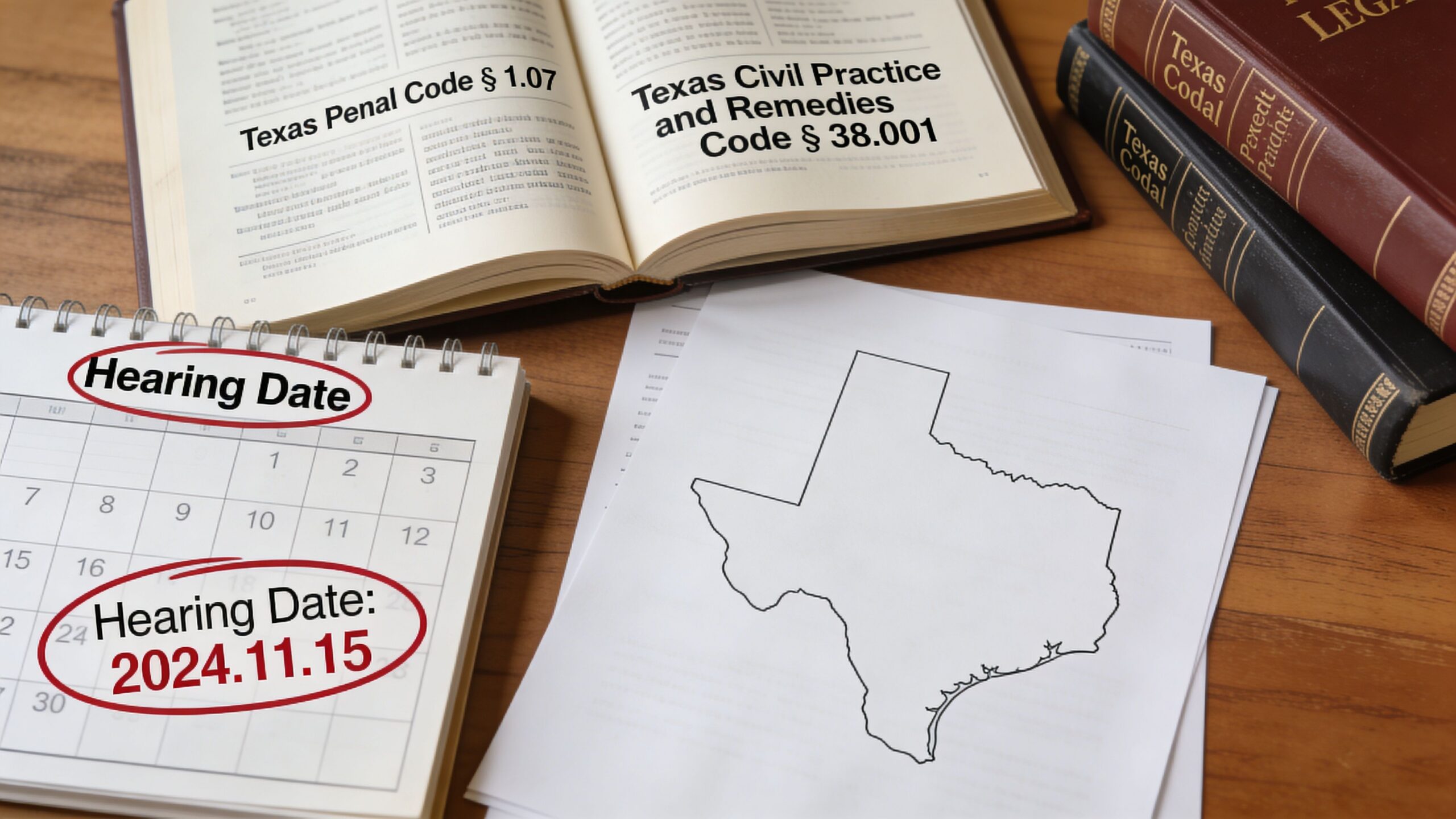
If you need a fuller explanation of how the clock works, review this guide on the Texas divorce waiting period.
What the judge is reviewing
The judge is not there just to witness signatures. The court is reviewing whether the decree can lawfully be entered.
That review commonly includes:
- Timing compliance: The petition must have been on file long enough.
- Voluntary agreement: The judge wants to know the terms were not forced.
- Legal sufficiency: The decree must contain enforceable language.
- Children’s issues: If children are involved, the court reviews whether the orders fit Texas requirements and the child’s best interests.
- Property terms: The division must be stated clearly enough to be carried out later.
Courts don’t reject decrees because the hearing is dramatic. They reject decrees because the paperwork is incomplete, unclear, or legally defective.
Residency and jurisdiction
You also need the court to have proper authority over your divorce. In plain English, that means at least one spouse must satisfy Texas residency requirements, and the case must be filed in the correct county.
This issue rarely creates drama at the prove-up itself, but when it does, it can stop the final hearing cold. If your work involves frequent relocation, military service, or a recent move between counties, residency should be reviewed carefully before you ever ask for a final setting.
Grounds for divorce
Most Texas prove-ups proceed on insupportability, which is the common no-fault ground. That means the marriage has become insupportable because of conflict or discord, and there is no reasonable expectation of reconciliation.
In a routine agreed divorce, the testimony on grounds is usually short. You’re not there to tell the story of the marriage in detail. You’re there to give the court the legal basis to grant the divorce.
What works and what doesn’t
Some preparation choices make this process smoother. Others almost guarantee delay.
| What works | What causes trouble |
|---|---|
| Reviewing the decree line by line before the hearing | Assuming the decree is fine because “we already agreed” |
| Checking dates against the filing date | Guessing when the waiting period ends |
| Making sure child-related terms are complete | Leaving health insurance, exchanges, or support details vague |
| Confirming court-specific submission rules | Showing up with forms the court doesn’t accept |
Why timing is more than a calendar issue
The waiting period is also your last quality-control window. Smart use of that time usually means reviewing financial disclosures, correcting drafting errors, and confirming that any related documents match the decree.
That’s especially important in divorces involving retirement accounts, a family business, real estate transfers, or a detailed parenting plan. The hearing may be short, but the legal effect lasts much longer.
Your Step-by-Step Prove Up Preparation Checklist
A prove-up usually lasts only a few minutes. The preparation behind it should be much more careful.
I tell clients to treat this as a file-review exercise first and a court appearance second. Judges in Harris County, Dallas County, Tarrant County, Travis County, and Bexar County all want the same basic legal foundation. The practical details vary. One court may require documents uploaded before a virtual setting. Another may want a clean proposed decree sent to the coordinator in advance. A third may still expect a live, in-person appearance even in an agreed case. If you prepare for your specific court instead of relying on a generic checklist, the hearing is far more likely to go through in one setting.
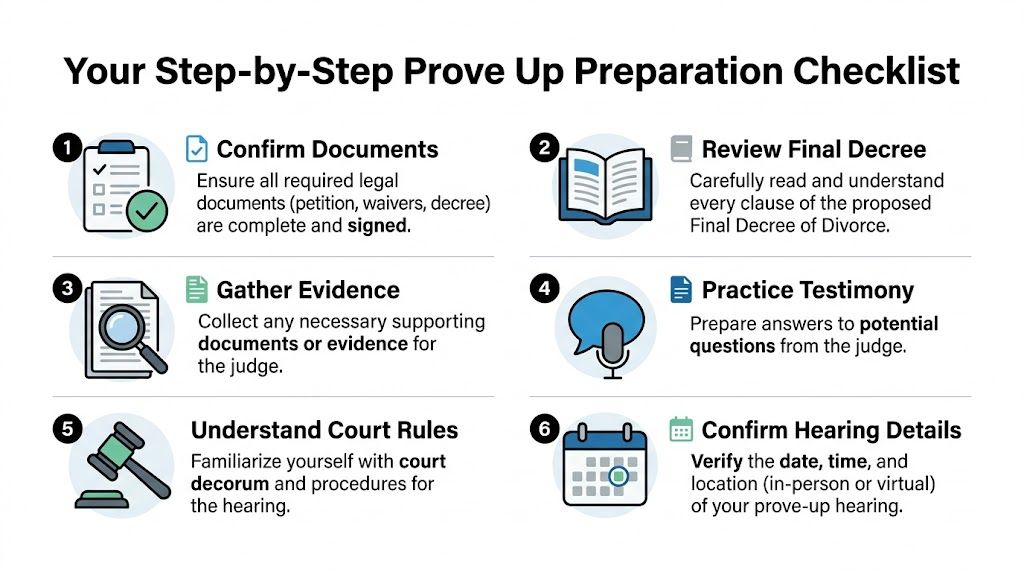
Gathering your essential documents
Start with the papers the judge will rely on, not with what you plan to say. Delays usually come from one of three problems: a missing document, inconsistent language between documents, or a decree that does not match local court procedure.
Review this set before the hearing is ever placed on the calendar:
| Document | Purpose | When to Prepare |
|---|---|---|
| Original Petition for Divorce | Confirms what was filed and when the case began | Early in the case, then review before hearing |
| Final Decree of Divorce | Contains the final orders the judge is asked to sign | Draft early, finalize before prove-up |
| Waiver of Service or proof of service | Shows the other spouse received legal notice or waived service | After filing, well before final setting |
| Any signed mediated settlement documents | Confirms final terms if the case resolved through mediation | As soon as settlement is reached |
| Child-related orders and attachments | Supports conservatorship, possession, support, and medical terms | Before the decree is submitted |
| Court-required local forms or affidavits | Meets county and court-specific filing requirements | As soon as hearing procedure is confirmed |
Then check how your court wants them delivered. Some Houston-area courts want proposed orders emailed to the coordinator. Some DFW courts are more likely to require e-filing or pre-hearing submission through a court portal. Austin and San Antonio settings can differ by court number, not just by county. Do not assume that what worked for a friend in another county will work in your case.
One practical rule avoids a lot of trouble. If a sentence in the decree is vague enough to start an argument after divorce, revise it before the prove-up. Judges sign orders. They usually do not rewrite them for you on the spot.
If military service affects notice, scheduling, or availability, review the Texas rules that often affect these cases in a Texas military divorce guide before setting the hearing.
Crafting your testimony script
The judge needs clear testimony proving the legal points required to grant the divorce. Short, accurate answers work better than a long explanation.
Many courts use a standard prove-up script, whether the questions come from your lawyer, from the judge, or from a written affidavit procedure approved by that court. Read the petition and decree before the hearing so your answers match the filed paperwork.
A typical hearing may sound something like this:
Q: Please state your name for the record.
A: Your full legal name.
Q: Are you the petitioner in this divorce?
A: Yes.
Q: Have you lived in Texas and in this county long enough for this court to hear your divorce?
A: Yes.
Q: Was your Original Petition for Divorce filed more than 60 days ago?
A: Yes.
Q: Has your marriage become insupportable because of discord or conflict, with no reasonable expectation of reconciliation?
A: Yes.
Q: Have you reviewed the Final Decree of Divorce?
A: Yes.
Q: Do you believe the property division is fair and do you ask the court to approve it?
A: Yes.
Q: If children are involved, do you believe the orders are in the children’s best interest?
A: Yes.
Q: Did you sign the decree voluntarily?
A: Yes.
Q: Are you asking the court to grant the divorce and sign the decree?
A: Yes.
This video can help you get more comfortable with the hearing format before you appear:
Answer the question asked, then stop. Judges value accuracy and control.
How to practice without sounding robotic
Practice out loud once or twice, using the actual decree in front of you.
That is enough for many individuals. The goal is familiarity, not performance.
Focus on these points:
- Use your real name and the case language: Match the petition, decree, and any waiver or service documents.
- Read the decree before the hearing: You should know what the property terms, child provisions, and signature pages say.
- Keep your answers direct: “Yes, Your Honor” is usually all the court needs.
- Pause if you do not understand a question: It is better to ask for clarification than to give inaccurate sworn testimony.
Do you need a witness
Usually, no. In an agreed divorce, the petitioner’s testimony is often enough.
A witness may matter in a default case, a fault-based case, or a setting where the court wants additional proof on a narrow issue. Some courts also rely more heavily on affidavits than live supporting testimony, particularly in short agreed matters handled on a submission docket.
If your case falls outside the usual agreed-divorce pattern, confirm the requirement with the court coordinator or your attorney before the hearing date.
Final review before the hearing
Run this check the day before:
- Hearing format: Confirm whether your court expects in-person appearance, Zoom appearance, affidavit submission, or another procedure.
- Court-specific instructions: Verify check-in time, email addresses, Zoom links, and whether the court wants the decree sent in advance.
- Document access: Bring clean copies if you are appearing in person, or keep searchable PDFs ready if you are appearing remotely.
- Name consistency: Make sure the petition, decree, waiver, and testimony all use the same names and case details.
- Child-related details: Confirm support, medical support, possession terms, and dates of birth are correct.
- Signature readiness: Check that every required party signature is in place and the judge’s signature line is ready.
Small drafting mistakes can stop a prove-up cold. Careful preparation usually means one short hearing, one signed decree, and no need to come back and fix avoidable problems later.
Navigating Your Hearing In-Person Virtual or Military
The prove-up itself may be simple. The format is not always simple. That’s where county practice starts to matter.
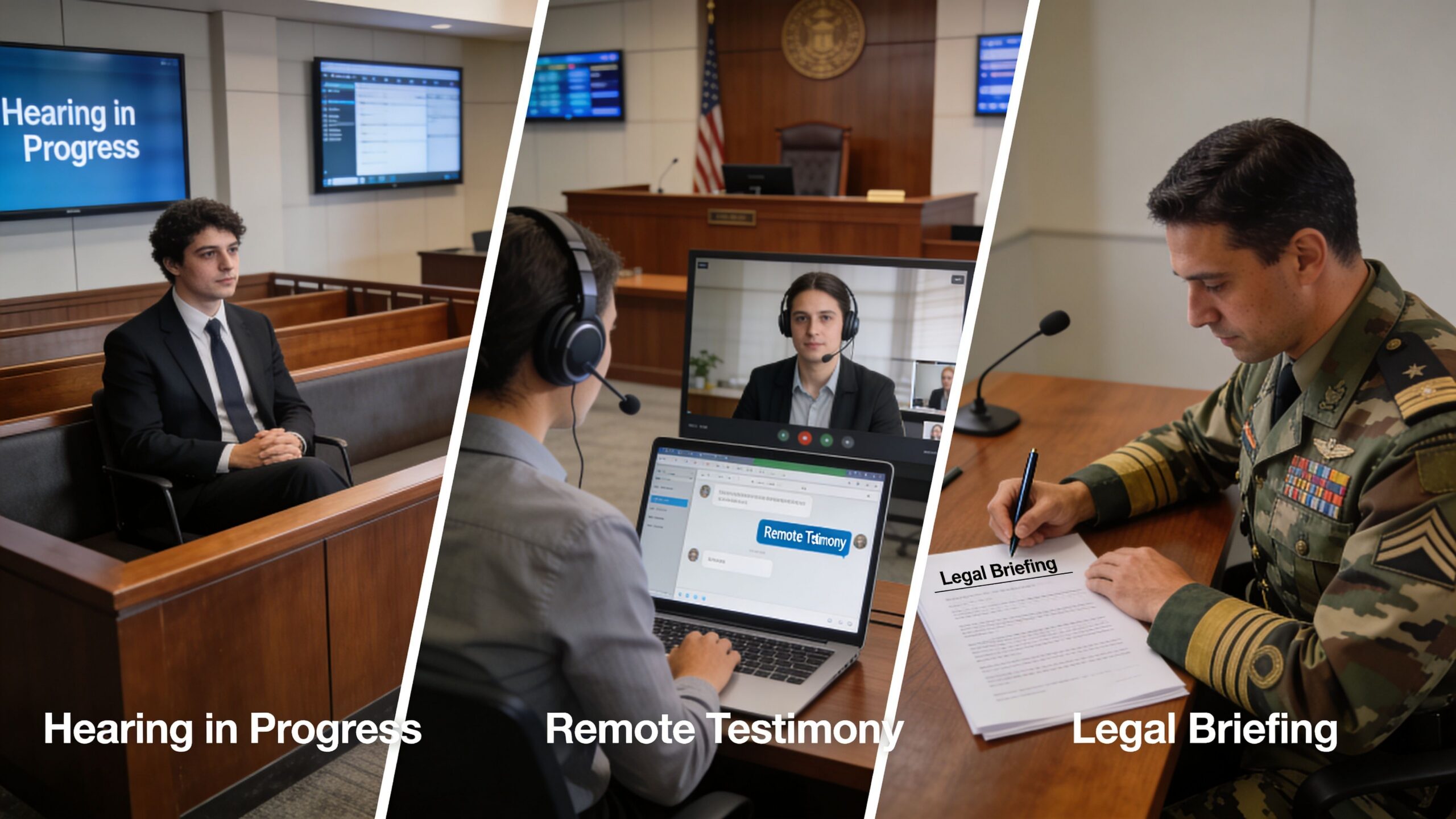
The in-person courtroom experience
An in-person prove-up is still common across Texas. If that’s your setting, think practical and respectful.
Arrive early. Bring your file. Dress like you’re handling an important legal matter, because you are. Speak clearly, stand when asked, and address the judge respectfully.
In-person hearings often work best when:
- The court has detailed local procedures
- The case involves children and the judge wants live testimony
- There are documents that may need immediate correction
- You want fewer technology risks
The downside is convenience. Travel, parking, security lines, missed work, and courthouse logistics can all add stress.
Virtual hearings and county-specific variation
Texas courts don’t handle remote prove-ups the same way. That’s the part many online guides skip.
According to this discussion of Texas prove-up hearing practice, county-specific variations are significant, some Houston-area courts such as Harris have shifted to hybrid Zoom and in-person models, and a 2024 survey found that 68% of Texas judges now allow virtual prove-ups for uncontested divorces. The same source notes that judges in high-volume counties like Bexar are scrutinizing remote hearings more closely.
That has real consequences in metro areas:
| Area | Common issue | Practical takeaway |
|---|---|---|
| Houston and nearby counties | Hybrid options may exist, but procedures can differ by court | Confirm the assigned court’s exact submission and appearance rules |
| Dallas-Fort Worth | Practices can vary by county and by individual court | Don’t assume one county’s process applies to another |
| Austin area | Remote options may exist, but local form requirements still matter | Check whether affidavits or pre-submitted orders are required |
| San Antonio and Bexar County | Remote hearings may get closer review | Double-check child-related and decree language before submission |
Remote does not mean relaxed. Virtual hearings often require more preparation because the judge sees only your testimony and your paperwork.
If your hearing is virtual, test your audio, camera, and internet connection in advance. Sit in a quiet room. Use a neutral background. Keep your decree and any supporting documents open in front of you.
Military and out-of-state circumstances
Military families often need a different approach. Service members may be stationed outside Texas, deployed, or dealing with schedules that make courthouse attendance difficult.
That doesn’t automatically prevent finalization, but it does make court-specific planning more important. Residency, service issues, military status protections, and remote appearance rules should all be reviewed carefully. If this applies to you, start with a clear overview of Texas military divorce laws.
For military clients, what works is early coordination. Confirm the hearing format, confirm the available remote options, and make sure the court knows whether scheduling limits exist due to service obligations. Last-minute requests are harder to solve.
Common Prove Up Problems and How to Avoid Them
Most failed prove-ups are not about conflict. They’re about sloppiness.
Paperwork problems that stop the hearing
The biggest issue is usually the decree itself. A decree that is vague, incomplete, inconsistent with prior filings, or missing required language can trigger a reset.
Common trouble spots include:
- Property descriptions that are too broad: “Each party keeps personal property in his or her possession” may not solve disputes about specific valuable items.
- Debt provisions that don’t identify the account clearly: Enforcement becomes harder later.
- Child provisions with internal contradictions: One paragraph says one pickup time, another says something else.
- Missing supporting paperwork: A court may expect waivers, affidavits, or child-support documents before the prove-up can proceed.
The solution is slow reading. Not fast filing.
When the judge asks a question you didn’t expect
Even a smooth hearing can include a question that wasn’t in your script. That doesn’t mean something is wrong.
A judge may ask for clarification about a retirement account, a child’s residence, a support term, or why a piece of property is being handled a certain way. The best response is simple. Listen. Answer only what you know. If the question points to a drafting problem, correct the document instead of trying to explain around it.
Long marriages and complex estates
Some cases receive closer scrutiny because the underlying issues are more complicated. That is especially true in long-term marriages, high-asset estates, and divorces involving businesses, professional practices, multiple real properties, or separate-property claims.
The rise of gray divorce, defined here as divorces involving couples married 20 years or more, accounts for about 10% of all divorces in Texas, according to this summary of Texas divorce statistics and gray divorce trends. In those cases, prove-up hearings may involve greater scrutiny of complex asset division and spousal maintenance issues.
That doesn’t mean the hearing will become a trial. It does mean judges are less likely to breeze past unclear financial terms.
A short hearing can still rest on a very detailed agreement. The more complicated the estate, the more exact the drafting must be.
What works better than “good enough”
If your case includes a business, a long marriage, or substantial property, these habits matter:
- Use exact descriptions: Name accounts, real property, and transfer obligations clearly.
- Separate decree issues from transfer issues: The decree may award property, but other documents may still be needed to complete the transfer.
- Review maintenance terms carefully: Duration, triggering events, and payment details should be unmistakable.
- Resolve fault-based allegations deliberately: Even in a no-fault system, allegations like infidelity can affect how the final package is reviewed when they intersect with asset division arguments.
At the prove-up stage, “close enough” is often what causes a second hearing.
Frequently Asked Questions About Texas Prove Up Hearings
Can you do a prove-up hearing without an attorney
Sometimes, yes. Many people appear on their own in straightforward agreed divorces. The risk isn’t usually the hearing itself. The risk is the paperwork behind it. If the decree is defective, missing terms, or inconsistent with Texas requirements, the judge may refuse to sign it.
What happens if your spouse changes their mind at the last minute
If your spouse withdraws agreement before the decree is entered, the case may no longer be suitable for a simple prove-up. At that point, the court may require further negotiation, mediation, or contested settings. A signed draft does not carry the same effect as a signed court order.
What if the judge denies the divorce at the hearing
Usually, a judge is not denying the existence of grounds for divorce. More often, the court is declining to sign the decree in its current form. That can happen if the paperwork is incomplete, the child-related terms are not acceptable, or the legal requirements have not been met. In many cases, the problem can be corrected and the matter reset.
How long after the hearing is your divorce final
In most cases, the divorce becomes final when the judge signs the Final Decree of Divorce. The hearing and the judge’s signature often happen at the same time or very close together, but you should always confirm that the signed decree was entered.
Do both spouses have to attend
Not always. In many agreed divorces, only one spouse appears for the prove-up. Some courts allow alternatives depending on local procedure and the paperwork filed. The assigned court’s rules matter.
What to Do Next Secure Your Future with Confidence
By the time you reach a prove-up hearing, most of the emotional work has already happened. What remains is precision. Your decree must be complete, your testimony must be accurate, and your court’s local process must be followed exactly.
If you want your final hearing handled carefully the first time, get legal guidance before the setting, not after a rejection. A short hearing can still carry long-term consequences for your property, your children, and your next chapter.
If you're preparing for a prove-up hearing or you're not sure whether your divorce is ready for final court approval, schedule a free consultation with Law Office of Bryan Fagan, PLLC. You can get clear guidance on your decree, your county’s hearing process, and the steps needed to finalize your Texas divorce with confidence.