Skip to content
The hardest part for many people isn't signing divorce papers. It's lying awake wondering how you'll pay the mortgage, cover groceries, or rebuild after years spent raising children or supporting your spouse's career.
If you're searching for spousal support duration texas, you're probably trying to answer one urgent question: How long will financial support last, and will it be enough to help you get stable? Texas law does give you a framework, but the answer isn't always as simple as a number of years on a chart. Some cases fit neatly into the statute. Others turn on disability, family violence, caregiving demands, or a negotiated agreement that changes the outcome entirely.
A divorce case also rarely involves just one issue. Spousal support often intersects with property division, child-related responsibilities, temporary orders, mediation, and the final decree. If you own a business, have retirement assets, serve in the military, or expect a contested divorce, the right strategy matters early.
Facing Divorce and Worried About Your Financial Future?
You may be asking yourself, "How will I manage once the divorce is final?" That fear is common, and it's one of the most emotionally draining parts of a Texas divorce. The uncertainty feels even heavier if one spouse handled most of the income while the other handled the home, the children, or a family business role that didn't come with a paycheck.
Texas does allow post-divorce support in some situations, but the rules are strict. The law doesn't treat support as an automatic reward for a long marriage. Instead, judges look at whether support is economically necessary and how long it should last to help a spouse move toward self-sufficiency.
That means two things can be true at once. You may have a valid need for support, and you may still need a strong legal and financial plan to secure it.
When emotions are running high, legal guidance helps, but so does personal support. Many clients benefit from counseling during this process, especially when fear about money is tied to grief, conflict, or sudden change. If you need emotional support while making legal decisions, you can find counselling services that help people work through major life transitions.
Practical rule: The sooner you understand the support rules, the better your decisions will be about mediation, settlement, and trial preparation.
A divorce in Texas usually moves through several stages: filing, temporary orders if needed, exchanging financial information, negotiation or mediation, and then a final decree if the case settles or goes to court. Questions about support duration can affect each of those steps. For example, a temporary support request may shape your monthly budget now, while a long-term support strategy may depend on what assets you keep in the property division.
You don't need to know everything today. You do need a clear starting point.
Understanding Texas Spousal Maintenance and Alimony
Texas uses terms that confuse a lot of people. In everyday conversation, people say "alimony." In court, the more precise term is usually spousal maintenance.

Two kinds of support that work very differently
Court-ordered spousal maintenance is support a judge can order under Texas law. It is limited, closely regulated, and not easy to obtain. It serves as a narrow safety net, available for certain situations, but only if you fit the legal requirements.
Contractual alimony is different. That is a private agreement between spouses, often reached in settlement negotiations or mediation. It functions as a custom contract you design yourselves. You can build terms around your real life instead of relying only on what a judge might order under the statute.
This distinction matters because many people assume all spousal support works the same way. It doesn't.
Why eligibility matters before duration
Before anyone argues about length of payments, the court first looks at whether you qualify at all for court-ordered maintenance. Texas courts generally start from the idea that maintenance should be limited. A spouse asking for support usually needs to show that they can't meet their minimum reasonable needs with the property and income available after divorce.
That phrase causes confusion. It doesn't mean luxury. It doesn't mean the same lifestyle you had during the marriage. It means a reasonable baseline for living expenses.
If you're trying to understand whether you may qualify, this guide on Texas spousal maintenance eligibility is a helpful companion.
A simple way to think about it
Use this comparison:
- Spousal maintenance: A judge-controlled remedy with legal limits.
- Contractual alimony: A negotiated agreement with much more flexibility.
- Property division: The split of marital assets and debts. This is separate from support, but often closely connected to it.
- Child support: Money for the children, not for a former spouse.
Maintenance is usually about creating a financial bridge, not a permanent income stream.
That difference shapes how lawyers build a case. If your case is headed to trial, evidence about your needs, employability, health, and budget becomes central. If your case is headed to mediation, the discussion may shift toward what both sides can live with, especially if a flexible support agreement helps resolve larger fights over the house, retirement accounts, or business interests.
The Official Timelines for Spousal Support Duration in Texas
A lot of clients ask the same question in the first meeting: "How long would support last if the judge orders it?" That is the right question, but Texas does not answer it with one simple number. The law gives the court a ceiling based largely on how long the marriage lasted, then tells the judge to order support for the shortest reasonable time under the facts of that case.
For many marriages, the timeline starts with the 10-year mark. Once a marriage has lasted at least 10 years, a spouse may have a path to court-ordered maintenance if the legal requirements are met. Duration then follows the statutory caps in Texas Family Code Section 8.054, which sets limits of up to 5 years for marriages of 10 to 20 years, up to 7 years for marriages of 20 to 30 years, and up to 10 years for marriages of 30 years or more.
Texas Spousal Maintenance Duration Limits by Marriage Length
| Length of Marriage | Maximum Duration of Spousal Maintenance |
|---|---|
| 10 to 20 years | Up to 5 years |
| 20 to 30 years | Up to 7 years |
| 30 years or more | Up to 10 years |
Those numbers are caps. They are not guarantees.
A helpful way to view this is to treat the statute like a speed limit sign, not a travel itinerary. The sign tells you the outer boundary. It does not tell you how long your particular trip will take. In a maintenance case, the judge still asks how much time is reasonably needed for the receiving spouse to earn enough to cover basic living expenses.
That is why the "10-year rule" causes so much confusion. Reaching 10 years does not trigger automatic support. It opens the door to ask for maintenance. The spouse seeking it still has to show why support is needed, and for how long.
Longer marriages also do not automatically produce longer awards. A 22-year marriage may still result in a short maintenance period if the receiving spouse can return to work quickly, receives enough property to generate income, or has marketable skills that make self-support realistic within a shorter window.
Courts usually want practical proof, not general statements. If you are asking for a longer duration, or trying to limit one, these details often matter:
- A realistic monthly budget showing housing, utilities, food, insurance, transportation, and medical costs
- Work history and earning capacity including time out of the workforce, prior training, and current job prospects
- Property awarded in the divorce especially cash, retirement assets, or income-producing property
- A transition plan such as retraining, licensing, counseling, or a defined job search timeline
Here is the strategic point many people miss. The statutory chart is only part of the conversation. In real cases, lawyers often use that chart as a starting point in settlement talks, then argue about facts that can shorten, extend, or replace a maintenance claim through other tools. In some families, a negotiated support plan fits better than a hard fight over the court's default timeline. In others, the focus should be on building evidence that the shortest reasonable period is still longer than the other side wants to admit.
If your situation involves a condition that may keep support in place beyond the usual caps, this discussion of Texas permanent spousal maintenance and disability-based support issues can help you see where the timeline rules change.
The divorce process matters too. Temporary support during the case serves one purpose. Final post-divorce maintenance serves another. And contractual alimony, which spouses can negotiate themselves, may allow terms that fit the family's finances better than the court's limited timetable. That is often where careful planning makes the biggest difference.
Important Exceptions That Can Extend Support Duration
A common worry sounds like this: "The chart says support should end in a few years. What happens if my situation still has not changed by then?" That is the right question to ask. In Texas, some cases do not fit neatly inside the usual timeline because the underlying problem is not short-term adjustment. It is a continuing barrier to self-support.
When the usual caps may not control
The standard duration limits are a starting point, not the end of the analysis. Texas courts can keep maintenance in place longer when a spouse has an incapacitating physical or mental disability, or when a spouse cannot earn enough because caring for a child of the marriage with a disability takes up the time and energy that regular employment would require.
Family violence can also change the path to eligibility, especially in marriages that otherwise would not qualify under the usual length-of-marriage rules. The practical lesson is simple. Exceptions usually rise or fall on proof. Medical records, physician statements, school records, therapy schedules, care plans, police reports, protective orders, and witness testimony often matter far more than broad statements that life is hard.
If your case may involve long-term disability issues, review this explanation of permanent spousal maintenance in Texas and when support can last longer. "Permanent" does not always mean forever, but it does point to the kinds of facts that can justify support for an extended period.
A caregiving example
Consider a parent who stays home because a child has severe developmental or medical needs. That parent may have work experience, training, and every intention of returning to a job. Yet the daily schedule can still make ordinary employment unrealistic. Doctor visits, therapy, school meetings, medication management, transportation, and sudden disruptions can consume the workday in pieces.
Courts look at that reality in a practical way. The central issue is whether the spouse can meet basic needs while carrying that caregiving load, not whether a job exists somewhere in theory.
That distinction matters in settlement too. A well-prepared spouse can use calendars, treatment schedules, and provider letters to show why a longer duration is reasonable. The other side may argue, "You can work." The stronger response is, "Here is what the caregiving schedule requires, and here is why part-time or flexible work still does not close the gap."
Sponsored immigrants and support obligations
Some divorces involve a second support system outside ordinary Texas maintenance law. If a U.S. citizen or permanent resident signed an Affidavit of Support for an immigrant spouse, that document can create a separate financial obligation under federal law. In plain terms, it can function like a contract that survives the divorce and may last longer than a Texas maintenance order.
That issue changes strategy. A spouse paying support may need to evaluate exposure under both state divorce rules and the affidavit. A spouse seeking support may have another path to enforce support even if Texas maintenance is limited. These cases require careful pleading and careful settlement drafting, because resolving one claim does not always resolve the other.
Military and other complex cases
Military divorces add another layer. Housing allowances, special pay, retirement issues, deployment history, and relocation can all affect how long support should last and how it should be structured. High-asset cases can present a different problem. One spouse may look wealthy on paper but receive compensation through bonuses, business distributions, or deferred income that does not arrive in a steady monthly pattern.
That is why this section matters beyond the statute. Families often have more room to argue about duration than they first assume. Sometimes the answer is proving that a legal exception applies. Sometimes it is negotiating contractual alimony with terms that fit the family better than a court's limited default options. In either event, the strongest position usually comes from building a record that explains why your household does not fit the standard timetable.
How Judges Determine the Final Support Order
A lot of clients walk into my office with the same fear: "If I qualify for support, does that mean the judge will automatically order enough money for long enough to keep me afloat?" The honest answer is no. Qualification gets you to the courthouse door. The final order depends on the story the evidence tells about need, ability to pay, and how long support is necessary.
What the court looks at
A judge is trying to answer a practical question. After the divorce is final and the property is divided, what does each spouse need to meet basic reasonable expenses, and what can each spouse earn or pay?
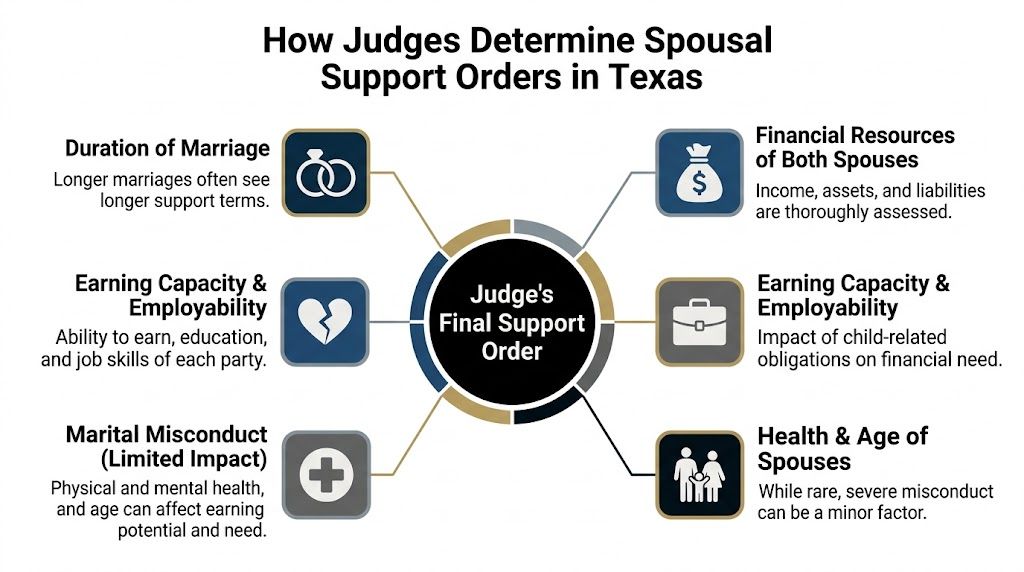
To answer that, the court usually looks at several pieces of the puzzle:
- Ability to meet basic needs: Can the spouse requesting support pay for housing, food, utilities, transportation, insurance, and other reasonable monthly expenses?
- Education and job skills: Can that spouse return to work now, or is training needed first?
- Work history: A long gap in employment can reduce earning power, even for someone who wants to work.
- Contributions as a homemaker: Time spent raising children or supporting the household may have come at the cost of career growth.
- Age and health: Physical or mental limitations can slow or prevent a return to full-time employment.
- Marital misconduct: In some cases, fault may still affect how the court views the overall equities.
- Child-related responsibilities: A parent caring for a child with significant needs may have less flexibility to work full time.
Those factors matter because support is not supposed to be abstract. It has to work in an actual monthly budget.
Judges often review bank records, tax returns, paycheck history, business records, and sworn testimony about expenses. In a disputed case, a vocational expert may be used to explain what a spouse can realistically earn in the current job market, not just what someone assumes they should earn.
The amount cap shapes the duration fight
Texas law limits both monthly amount and duration, and the two issues are tied together. Under Texas Family Code §8.055, which caps maintenance at the lesser of $5,000 per month or 20% of the payer's average gross monthly income, the court still must decide what amount is reasonable and necessary under the facts of the case.
That matters more than many people expect.
If the legal cap does not cover the receiving spouse's actual short-term needs, the argument often shifts from "What is the maximum number?" to "How do we structure a result that gives this family a workable transition?" Sometimes that means fighting hard over how long support should last within the statutory framework. Sometimes it means using settlement strategy, property division, or later modification requests to address the gap.
Why judges connect amount, duration, and the rest of the divorce
A support order works like a stool with three legs. One leg is monthly need. One is ability to pay. One is the broader divorce outcome, including property division and child-related costs. If one leg changes, the whole balance changes.
For example, a spouse may look strong on paper because the paycheck is high, but the actual monthly picture may include child support, health insurance, rent, debt payments, and irregular compensation. On the other side, a spouse requesting support may receive assets in the divorce that reduce immediate monthly need, or may have a clear path back into the workforce within a set period.
That is why judges rarely decide duration in isolation. They are asking how long support is reasonably needed to bridge the gap, not how long one spouse would prefer to receive it.
Evidence that can strengthen your position
If you are asking for support, your goal is to give the court a grounded, credible timeline. You want the judge to see both the present problem and the path to greater independence.
Helpful evidence often includes:
- A realistic monthly budget. Use actual numbers, not guesses or inflated estimates.
- Reliable income records. Pay stubs, tax returns, profit and loss statements, and benefit records all help.
- Proof of barriers to self-support. Medical records, school enrollment, childcare demands, or evidence of time out of the workforce can be persuasive.
- A transition plan. Show what you need, how long you need it, and what steps you are taking to reduce dependence over time.
If you are resisting an overreaching request, the strategy is different. You may need to show that the proposed budget is overstated, that income is being understated, that assets awarded in the divorce reduce need, or that the requesting spouse has a more immediate earning capacity than claimed.
That kind of preparation often decides the duration fight. The law gives the outer boundaries. The evidence helps determine where, within those boundaries, your case lands.
Using Contractual Alimony to Create Your Own Terms
A common turning point in a divorce case looks like this. One spouse needs support for longer than a judge would likely order under the statute, and the other spouse is willing to help for a longer period if the overall settlement also protects property, business interests, or future cash flow. That is often where contractual alimony becomes one of the most useful tools in a Texas divorce.

Why negotiated support can work better for some families
Court-ordered spousal maintenance follows narrow statutory rules. Contractual alimony is different. It is a private agreement between spouses, usually built into the divorce settlement, and it can be shaped around the actual problem you are trying to solve.
That difference matters.
A judge may be limited in what the court can order for duration and amount. In settlement, you can build terms around your life instead of relying only on what a judge might order after a trial. For example, support can be tied to the time needed to finish a degree, stabilize after selling a home, care for a child with special needs, or ease the transition from a single household budget to two separate ones.
In other words, statutory maintenance gives you the outer frame. Contractual alimony lets you design more of the inside.
What you can tailor in an agreement
A well-drafted agreement can answer practical questions that often decide whether support is effective:
- How long payments will last. You can set a timeline that matches retraining, licensing, relocation, or a phased return to work.
- How payments will be structured. Some families use monthly payments. Others prefer step-down payments, a shorter higher-payment period, or terms coordinated with other settlement obligations.
- How support fits with property division. The house, retirement accounts, debt allocation, and business interests can all affect what support terms make sense.
- What events will end support. Remarriage, cohabitation, sale of a home, a new job, or another agreed trigger can be addressed clearly.
- Whether the terms can be changed later. This point deserves special attention because some agreements are flexible and others are intentionally fixed.
That last issue is easy to miss. Many people assume all support works the same way after divorce. It does not. A court order for maintenance and a contractual agreement can have very different rules for enforcement and modification.
A settlement example that shows why flexibility matters
Suppose one spouse left the workforce for years to raise children, and the family’s income mainly came from the other spouse’s business. At trial, the court might focus on a relatively limited maintenance question. In settlement, the conversation can be broader.
The spouses might agree that one keeps more of the business value, the other keeps the house for a set period, and contractual alimony fills the monthly gap while job training or a return to work is underway. That approach often works better because it treats support as one piece of the overall financial plan, not as an isolated fight.
This is often how durable settlements are built. Each side gives something. Each side gets something that matters.
Mediation is often where these terms take shape
Many Texas divorce cases go through mediation before trial. Mediation gives both sides room to solve the full financial puzzle instead of asking only what a judge could order at the end of a hearing.
If you are preparing for that process, it helps to think several steps ahead. What support amount would carry you through the transition? What end date is realistic? What trade-offs would you accept in property division to get terms that are more stable or longer lasting? If you are the paying spouse, what language would protect you from an open-ended obligation?
If you are concerned about whether support terms could later be changed after the divorce, review how a modification of a Texas divorce decree may work after major life changes. That issue can affect how you negotiate the original agreement.
A short primer may also help if you want to hear this topic discussed aloud before a mediation session:
What to watch before you sign
Contractual alimony can solve problems that statutory maintenance cannot. It can also create new problems if the wording is vague.
Before signing, make sure the agreement clearly states:
- When payments begin
- When payments end
- The exact payment amount and due date
- What event ends the obligation early, if any
- Whether the obligation can be modified
- How the agreement will be enforced
- How the support terms interact with the final divorce decree
Small wording choices matter here. A support clause that sounds clear during mediation can become expensive and frustrating later if it does not say exactly what happens after a missed payment, a remarriage, a job loss, or a major income change.
A vague support agreement often shifts the conflict from divorce court to post-divorce enforcement. Clear drafting reduces that risk.
Contractual alimony works best when you use it on purpose. For some clients, that means buying enough time to rebuild earning capacity. For others, it means trading support for a better property outcome, creating a smoother exit from a shared business, or setting terms a judge likely could not order. That is the advantage here. You are not limited to asking how long support can last under the statute. You can also ask what arrangement gives your family the fairest path forward.
Your Next Steps Modifying Support and Protecting Your Future
A support order doesn't always stay frozen forever. Life changes. Jobs end, health shifts, children need more care, and sometimes a former spouse stops paying. What you do next can protect your finances and reduce avoidable damage.
When a modification may be worth exploring
If your divorce is already final and the current support terms no longer fit reality, a modification may be possible. In general, post-divorce modifications are tied to a significant change in circumstances. That doesn't mean every inconvenience qualifies, but it does mean the court may revisit support when the facts materially shift.
If you need to review that process, this resource on modification of a Texas divorce decree explains how post-decree changes are addressed.
Examples that often lead people to seek legal advice include:
- A serious health change: one spouse can no longer work as expected.
- A major income shift: the paying spouse loses work or the receiving spouse becomes more self-supporting.
- New caregiving demands: a child or family situation changes what employment is realistic.
- Order terms that were poorly drafted: enforcement or interpretation becomes a problem.
Modification cases are evidence cases. If you're asking the court to change an order, bring documents, not just frustration.
If your former spouse stops paying
Enforcement is its own process. If support was ordered and your ex stops paying, don't assume the problem will fix itself. Missed payments can snowball quickly.
Your options may depend on whether the obligation is court-ordered maintenance or contractual alimony. The language of the decree and settlement documents matters. In either situation, save records of missed payments, communication, and financial harm. The sooner an attorney can review the wording, the easier it is to identify the available remedies.
A clear checklist for the next week
If you're in the middle of divorce or recently finished one, start here:
- Pull together financial records. Gather pay information, account statements, debt records, tax returns, and a current monthly budget.
- List your actual needs. Focus on housing, insurance, transportation, food, medical expenses, and child-related costs.
- Write out your work history. Include time out of the workforce, education, certifications, and any limits on current employment.
- Preserve important messages. Emails and texts about support, settlement, or missed payments can matter.
- Review the decree carefully. The exact wording often controls what can be enforced or modified.
- Prepare for mediation or court with a plan. Know what outcome you need, but also where you can be flexible.
Key Takeaway
Keep these points in mind as you evaluate your case:
- The duration chart sets maximums, not guarantees. Courts still look for the shortest reasonable period.
- Eligibility comes first. Support isn't automatic just because a marriage lasted a long time.
- Exceptions matter. Disability, caregiving responsibilities, family violence, and sponsored immigrant obligations can change the result.
- Amount and duration work together. A support order has to be reasonable and workable in light of the full financial picture.
- Contractual alimony can be a powerful solution. It gives spouses room to create terms that fit their lives more closely than a statutory order might.
- Post-divorce action may still be available. Modification and enforcement are often the next chapter, not the end of the story.
What to do next
If you're still in the divorce process, don't wait until the final hearing to think about support. This issue should be part of your strategy from the beginning, alongside custody planning, temporary orders, mediation, business valuation, and property division.
If you're a parent, support planning should be coordinated with your possession schedule, child support obligations, and the practical costs of raising your children in two households. If you're a business owner or high-income professional, income documentation and settlement structure become especially important. If you're in a military divorce, retirement, benefits, and federal rules may affect how the larger settlement is built.
You don't need a perfect case to take the next step. You need organized information, realistic goals, and advice tied to your actual facts.
If you're dealing with questions about spousal support duration texas, a free consultation with Law Office of Bryan Fagan, PLLC can help you understand whether you're likely looking at statutory maintenance, a negotiated contractual alimony solution, a modification request, or an enforcement action. You can use that meeting to review your budget, your marriage history, your caregiving responsibilities, and your divorce timeline so you can move forward with more clarity and a plan built around your future.