Skip to content
When divorce is already hard, the last thing you need is a process server showing up at your home or job with papers in hand.
If you're searching for waiver of service divorce texas, you're probably trying to keep things calmer, more private, and less expensive from the start. That's a smart instinct. In many Texas divorces, the way the case begins affects the tone of everything that follows, including property discussions, parenting negotiations, and whether the case stays uncontested.
A waiver of service can be a very useful tool. It can also be a mistake if it's used in the wrong kind of case or signed without understanding what it does. The key is knowing when it helps, what it changes, and what it does not change.
What Is a Waiver of Service in a Texas Divorce?
Being “served” in a divorce means a constable, sheriff, or private process server formally delivers the filed divorce paperwork to the other spouse. That process is legal and common, but it can feel harsh. Some people are served at home. Others are served at work. Even when no one intends drama, formal service often makes an already painful situation feel more public and confrontational.
A waiver of service is a signed legal document that lets the responding spouse acknowledge receipt of the filed divorce petition without requiring formal delivery by a process server. In plain English, it tells the court, “I got the petition, and I don't require formal service.”

What the waiver does
A waiver changes how notice happens at the beginning of the case. It does not make the divorce automatic. It does not mean the responding spouse agrees with every allegation in the petition. It does not erase the need for a final decree.
Texas uses this process often in cooperative divorces. Uncontested cases make up about 70% of Texas divorce filings, and waivers of service are used in over 85% of those cases according to this Texas waiver of service overview. That same resource notes that using a waiver can streamline the process, reduce emotional stress, and in some cases trim legal fees by 15 to 20%, while still preserving Texas’s mandatory 60-day waiting period.
What the waiver does not do
Many people worry that signing a waiver means surrendering rights. Usually, that fear comes from the name. “Waiver” sounds broader than it is.
In most situations, signing a waiver of service means only that you are giving up the right to be formally served with the petition. You are not automatically waiving rights to property, child custody, child support, or spousal support just because you signed the document.
Practical rule: A waiver of service deals with notice. It does not, by itself, decide who gets the house, who keeps retirement funds, or what possession schedule will apply to your children.
Why timing matters from the very start
The waiver only works if there is already a filed case. The petition must be on file with the district clerk first. If you're the filing spouse, that starts with the Original Petition for Divorce in Texas. If you're the responding spouse, ask to see the file-stamped petition before signing anything.
That one detail matters more than people realize. A waiver signed too early can be invalid. Then the parties lose time and often end up paying for formal service anyway.
When a waiver is a good fit
A waiver often makes sense when:
- You both know the divorce is coming and no one is trying to hide the case.
- Communication is civil enough to exchange paperwork directly.
- The case looks uncontested and both spouses plan to participate.
- Privacy matters because you don't want service at work, at home, or in front of children.
In those situations, a waiver often sets a more respectful tone. That doesn't solve every disagreement, but it can reduce the first spike of stress and help both sides focus on practical next steps.
Key Benefits of Using a Waiver of Service
One spouse wants to keep the divorce respectful. The other wants to avoid being served at work, in front of the children, or by surprise at home. In that situation, a waiver of service is often a strategic choice, not just a paperwork shortcut.
Used at the right time, a waiver can lower cost, reduce tension, and keep an agreed divorce from drifting into a fight over process. It is not the right tool for every case. But in the right case, it protects dignity and preserves momentum.
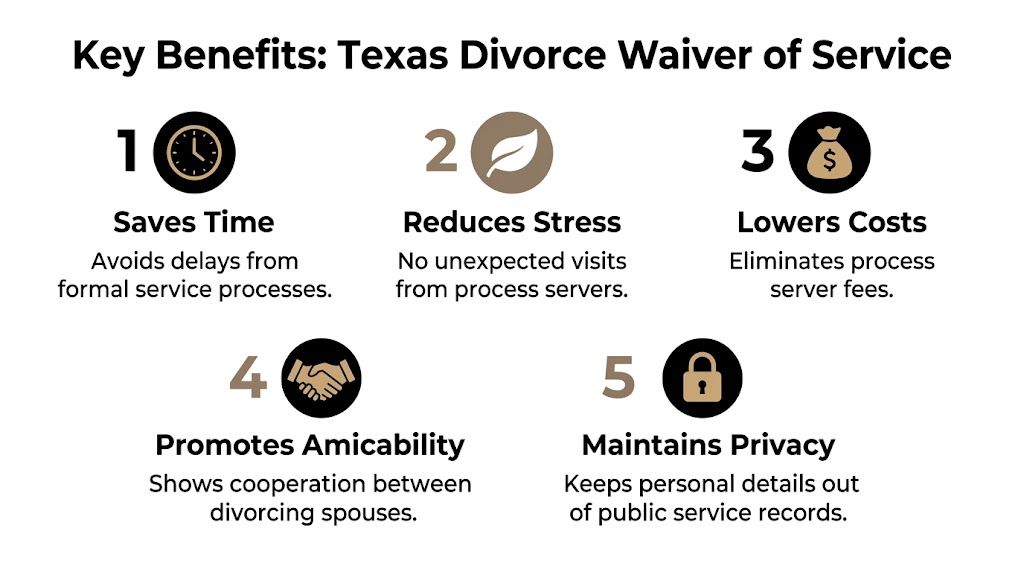
It helps you control the tone of the case
The first step in a divorce often sets the tone for everything that follows. If a spouse is formally served without warning, the case can start with embarrassment, anger, or suspicion. I see that reaction most often in cases that could have stayed cooperative if the opening had been handled with more care.
A waiver gives both spouses a chance to start with direct communication instead. That matters in amicable divorces, where the goal is to solve problems without turning every step into a contest.
It protects privacy in ways clients care about
For many families, privacy is not a small concern. It is one of the main reasons to use a waiver.
Formal service can happen at home, at work, or anywhere the process server can locate the respondent. A waiver avoids that public moment. That can be especially important if you have school-aged children, a sensitive job, or extended family who do not yet know a divorce has been filed.
Military families often care about this for another reason. Service can become more complicated if a spouse is away for training, deployed, or living on base. A waiver may simplify the opening stage if both spouses are cooperating and the timing is handled correctly.
It usually saves money and wasted effort
A waiver can eliminate the need to hire a process server or constable for routine service. That does not make the divorce free, but it does cut out one expense that often adds no value in a cooperative case.
The bigger savings are sometimes indirect. If both spouses are already sharing documents and working toward agreement, avoiding formal service can keep the case from slowing down over avoidable logistics. You can put that time and money toward the paperwork that moves the divorce forward, including the documents commonly needed for a Texas divorce filing.
It keeps an uncontested divorce from becoming harder than it needs to be
A large share of Texas divorces are resolved without a full trial. In those cases, the smartest move is often the one that reduces friction early.
A waiver helps by removing one common source of delay. There is no waiting to track someone down for service. There is no proof of service issue to fix later. The case can stay focused on the substantive work, such as drafting the final decree, collecting financial information, and addressing parenting details.
That is especially useful in divorces where both spouses already agree on the broad outcome.
It can be a smart choice in high-asset cases
Some people assume a waiver is only for simple divorces. That is not always true.
In a high-asset case, the parties may still choose a waiver because they want to reduce unnecessary conflict at the outset while accountants, business valuation experts, or attorneys sort through the harder issues. The waiver does not remove the need for careful review. It avoids starting a complicated case with a public confrontation that makes settlement harder.
The trade-off is straightforward. If there is distrust, hidden property, or a real concern that one spouse will ignore the case, formal service may be the safer path. In a financially complex but cooperative divorce, a waiver can still be the better strategic choice.
The emotional benefit is real
Clients often focus on legal deadlines first. A few weeks later, they tell me the bigger benefit was emotional. The case started with less hostility, the children were shielded from an upsetting scene, and routine communication stayed more civil than expected.
A waiver can help reduce:
- public embarrassment
- early defensiveness
- stress for children
- pressure on spouses who are trying to co-parent after divorce
That matters because divorce is not only a legal process. It is also the start of a new working relationship for parents, and the opening step can either make that easier or harder.
The right benefit depends on the kind of divorce you have
In an amicable divorce, the main benefit is usually preserving cooperation.
In a high-asset divorce, the main benefit is reducing unnecessary conflict while the parties work through detailed financial issues.
In a military divorce, the main benefit may be practicality and privacy, especially when location, duty status, or scheduling make personal service more disruptive.
The best question is not whether a waiver is faster in the abstract. The better question is whether it fits the level of trust, complexity, and communication in your case.
How to Properly Complete and File Your Waiver
A common Texas divorce mistake happens in the first few days. One spouse wants to keep things civil, sends over a waiver immediately, and the other signs it before the divorce petition is even filed. The intent is good. The paperwork is not.

Courts expect the sequence to be right. If it is not, you can lose time, pay for corrected filings, or end up using formal service after all. In an amicable divorce, that undercuts the very reason people chose a waiver in the first place. In a high asset or military case, a sloppy waiver can create avoidable disputes about notice, timing, or whether the right version of the document was signed.
Start with the filed petition, not before
The waiver must be signed after the Original Petition for Divorce is filed with the court. That is one of the first things I check.
The responding spouse should receive the filed, file stamped petition before signing the waiver. If the waiver is signed too early, the court may reject it or require the problem to be fixed before the case can move ahead. That can turn a simple courtesy into a delay.
Timing matters for strategic reasons too. In a cooperative divorce, waiting until the petition is on file keeps the process clean and lowers the chance of rework. In a case involving retirement accounts, real estate, business interests, or military benefits, clean procedure matters even more because you do not want preventable paperwork issues distracting from larger decisions.
The basic filing sequence
For most Texas divorces, the process looks like this:
- File the Original Petition for Divorce with the district clerk.
- Get a file-stamped copy of the petition.
- Provide that stamped petition to the responding spouse.
- Have the responding spouse review and sign the waiver after filing.
- Sign before a notary who is not the attorney in the case.
- File the signed waiver with the court.
- Keep copies for both spouses.
If you are assembling everything for the opening stage of the case, this guide to essential divorce documents for filing in Texas can help you keep the paperwork straight.
What the waiver needs to include
A waiver is short, but it still has to match the case exactly. Clerks and judges look for accuracy, not rough compliance.
Check these items carefully:
- Correct case information. The cause number, court, and party names should match the filed petition.
- The respondent’s mailing address. This can matter if the court is asked to impose personal obligations.
- The respondent’s signature. The right person has to sign the right document.
- Proper notarization. The waiver usually needs to be notarized, and the notary cannot be the filing spouse’s attorney.
One missing detail can create a problem later.
Read the wording before anyone signs
Here, strategy matters more than form.
Some waivers only give up formal service of the petition. Others are drafted more broadly and may affect notice of future filings or settings. In an agreed divorce with strong communication, broader language may never cause a practical issue. In a divorce with uneven information, valuable property, reimbursement claims, or military service complications, broader language deserves a closer review.
I usually tell clients to slow down if the waiver does more than confirm receipt of the filed petition. Saving a few days at the start is not worth giving up protections you may want later.
Filing details people overlook
These are the errors I see most often:
| Issue | Why it matters |
|---|---|
| Signed before the petition was filed | The waiver may be invalid |
| Not notarized | The clerk or court may reject it |
| Wrong or missing address | It can affect what orders the court can enter |
| Incorrect cause number or court | The waiver may not match the case |
| Broad language ignored | The respondent may waive more notice than intended |
Here’s a quick visual explanation of the process and why details matter:
A practical way to handle the exchange
The filing spouse should send the file stamped petition and the proposed waiver together. The responding spouse should read both, confirm the case information, and make sure the waiver says only what they intend to agree to. Then the waiver should be signed before a proper notary and filed promptly.
That approach keeps an amicable case on track. It also protects both sides from the kind of avoidable mistake that creates tension, added cost, or a fight over procedure instead of substance.
If you are the spouse being asked to sign, ask for the filed petition first. Read every line of the waiver. If the wording feels broader than you expected, get legal advice before you sign.
Understanding the Legal Effects and Potential Risks
Signing a waiver of service should feel informed, not blind. The document may be routine, but it has legal consequences. You need to know what rights stay with you, what risks can appear, and why the wording matters.

What you are agreeing to
In a standard situation, you're agreeing that you received the filed petition and that formal service is unnecessary. That's the narrow function of the waiver.
You are not automatically agreeing to:
- property division terms
- conservatorship or possession terms for children
- child support amounts
- spousal maintenance terms
That said, the exact wording controls. A waiver should never be signed on assumptions alone.
The difference between a specific and global waiver
Many people encounter difficulties when dealing with this. A Specific Waiver generally waives only initial service. A Global Waiver goes further and can waive notice of future filings or hearings.
That distinction matters a great deal. In an amicable case with little property and no real disagreement, broader language may not create a practical problem. In a contested or potentially contested case, it can.
A waiver of service should match the level of trust in the case. If trust is low, broader waiver language can create serious risk.
Why global waivers deserve caution
A global waiver can leave the responding spouse with less notice and less participation than expected. If that spouse doesn't file an answer or stay involved, the other side may try to move the case forward without meaningful opposition.
According to this article on waiver risks in Texas divorce cases, a key concern is that Global Waivers waive all future notices. That source also notes that once filed, a waiver is binding unless coercion is proven. In high-asset divorces, attorneys report that up to 25% of waiver-initiated cases may later involve modification requests tied to issues such as hidden assets discovered after the fact.
High-asset and business-owner cases
If you own a business, hold investment accounts, have stock compensation, or manage separate and community property claims, caution matters. A waiver may still be appropriate, but the type of waiver and the surrounding strategy matter much more.
In complex estates, the biggest mistake is assuming the case is “simple” because both spouses are being polite. Politeness is not the same thing as full financial disclosure. If there are questions about valuation, reimbursement claims, business income, or tracing separate property, a narrow waiver is usually safer than broad language.
Military families and special considerations
Military divorces bring their own timing and notice concerns. Service members and spouses often deal with deployment schedules, out-of-state logistics, and federal protections that interact with Texas procedure.
The same basic advice applies. Read the waiver carefully. Confirm whether it only waives service or reaches future notices too. If your family has military issues, retirement questions, or jurisdiction concerns, don't sign first and ask questions later.
A safer way to think about the decision
The right question isn't “Can I sign a waiver?” The better question is “What kind of waiver fits this case, if any?”
Use this framework:
Good candidate for a waiver
Low conflict, full communication, clear agreement on the path forward, and no concern about hidden information.Possible candidate, but review first
Children are involved, the estate is meaningful, or one spouse feels uncertain about next steps.Bad candidate for a broad waiver
Mistrust, intimidation, suspected hidden assets, or disagreement over parenting, support, or major property.
A waiver can be helpful. It can also be the document that alters your standing if you sign the wrong version.
Your Divorce Timeline After Filing the Waiver
Once the waiver is filed, many people expect the divorce to move straight to the finish line. It doesn't work that way. The waiver removes one step, but the case still has to follow Texas procedure.
The waiting period still applies
A waiver of service does not eliminate Texas’s mandatory waiting period. Most divorces still must remain pending for at least 60 days before they can be finalized. That means you should think of the waiver as a procedural shortcut, not a way around the court’s timeline.
What the responding spouse should do next
One of the most practical issues after filing the waiver is participation. The responding spouse should consider whether to file an Answer. That's often the safest way to avoid later disputes about notice or default, especially if there is any chance the case could shift from amicable to contested.
If you want a broader picture of the road ahead, this guide on what happens after filing for divorce in Texas helps place the waiver in the full process.
What usually happens after that
Most cases move through a few predictable stages:
Paperwork and disclosures
The parties exchange information, review property and debt issues, and make sure the final terms are accurate.Negotiation or mediation
If there are disagreements, mediation often helps narrow them. That can be especially useful for parents working through conservatorship, possession schedules, or support terms.Drafting the Final Decree of Divorce
The decree needs to reflect the actual agreement. This is where details matter. Vague language creates enforcement problems later.Final hearing or prove-up
In an uncontested case, one spouse typically appears briefly in court to finalize the divorce.
Filing the waiver is the start of the middle phase, not the end of the case.
Where cases can get off track
Even after a valid waiver is filed, divorces stall when one spouse stops cooperating, refuses to sign the decree, changes positions about property, or raises child-related concerns late in the process.
That is why a waiver should be seen as one piece of a larger case strategy. It works best when the rest of the case is also being handled with care, accurate paperwork, and realistic expectations.
What to Do Next Your Action Plan and When to Call an Attorney
You filed for divorce, and your spouse says, "Just send me the waiver and I’ll sign it." In some Texas cases, that is a practical shortcut. In others, it is the moment to slow down and look more carefully at what is really happening.
The right next step depends on the kind of divorce you have, not just on whether a waiver is available. In an amicable case, a waiver can save service fees, lower tension, and keep the process more private. In a high asset case, the timing of a waiver matters because early cooperation can disappear once bank accounts, retirement funds, or a business valuation are on the table. In a military divorce, deployment schedules, residency questions, and federal benefit issues can make a simple waiver decision more consequential than it first appears.
A practical decision guide
A waiver usually makes sense when communication is steady, both spouses already know the case has been filed, and the goal is still an uncontested finish. It also helps when the spouse signing it has seen the filed petition, has time to read the waiver carefully, and is not being pushed to sign the same day.
Use more caution if trust is already breaking down. I advise clients to pause and get legal review when a spouse is reluctant to share financial information, wants broad waiver language, or insists that "this is just routine" without answering questions. The risk is not the form itself. The risk is signing away notice in a case that may stop being cooperative.
Warning signs include:
- Conflict about children is increasing
- One spouse may be hiding income, debt, or property
- There is a business, separate property claim, or large retirement account
- A spouse is in the military or stationed away from home
- The waiver is vague, broad, or hard to understand
- You are being rushed to sign before getting advice
A focused next-step plan
Start with the filed petition. Read it line by line. Make sure the requests match what you believe the case is about.
Then read the waiver itself just as carefully. Confirm that it is signed after the petition was filed, properly notarized, and limited to waiving formal service, unless you fully understand and agree to anything more.
After that, look ahead. Ask what this waiver is supposed to accomplish. If the answer is "save a process server fee in an amicable case," that is usually reasonable. If the answer is "sign this now and we will sort out the property later," that is a poor setup for a smooth divorce.
If support may become part of settlement discussions, a neutral planning tool like the Spousal Support Calculator can help you estimate possible maintenance issues before negotiations begin. It does not replace legal advice, but it can help you ask better questions and spot terms that deserve a closer look.
When it makes sense to call an attorney
Call an attorney before signing if you feel pressure, confusion, or distrust. Call if the case involves children, a house, retirement benefits, a family business, military service, or any claim that property is separate rather than community. Those are the cases where a quick signature can create expensive cleanup later.
A limited review is often enough. An attorney can review the petition, the waiver, and the proposed decree without turning an uncontested case into a fight. Law Office of Bryan Fagan, PLLC handles Texas family law matters, including divorce, custody, support, mediation, and enforcement, and can review whether a waiver fits your case strategy.
Key takeaway
A waiver of service is a tool, not a shortcut for every divorce. It works best when both spouses are informed, the paperwork is narrow and accurate, and the case is likely to stay cooperative.
Read before you sign. Slow down if anything feels one-sided. Get legal advice when the facts suggest the divorce may be more complicated than it first appeared.