Skip to content
The thought of a stranger showing up at your door or workplace with divorce papers is enough to make anyone's stomach drop. Thankfully, for Texas families, a Waiver of Service offers a calmer, more dignified way to begin the divorce process. It’s a legal document that tells the court, "I've received the divorce petition and I'm ready to participate," without the drama of formal, in-person service.
Starting Your Divorce with Dignity, Not Drama

When you’re facing a divorce, your mind is already spinning with huge life decisions. The last thing you need is the added stress of a process server knocking on your door at home or, even worse, at your job.
This formal process, known as "service," is a legal requirement meant to ensure you've been officially notified of the lawsuit. But let's be honest—it often feels public, invasive, and unnecessarily adversarial right from the start.
A More Cooperative First Step
A Waiver of Service completely changes the tone from day one. Instead of being tracked down and served, you simply agree to voluntarily accept a copy of the divorce petition from your spouse or their attorney. You then sign the waiver—a straightforward, one-page form—in front of a notary before it's filed with the court.
This single, simple action accomplishes several important things right away:
- It satisfies the court's legal notice requirement. You are officially part of the case without any fuss.
- It saves time and money. Your spouse avoids the cost of hiring a process server, which can run anywhere from $75 to $200 or more in Texas.
- It protects your privacy. You get to control when and where you receive the documents, keeping a deeply personal matter out of the public eye.
- It sets a collaborative tone. Choosing a waiver signals to everyone—your spouse and the court—that you intend to handle this situation cooperatively.
By choosing a waiver, you and your spouse can focus your energy on what truly matters—like your children, finances, and future—instead of getting bogged down in procedural fights.
This approach is especially helpful for parents who want to shield their kids from conflict and for professionals or business owners who need to maintain their reputation. It allows you to move forward with grace and control.
Of course, to finalize everything, you'll need other key documents, like a Divorce Settlement Agreement template. Starting with a waiver just sets the stage for reaching those final agreements on amicable terms.
The waiver isn't about giving up your rights; it's about choosing a smarter, more peaceful path forward. It's your first real opportunity to steer your divorce toward a resolution, not a battle.
How a Waiver of Service Works in Texas Family Law
When you first hear the term "Waiver of Service," it might sound like you're giving something up, but it's actually a straightforward tool designed to make your divorce process smoother and less confrontational.
In simple terms, it’s a formal, notarized document that you sign and file with the court after your spouse has officially filed their Original Petition for Divorce. Its main job is to tell the court, "Yes, I've received a copy of the divorce papers." This simple acknowledgment satisfies the court's requirement for official notice, allowing the case to move forward without the hassle and delay of formal service.
Understanding the Legal Framework
This whole process is laid out in the Texas Rules of Civil Procedure, which are the official guidelines for how lawsuits operate in the state. Specifically, Rule 119 spells out what makes a waiver valid. It has to be in writing and signed by you (the Respondent) or your attorney after the divorce petition has been filed. The Texas Family Code also governs how divorce proceedings, including notice, are handled.
Here’s a glimpse of what the official Texas statutes that guide these procedures actually look like.
This is the kind of legal code that lawyers and judges refer to every day, showing how these steps are formally documented and enforced across Texas.
Now, here’s the most critical point to understand: signing the waiver does not mean you agree with anything your spouse has requested in their petition. You are not agreeing to their ideas on property division, who gets the kids, or any financial terms.
Signing a Waiver of Service is like signing for a certified letter. You're just acknowledging that you received the package—you're not agreeing with what's inside it.
This distinction is incredibly important. The waiver is purely a procedural step, not a surrender of your rights. It just starts the clock on the timeline for you to formally respond to the lawsuit.
What Signing the Waiver Really Means
By signing the waiver, you're taking a proactive step. You are officially telling the court that you know about the divorce proceedings and you plan to participate. This gives you some breathing room to hire an experienced family law attorney and prepare your formal response, which is a legal document called an "Answer."
Your Answer is where you will lay out your position on all the issues in the divorce. Filing it is what prevents a judge from making a final decision—known as a default judgment—without ever hearing your side of the story.
In Texas family law, a waiver of service is a total game-changer for couples who want to keep things as amicable and efficient as possible. Think about a divorce in Houston or Dallas-Fort Worth—under Texas Rules of Civil Procedure Rule 119, the respondent can just sign this document to acknowledge they got the petition, without needing a process server to hunt them down. This is incredibly common. In uncontested divorces, which make up about 70% of all Texas divorces according to 2022 data from the Texas Department of State Health Services, waivers are used in over 85% of cases to skip the drama of public service. You can discover more about how a waiver can streamline your case and keep things civil.
Choosing to sign a waiver is often the first real step toward an uncontested or collaborative divorce, where you and your spouse work together to find solutions instead of battling it out in court. It preserves goodwill and can save you a significant amount of time, money, and emotional energy as you start navigating the path to your new future.
Comparing a Waiver with Traditional Service of Process
When you learn your spouse has filed for divorce, how you receive that news can set the tone for the entire process. To give you a clear picture, let's walk through the differences between signing a Waiver of Service and the traditional, often jarring, method of being formally "served." Understanding this distinction is key to seeing why one path usually leads to a much more peaceful resolution.
The old-school route involves a sheriff, constable, or a private process server tracking you down. They could show up at your home, your office, or even while you're out with family. Their one and only job is to physically hand you the divorce papers—a process that can feel incredibly public, intrusive, and just plain uncomfortable.
A Waiver of Service, on the other hand, lets you bypass that entire awkward scene. It puts you back in control of a very difficult moment.
Key Differences at a Glance
Choosing between a waiver and traditional service isn't just about paperwork; it's about the emotional starting line of your divorce. Each path creates a different atmosphere for everything that comes next, from negotiating custody to dividing your property.
Here’s a practical, side-by-side look at how these two methods stack up, focusing on what will matter most to you and your family.
Waiver of Service vs Traditional Service in a Texas Divorce
| Feature | Waiver of Service | Traditional Service of Process |
|---|---|---|
| Emotional Impact | Low-stress and private. It sets a cooperative, respectful tone right from the start. | High-stress and public. It often feels confrontational, embarrassing, and invasive. |
| Privacy | Completely private. You get the documents discreetly from your spouse or their attorney. | Public. A stranger delivers documents at your home or workplace, often in front of others. |
| Cost | Usually $0 in extra fees. You avoid the cost of hiring a process server. | Costs can run from $75 to over $200. This is an expense your spouse pays, which can create financial friction early on. |
| Timeline | Faster. The case moves forward as soon as you sign, notarize, and file the waiver. | Slower. It can take a process server days or even weeks to find and serve you, causing delays. |
| Control | You have total control over when and where you receive and review the documents. | You have zero control. You can be served at any time or place, which feels very disruptive. |
For most cooperative or uncontested divorces in Texas, it’s pretty clear that the waiver is the best choice for keeping things peaceful and staying in control.
When is Traditional Service Necessary?
While a waiver is perfect for most situations, there are times when traditional service is the only option. If a spouse is actively avoiding the divorce, can't be found, or is completely uncooperative, the person filing has no choice but to use formal service to satisfy the court's legal requirements. This formal process gives the court official proof that the uncooperative spouse was properly notified.
For those stuck on this more difficult path, it's crucial to understand the rules. You can learn more in our detailed guide on how to serve divorce papers properly and respectfully in Texas.
But if you and your spouse are on speaking terms and both want to move forward constructively, the waiver is the best tool to honor that intention.
This decision tree shows the simple, protective path that signing a waiver offers.
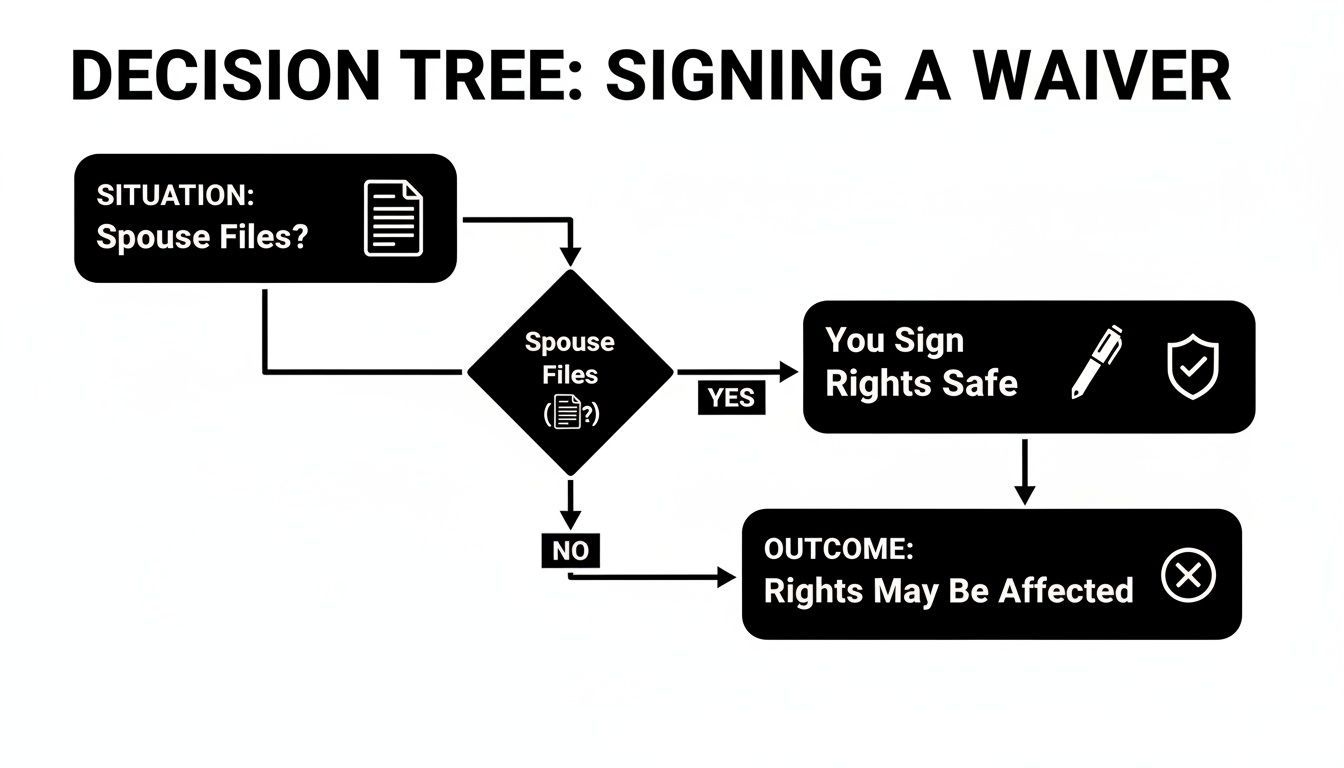
As you can see, the moment your spouse files, signing a waiver is the most direct route to protecting your rights without adding unnecessary conflict to the fire.
The Strategic Advantages of Using a Waiver
Deciding to sign a Waiver of Service is more than just a way to sidestep an awkward moment at your front door. Think of it as a strategic first move, one that can set a positive and cooperative tone for the entire divorce process. The benefits here aren't just about convenience; they're about laying the groundwork for a resolution that’s less stressful and far more cost-effective.

Let's break down exactly how this simple document can protect your finances, your privacy, and ultimately, your peace of mind.
Saving Time and Money from Day One
The most immediate benefit is financial. Formal service means paying a private process server or a sheriff's deputy, a cost that usually runs anywhere from $75 to over $200. While your spouse is the one paying this fee upfront, that money is coming directly out of the marital estate—your shared funds. A waiver simply eliminates that expense.
Time is just as valuable. Arranging for someone to be formally served can take days, sometimes even weeks, especially if a spouse is difficult to track down. A waiver cuts through all that red tape, allowing your case to move forward right away so you can start working toward a final agreement.
Protecting Your Privacy and Dignity
Maybe the most important advantage is the privacy it affords you. Being served divorce papers at your office in front of your boss or at home with the kids watching is deeply humiliating. It instantly turns a private family matter into a public spectacle.
For professionals, executives, and business owners, this kind of discretion isn't just a nice-to-have; it's essential. Signing a waiver keeps this sensitive legal process behind closed doors, protecting your personal and professional reputation from unnecessary damage.
By choosing a waiver, you start your divorce on a foundation of mutual respect. This cooperative spirit is your greatest asset when it's time to negotiate the complex issues that lie ahead.
That first act of cooperation can dramatically improve communication down the road. It makes it much easier to have productive, adult conversations about tough topics like creating a parenting plan or figuring out how to divide your assets.
Setting the Stage for a Smoother Resolution
A calm beginning often leads to a calmer journey. When you and your spouse agree to use a waiver, you're sending a clear signal: "We're going to work together on this." This cooperative mindset is absolutely crucial as you move into negotiations on key issues like:
- Child Custody: A less contentious start helps parents stay focused on what really matters—creating a stable and loving plan for their children.
- Property Division: Amicable negotiations are vital for fairly dividing complex assets like a family business, retirement accounts, or a high-value real estate portfolio.
- Mediation: A collaborative tone makes mediation far more likely to succeed, saving you from the immense emotional and financial drain of a courtroom battle.
This single document has a powerful ripple effect. Since the 1980s, waivers have made Texas family law far more efficient, particularly with the rise of no-fault divorces. In custody cases, avoiding public service—an event that embarrasses 35% of recipients—has been shown to boost mediation success rates by up to 40%. For military families, waivers offer a 90-day response window under the Texas Family Code, which aligns with federal protections. Even in high-net-worth cases in Dallas courts, waivers can trim legal fees by 15-20% by fast-tracking the case to temporary orders.
Ultimately, opting for a waiver can be the first step toward a more efficient and amicable outcome—something that's especially valuable if you are pursuing an agreed divorce. You can learn more about how to file for an agreed divorce in Texas without delays in our comprehensive guide.
Potential Risks and How to Protect Yourself
Signing a waiver of service is almost always a positive, strategic step, but you should never sign any legal document without fully understanding what it means. While a standard waiver form is perfectly safe, the real risk comes from a non-standard version—one that an opposing attorney might have altered to include extra clauses that could seriously damage your case.
This is where a moment of caution can save you a world of trouble down the road.

The main danger is signing away rights you never intended to give up. A standard, court-approved waiver only does one thing: it acknowledges that you received the divorce petition. That’s it. A custom-drafted waiver, on the other hand, could sneak in problematic language you might not recognize as dangerous.
Watch Out for Non-Standard Language
A problematic waiver might include a phrase that goes far beyond simply acknowledging you got the lawsuit papers. It could contain language that essentially says you give up your right to receive any future notices from the court.
Here are a few examples of risky clauses to watch for:
- "I hereby waive any and all further notice of hearings in this case."
- "Respondent waives the right to any further citation or notice in this cause."
- "I agree that this case may be finalized without further notice to me."
Signing a document with language like this is a massive mistake. It could allow your spouse to schedule hearings, attend mediation, or even finalize the divorce entirely without your knowledge. You would have no opportunity to present your side of the story on critical issues like child custody, who gets the house, or spousal support.
Your strongest protection is simple but powerful: never sign a waiver of service without having an experienced family law attorney review it first. This is non-negotiable.
A quick review by a legal professional can confirm whether the document is a standard, state-approved form or if it contains hidden traps. This simple step provides invaluable peace of mind and ensures your rights are protected right from the start.
Steps to Protect Yourself
If your spouse asks you to sign a waiver, your path forward is clear and straightforward. Taking these proactive steps ensures you begin your case from a position of strength and security, not vulnerability.
- Do Not Sign Immediately: Politely tell your spouse you need a few days to look over the document before signing. There is no legitimate reason for them to pressure you into signing on the spot.
- Seek a Professional Review: Immediately schedule a consultation with a qualified Texas family law attorney. The team at The Law Office of Bryan Fagan can review the waiver to ensure it's a standard document that protects your interests.
- Understand Your Next Steps: Use that consultation to also talk about the next phase of your case, like the deadline for filing your official Answer and how to prepare for negotiations on property and custody.
Think of this review as a small insurance policy for your entire divorce. It’s a minimal investment of time that safeguards your future and ensures you remain an active participant in every decision that will shape your new life.
What Happens After You Sign the Waiver?
You’ve taken a deep breath and signed the Waiver of Service. It’s a smart, peaceful first step, but it naturally leads to the question: what comes next? Signing the waiver officially puts you in the driver's seat of your timeline, and understanding the road ahead is key to feeling in control.
The moment the waiver is filed with the court, a critical countdown begins. Your next and most important task is to file a formal response to the divorce petition. This document is called an "Answer."
Step-by-Step: From Filing to Final Decree
Signing the waiver is just the beginning, but it’s a beginning that puts you on a path toward resolution. Once your Answer is filed, you’ve secured your place at the negotiating table. From here, the Texas divorce process typically follows a structured path designed to help you and your spouse reach a final agreement.
Here is a step-by-step breakdown of what you can expect:
- File Your Answer: This is your first official response. Your deadline in Texas is by 10:00 a.m. on the first Monday after 20 days have passed from the date the waiver is filed. Missing this can lead to a default judgment, so it is critical to get expert help. You can learn more about how to respond to a divorce petition in Texas.
- Financial Disclosures (Discovery): Both you and your spouse will be required to exchange detailed financial information. This includes bank statements, tax returns, and lists of assets and debts. This step ensures total transparency so that community property can be divided fairly under the Texas Family Code.
- Temporary Orders Hearing: If you have urgent issues that can't wait—like temporary child custody arrangements or who will pay the mortgage—the court can issue temporary orders to provide stability while the divorce is pending.
- Mediation: Most Texas courts require couples to attend mediation. This is a confidential meeting where a neutral third-party mediator helps you and your spouse negotiate a settlement on all disputed issues, from custody and child support to property division.
- Final Decree of Divorce: Once you’ve reached an agreement on everything, your attorneys will draft the Final Decree. This is the comprehensive legal document that outlines all the terms of your divorce, which a judge then signs to make it official.
Key Takeaways: What to Do Next
Understanding what a waiver of service is—and what it isn't—is the first step toward a more controlled and less stressful divorce. But you don't have to figure out the next steps alone.
Here’s your action plan:
- Acknowledge, Don't Agree: Remember that signing a waiver only confirms you received the divorce papers. It is not an agreement to the terms your spouse requested.
- Never Sign Blindly: Before you sign, have an experienced Texas family law attorney review the document to ensure it doesn’t contain any language that could harm your case.
- Mind the Deadline: Once the waiver is filed, your clock starts. You must file your official "Answer" by the Texas deadline to protect your rights.
The decisions you make at the beginning of your divorce can shape the entire process. The experienced attorneys at The Law Office of Bryan Fagan, PLLC are here to protect your rights and guide you with compassion. We help Texas families navigate divorce with confidence, providing clear explanations and solution-focused strategies. Schedule a free, no-obligation consultation today to discuss your case and learn how we can help you and your family. Visit us at https://texasdivorcelawyer.us to get started.