Skip to content
When your family life is already under strain, the idea of standing alone in a Texas courtroom can feel equal parts necessary and terrifying.
You may be asking a blunt question: How do you win in family court without a lawyer? The honest answer is that you don't win by sounding more hurt, more sincere, or more morally right. You win by thinking like the court thinks. In Texas family court, that means facts, procedure, credibility, and calm.
Texas judges don't decide divorce, custody, support, and property disputes based on who tells the saddest story. They decide based on evidence, legal standards, and whether you followed the rules. If you're handling your own case, your job is to become the most organized, reasonable, fact-driven person in the room.
That mindset matters in every type of family case. In divorce, Texas is a community property state, which means the court starts from the idea that property acquired during the marriage belongs to the marital estate and must be divided in a manner the judge finds just and right. In custody cases, the court focuses on the best interest of the child. In support cases, the court looks for reliable financial information and consistent documentation. In all of them, procedure matters as much as the underlying facts.
Should You Really Represent Yourself in Texas Family Court
Representing yourself can make sense in a narrow set of cases. If your divorce is uncontested, there are no children, no major property disputes, no business interests, and no safety concerns, a self-represented path may be manageable. But many people underestimate how quickly a "simple" case becomes complicated.
Texas family law isn't just paperwork. It involves deadlines, service rules, evidence rules, local court practices, temporary orders, mediation, and final orders that can affect your parenting rights, property, and future finances for years.

Cases that are usually poor fits for self-representation
Some situations raise the risk level immediately:
- Contested custody disputes: If you and the other parent disagree about conservatorship, possession, or decision-making, the outcome is critical.
- Family violence or coercive control: Safety planning and protective orders require care and precision.
- A family business or professional practice: Valuation and characterization issues can affect the property division.
- High-value estates: Retirement accounts, real property, stock options, and separate property claims often turn on detailed proof.
- A represented opposing party: If the other side has counsel, you're already at a procedural disadvantage.
Texas courts often apply standards that sound simple in conversation but become technical in practice. One example is the fit-parent presumption in custody-related litigation. According to Husker Law on winning a custody battle without a lawyer, self-representation is possible, but success rates for litigants without lawyers are substantially lower, especially because unrepresented parties often struggle with procedural errors, evidence presentation, and legal standards.
Reality check: Saving legal fees can cost far more if you lose parenting time, sign a bad decree, or fail to preserve a claim you can't easily fix later.
A better question than can you do it
The question isn't whether you can file your own case. Many people can. The better question is whether you can protect your interests through the entire life of the case, from filing through temporary orders, mediation, final hearing, and enforcement if the other side doesn't comply.
Here's a practical way to assess it:
| Situation | Self-representation risk |
|---|---|
| Uncontested divorce, no children, minimal property | Lower |
| Dispute over child custody or support | High |
| Separate property claims | High |
| Business ownership or complex finances | High |
| Domestic violence allegations or safety concerns | Very high |
If you're still deciding, read this plain-English breakdown of whether you really need a divorce lawyer in Texas. It helps you weigh cost against risk in a more realistic way.
Texas law basics you need to understand early
Under the Texas Family Code, divorce cases can involve property division, conservatorship, possession and access, child support, and in some cases spousal maintenance. Courts can also issue temporary orders while the case is pending. Those temporary rulings often shape what happens later.
If children are involved, stop thinking in terms of "winning the child." Texas courts usually focus on stable parenting arrangements, not labels. If property is involved, stop thinking in terms of "what feels fair to me." The court wants documented proof about what exists, what was acquired during marriage, and what should be awarded to each spouse.
Mastering Your Initial Court Filing and Paperwork
A lot of pro se cases are lost before anyone says a word in court. The problem is usually not the law. It is a bad petition, missing paperwork, the wrong county, or service that was never completed correctly.
That is the first mindset shift. Filing is not clerical busywork. Filing is your first legal argument. Every name, date, request, and checkbox tells the court what this case is about and what power the judge should use.
In Texas, a divorce begins with an Original Petition for Divorce. That document identifies the parties, states the basis for the court's authority, addresses children if any are involved, and tells the judge what relief you want. If you need a clearer explanation of what belongs in that first pleading, The Original Petition for Divorce in Texas breaks down the required contents in plain English.
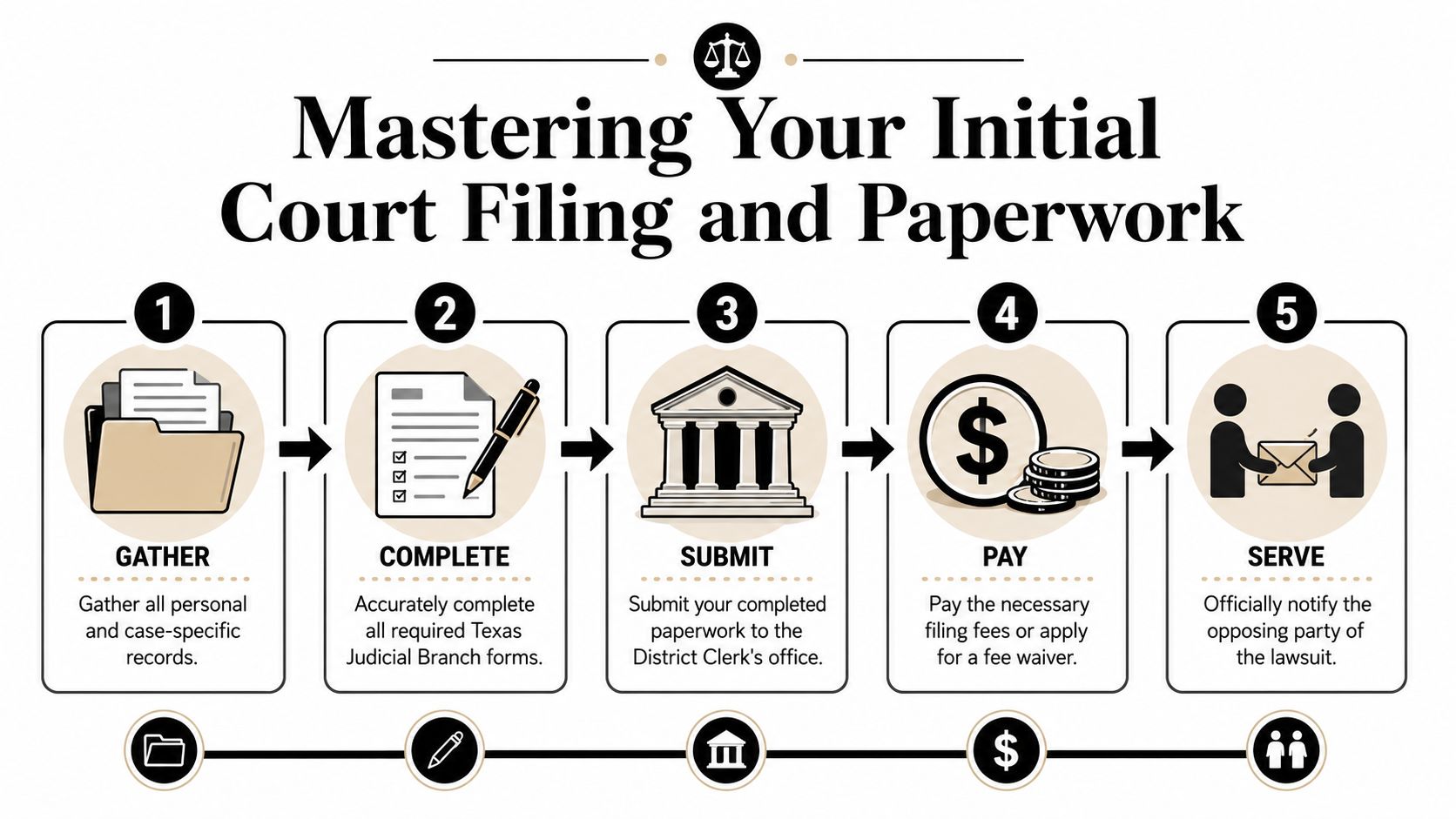
Step one: file in a court that can actually hear your case
Before drafting anything, confirm residency and county filing requirements. If those are not met, the case can be dismissed or delayed while you start over.
Texas divorce filings generally require that one spouse has lived in Texas for the required state residency period and in the county of filing for the required county residency period immediately before filing. Check the current rule in the Texas Family Code or your county's court resources before you submit anything. Do not guess on jurisdiction. Judges take it seriously, and so should you.
If children have lived in another state recently, custody jurisdiction can become a separate issue from the divorce itself. Self-represented parties miss that point all the time.
Step two: draft your opening documents like someone will challenge every line
That is because someone might.
Your starting packet often includes the petition and any county-specific forms required by the clerk or local rules. The court expects consistency. If one document lists a different separation date, misspells a name, omits a child, or asks for relief that does not match your later testimony, you have created a credibility problem for yourself.
Use a lawyer's frame of mind while drafting:
- State only facts you can support. If you are unsure of a date or account balance, verify it first.
- Ask for relief with purpose. If you want conservatorship terms, child support, exclusive use of property, or a name change, say so clearly.
- Avoid emotional narration. A petition is not the place to argue that your spouse is selfish, cruel, or impossible.
- Match the legal issue to the actual dispute. If the fight is over parenting time, do not bury that issue under pages of irrelevant grievances.
For a more detailed look at how that pleading is structured, review this Texas Original Petition for Divorce guide.
Step three: file with the district clerk and deal with fees correctly
Once the paperwork is ready, file it with the district clerk in the proper county. Courts charge filing fees, and the amount varies by county. If cost is a real barrier, ask about filing a Statement of Inability to Afford Payment of Court Costs or the form your county currently uses for a fee waiver request.
Do this carefully. If the fee issue is not handled, the case may not move.
Also remember a basic but important point. Filing opens the case. It does not notify your spouse.
Step four: treat service like a legal requirement, not a courtesy
Service is one of the places self-represented litigants make avoidable mistakes. Texting your spouse a copy of the petition is usually not enough. Handing them papers in the parking lot is usually not enough. If service is defective, the court may refuse to finalize the case, especially if the other side decides to contest something later.
Use the correct method from the start. That may mean formal service through a constable, sheriff, or private process server, unless the other party signs a valid waiver that meets Texas requirements. Sloppy service creates expensive delay, and in some cases it can undo orders you thought were final.
Step five: file with the end in mind
The strongest pro se litigants do not file forms just to get a case number. They file in a way that sets up the rest of the case cleanly. Your petition should match the story your evidence will later prove. Your requested relief should match what you can reasonably ask a judge to order. Your paperwork should make you look organized, credible, and serious.
If you want a start-to-finish overview of the process after filing, the first mention of How to File for Divorce in Texas Step by Step is the one to use. It walks through the sequence from petition to final decree.
One more practical point. Save stamped copies of everything, keep a filing log, and read your county's local rules early. In family court, small paperwork mistakes often turn into courtroom problems. Strategic litigants catch them before the judge ever sees the file.
Building a Winning Case with Compelling Evidence
You do not win a family case by proving you are more hurt, more angry, or more sincere. You win by proving the facts a judge can use.
That mindset shift is where many self-represented parents lose ground. They walk into court as a spouse or parent telling their story. The court needs something different. It needs a person who can identify the legal issue, connect it to admissible proof, and present it in a way that is easy to follow. In Texas family court, organized proof often beats emotional truth that is poorly presented.
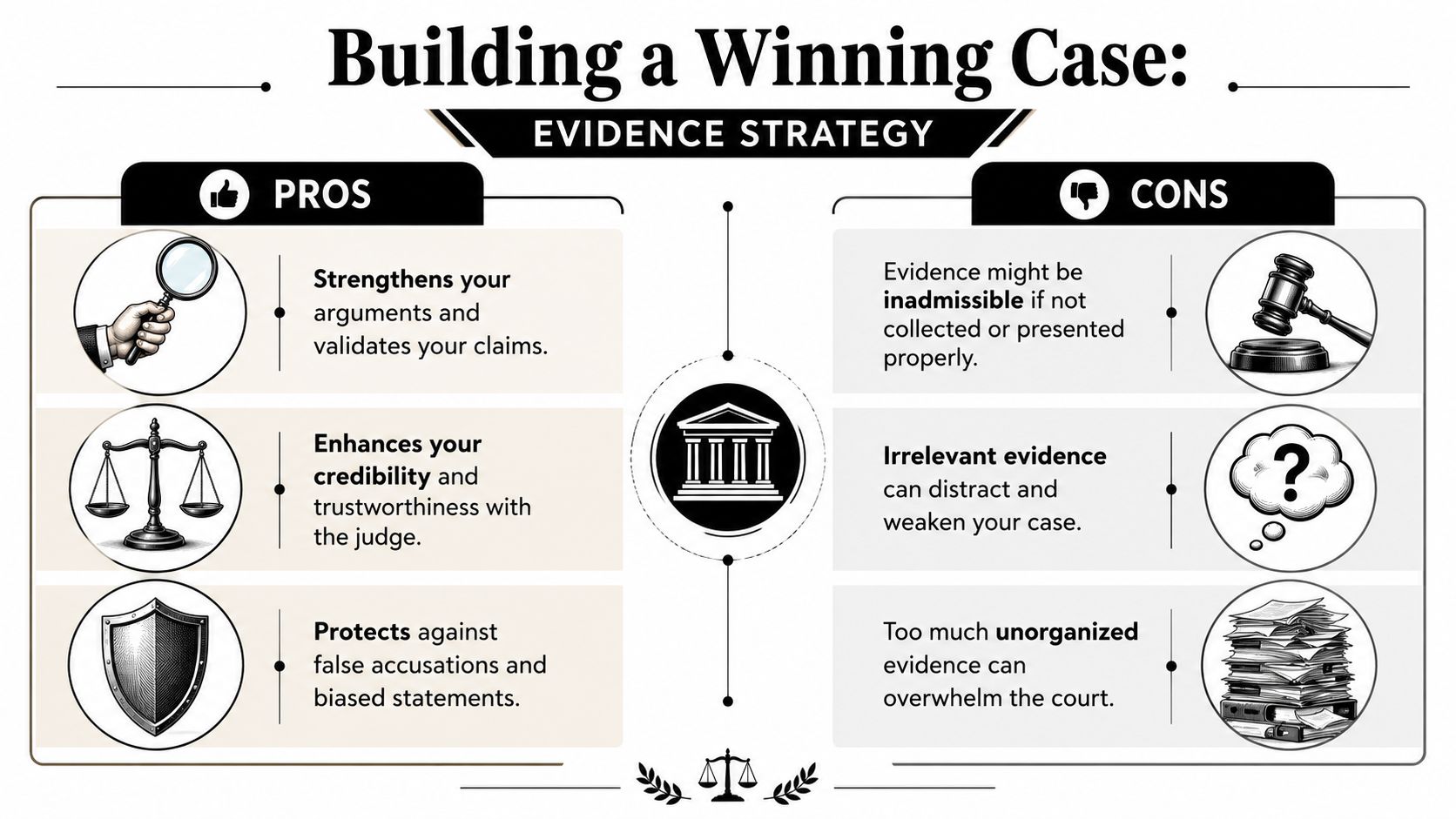
What judges usually find persuasive
Judges are deciding specific issues, not grading the entire marriage. That means your evidence has to answer the question in front of the court.
In a custody dispute, persuasive evidence usually shows who handles the child's daily needs, who communicates in a child-focused way, who follows through, and who supports stability. In a property dispute, persuasive evidence usually shows what exists, what it is worth, when it was acquired, and whether a debt or asset is separate or community property.
A useful evidence file often includes:
- Communications: Emails or text messages that show scheduling, school involvement, medical decisions, or reasonable efforts to solve problems.
- Calendars and timelines: A dated record of pickups, drop-offs, appointments, missed visits, and who handled important parenting tasks.
- Financial records: Pay stubs, tax returns, bank statements, retirement account records, loan documents, and business records if support or property division is disputed.
- Photos and records with a clear purpose: Use them only if they prove a point the judge must decide.
The strongest exhibits usually do one of three things. They confirm a date, show a pattern, or contradict a claim.
Why cleaner records often beat dramatic evidence
Self-represented litigants often bring screenshots of insults, social media posts, and long message chains full of accusations. Some of that may be true. Much of it still does not help.
A judge is looking for reliable proof tied to a legal issue. Twenty pages of hostile texts may show conflict. A school attendance record, pediatric appointment history, and a calm message proposing makeup time often say much more about parenting judgment.
That is one reason co-parenting apps can matter. Tools like OurFamilyWizard and TalkingParents can create a structured communication log with dates, messages, and scheduling history in one place. An app does not win a case by itself. It does make your record easier to organize and harder for the other side to reframe.
Good evidence answers the judge's unspoken question: "Why should I rely on your version of events?"
What hurts your case even if it feels important
The biggest mistake is over-collecting and under-thinking. People save everything, then fail to decide what each document is supposed to prove.
Use this filter before you print or upload anything:
| Keep and organize | Leave out or limit |
|---|---|
| Dated messages about the child, money, or possession schedule | Long emotional exchanges that do not prove a legal point |
| School, medical, counseling, and activity records | Character attacks with no connection to the orders requested |
| Financial records tied to support, reimbursement, debt, or property | Social media posts with no clear date, source, or relevance |
| Notes and logs that can be backed up by other records | Repeated copies of the same allegation |
This is a trade-off. A thinner file can be stronger than a thick one. If you hand the court 200 pages and only 15 matter, you make the judge work harder to find your point. That is rarely a good strategy for a pro se party.
If you need help narrowing the file, review this guide on what evidence matters most in a Texas divorce case.
Build proof around the order you want
Start with the ruling you want the judge to make. Then work backward.
If you want primary conservatorship, collect proof of routine involvement, stable decision-making, school and medical participation, and your willingness to foster the child's relationship with the other parent when appropriate. If you want a fair division of property, gather account statements, purchase records, deeds, loan balances, and documents showing where key assets came from.
That is how lawyers prepare cases. They do not keep documents because the documents exist. They choose documents because each one advances a point that matters under Texas law.
Your file should read like a case theory, not a diary.
Preparing for Your Day in Court
You are standing at counsel table. The judge has your file, the other side is ready, and you get one clean chance to sound organized, credible, and focused. That moment is usually won before the hearing starts.
Preparation for court is not about trying to look like a lawyer. It is about thinking like one under pressure. By your hearing date, your job is to stop acting like the injured spouse or anxious parent and start presenting a disciplined case built around the exact order you want.
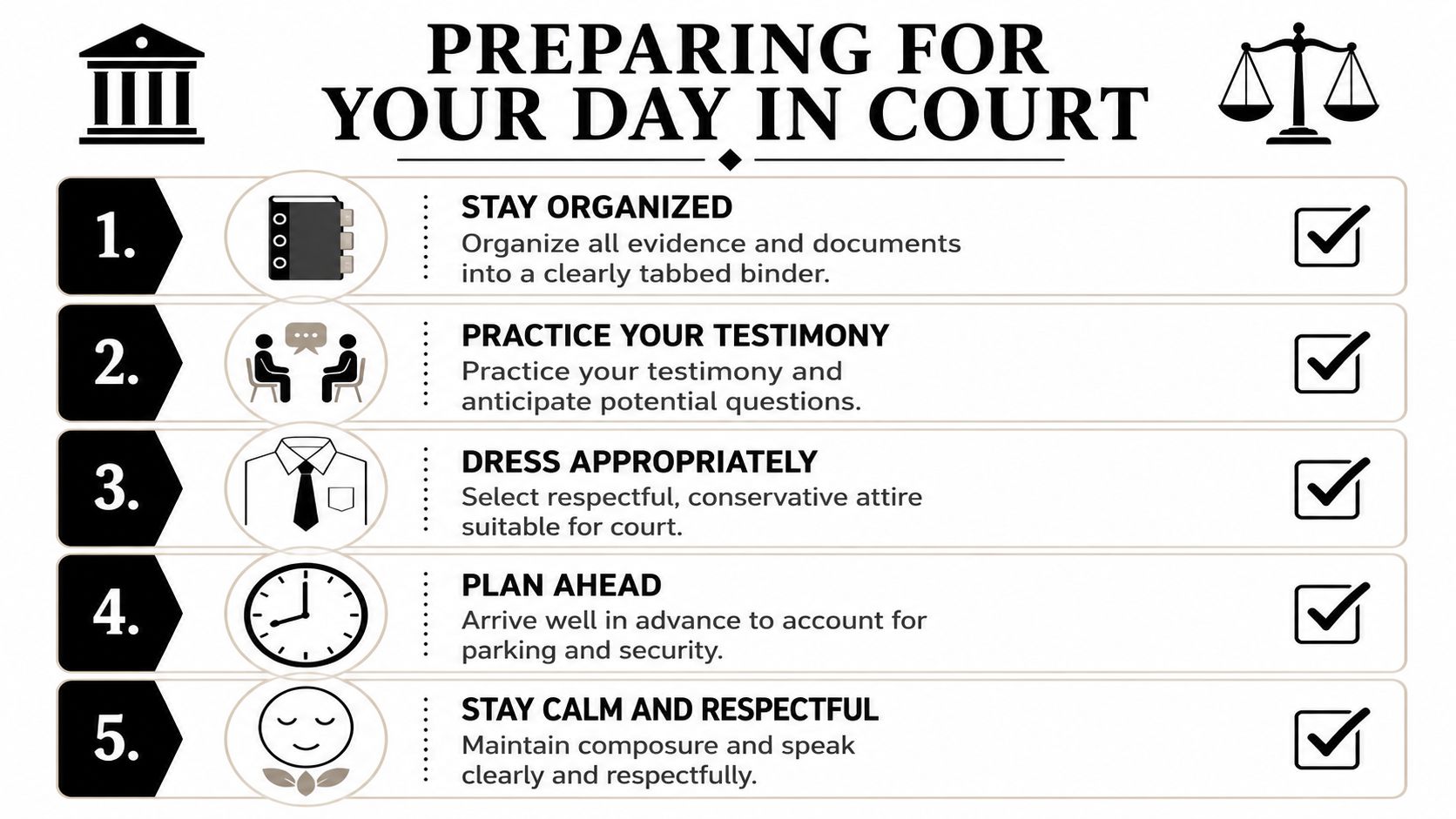
Build a hearing file you can actually use
A hearing file should help you answer questions fast. If you have to dig through loose papers while the judge waits, you lose momentum and credibility.
Set up a simple system you can handle under stress:
- Create a short chronology. List the important dates in order with one sentence for each event.
- Tab your exhibits by subject. Put school records together, communications together, financial records together.
- Write a hearing outline. Limit it to the few points that directly support the order you want.
- Prepare copies in advance. Bring your set, any copies the court requires, and copies for the other side if the rules or the court's procedures require service or exchange.
Lawyers prepare for hearings by reducing chaos. Do the same. If a document does not help you prove a point the judge must decide, it should probably stay out of your hearing binder.
This short video gives a helpful visual overview before a hearing:
Rehearse the questions the judge is likely to ask
Judges often ask direct, practical questions. What are you requesting? Why is it in the child's best interest? What proof supports that request? What happened on a specific date? What relief can the court realistically order today?
Practice answering those questions out loud.
Keep each answer short, specific, and fact-based. If you ramble, argue, or drift into old relationship grievances, you make it harder for the judge to follow your position. A good answer usually has three parts. The fact, the date or example, and why it matters to the ruling.
For example, if you want a possession schedule changed, do not start with everything wrong in the relationship. State the request, identify the parenting problem, and point to the records that show it. That is how a persuasive hearing presentation is built.
Courtroom conduct affects how your evidence is received
Judges decide cases on law and evidence, but they also watch judgment, self-control, and credibility. Family court is full of people who are angry, scared, or exhausted. The person who stays composed stands out.
Use basic courtroom discipline:
- Dress conservatively. Wear clean, respectful clothing suitable for a serious professional setting.
- Arrive early. Courthouse parking, security, and docket delays are common.
- Stand and speak respectfully. Address the judge as "Your Honor" unless the court uses a different preference.
- Do not interrupt. Let the judge finish the question. Let the other side finish the answer.
- Control visible reactions. No sighing, eye-rolling, muttering, or talking at counsel table.
A calm presentation helps the court trust your version of events. In close cases, that matters more than self-represented parties realize.
Prepare your spoken case, not just your paperwork
Many pro se litigants overprepare documents and underprepare testimony. Paper alone rarely carries a hearing. You need a clear spoken presentation that matches your exhibits.
Use a simple structure:
- What specific order are you asking the court to sign?
- What facts support that order?
- Which exhibits back up those facts?
- What practical plan are you proposing?
If your case involves children, focus on schedules, school, medical care, communication, transportation, and decision-making. If your case involves property or support, organize your remarks by issue, such as income, accounts, debts, reimbursement claims, or separate property.
Keep your tone businesslike. The court does not need your full history. The court needs a workable reason to rule in your favor.
Courtroom Strategy and Effective Negotiation
The biggest mistake self-represented litigants make is arguing like injured spouses or frightened parents instead of legal advocates.
That mistake shows up in word choice. It shows up in body language. It shows up in mediation when someone refuses every reasonable option because they want moral validation from the process. Texas family court rarely gives that kind of validation. It gives orders.
Speak in facts, not internet labels
Judges want observable behavior, dates, and proof. They don't want internet shorthand. According to a discussion of courtroom credibility and self-represented parents, judges may treat words like "narcissist" as baseless accusations when there is no formal diagnosis. The same source states that 60 to 70% of self-represented parents are denied custody because they fail to demonstrate stability and calmness, often by alienating the other parent.
That doesn't mean bad behavior by the other parent is irrelevant. It means you need to describe it in a way the court can use.
Compare these two approaches:
| Weak courtroom language | Strong courtroom language |
|---|---|
| "She's a narcissist and manipulates everyone." | "On these dates, she refused to share school information and I attached the messages." |
| "He's alienating the children." | "He told the child not to call me during my scheduled time. I documented the missed calls and the message exchange." |
| "He's toxic." | "He didn't return the child at the agreed exchange time on these specific dates." |
Mediation is not surrender
In many Texas family cases, mediation is part of the path to resolution. That isn't a sign your case is weak. It's a structured negotiation process where you and the other party, often through a mediator, try to resolve custody, support, property division, and decree language before trial.
Mediation works best when you enter with priorities, not just grievances.
Use this framework:
- Know your must-haves: Parenting schedule terms, school decisions, possession logistics, debt allocation, sale of property.
- Know your trade-offs: What you're willing to adjust to reach a workable agreement.
- Know your nonstarters: Terms that create safety risks, impossible logistics, or unfair financial exposure.
If your case involves child support, enforcement, or post-divorce disputes, it helps to understand how those issues connect to negotiation and future litigation. Related topics like custody, support, mediation, and enforcement often overlap in ways self-represented parties don't anticipate.
The unwritten rule of persuasion
The court is always asking which parent or spouse sounds more reliable, more organized, and more likely to follow orders going forward. That is why calm matters so much.
A strategic legal advocate does a few things consistently:
- Sticks to the point
- Answers the question asked
- Admits small weaknesses instead of dodging
- Shows respect for the other parent's role when appropriate
- Offers workable solutions instead of just complaints
The judge doesn't need you to prove you're the better person. The judge needs you to show you're the safer, steadier, more credible decision-maker under the Texas Family Code standards that apply to your case.
This is the part most online guides miss when addressing how to win in family court without a lawyer. Forms matter. Filing matters. Evidence matters. But courtroom persuasion usually turns on whether you can sound like a person solving a legal problem rather than escalating a personal war.
Your Next Steps and When to Get an Attorney
You can represent yourself in Texas family court. Sometimes that's the only practical option. But you should treat it like handling your own surgery instructions, not assembling furniture. The consequences can last for years.
If your case involves children, contested property issues, a business, retirement accounts, separate property claims, protective order concerns, or an opposing lawyer, the risk goes up fast. The same is true if temporary orders have already been entered and you're now trying to change the momentum of the case.
Signs it's time to stop going alone
You should strongly consider getting legal help if any of these are true:
- The other side hired a lawyer: You now need to respond to someone who knows the system.
- You don't understand the orders being proposed: Signing unclear language can create long-term problems.
- You feel overwhelmed by deadlines or procedure: Missing one filing or service issue can damage your case.
- Your case changed: Many cases start simple and become contested around custody, money, or possession schedules.
Texas family law covers more than the final trial. It includes temporary orders, discovery, mediation, decree drafting, property transfer language, support enforcement, and post-judgment fixes when something was omitted or written badly.
What to do next
Take these steps now, while you still have time to strengthen your position:
- Review your case objectively: Ask whether this is really uncontested or only temporarily quiet.
- Organize your documents: Build one clean file for parenting, one for finances, and one for court papers.
- Practice your presentation: Speak in dates, actions, and requests. Cut labels and speeches.
- Learn the process: Make sure you understand filing, service, mediation, hearing practice, and the final decree.
If you want one option for getting case-specific guidance before you make another move, the Law Office of Bryan Fagan, PLLC handles Texas divorce, custody, support, mediation, and enforcement matters and offers consultations for people trying to understand their next step.
Key Takeaway
If you want to win in family court without a lawyer, act less like a wounded spouse and more like a prepared legal advocate. Build a plan. Follow Texas procedure. Use organized proof. Stay calm. Ask for practical relief. And if the case becomes more complex than you can safely manage, getting counsel is not giving up. It's protecting your future.
You don't have to guess your way through a Texas divorce or custody case. Schedule a free, confidential consultation with Law Office of Bryan Fagan, PLLC to talk through your options, understand the risks in your case, and decide whether self-representation, limited guidance, or full representation makes the most sense for you.