Skip to content
Your phone is full of texts, your email is a mess, and a stack of bank records is suddenly starting to feel more important than anything either of you said out loud.
Divorce does that. It makes ordinary parts of life feel like evidence. The problem is that many respond in one of two unhelpful ways. They either save everything and drown in clutter, or they focus on the most emotional proof and miss the documents that move the case.
If you're asking what evidence matters most in a Texas divorce case, the right answer is not “everything.” The right answer is the evidence that matches the issue you need to prove. A bank statement may be critical in a property dispute and nearly useless in a conservatorship fight. A text message may do very little for asset division but become powerful if it shows poor judgment around your child.
That strategic difference matters from the day your case is filed. A Texas divorce usually begins with an Original Petition for Divorce, may involve temporary orders, then moves through disclosure, discovery, negotiation, mediation, and, if needed, a final trial and decree. Most cases don't need a courtroom battle over every point. They need organized proof, used at the right time, for the right purpose.
Starting Your Divorce Journey with a Strategic Mindset
Many clients begin in the same place. They bring screenshots, long notes about old arguments, photos, receipts, and a deep fear that one missed detail will ruin their case.
That fear is understandable. It just isn't the best way to prepare.
A Texas divorce is not a contest to see who can produce the biggest pile of paper. It's a process of building a credible story about your finances, your parenting, your needs, and your future. If you approach it that way, the noise starts to clear.
What strategy looks like early on
Start by asking a sharper question than “What should I save?” Ask, “What legal issue am I trying to prove?”
If the dispute is over property, the focus usually belongs on account statements, deeds, tax returns, loan applications, retirement records, and proof tracing an asset to a premarital, inherited, or gifted source. If the dispute is over your children, the court is looking much more closely at daily care, communication, stability, school involvement, and decision-making.
Practical rule: Strong evidence doesn't just show that something happened. It shows why that fact matters under Texas law.
Texas courts use different standards for different parts of a divorce. Property division is governed by a “just and right” division of the community estate. Custody decisions turn on the child's best interests. Spousal maintenance has its own legal requirements. That means one piece of evidence can carry very different weight depending on the issue.
Some clients also benefit from broader organization tools used in other legal settings. If you're trying to create a clean record and avoid missing important materials, this essential guide for legal risk teams offers a useful way to think about collection and review.
From panic to proof
You don't need to win every argument. You need to prove the points that affect your outcome.
That mindset changes how you prepare for mediation, temporary orders, and trial. It helps you stop chasing distractions and start protecting what matters most. When you know what each document, message, or witness is supposed to prove, your case becomes easier to explain and harder to dismiss.
The Foundation of Your Case Financial Records and Property
In most Texas divorces, financial records are the backbone of the case. Courts must divide the marital estate in a way that is “just and right,” and Texas guidance notes that less than 10% of Texas divorces reach trial, which means the quality of your paperwork often shapes settlement and mediation long before a judge hears live testimony (Texas divorce trial frequency and financial evidence).
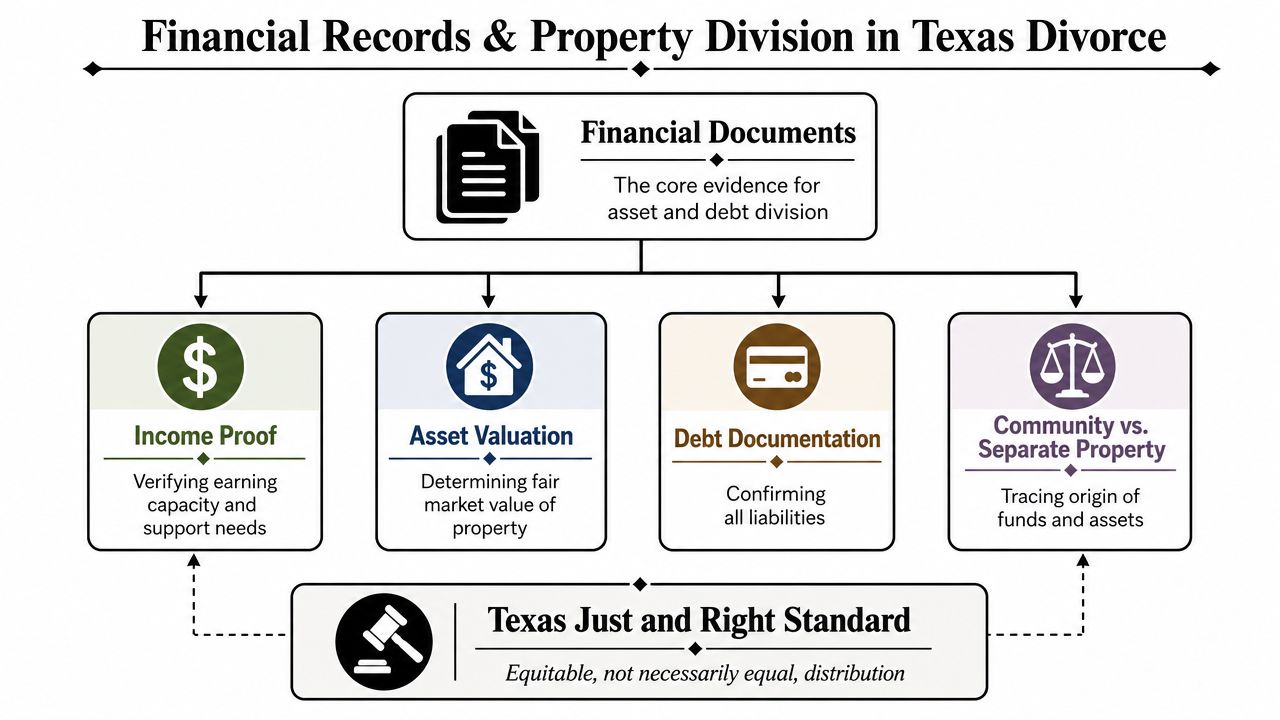
The records that usually matter first
Some documents carry more weight than others because they answer the court's biggest questions fast.
| Evidence type | What it helps prove |
|---|---|
| Bank statements | Cash flow, transfers, unusual spending, account balances |
| Credit card records | Debt, lifestyle spending, possible waste of marital funds |
| Tax returns and wage records | Income history and support issues |
| Mortgage statements and deeds | Real property obligations and ownership |
| Retirement and brokerage statements | Asset value and tracing |
| Loan applications | What a spouse disclosed owning at the time |
Texas family law guidance also points to tax returns, W-2s, 1099s, K-1s, pay stubs, bank records, mortgage statements, retirement records, insurance policies, deeds, and titles as high-value evidence in property and support disputes. Loan applications can be especially useful because they often show what a person claimed to own when asking for credit (financial records used in Texas divorce disputes).
Why the same record can matter in different ways
A pay stub isn't just a pay stub.
For property division, it may help show community income earned during the marriage. For child support or spousal maintenance issues, it may help establish present earnings and whether a claimed hardship is real. In a business-owner case, it may matter less than broader bank activity, business deposits, retained earnings, or personal expenses paid through a company.
Separate property claims are where documentation becomes especially technical. Texas law starts with a presumption that property is community property. If you claim an asset is separate because it was owned before marriage, inherited, or received as a gift, you usually need records that trace the source and timing of that property clearly.
If you can't trace it, you may not be able to keep it separate.
A practical way to gather records
Don't rely on memory. Build a file system.
- Start with income proof: Gather recent pay stubs, prior tax returns, W-2s, 1099s, and K-1s.
- Move to cash accounts: Download checking, savings, and money market statements.
- Then secure debt records: Include credit cards, personal loans, auto notes, and mortgage statements.
- Add ownership documents: Deeds, titles, insurance declarations, retirement summaries, and brokerage statements.
- Don't overlook business materials: Profit and loss statements, general ledgers, balance sheets, and records of owner draws may matter if a closely held business is involved.
If you want a more detailed starting list before filing, review this guide on what documents you should gather before filing for divorce.
For clients worried about how divorce-related debt and missed payments can affect life after the decree, outside financial cleanup resources may also help. Some people look at services such as Superior Credit Repair in Texas while rebuilding after separation, especially when joint debts and damaged credit reports remain part of the fallout.
What works and what doesn't
What works is complete, dated, organized financial proof.
What doesn't work is showing up with a few isolated statements and broad accusations about hidden money. Judges, mediators, and opposing counsel all look for patterns. A well-organized set of records can reveal income, debt, transfers, omitted assets, and spending choices with much more force than an angry allegation ever will.
Proving Your Point with Digital Communications
A text thread can be strong evidence. It can also be useless.
The difference usually comes down to preservation, context, and authentication.

Why digital evidence often gets mishandled
People tend to treat digital material casually. They forward messages, crop screenshots, delete posts, switch phones, or save only the most inflammatory exchange. That creates problems.
Texas guidance on divorce evidence has noted a major gap in how many discussions handle digital proof. Texts, emails, social media posts, screenshots, and electronic records can materially affect credibility, custody disputes, and fault-based claims, but they need to be preserved and presented carefully (digital evidence in divorce cases and why preservation matters).
A message also means different things in different disputes. An email discussing a transfer between accounts may matter in a property case. A text showing repeated hostility during exchanges with the children nearby may matter far more in a custody dispute.
What to do with texts, emails, and social media
Handle digital evidence like evidence, not like gossip.
- Preserve the whole exchange: Save surrounding messages so the timeline makes sense.
- Keep the date and sender visible: Cropped screenshots invite challenges.
- Don't alter or delete: Changing content, even with good intentions, can damage credibility.
- Print and label important exchanges: Physical exhibits are often easier to organize and review with counsel.
- Match the message to the legal issue: Not every ugly text belongs in court.
If social platforms are part of your case, this article on whether social media can ruin your divorce case in Texas is a useful companion read.
Admissible evidence is different from persuasive gossip
Texas Law Help explains that evidence must be relevant, material, authentic, and not privileged. For digital records, that means you can't just hand the judge your phone and expect the content to carry weight. You generally need to prepare the item as an exhibit and be ready to testify that it is a true and accurate copy of the exchange.
That practical point matters more than many realize. A damaging message that can't be authenticated may do nothing for your case.
Here is a short overview that helps many clients understand how online activity can become evidence:
Save first. Argue about relevance later.
What digital proof usually does best
Digital evidence tends to work best when it corroborates something else.
A parenting app log can support your testimony about missed exchanges. An email can confirm that both spouses knew about an account or debt. A social media post may challenge a claim that someone was uninvolved, unavailable, or hiding a relationship tied to spending.
What usually doesn't work is submitting a pile of dramatic screenshots without dates, context, or a clear legal purpose.
The Human Element Witness Testimony and Credibility
Paper matters. People still matter just as much.
Texas divorce and custody cases often turn on credibility, especially when the dispute involves parenting, fault allegations, substance use, decision-making, or conflicting explanations about what happened at home. Texas practitioners note that testimony from the parties and, in some cases, the children is often the most frequently used form of evidence in a divorce trial. The same Texas update reports that divorce rates have fallen from about 40% around 2000 to about 32% currently, with annual divorce incidence at 2.1 per 1,000 residents, and that fathers receive about 33% of parenting time, near the 35% nationwide figure (Texas divorce and custody evidence trends).
Who makes a useful witness
A useful witness is not just someone who likes you.
The best witnesses usually have direct knowledge of a specific issue. A teacher may speak to attendance, school contact, and parental involvement. A family member may be able to describe who handled day-to-day care. A counselor, coach, or medical provider may offer context if they have firsthand knowledge and are properly brought into the case.
Why your own testimony can help or hurt
Your testimony ties the case together. It explains records, fills in missing context, and gives the court a reason to trust the story your documents tell.
That also means your conduct becomes evidence. If your financial affidavit conflicts with your records, or your testimony about parenting doesn't match school communications, the problem isn't just one inconsistency. It is that the judge may begin to question everything else.
Credibility is built in small moments. Accurate dates, calm answers, and reasonable concessions often do more for your case than outrage.
What works better than character attacks
Judges usually respond better to specifics than labels.
Instead of saying your spouse is irresponsible, a stronger approach is to offer testimony tied to events, dates, and corroborating records. Instead of saying you are the better parent, show the court who attended doctor visits, who communicated with teachers, who handled routines, and who supported the child's relationship with the other parent.
Strong testimony gives life to documents. Weak testimony can neutralize them.
Essential Evidence for Child Custody and Conservatorship
When your case involves children, the legal question changes. The court is no longer focused on dividing property in a just and right way. The focus is the best interest of the child.
That shift changes what counts as strong evidence.
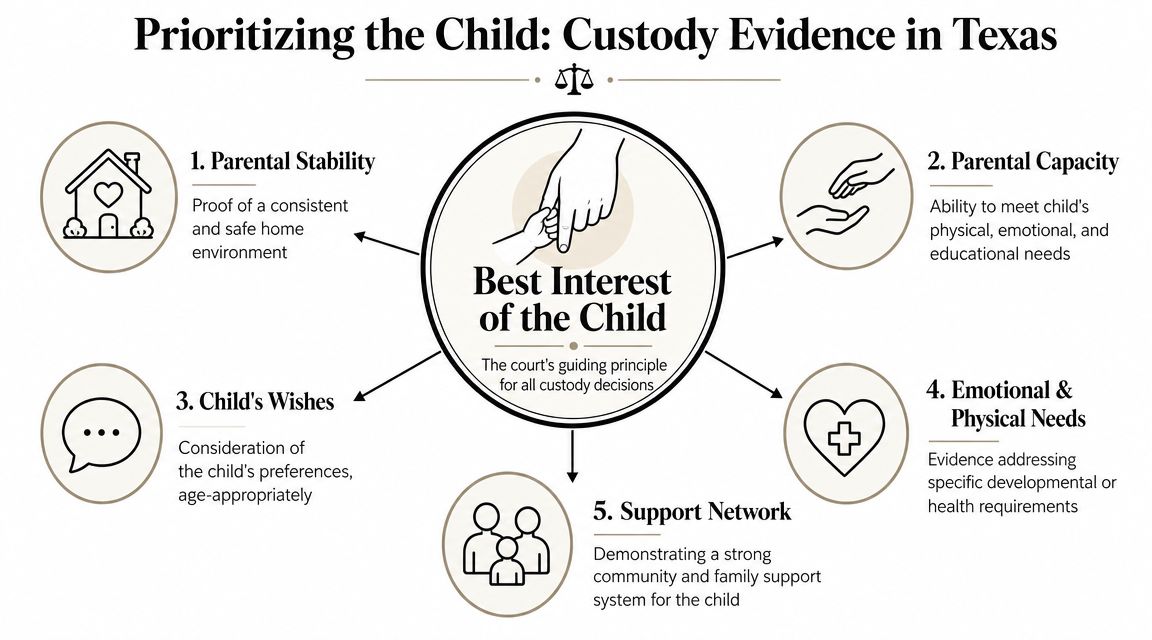
Texas-specific family law guidance makes an important point that many people miss. Different legal standards apply to different issues. Property division is about a “just and right” split, but custody turns heavily on the child's best interests. A text message that means little in a property dispute may become highly important in a custody fight if it shows instability or poor judgment (how evidence changes based on the issue in a Texas divorce).
The proof that tends to matter most for parents
Judges usually look for evidence of steady parenting, not perfect parenting.
That often includes:
- School records: Attendance, report cards, behavior reports, and proof that you communicate with teachers.
- Medical and dental records: Appointment history, follow-up care, and who manages treatment.
- Parent communication logs: Texts, emails, or app messages showing cooperation or repeated conflict.
- Daily parenting records: Calendars, exchange logs, and notes about routines, homework, meals, and activities.
- Photos with context: Not staged snapshots, but images tied to normal caregiving and involvement.
- Third-party observations: Teachers, coaches, relatives, or childcare providers with direct knowledge.
What a judge is usually trying to determine
In custody and conservatorship cases, judges often want answers to practical questions:
| Question | Helpful evidence |
|---|---|
| Who handles daily care? | Calendars, school messages, medical records |
| Which parent supports stability? | Attendance records, routine logs, housing information |
| Can each parent co-parent? | Message history, exchange records, app communications |
| Is there a safety concern? | Police reports, medical records, authenticated messages, witness testimony |
| Who knows the child's needs best? | Therapy records, school plans, doctor communications |
What parents often get wrong
Parents often overvalue emotional proof and undervalue routine proof.
A single ugly message may get attention. A months-long record showing that you consistently handled school drop-offs, doctor visits, homework, medication, and respectful communication usually carries more lasting force. Courts care about the child's real daily life.
This is also where first impressions in temporary orders hearings can matter. Early evidence often shapes possession schedules, communication expectations, and decision-making authority while the case is pending. Mediation can later resolve many conservatorship issues, but only if both sides come prepared with credible parenting evidence.
Your custody case gets stronger when your evidence shows a pattern, not just a complaint.
The Rules of the Game Making Your Evidence Count in Court
Good evidence can still fail if you don't present it properly.
Texas judges do not consider every document, screenshot, or story a party wants to offer. To be used in court, evidence generally must be relevant, material, authentic, and not privileged. For digital proof, Texas Law Help specifically notes that you should prepare to authenticate it by printing it, labeling it as an exhibit, and testifying that it is a true and accurate copy of the exchange (how to gather and present evidence in Texas court).
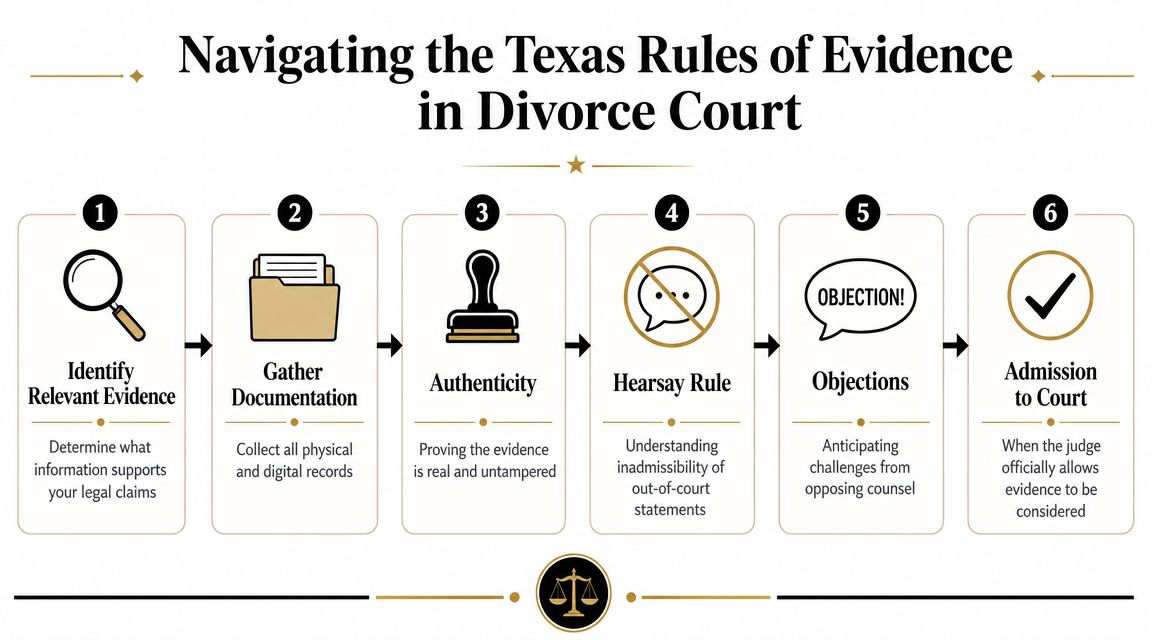
Four questions to ask before you rely on any exhibit
Use this quick filter:
- Is it relevant? Does it help prove a disputed issue in your divorce?
- Is it material? Does that issue matter to the ruling the court must make?
- Can you authenticate it? Can a witness explain what it is, where it came from, and why it's accurate?
- Is it privileged or otherwise barred? Some communications cannot be used even if they seem important.
A common mistake is confusing suspicion with proof. Another is confusing proof with admissible proof.
Why procedure matters as much as content
Think of evidence like a key. The facts on the paper are the teeth of the key, but authentication is what lets it turn the lock.
A screenshot without foundation may stay out. A bank statement with no witness to identify it may draw objections. A witness repeating what someone else said may run into hearsay problems. Discovery also matters here because formal requests for records, disclosures, and subpoenas often provide the foundation for the documents you will later use. If you're trying to understand that process, this overview of discovery in a Texas divorce case can help.
What this means in practice
You don't need a dramatic exhibit binder. You need a clean, legally usable record.
That often means selecting fewer items and preparing them better. It can also mean working with counsel to decide which exhibits belong at a temporary orders hearing, which belong in mediation briefing, and which should be reserved for trial. In a practical sense, firms such as the Law Office of Bryan Fagan, PLLC help clients organize records, identify what supports a legal claim, and prepare evidence for use at hearings, mediation, and trial.
The court can only rely on the evidence that gets through the gate.
What to Do Next Protecting Your Family and Your Future
The strongest divorce cases are usually not the loudest ones. They are the best organized.
If you're facing divorce in Texas, start with three steps. Gather your financial records. Preserve your digital communications without changing them. Identify the people and records that can confirm your parenting, your finances, or your need for support. Then stop and ask whether each item proves something the court must decide.
That last step is where many people go off course. They collect a huge amount of material but never sort it by issue. Property proof, custody proof, and support proof are not interchangeable. The same document can help in one part of the case and do almost nothing in another.
A divorce also moves through stages. Filing is only the beginning. Temporary orders may shape your home life while the case is pending. Discovery and disclosure can uncover records you don't yet have. Mediation may resolve many disputes if your evidence is organized and credible. If settlement fails, the final decree will depend on what you can prove under the rules that apply to your issue.
Key takeaway
What evidence matters most in a Texas divorce case depends on what you need the court to decide. Financial records usually carry the most weight in property disputes. Parenting records and credible testimony often carry the most weight in conservatorship cases. Digital evidence can be powerful, but only if it's preserved and authenticated correctly.
You don't have to solve that strategy alone. The right legal guidance can help you separate useful proof from distracting clutter and turn a stressful situation into a clear plan.
If you're preparing for divorce, custody litigation, mediation, or a dispute over property and support, Law Office of Bryan Fagan, PLLC can help you assess what evidence matters in your case and what steps to take next. Schedule a free consultation to talk through your situation, protect your rights, and build a strategy for your family and your future.