Skip to content
Texas is not a mandatory 50/50 divorce state. In Texas, a judge divides community property in a way the court considers “just and right,” and that can mean a near-even split like 51/49 or 52/48, or in some cases a more uneven result such as 60/40 or 70/30 when the facts support it.
If you're lying awake wondering whether divorce means losing half of everything you've built, you're not alone. Many people walk into a first meeting with that exact fear, especially if they own a home, run a business, have retirement savings, or stayed home to raise children while the other spouse earned the paycheck.
The Most Common Myth About Divorce in Texas
A client once sat down and said, “I can handle hard news. I just need to know if I'm automatically losing half.”
That question gets to the heart of the biggest misunderstanding in Texas divorce law. People hear that Texas is a community property state and assume the process is simple math. They picture every bank account cut in half, every paycheck split down the middle, and every asset divided evenly without regard to what happened in the marriage.
That isn't how Texas courts work.
Why the myth feels so convincing
The fear usually starts with a grain of truth. Property and income acquired during marriage are generally presumed to belong to the marital estate. That makes people think every divorce must end in a clean half-and-half division.
But courts aren't using a calculator alone. They are looking at fairness.
If one spouse has much greater earning power, if one spouse wasted marital funds, if one spouse will leave the marriage with more financial need, or if a child-related arrangement affects future expenses, the result may look very different from what people casually call “half.”
Practical rule: In a Texas divorce, the real question usually isn't “Do we split everything equally?” It's “What belongs to the community estate, what belongs to one spouse alone, and what division is fair under these facts?”
What this means for you
You may have stronger arguments than you realize.
If you brought assets into the marriage, received an inheritance, suspect your spouse hid or spent community money improperly, or need a larger share because of your financial situation, the law gives you room to make that case. If you're a parent, custody and support issues also affect how you plan for the next chapter, which is why it's helpful to understand related topics like child custody in Texas and child support in Texas.
The process itself also matters. A divorce typically moves from filing, to temporary orders if needed, to information gathering, negotiation or mediation, and finally to a signed final decree. Property division isn't decided in one dramatic moment. It's built step by step.
Understanding Community Property and the Just and Right Standard
A Texas divorce property case usually starts with one practical question: what is the court allowed to divide, and what facts can justify a division that fits your situation?
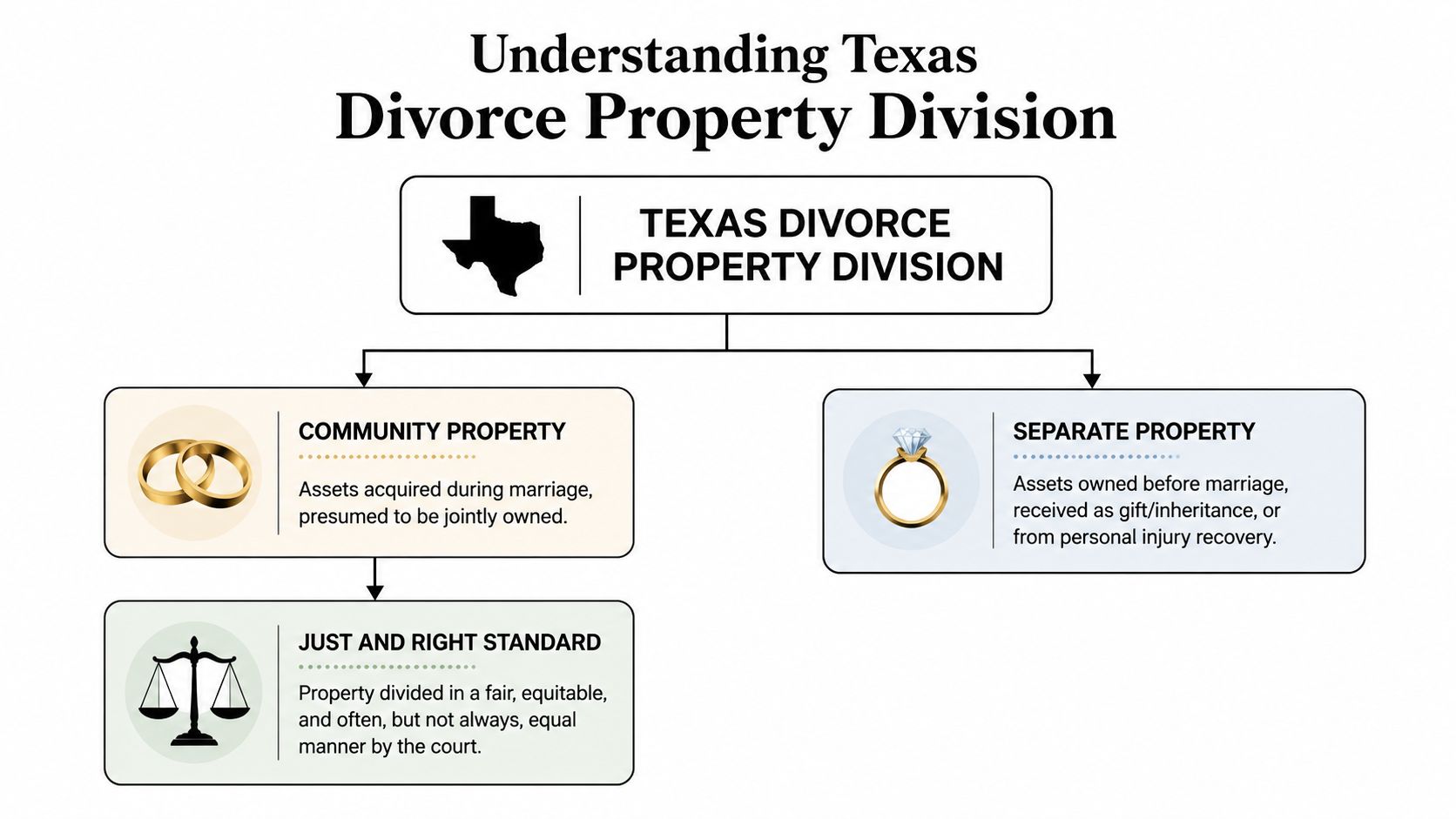
Texas law sorts property into two categories. Community property is generally the property, income, and debt accumulated during the marriage. Separate property belongs to one spouse alone and is not part of the divisible estate. Texas is not a strict 50/50 state. Under the Texas Family Code, a judge must divide the community estate in a manner that is “just and right,” and that can mean one spouse receives more than the other, as explained in this discussion of Texas property division.
What community property means in plain English
Community property works like the marital pot the court can divide. Paychecks earned during the marriage, savings built from those paychecks, retirement contributions made during the marriage, and property bought with marital funds often go into that pot.
Title is only one clue.
A bank account, vehicle, or investment account can still be community property even if only one spouse's name appears on it. What matters is often when the asset was acquired and how it was funded. If you want a stronger foundation for that analysis, this guide to community property divorce in Texas explains the framework in more detail. You can also review How Property Is Divided in a Texas Divorce, which discusses the just-and-right standard more closely.
What “just and right” actually means
In a Texas divorce, the question is not, “Do we split everything equally?” The better question is, “What belongs to the community estate, what belongs to one spouse alone, and what division is fair under these facts?”
That difference matters. A judge is not using a grocery-store scale and weighing each side to the ounce. The judge is looking at the full picture. If one spouse wasted community funds, committed fraud on the community, has much greater earning capacity, or benefited from a reimbursement claim, those facts can affect the final division. The same is true if one spouse cannot clearly prove an asset is separate and it is therefore presumed to be community property.
Careful case-building changes the outcome. Broad arguments about fairness rarely persuade a court by themselves. Specific proof often does.
| Question | Short answer |
|---|---|
| Does Texas require a strict 50/50 split? | No |
| Is all property divided? | No. Only community property is divided |
| Can a judge give one spouse more? | Yes, if the facts support it |
| Does fairness always mean equality? | No |
How the standard plays out in a real case
The just-and-right standard affects the whole process, not only the final hearing. Early in the case, each side gathers records, traces accounts, values assets, and looks for facts that support a larger or smaller share of the community estate.
That may include bank statements showing unusual withdrawals, business records showing income that was not fully disclosed, or documents tracing where a down payment came from. A reimbursement claim can arise when one estate, separate or community, benefited another and should be repaid. A fraud-on-the-community claim may exist if a spouse spent marital money for an improper purpose or tried to move assets out of reach. These are not side issues. They are often the facts that give you a concrete argument for a division that is just and right.
If you understand those pressure points early, you can make better decisions about settlement, mediation, and trial strategy.
Defining Your Separate Property That Is Not Divided
For many people, the most important financial protection in divorce isn't winning more of the community estate. It's correctly identifying what the court can't divide in the first place.
Separate property includes assets owned before marriage, property acquired by gift or inheritance during marriage, and recovery for personal injuries other than loss of earning capacity. Once an asset is proven to be separate property by clear and convincing evidence, the judge must confirm it as that spouse's sole property, as described in this explanation of separate and community property in Texas divorce.
Three common examples that help
A few examples make this easier:
- Before-marriage savings. If you had a savings account before the wedding, the amount you brought into the marriage may be separate property.
- Inheritance from family. If your parent left you land or money during the marriage, that may remain yours alone.
- A personal gift to you. If someone gave you jewelry specifically as a gift to you, that may be separate property.
The legal rule sounds simple. Proving it is often the hard part.
Why documentation matters so much
Texas places a high burden on the spouse claiming separate property. “Clear and convincing evidence” means you need strong proof, not guesses, not rough memory, and not a vague belief that something was yours first.
That usually means paper trails. Deeds. Account statements. Gift letters. Probate records. Deposit histories. If separate funds were mixed into joint accounts, tracing may be necessary to show where the money came from and where it went.
The closer your records are to the original transaction, the better.
If this issue may affect your case, this page on separate property in Texas divorce is a useful starting point.
Where people accidentally lose a good claim
Commingling creates problems. If inherited money goes into a shared account and both spouses use that account freely over time, it becomes harder to prove what portion stayed separate.
A retirement account can create a similar issue. The part you built before marriage may be separate, while the part earned during marriage may belong to the community estate. That doesn't make the entire account one thing or the other. It means you need records that separate one portion from the other.
Keep this in mind early. The court won't protect separate property if you can't prove it's separate.
Factors That Justify a Disproportionate Share
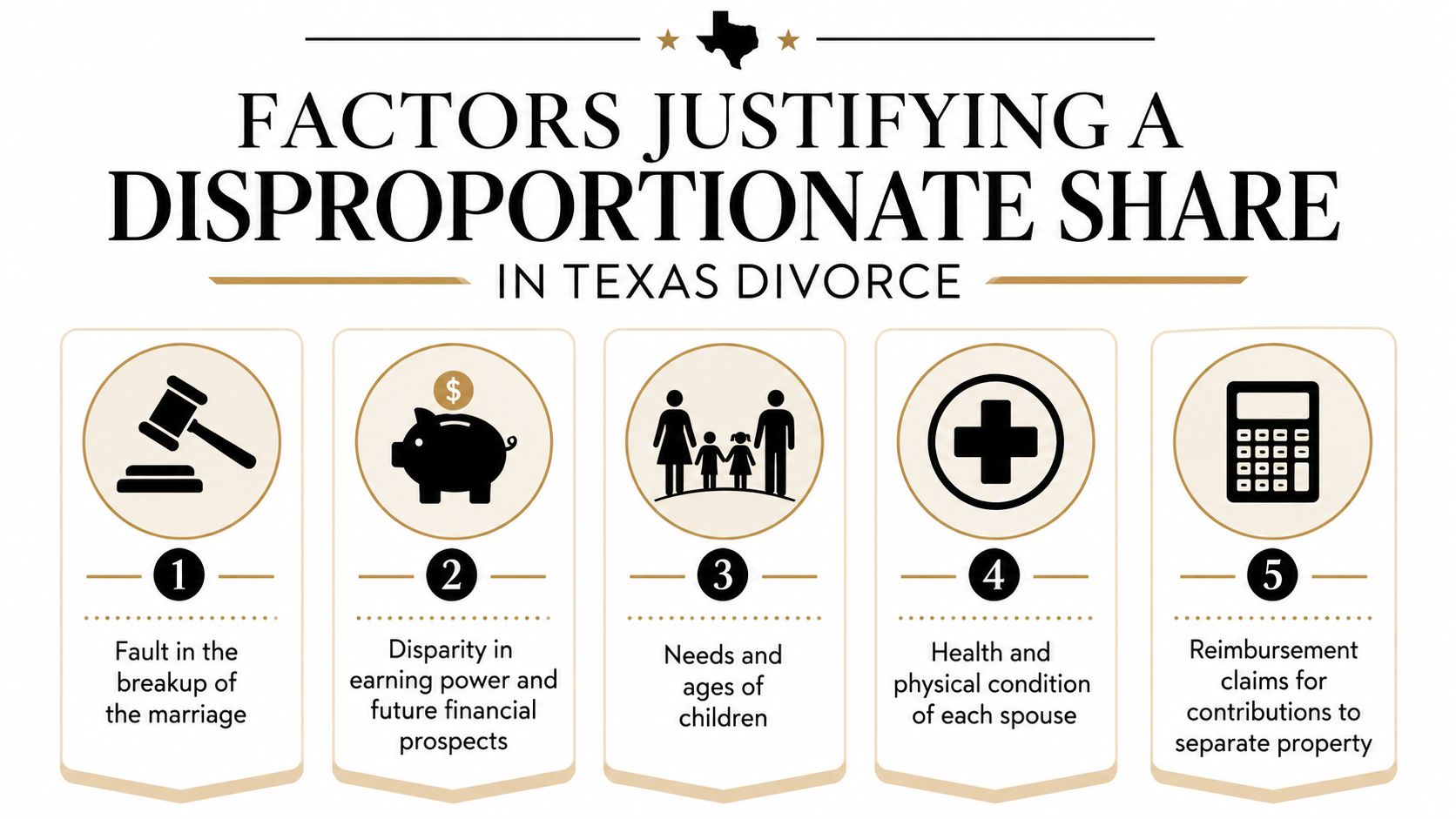
Once the court identifies the community estate, the next question is whether one spouse should receive more than half of it. Texas Family Code §7.001 requires a “just and right” division, and courts can award a disproportionate share when factors such as income disparity, fault in the breakup of the marriage, and relative financial conditions are proven. Some divisions can reach 60/40 or 70/30, as discussed in this explanation of disproportionate share in Texas divorce.
Fault and financial fairness
Fault can matter in property division. Not in every case, and not in a casual or emotional sense. It matters when the evidence shows conduct that should affect what is fair.
Examples may include cruelty, waste, or fraud tied to the breakdown of the marriage or the depletion of marital assets.
If adultery involved spending community money on another relationship, that may support more than a general complaint. It may support a financial claim.
Fraud on the community
This is one of the most actionable and least understood issues in Texas divorce. Fraud on the community usually refers to a spouse unfairly disposing of, hiding, or wasting marital assets without the other spouse's knowledge or consent.
That can include spending on an affair, moving money, concealing accounts, or transferring assets in a way that harms the community estate. The court may respond by awarding the innocent spouse a larger share to account for that wrongdoing.
The key is proof.
- Bank records can show unusual withdrawals or transfers.
- Credit card statements can show gifts, travel, or hidden spending.
- Business records may reveal funds moved through a closely held company.
- Digital evidence can help establish timing and pattern.
If infidelity and hidden spending are part of your concern, practical investigative guidance on hiring an infidelity investigator may help you think about documentation and evidence issues before you act.
Courts respond better to organized evidence than to suspicion, even when the suspicion turns out to be right.
Other reasons a split may move away from equal
Not every disproportionate division comes from misconduct. Some cases turn on future need.
Consider situations like these:
- One spouse earns far more and has stronger future earning power.
- One spouse has health limitations that make self-support harder.
- One parent will carry more of the child-related day-to-day burden after divorce.
- One estate contributed to another and a reimbursement claim needs to be addressed.
Reimbursement claims often matter when community funds or effort benefited separate property. The remedy isn't always simple ownership transfer. Sometimes it's a financial adjustment within the overall division.
Many of these disputes are resolved before trial. In practice, careful preparation often shapes the outcome in Divorce Mediation in Texas: How It Works, where documented claims can turn a vague demand into a workable settlement proposal.
Dividing Complex Assets Like Businesses and Retirement Accounts
You may be looking at a business you built over years or a retirement account that represents decades of work and wondering, "How can this possibly be divided fairly?" That anxiety is common. These assets are often the part of the estate that needs the most careful legal and financial work.
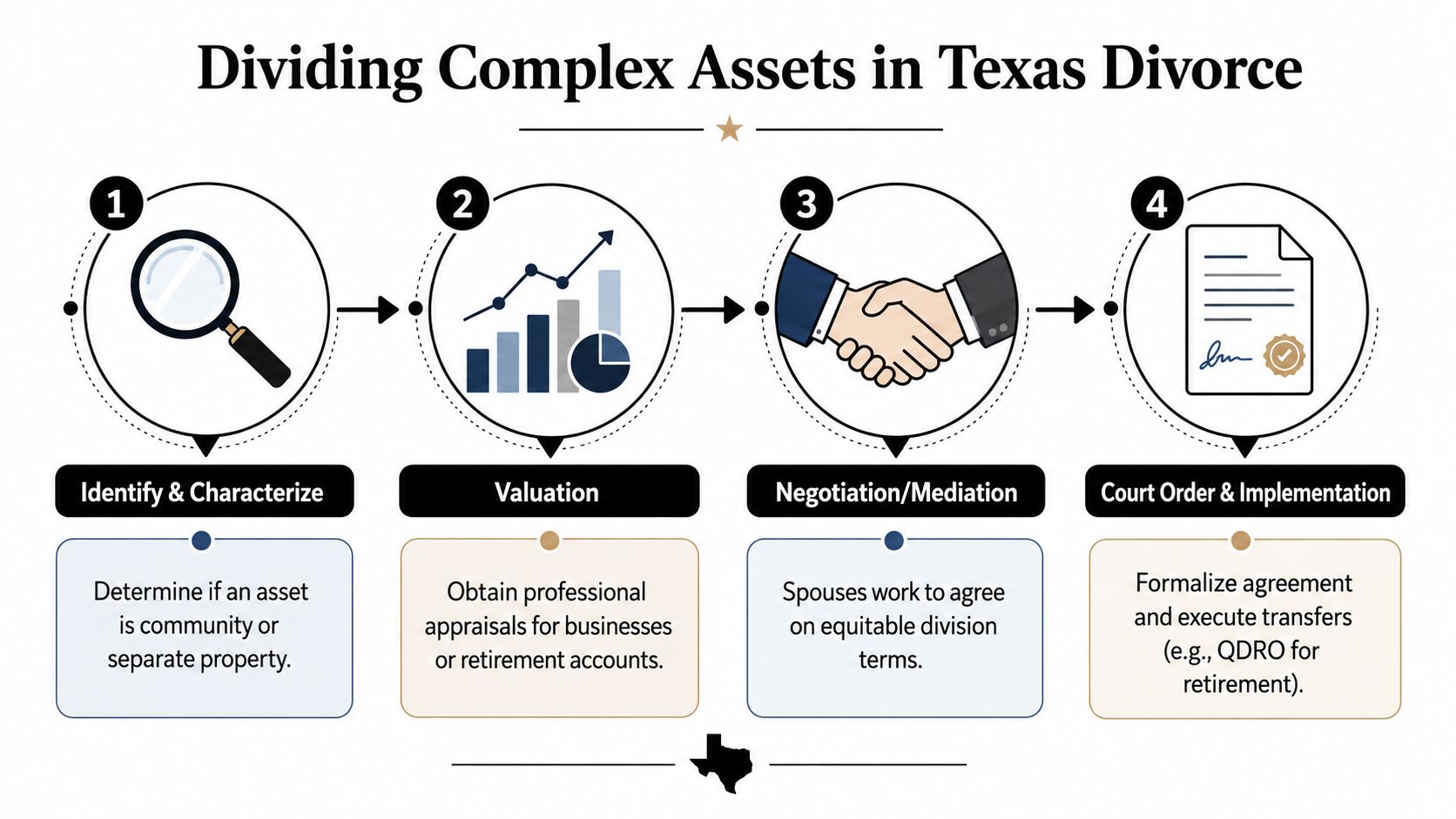
A checking account can be split by math. A business interest, pension, stock option package, or retirement plan usually cannot. The court still follows the same core questions, though: what is the asset, what part of it is community property, what part is separate property, what is it worth, and what division would be just and right in your specific case.
Business interests need more than rough estimates
A business is rarely just a number on paper. It may include goodwill, accounts receivable, inventory, equipment, debts, owner compensation, and benefits paid through the company. In some cases, a spouse also claims that business income was reduced, delayed, or diverted during the divorce to make the company look less valuable.
That is why valuation usually starts with records, not assumptions. Tax returns, profit and loss statements, bank records, payroll information, ownership documents, and compensation history can show whether the business is producing real income or whether the paper story leaves something out.
Characterization matters too. A company started before marriage may still have a community component if marital labor grew its value or community funds were used in the business. A company formed during marriage is not automatically divided in half either. The court may award the business to one spouse and offset that award with other property, a payment structure, or debt allocation. If this issue affects your case, Dividing a Business in a Texas Divorce explains how closely held businesses are valued and divided.
Retirement accounts require exact drafting
Retirement assets often look simpler than they are. The balance on the statement is only the starting point. You still have to determine what portion was earned during marriage, whether any part can be traced as separate property, and what order is needed to complete the transfer correctly.
For many employer-sponsored plans, the divorce decree does not move the funds by itself. A Qualified Domestic Relations Order, or QDRO, is often required to tell the plan administrator exactly how to divide the marital portion. IRAs usually follow a different transfer process, but they still require careful wording and timing to avoid expensive mistakes. If you need a closer explanation, this guide on how retirement accounts are divided in a Texas divorce helps you spot the issues early.
A few common examples show why details matter:
| Asset | Common issue |
|---|---|
| 401(k) | Often requires a QDRO and a clear marital cutoff date |
| Pension | May need a formula for future monthly payments |
| IRA | Usually does not require a QDRO, but transfer language still matters |
| Brokerage account | May involve tracing, tax basis, and valuation date disputes |
Debt and tax consequences can change the real result
A fair division is about net value, not just who receives which asset. Mortgages, credit cards, tax debt, business loans, and unpaid obligations all affect the picture. So do taxes and penalties tied to liquidation or transfer.
That means two assets with the same face value may not be equal in real life. A retirement account with pre-tax dollars is different from cash in the bank. A business with irregular income and hidden liabilities is different from a debt-free savings account.
If you keep that principle in mind, the process starts to feel less random. The goal is not to divide every item down the middle. The goal is to identify what each asset is worth, prove any separate property or reimbursement issues attached to it, and push for orders that reflect the financial effect on your future.
Practical Steps to Protect Your Financial Future
Anxiety usually drops when you start replacing assumptions with records. If you're asking, “Is everything split 50/50 in a divorce in Texas?” the best next move is to build your file before conflict escalates.
Start with a full inventory
Write down every asset and every debt you can identify. Include real estate, vehicles, business interests, retirement accounts, savings, credit cards, loans, and anything else with value or liability attached to it.
Don't rely on memory alone. Use statements, deeds, tax records, account screenshots, and loan summaries.
Gather proof before documents disappear
Focus on records that help answer three questions: what exists, when it was acquired, and where the money came from.
- Bank and investment statements help show balances and movement of funds.
- Tax returns often reveal income, business activity, and hidden leads.
- Deeds and closing records can help establish purchase dates and title history.
- Retirement plan documents may distinguish marital accrual from pre-marriage amounts.
- Business records can clarify compensation, ownership, and cash flow.
The spouse with organized records usually has more options in mediation, clearer testimony in court, and less room for surprise.
Protect day-to-day financial stability
You may need practical guardrails while the case is pending.
Open an account in your own name if you don't already have one. Review your credit. Keep copies of important household bills. Avoid draining accounts or making retaliatory transfers, because those actions often create new legal problems.
For many people, this work should start before filing. When you're ready to begin the formal process, The Original Petition for Divorce in Texas is the pleading that starts the case.
Use process to your advantage
Many Texas divorces settle through negotiation or mediation rather than trial. Mediation can be especially useful when both spouses want privacy, flexibility, and more control over outcomes. If the other side refuses to be reasonable or fails to follow court orders, enforcement tools may become necessary later, and those issues can connect with broader family law concerns such as enforcement of court orders or post-decree disputes.
Preparation doesn't guarantee a painless divorce. It does put you in a far stronger position.
What to Do Next How an Attorney Secures a Fair Outcome
You may be sitting at your kitchen table with a stack of bank statements, retirement account printouts, and old closing documents, trying to answer one hard question. What do I need to prove so the result is fair?

That is where legal strategy matters. In Texas, a fair outcome usually comes from building a clear, supported explanation of your property story. Your lawyer may need to trace separate property back to its source, show that community funds were misused, present a reimbursement claim, test whether a business valuation is realistic, or draft retirement division language that is operative when the order is signed.
A divorce case is often like assembling a ledger and a timeline at the same time. One shows what exists. The other shows how it got there. If either piece is missing, the court or the other side may treat your claim as unsupported, even if you know it is true.
Legal guidance often changes the outcome in practical ways:
- Characterization identifies whether an asset should be treated as community or separate property.
- Proof turns your position into something the court can rely on, such as account records, deeds, tax returns, or testimony tied to documents.
- Case theory connects the facts to requests for a larger share when fraud, waste, earning differences, or reimbursement issues are present.
- Settlement terms need to be specific enough to enforce later, especially with retirement accounts, debts, refinancing deadlines, or business interests.
- Final decree review catches errors before they become expensive problems after the divorce is over.
This is also why lawyers look past the headline question of "50/50." Actual work is often in the details you can act on. Can you prove a house down payment came from separate funds? Can you show one spouse transferred money for a non-marital purpose? Can you document that community funds improved separate property and should be reimbursed? Those points give you something concrete to argue, instead of asking the judge for fairness in the abstract.
If communication has broken down, support outside the courtroom can still help lower the temperature. Some families benefit from resources such as WeUnite's family conflict support, particularly when separation and parenting conflict are making settlement harder.
For a broader overview of what this looks like in practice, this video may help clarify the issues before you make your next decision.
Key Takeaway
A fair result in a Texas divorce rarely turns on a single percentage. It usually turns on preparation, records, and whether your arguments are tied to specific facts such as separate property tracing, fraud on the community, reimbursement, asset valuation, and decree language that protects you after the case ends.
The Law Office of Bryan Fagan, PLLC handles Texas family law matters involving property division, custody, support, mediation, and enforcement.
If you're facing divorce and need clear answers about your property, your rights, and the steps ahead, schedule a free consultation with Law Office of Bryan Fagan, PLLC. You don't have to sort through separate property claims, retirement division, mediation strategy, child-related concerns, or final decree language on your own. A focused conversation can help you understand what a just-and-right outcome may look like in your case and what to do next to protect your future.