Skip to content
You may be staring at the length of your marriage and wondering whether those years will protect you financially once the divorce is over.
If that sounds familiar, you're not alone. Many Texans come into divorce believing the 10-year rule means they'll automatically receive alimony if they've been married long enough. Others fear the opposite and assume they have no options at all. Both reactions are understandable, and both can lead you in the wrong direction.
Texas divorce law gives you some real protections, but it doesn't work by simple shortcuts. If you're asking, what is the 10 year rule for divorce in Texas, the answer matters most when you're trying to understand your financial future, whether you can request support, how property will be divided, and what steps you should take early in your case.
A divorce also involves more than one issue at a time. You may be thinking about your income, the house, retirement accounts, a business, temporary orders, child custody, child support, mediation, and how long the process will take from filing to final decree. In Texas, those pieces often move together. That's why getting the law straight from the start can reduce fear and help you make smarter decisions.
Facing Divorce After a Long Marriage
You may have spent years building a life around your marriage, your home, your children, and your spouse's career, only to find yourself asking one painful question: What happens to me now?
For some people, the worry starts after a spouse says they want a divorce. For others, it begins when they realize they've been out of the workforce, earning less than their spouse, or managing most of the childcare while the marriage slowly falls apart. If you're in that position, it's natural to hope that the law recognizes the time and effort you invested.
Consider a common situation. You've been married for over a decade. You may have paused your own career to raise children, helped support your spouse through school, or worked inside a family business without building retirement savings in your own name. Now divorce is on the table, and friends tell you, “You've been married over 10 years, so you'll get alimony.”
That advice sounds reassuring. It's also incomplete.
A long marriage can matter in Texas, but length alone doesn't decide your outcome.
The confusion usually comes from a real legal rule that people oversimplify. Texas does have a 10-year threshold that affects whether you may ask a court for spousal maintenance. But that rule is only one part of a much bigger picture. It doesn't automatically create monthly payments, and it doesn't control how your property gets divided.
If you're a parent, your concerns may stretch even further. You may be trying to protect parenting time, secure child support, and keep the household stable while the case moves through temporary hearings, mediation, and final orders. If you own a business or have a high-value estate, you may also be worried about valuation, debt allocation, or whether one spouse will claim a larger share of the marital estate.
Texas divorce usually starts with filing an original petition, moves through service or waiver, temporary orders if needed, discovery, negotiation or mediation, and then ends in a final decree if the case settles or goes to trial. Understanding the 10-year rule early helps you prepare for one important part of that process: your claim for financial support after divorce.
What the Texas 10-Year Rule Actually Is
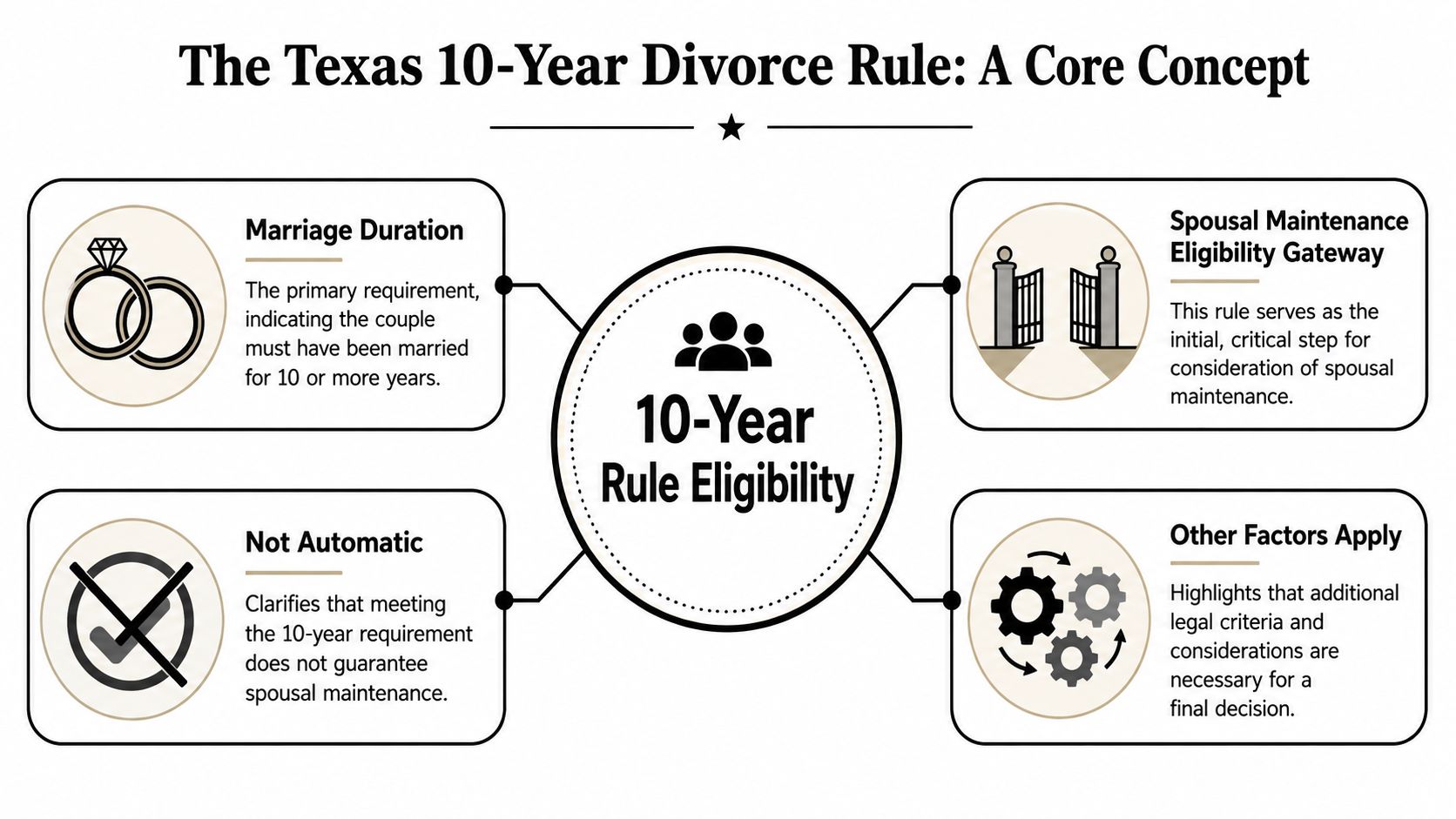
The Texas 10-year rule is best understood as a gateway, not a promise.
Under Texas Family Code 8.051 as summarized here, if a marriage lasted at least 10 years, a court may order maintenance. The 10-year threshold is critical because without meeting this duration, spousal maintenance is generally not available barring specific exceptions. That single word, may, matters.
If you want a plain-English answer to what is the 10 year rule for divorce in Texas, it's this: after a marriage of at least 10 years, you may have the right to ask the court for post-divorce spousal maintenance.
Think of it as the courthouse door
The 10-year rule is like a key to one door in your divorce case. If your marriage lasted long enough, the door opens and you can make the request. If it didn't, that request is usually blocked unless an exception applies.
But opening the door isn't the same as winning your case.
That's why it helps to separate two questions:
- Can you ask for maintenance?
- Can you prove you should receive it?
Those aren't the same issue.
If you want a deeper overview of terms people often call alimony, this guide on what alimony means in Texas can help you sort through the language. Texas courts use the term spousal maintenance for court-ordered support, and that distinction matters.
What the rule does and does not do
The rule affects eligibility to seek maintenance, not every financial issue in your divorce. It does not automatically award support. It does not decide custody. It does not control child support. It does not give one spouse a larger share of the house or retirement account just because the marriage crossed the 10-year mark.
You may also hear people use broad labels like “alimony” for any post-divorce support arrangement. In Texas, there can be court-ordered maintenance and there can also be agreements between spouses. A focused resource like Spousal Maintenance in a Texas Divorce explains when Texas courts award post-divorce spousal maintenance.
Practical rule: If your marriage lasted at least 10 years, you may be eligible to request maintenance. You still have to prove the legal facts that justify it.
That difference is where many cases are won or lost.
The Biggest Misconception About the 10-Year Rule
The biggest myth is simple: a 10-year marriage does not automatically entitle you to spousal maintenance.
That misunderstanding creates real problems. It can lead you to overestimate what the court will do, underprepare your evidence, or reject reasonable settlement options because you assume maintenance is guaranteed. In reality, Texas courts look closely at whether you can meet your own basic financial needs after the divorce.
According to this discussion of divorce after 10 years in Texas, while the 10-year duration is a strict eligibility threshold, it is not a guarantee. Courts still require proof of 'inability to provide for minimum reasonable needs' due to disability, caretaking of a disabled child, or lack of earning capacity. Spousal maintenance is rarely awarded in Texas, and the 10-year rule only increases the likelihood of consideration, not the outcome.
What minimum reasonable needs means in real life
That phrase sounds formal, but the idea is practical. A judge is looking at whether you can cover basic living needs after considering your own income and the property you receive in the divorce.
That may include things like:
- Housing costs such as rent or mortgage
- Utilities and groceries needed for ordinary living
- Transportation so you can work and care for your family
- Medical needs if health issues affect your earning ability
- Basic child-related realities when those duties limit your work options
It does not mean the court is trying to preserve every part of the lifestyle you had during marriage. The focus is narrower.
Evidence matters more than assumptions
A judge won't award maintenance because the marriage was long or because one spouse earned more. The court will want proof that you can't presently meet minimum reasonable needs and that you've made efforts to support yourself if you're able to work.
That's where many people get caught off guard. They think the timeline of the marriage is the case. It isn't. The case is built on documents, testimony, and credible explanations.
Here are examples of what often becomes important:
- Your earning history and whether you've been out of the workforce
- Your health and whether disability affects employment
- Your role as a caregiver if a disabled child needs substantial care
- Your access to property awarded in the divorce
- Your efforts to work or train for work if that's realistically possible
Courts don't usually reward assumptions. They respond to proof.
If you're approaching divorce with the belief that “I crossed 10 years, so support is automatic,” shift your mindset now. A stronger approach is this: I may qualify to ask, and I need to show the court why support is necessary.
That change in thinking strengthens your position. It moves you away from rumor and toward preparation.
Spousal Maintenance vs Community Property Division
Many people blend these two issues together. Texas law does not.
Spousal maintenance is about ongoing support after divorce. Property division is about splitting what you and your spouse accumulated during the marriage. One deals with future support. The other deals with the marital estate you already built.
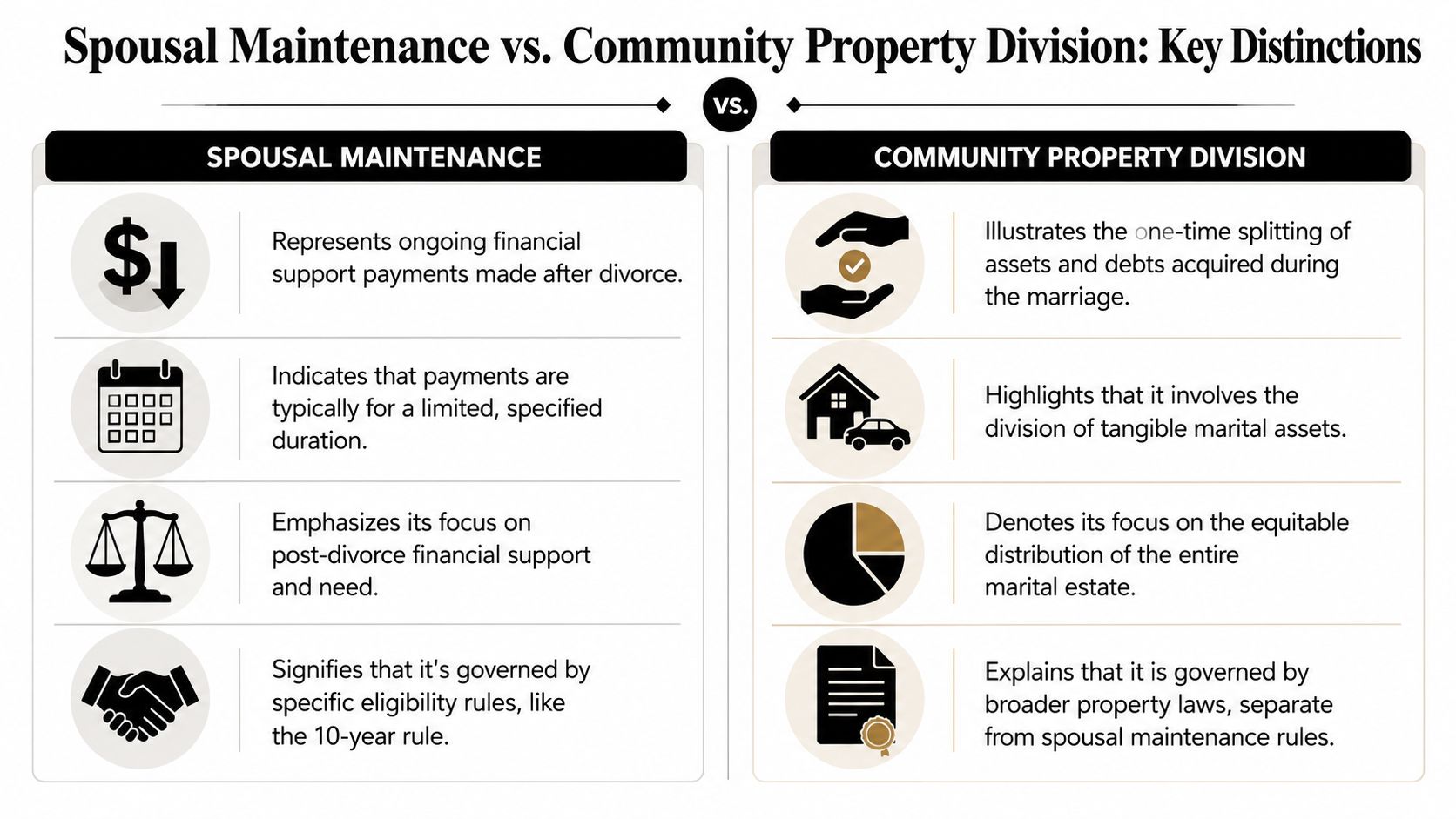
Texas follows the community property principle. As explained in this overview of Texas property division, Texas Family Code §3.002 treats assets and debts acquired during marriage as community property, and courts divide that property in a “just and right” manner. That process is separate from maintenance and is not governed by the 10-year rule.
A side-by-side view
| Issue | Main question | What it covers |
|---|---|---|
| Spousal maintenance | Do you need post-divorce support? | Limited ongoing payments after divorce if legal requirements are met |
| Community property division | How should marital property and debt be divided? | House, bank accounts, retirement, businesses, vehicles, debt, and other marital assets |
That distinction matters because some spouses assume they won't receive a fair share of marital property unless they were married at least 10 years. That's not how Texas law works. Community property rights arise from what was acquired during the marriage, not from crossing a 10-year milestone.
If you want a focused explanation of that issue, this guide on community property in a Texas divorce is a useful starting point.
Why this matters in your case
A spouse may receive a substantial share of community property and still not qualify for maintenance. Another spouse may need to request maintenance because the property division alone doesn't cover minimum reasonable needs.
This is especially important if you own a business, investment accounts, or valuable retirement assets. Property division can become complex quickly. Courts may consider circumstances such as the length of the marriage, financial conditions, and other fairness concerns when deciding what is “just and right,” but that analysis is still separate from a maintenance claim.
Texas also doesn't require legal separation before filing for divorce. Some couples continue living in the same house while the case is pending for financial or parenting reasons. The divorce process still generally follows the same path: filing, service or waiver, temporary orders if needed, discovery, mediation, and final decree.
For a quick visual overview, this video may help:
How Courts Determine Maintenance Amount and Duration
Once you clear the first hurdle of eligibility, the court turns to two practical questions: what amount would help you meet minimum reasonable needs, and how long should that support last?
Texas places hard limits on both. As noted earlier, spousal maintenance cannot exceed the lesser of $5,000 per month or 20% of the paying spouse's gross monthly income. The law also sets outer limits on duration based on the length of the marriage. For marriages lasting 10 to 20 years, the cap is up to 5 years. For 20 to 30 years, up to 7 years. For more than 30 years, up to 10 years.
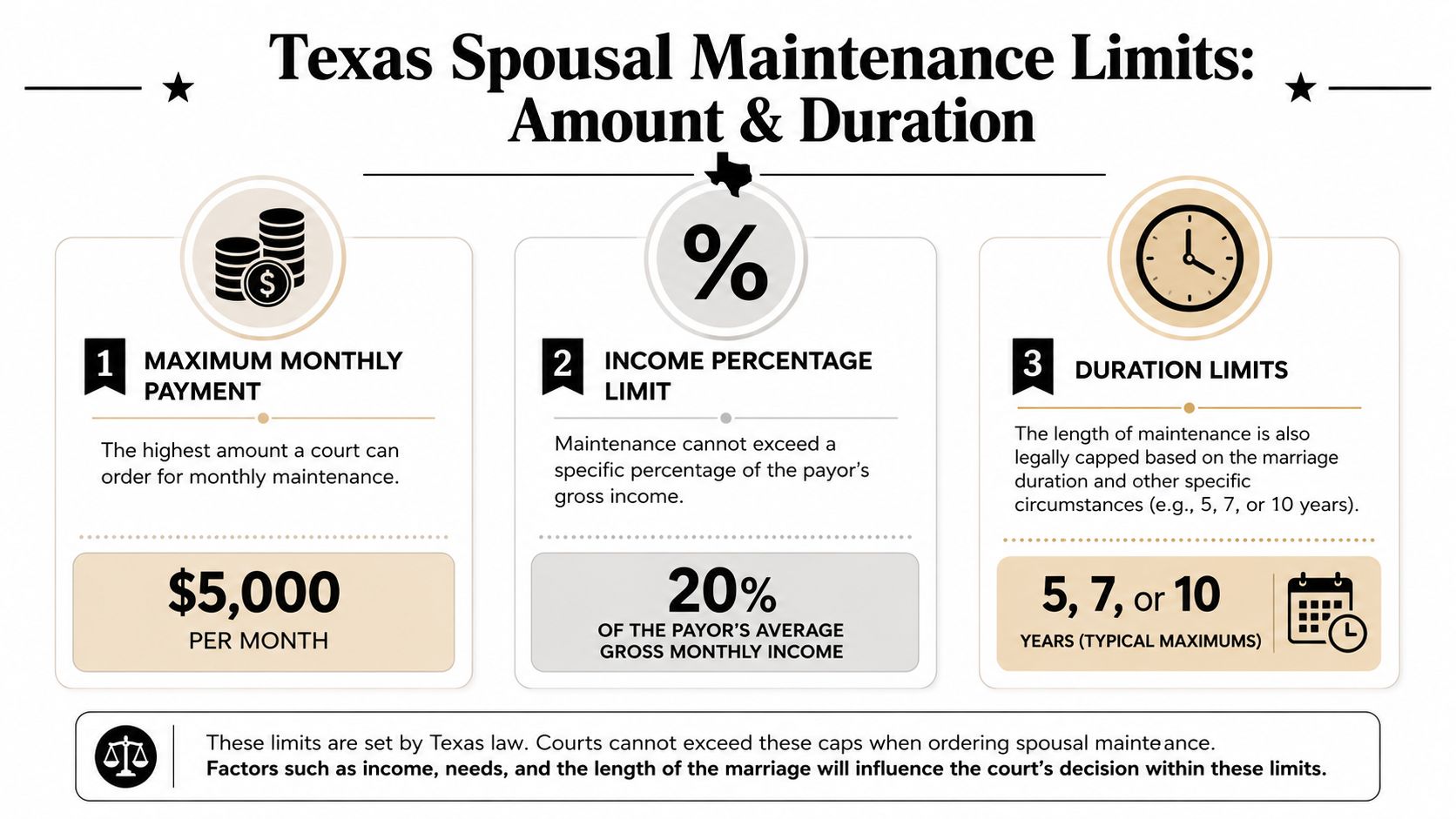
Those limits work like the top line on a budget, not a promise of what you will receive. A 22-year marriage may allow maintenance for up to 7 years, but a judge still asks a more grounded question: how much time do you need to get to financial stability?
That is where many people get tripped up. They hear "up to 7 years" or "up to 10 years" and assume the court starts at the maximum. Texas courts do the opposite. Judges are directed to order the shortest period that allows the receiving spouse to earn enough to meet minimum reasonable needs, unless disability, caregiving demands, or another legally recognized barrier supports a longer term.
A simple way to look at it is this: the cap tells you the ceiling, but your evidence tells the court where your case belongs underneath that ceiling.
For example, if your marriage lasted 22 years, duration could fall within the 7-year range. If the paying spouse's gross monthly income is high, the amount still cannot go above the lower of the statutory dollar cap or 20% of gross monthly income. If you want a clearer sense of how those limits are applied in real cases, this guide on how much alimony may be ordered in Texas gives useful context.
The judge may look closely at facts such as:
- your age and health
- your work history and present earning ability
- whether you need education or job training
- how long it may take you to become self-supporting
- the property and cash flow you will receive in the divorce
- whether one spouse can pay maintenance
That last point matters more than people expect. A court can award only what the law allows and what the evidence supports. If income is irregular, tied to a small business, or disputed, maintenance often becomes a battle over proof, not assumptions.
The legal cap sets the outer boundary. Your records, testimony, and day-to-day financial reality shape the actual award.
If you are asking for maintenance, start thinking like a teacher. Show the judge your monthly budget, your job prospects, your training needs, and any health or caregiving limits in plain, documented terms. If you are defending against a maintenance request, the same rule applies. Specific financial evidence usually carries far more weight than broad claims that someone "should" or "should not" get support.
Important Exceptions to the 10-Year Rule
If your marriage hasn't lasted 10 years, that doesn't always end the discussion.
Texas law recognizes limited exceptions where a spouse may still seek maintenance without meeting the standard 10-year duration. These exceptions are narrow, but they're important, especially if you've been told too quickly that you have no path forward.
Family violence and disability-related exceptions
A shorter marriage may still support a maintenance claim in situations involving family violence. The same is true when the spouse seeking support has an incapacitating physical or mental disability, or when that spouse is the caregiver for a child of the marriage whose disability requires substantial care and supervision.
These exceptions exist because the law recognizes that some spouses face genuine barriers to self-support that have little to do with how many years the marriage lasted.
If you think one of these issues applies to you, your evidence becomes even more important. Court records, criminal case records, medical records, physician statements, caregiving details, and testimony can shape whether the court sees the full picture.
The immigrant spouse exception many people miss
One of the least discussed exceptions involves a sponsored immigrant spouse.
According to this explanation of the Texas 10-year rule and Affidavit of Support issues, even in marriages under 10 years, a sponsored immigrant spouse may be able to enforce an Affidavit of Support, which guarantees financial support at 125% of the Federal Poverty Guidelines and bypasses the standard 10-year eligibility barrier for spousal maintenance.
That's a separate and serious financial issue. If your spouse signed an I-864 Affidavit of Support during the immigration process, your divorce analysis may look very different from what most general divorce advice suggests.
Here are situations where you should pause before assuming the 10-year rule controls everything:
- You were sponsored for immigration purposes and an Affidavit of Support may exist
- There was family violence tied to the relationship
- A disability affects your ability to work
- You care for a disabled child whose needs prevent regular employment
If one of these exceptions fits your life, your case may be stronger than you think.
This is one reason generalized advice from friends, family, or online forums can be risky. Texas family law is fact-specific, and exceptions can completely change your options.
Building Your Case for Spousal Maintenance
A maintenance claim usually rises or falls on proof.
In a Texas divorce, the judge is not just listening for a hard story. The judge is looking for a clear, documented answer to a practical question. Can you meet your minimum reasonable needs on your own, and if not, why not right now? The 10-year rule may let you ask for maintenance, but your evidence is what gives the request real weight.
Start with the documents that show how you actually live
Your records should work like pieces of a timeline. One set shows what money comes in. Another shows what must go out each month. Another explains why getting back to full financial independence may take time.
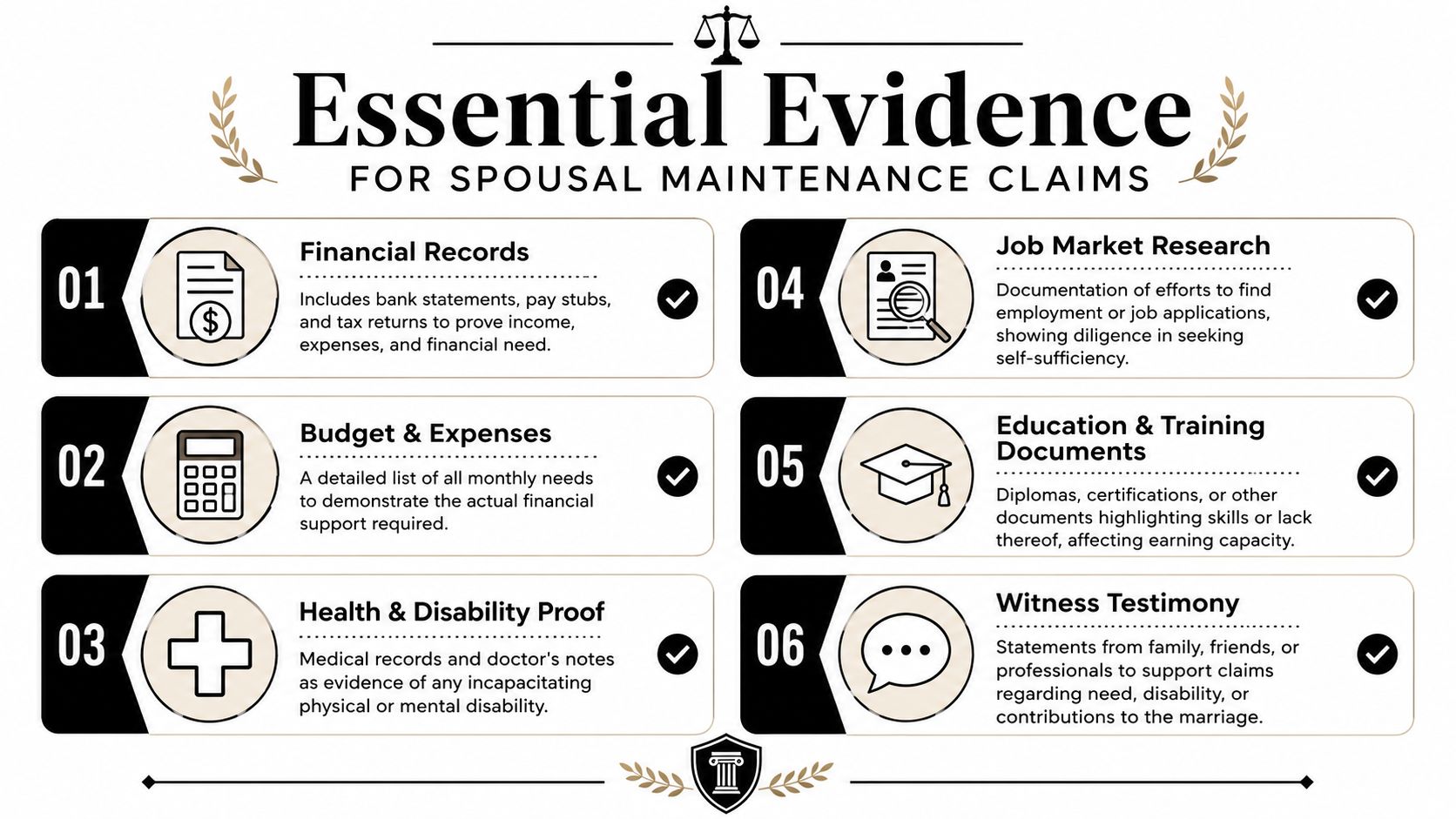
Useful proof often includes:
- Financial records such as bank statements, pay stubs, tax returns, and credit card statements
- A detailed monthly budget covering housing, utilities, food, insurance, transportation, child-related costs, and medical expenses
- Medical records if a health condition limits your ability to work or affects the type of work you can do
- Job search records such as applications, rejection emails, interview notes, and workforce training efforts
- Education and training documents that show your current qualifications and what retraining may be needed
- Witness testimony from people who can explain caregiving duties, health limitations, or your role during the marriage
That last point matters more than many people expect. If you spent years out of the workforce raising children, supporting your spouse's career, or caring for a family member, the court needs more than a general statement. It needs a concrete picture of what those years meant for your earning ability today.
Show effort, not just need
Texas courts often want to see that you are trying to become self-supporting if you are able to do so. A maintenance request is stronger when you can show both present need and reasonable effort.
That means keeping records of job applications, classes, certifications, resume updates, and any barriers that slowed your return to work. If your health, age, or caregiving duties limit those efforts, document that too. A judge is more likely to trust a claim that is specific, consistent, and supported from several directions.
Build the case early
Waiting until mediation or trial to gather proof can hurt you. Important records get lost. Online account access changes. Memories become less precise.
Start organizing your file as soon as maintenance becomes a realistic issue. Your case may involve the divorce petition, required disclosures, discovery requests, temporary orders, mediation, and possibly a final hearing. Each stage gives you a chance to present a clearer financial picture.
A practical sequence often looks like this:
- Identify maintenance as a live issue early in the divorce.
- Gather financial and personal records before they become harder to access.
- Prepare a realistic budget based on actual monthly needs.
- Document work limitations and job search efforts in an ongoing file.
- Use mediation and court filings to present a clean, credible explanation of need.
For readers also thinking beyond the courtroom, practical money habits after divorce can matter just as much as the legal result. Some people use resources on how to achieve financial freedom as part of a broader recovery plan.
Cases with business income need extra care
If your spouse owns a business, receives irregular compensation, or controls cash flow in ways that do not show up on a simple paycheck, documentation becomes even more important. Income may be hidden inside business expenses, deferred payments, retained earnings, or irregular draws. In those cases, the paper trail matters. So does a careful review of financial statements and tax records.
Law Office of Bryan Fagan, PLLC is one Texas family law resource people sometimes consult for information about filings, mediation, support disputes, and enforcement.
Practical tip: Do not ask the court to fill in the blanks. Give the court organized records that make your financial reality easy to follow.
What To Do Next Protecting Your Financial Future
By now, the core point should be clearer. The 10-year rule is not a prize for staying married long enough. It is a legal threshold that may allow you to ask for spousal maintenance. After that, your case turns on need, earning ability, and evidence.
That's why your next step shouldn't be guessing. It should be getting organized.
Focus on the issues you can control
If you think maintenance may matter in your divorce, start with the facts you can gather and the decisions you can make now:
- Confirm the marriage timeline so you know whether the 10-year threshold or an exception may apply.
- List all income sources and monthly expenses in a realistic budget.
- Collect records early before documents become harder to access.
- Think about employability realistically. If you can work, document your efforts.
- Prepare for mediation because many Texas divorce cases resolve there rather than at trial.
- Look at the whole case including custody, child support, property division, and enforcement risks.
If you're also trying to rebuild after separation, practical financial education can help you make better long-term choices. For broader money habits after divorce, some readers find guidance on how to achieve financial freedom useful as part of a bigger recovery plan.
Key takeaway
Keep this framework in mind:
- Ten years may let you ask
- Need must still be proven
- Property division is a separate issue
- Evidence often decides the result
Divorce can feel personal, financial, and procedural all at once because it is. You may be making decisions about where you'll live, how often you'll see your children, whether the business survives the split, and what your post-divorce budget will look like. That's a lot to carry on your own.
A clear legal strategy helps. So does a calm explanation of what the court is likely to care about, what documents matter most, and when to negotiate versus when to stand firm. Whether your case involves children, a closely held business, retirement accounts, temporary orders, or a disputed maintenance claim, informed planning can protect both your peace of mind and your future options.
If you're facing divorce and worried about support, property, custody, or the court process from filing through final decree, schedule a free consultation with Law Office of Bryan Fagan, PLLC. You can get clear answers about how Texas law applies to your facts, what evidence you should gather, whether mediation makes sense, and how to protect your financial future with a practical plan.