Skip to content
You open your mailbox or check a court record and discover that your spouse obtained a Texas divorce decree without you ever knowing the case existed. The shock is personal, but the next question is legal: was the required service completed correctly?
Texas law can provide a path to challenge a default divorce decree when service was defective. But not every mistake produces the same result. The difference between a void judgment and a voidable judgment can determine whether you may attack the decree later or must meet strict deadlines.
You Just Learned You Were Divorced Without Proper Notice
You may have believed you were still married when a lender, benefits office, or family member told you otherwise. You may then find a default divorce decree that divides property, addresses children, or awards support without your participation. Your first reaction may be anger, fear, or disbelief. Those feelings are understandable, but the court file now matters more than anyone's explanation.
A default decree is entered after a respondent doesn't file an answer or otherwise participate. That doesn't automatically mean the decree is invalid. Texas courts expect careful compliance with citation, service, and return requirements because a person must receive legally sufficient notice before a court can exercise authority over that person in a divorce case.
If you ignored papers that were properly served, your options may be limited. If you never received legally valid service, the analysis changes. Texas courts generally don't presume valid service in a no-answer default. The record must show that the petitioner followed the required process.
Your first priority: obtain the complete court file before relying on what your spouse, a clerk, or an online docket summary says happened.
You should look for the original petition, citation, return of service, publication documents, affidavits, docket entries, and final decree. If publication was used, you also need the proof showing where and how notice was posted or published. A missing document may matter, but a missing document doesn't automatically prove that service failed. Your attorney must compare the record with the rules in effect when service occurred.
You can also review what happens if you ignore divorce papers in Texas to understand why a no-answer case can move forward. This guide focuses on a narrower question, Family Code 6.409 setting aside a decree for defective service, and the remedies that may be available after a default decree.
The stakes can be substantial. A decree may affect your home, business interests, retirement accounts, debts, custody rights, child support, or spousal maintenance. You shouldn't assume that actual knowledge of a divorce case fixes defective formal service, and you shouldn't assume that any technical error automatically erases the decree. The facts and the court record control.
Understanding Family Code 6.409 and Publication Service in Texas Divorce
You may discover that your spouse obtained a divorce after serving you by publication, even though you never saw the notice. Texas Family Code Section 6.409 governs citation by publication in a suit for dissolution of marriage. It sits within Chapter 6, which addresses Texas divorce proceedings. In plain English, publication is a backup method of notice used when the respondent cannot be found through diligent efforts and ordinary service has failed. For a practical overview, see our guide to divorce by publication in Texas.
The statute provides that citation by publication in a divorce suit is published one time only. The notice must tell the respondent that, unless an answer is filed by 10 a.m. on the Monday after 20 days from service, the court may enter a default judgment. You can review the statutory language in the Texas Family Code Chapter 6 provisions.
That deadline is a procedural checkpoint, not permission to publish notice whenever convenient. Before publication may be used, the petitioner must meet the requirements for that method, and the clerk's and court's records must show what occurred.
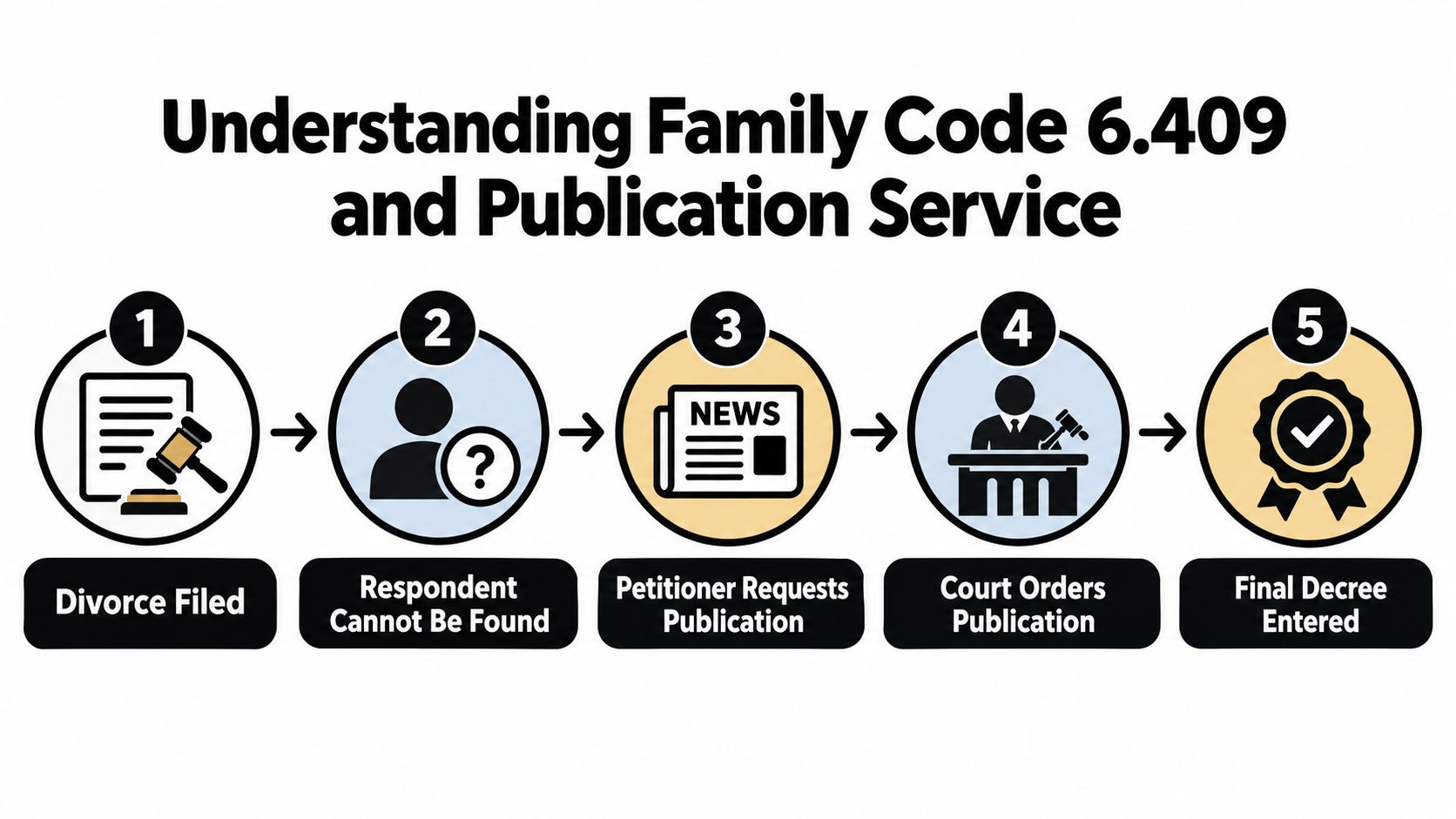
What valid publication service requires
Publication service generally begins with a diligent effort to locate the absent spouse. The petitioner must make reasonable attempts to find the respondent before asking to use publication. The citation must also identify the case accurately. If minor children are involved, the caption must include them when the applicable pleading and service rules require it. The Texas Bar Practice materials explain divorce pleadings and publication service.
The publication process has changed over time. Depending on the case and the law in effect when service occurred, citation may need to be posted online through the state court system and, in some cases, published in a newspaper, with at least 28 days before return. Later rule changes do not automatically apply to an earlier service. The service date therefore helps determine which procedures and records belong in the file.
The ordinary divorce waiting period and the service deadline address different issues: the 60-day rule limits when a divorce can be finalized, while the answer deadline controls when a respondent must respond after service. The Texas 60-Day Divorce Waiting Period explains the waiting-period rule.
The record must protect the absent spouse
If citation is by publication and no answer is filed, the court must appoint an attorney to represent the absent respondent. The record must also contain a statement of the evidence approved and signed by the judge. That document gives the court a written basis for reviewing the evidence rather than entering a decree on an unexplained record.
A Texas appellate decision addressing publication-service records shows why the attorney appointment and judge-signed statement matter. Missing proof or a defective statement may support an argument that the default decree should not remain in effect, although the result depends on the complete record and the applicable remedy.
A publication case therefore requires more than a newspaper notice. The file should show an authorized method, accurate notice, proper timing, diligent search efforts, the required attorney appointment, and the court's documented consideration of the evidence. Those records often determine whether a service problem attacks the court's authority or remains an error subject to procedural limits.
When Defective Service Makes a Decree Void or Just Voidable
The most important distinction is whether the decree is void or merely voidable. These terms aren't interchangeable. A void decree lacks the legal foundation necessary for the court to bind the respondent. A voidable decree may contain an error, but it remains effective unless you challenge it through the proper procedure and within the applicable deadline.
A complete failure of service is the clearest example of a potential void judgment. If the respondent was never served and didn't waive service or appear, the due-process problem can be fundamental. Texas law generally treats a void judgment as subject to attack later because the court never acquired the required authority over the absent party.
A technical error is different. The process may have been attempted, but the citation, return, publication, or record may contain a defect. Texas appellate law has historically distinguished that imperfect service from a total failure of service. A merely technical defect can make a decree voidable rather than void, which means timing and procedural posture become critical. Texas family-law commentary discusses the difference between void and voidable divorce judgments.
Why actual notice doesn't answer everything
You may have heard about the divorce from a friend, seen a social media post, or learned that your spouse filed a case. That information can create a difficult factual dispute, but actual notice isn't always the same as formal service. At the same time, actual notice may make it harder to argue that a later challenge should proceed as though you had no knowledge at all.
Your attorney will compare what you knew with what the court file proves. If the return of service is facially defective or the required service step never occurred, documentary evidence may support relief. If the record appears complete and your argument is only that you knew about the case but didn't receive papers personally, the challenge may be harder.
Texas default-divorce practice is strict because the respondent didn't appear to correct mistakes before judgment. The appellate cases In re Marriage of Beall and McCoy v. McCoy show that defaults were vacated when the record failed strict-compliance review, including situations involving small deviations in service. You can review the discussion of those cases in Texas appellate authority on defective service.
The deadline can depend on the defect
Texas family-law commentary identifies a historical four-year limitations period as the ordinary window for a bill of review, an equitable direct attack on a judgment. That period doesn't mean every challenge has four years, and it doesn't mean a bill of review is automatically available. A void judgment and a voidable judgment follow different paths.
The practical question is not “Was there a mistake?” It is, “What kind of mistake occurred, what does the record prove, and what remedy is available now?” That answer should guide your filing strategy.
How to Move to Set Aside a Decree for Defective Service
You should treat this as a record-based investigation, not as a narrative about how unfair the divorce feels. Your personal history matters, but the court will focus on citation, service, return, publication proof, and jurisdictional authority.
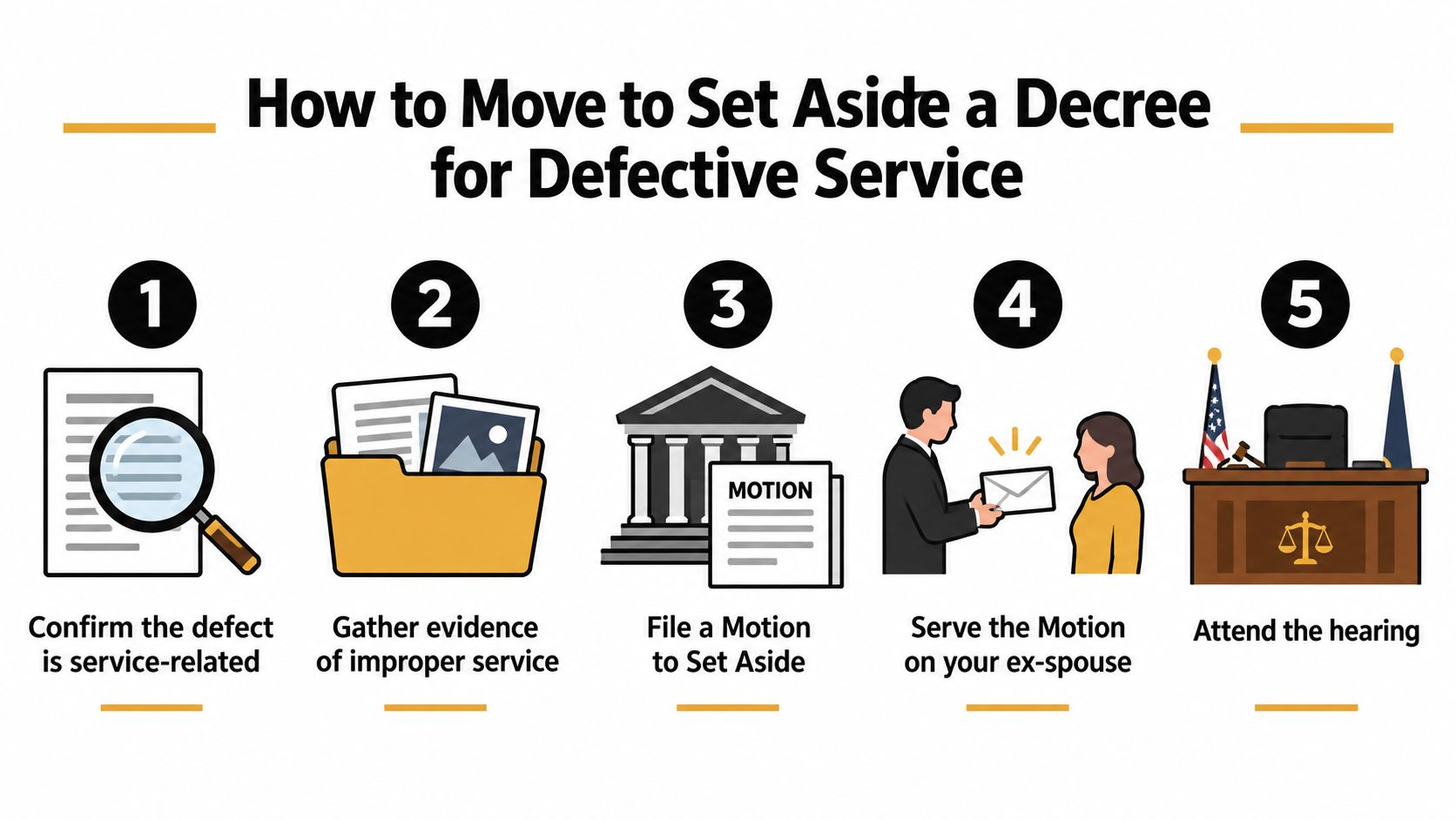
Start with the complete file
Request or download the clerk's record if available. Gather:
- The petition and citation: Confirm the case caption, parties, county, cause number, and the form of citation issued.
- The return: Read every line, including dates, identifying information, the person who served you, and the manner of service.
- Publication materials: Collect the publication affidavit, online posting proof, newspaper proof if applicable, and any order authorizing publication.
- The court record: Look for the attorney appointment and the statement of evidence approved and signed by the judge.
- The final decree: Identify provisions affecting property, children, support, debts, retirement, and business interests.
- Your evidence: Preserve address records, travel records, military assignments, medical records, messages, or other documents that explain where you were and whether service could have reached you.
Don't rely on a docket label such as “served” or “publication completed.” The filed documents must show strict compliance.
Identify the specific failure
Your motion should clearly state what went wrong. Examples may include no service attempt, an unauthorized method, an incorrect or incomplete citation, a defective return, failure to satisfy publication requirements, inadequate diligent-search evidence, or a missing required record component.
Explain the legal consequence without overstating it. You might plead that the failure deprived the court of jurisdiction and rendered the decree void. If the facts show an imperfect but attempted service, your attorney may need to pursue a direct attack or bill of review instead of assuming a collateral challenge will succeed.
File the correct post-judgment request
The filing should identify the decree, describe the service defect, request that the court set aside the default decree, and ask for any related relief necessary to restore the case for proper litigation. Attach sworn evidence when appropriate. The evidence should connect each allegation to a document or personal statement.
A practical motion structure may include:
- Introduction and requested relief, identifying the decree and asking the court to vacate it.
- Procedural history, stating when the petition was filed, how the record says service occurred, and when you learned about the decree.
- Defective-service grounds, matching each alleged failure to the citation, return, publication record, or missing document.
- Void-versus-voidable analysis, explaining why the defect supports the remedy you seek.
- Evidence and exhibits, with organized copies of the relevant file materials.
- Requested orders, including restoration of the case and any temporary protections needed for children, property, or support.
Your attorney may also evaluate whether an appeal, bill of review, restricted appeal, or another direct review mechanism fits the timing and record. A motion labeled “set aside” isn't automatically the correct vehicle.
Protect the issues affected by the decree
If you have children, review custody and support provisions immediately. A decree may have changed possession, decision-making, health-insurance duties, or child-support obligations. Parents should also preserve school, medical, and communication records rather than waiting for a hearing date.
Business owners and spouses with high-value estates need a separate asset review. Identify real estate, privately held companies, partnership interests, retirement accounts, investment accounts, stock options, valuable personal property, and debts. Setting aside a decree may reopen property division, but it doesn't guarantee a particular result.
If the decree creates immediate financial or parenting problems, ask counsel about temporary orders, enforcement risks, and mediation. Mediation may help resolve the underlying divorce after the procedural dispute is addressed, but it shouldn't replace an urgent review of service defects or filing deadlines.
Choosing the Right Remedy and Avoiding Common Pitfalls
The correct remedy depends on the judgment's legal status, the nature of the service problem, and the time that has passed. You may have a strong jurisdictional argument, but filing the wrong type of challenge can create avoidable risk.
| Remedy | When It Applies | Key Requirement |
|---|---|---|
| Motion or direct attack based on defective service | The record shows a service or jurisdictional defect that can be raised through direct review | Prove the defect from the court record and use the proper procedural vehicle |
| Appeal | The deadline and appellate posture allow review of the judgment or order | File within the applicable appellate timetable and identify reversible error |
| Bill of review | Ordinary direct-review options have closed, but equitable relief may remain available | Meet the applicable elements and limitations period, including the historical four-year window discussed in Texas practice |
| Collateral attack | The decree is allegedly void, not merely erroneous or voidable | Establish a fundamental jurisdictional failure |
The cases In re Marriage of Beall and McCoy v. McCoy demonstrate why a strict-compliance review can matter. A small deviation may support relief on direct attack, while the same argument may fail as a collateral attack if the judgment is only voidable. You can learn more about whether a divorce decree can be changed after it is final, but don't assume a general modification request can correct a service defect.
Mistakes that weaken a challenge
Waiting for a property dispute can be costly. If you learned about the decree, preserve the file and obtain legal advice promptly. A deadline may apply even when you believe the service was unfair.
Arguing only that you lacked actual notice may not be enough. The strongest challenges usually point to a missing service step, a defective return, or a required record that doesn't exist.
Ignoring the service date can create confusion. The law in effect when service occurred controls. The change involving online publication and newspaper requirements may affect older and newer files differently, and the rules aren't retroactive.
Assuming the decree disappears automatically is dangerous. Until a court sets it aside, treat the decree as legally operative. Follow its support, possession, property, and enforcement provisions unless a court enters different orders.
What to Do Next to Protect Your Rights and Your Family
You learn about the divorce from a wage withholding notice, a custody conflict, or a property problem. Start by preserving the court record. A defective-service challenge depends on what the file proves, not only on what you remember receiving.
Your immediate checklist
- Get the decree: Obtain a file-stamped copy of the final decree and every attachment.
- Get the service documents: Request the citation, return, publication affidavit, posting proof, and any order authorizing service by publication.
- Check the record: Look for the appointed attorney and the judge-approved, signed statement of evidence required in a publication default. Missing or incomplete records may support your argument, but the legal effect depends on the defect and the type of attack.
- Write down dates: Record when you learned of the case, when you obtained the file, and every court date or notice.
- Protect family interests: Gather custody, school, medical, support, property, business, and debt records.
- Avoid self-help changes: Do not stop paying support, deny possession, transfer assets, or ignore enforcement notices without legal advice.
A decree with defective service may be void if the court never acquired jurisdiction over you. In other situations, the decree may be voidable, meaning a deadline or procedural remedy can still block relief. That distinction makes prompt review important. Preserve envelopes, emails, notices, docket entries, and every document showing how service was attempted.
If the court restores the case, your first filings should address service and temporary orders before negotiation. The court may need to set temporary arrangements for parenting time, support, possession, property, or enforcement while the case proceeds. Parents should organize school and medical records, while business owners and spouses with significant assets should gather financial statements, account records, and debt information.
Treat the existing decree as operative until a court sets it aside or changes its terms. Do not assume that discovering the defect automatically cancels support, custody, property, or enforcement provisions.
The Law Office of Bryan Fagan, PLLC can review your decree, citation, return, publication records, and possible post-judgment remedies. Schedule a free consultation by visiting Law Office of Bryan Fagan, PLLC to discuss deadlines and steps to protect your family, property, and future.