Skip to content
The judge signed your divorce decree, but real life didn't freeze on that date.
A lot of people ask some version of the same question after divorce: Can a divorce decree be changed after it's final? In Texas, the honest answer is yes, sometimes. But not every part of the decree can be changed, and not every problem calls for the same legal tool.
That confusion trips people up. You may think you need a modification when you need enforcement instead. You may want to fix a typo in the decree, but worry you need to reopen the whole case. Or you may suspect your ex hid money and wonder whether “final” really means forever.
Texas law gives you a few different paths, and the right one depends on what went wrong. If your income changed, that points in one direction. If your ex refuses to follow the order, that points in another. If the decree contains a clerical mistake or was affected by fraud, that raises a very different issue.
What matters most is identifying the problem clearly before you file anything. That saves time, money, and frustration.
Your Divorce Is Final But Life Is Not
There's an expectation that the final decree will bring closure. Then a child's schedule changes. A parent moves. Someone loses a job. Someone gets remarried. Or your ex stops doing what the decree requires.
That's when “final” starts to feel confusing.
In everyday language, final sounds absolute. In family court, it usually means the case has reached judgment. It does not always mean every part of your post-divorce life is locked in place forever. Texas courts know that families keep moving, children grow, and financial realities shift.
Coffee-table version of the rule: some parts of your decree are built for closure, and some are built for adjustment.
If you're stressed, that distinction matters. It means you may still have options even if the ink on the decree has long dried.
From a practical perspective:
- If your problem involves children or ongoing support, you may be looking at a modification.
- If your ex isn't following the decree, you may need enforcement instead.
- If the decree says the wrong thing because of a typo or drafting mistake, you may need a correction.
- If something serious tainted the judgment, such as hidden assets or fraud, you may need to try to set part of it aside.
Texas family law has specific statutes and procedures for each of those situations. The challenge isn't just proving you're upset. The challenge is matching your facts to the correct legal remedy.
That's where many people lose momentum. They know something is wrong, but they don't yet know what the court calls it.
The Two Halves of Your Divorce Decree
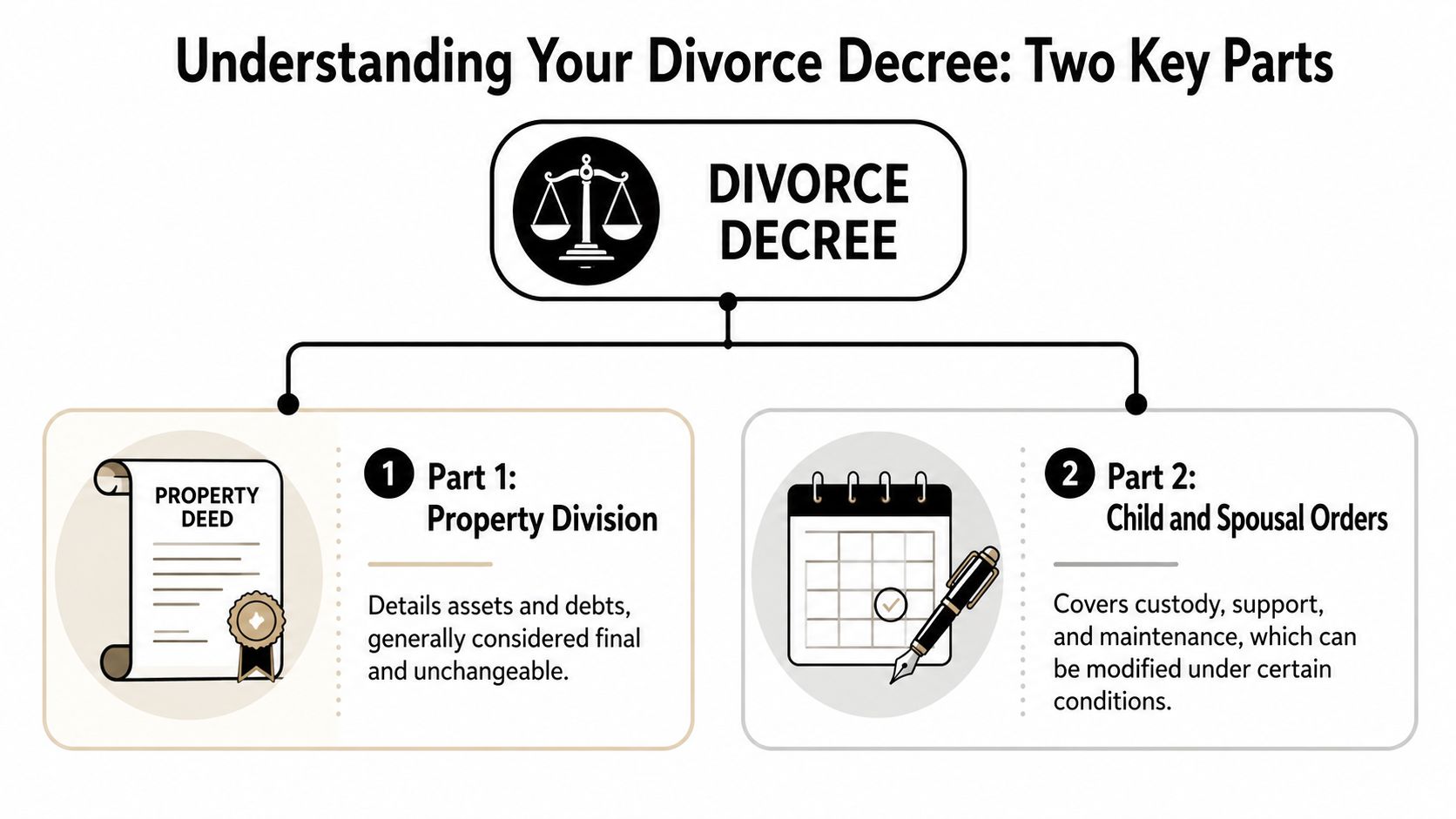
A final decree usually contains two different kinds of orders under one cover. If you separate them first, the rest of the post-divorce options make much more sense.
One part divides property and debt. The other sets rules for children and ongoing support. Texas courts treat those categories differently because they serve different jobs.
Property division is built for finality
Property orders work like a completed sale. Once the court awards the house, retirement accounts, debts, vehicles, business interests, and personal property, that division is usually meant to stay settled.
There is a practical reason for that. People need to know who owns what, who is responsible for which debt, and whether they can rely on the decree when refinancing, selling property, or closing joint accounts. If property could be re-divided whenever one former spouse felt unhappy with the result, there would be no real endpoint.
That does not mean property problems disappear. It means the usual issue is not "modify the division because I want a better one." The usual issue is narrower. Someone may need enforcement if an ex refuses to sign a title transfer. Someone may need a clerical correction if the decree lists the wrong account number or legal description. In more serious cases, a party may ask the court to set aside part of the judgment because of fraud, hidden assets, duress, or a similar defect.
Child-related orders are built for adjustment
Orders involving children and ongoing support are different because family life keeps changing after the divorce is over.
A possession schedule that fit a second grader may fall apart in high school. Child support based on one job may no longer fit after a layoff, disability, or a large increase in income. Spousal maintenance can also be affected by later changes, depending on the order and the facts. As explained in this explanation of decree modification rules, courts generally require a meaningful change in circumstances before they will revise these ongoing obligations.
That difference trips people up all the time. They hear "final decree" and assume every paragraph carries the same level of permanence. It does not. The property side is usually about closure. The child and support side is often about fit.
A simple way to identify the part causing the problem
Start by asking a plain-English question: are you trying to change who got what, or are you trying to address an order that continues into the future?
| Part of the decree | General rule | Typical post-divorce issue |
|---|---|---|
| Property and debt | Usually final | Hidden asset, title transfer, debt allocation dispute |
| Custody and visitation | May be changed in the right case | Parenting schedule no longer works |
| Child support | May be changed in the right case | Income changed or child's needs changed |
| Spousal maintenance | May be changed in some situations | Ability to pay or need for support changed |
That first sorting step matters more than many people realize.
If your ex is ignoring the decree, you may need enforcement, not modification. If the written decree contains a drafting mistake, you may need a correction, not a new ruling. If a later life change made an ongoing order unrealistic, modification may be the right path. If the judgment itself was tainted by fraud or similar misconduct, you may need to try to set aside part of it.
The right remedy starts with identifying the right half of the decree.
Choosing Your Path Modification Correction or Setting Aside
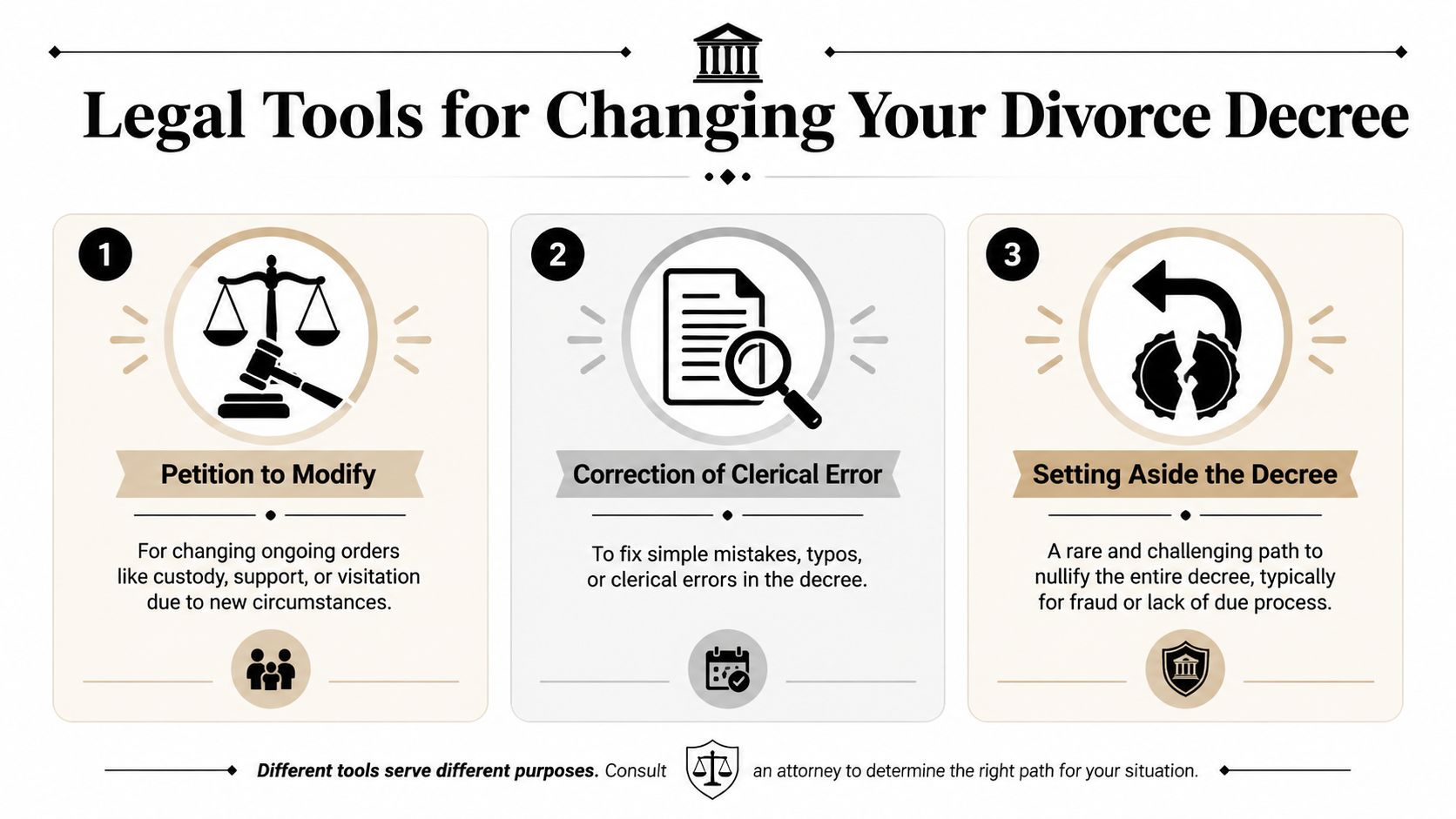
Once you know what part of the decree is causing trouble, the next question is which legal tool fits the problem.
Modification changes ongoing obligations
A modification asks the court to update an existing order because life changed after the divorce. In Texas, this usually applies to conservatorship, possession and access, child support, or spousal maintenance.
This is the most common post-divorce tool. It doesn't argue that the original judge made a bad decision. It argues that the original order no longer fits current reality.
Examples include:
- Income changes: one parent loses a job, changes careers, or has a lasting drop in earnings
- Parenting changes: work schedules shift, a parent relocates, or a child develops new educational or medical needs
- Support changes: the receiving spouse's circumstances change in a way that affects maintenance
Clerical correction fixes mistakes on paper
Sometimes the problem isn't the judge's decision. The problem is that the written decree doesn't match what was decided.
That can happen when a decree contains a typo, a wrong date, a transposed account number, or language that obviously came from a drafting mistake. A clerical correction is for paper errors, not buyer's remorse.
Important distinction: a correction doesn't give you a second chance to negotiate better terms. It fixes the record so the written order says what the court intended it to say.
Setting aside is rare and serious
Trying to set aside all or part of a final decree is a much steeper climb. This path usually comes up when someone alleges fraud, misrepresentation, duress, or another serious defect that affected the judgment itself.
This isn't routine cleanup. It's a high-stakes request to undo part of a final judgment because the process or facts were badly compromised. In Texas, lawyers often evaluate these cases very carefully before recommending any filing because the burden is high and the facts matter a great deal.
Many people actually need enforcement
A lot of post-divorce conflict isn't about changing the decree at all. It's about making someone follow it.
California's self-help materials draw a clear line between requests to change orders and enforcement tools like wage garnishment, and that distinction is often missing in consumer guidance. The same distinction matters in Texas, where many post-divorce disputes turn on enforcement petitions or the need to clarify ambiguous language, as noted in California Courts' post-divorce self-help guidance.
If your ex won't refinance a house, sign over a vehicle title, pay support, or comply with a possession schedule, asking for a modification may send you down the wrong road. The court may not need new terms. It may need to enforce the old ones.
Ask yourself this first
Before filing anything, pin your problem to one of these questions:
- Did life change after the decree? That suggests modification.
- Does the decree contain a paperwork mistake? That suggests correction.
- Was the decree infected by fraud or a serious defect? That may suggest setting it aside.
- Is your ex ignoring the decree? That suggests enforcement.
That one sorting step can change your whole strategy.
Grounds for Modifying Custody Support and Maintenance
For most divorced parents, this is the heart of the issue. Texas courts don't change orders just because one side is unhappy. The legal standard is usually a material and substantial change in circumstances.

In family-law systems, courts require a material or substantial change in circumstances before modifying ongoing terms such as custody, visitation, child support, or alimony. If both parties agree, the court may approve the change. If one party objects, the requesting spouse must file a motion and prove that qualifying change, as explained in this discussion of post-decree modification standards.
What material and substantial change means in real life
This phrase sounds technical, but the basic idea is simple. The change must be real, important, and lasting enough that the current order no longer works fairly.
Small annoyances usually won't carry the day. Temporary setbacks often won't either. Courts tend to look for meaningful changes in the facts that existed when the decree was signed.
Common examples can include:
- A parent's relocation: especially when distance disrupts the possession schedule
- Work schedule shifts: a new overnight schedule, travel-heavy job, or rotating shift that changes parenting availability
- A child's needs changing: medical care, counseling, school issues, or developmental needs that make the old arrangement impractical
- Lasting income changes: a meaningful increase or decrease in earnings that affects support
- A change in household circumstances: remarriage, illness, or other major family developments
Custody and parenting time
In Texas, custody disputes usually center on conservatorship, possession, and access. Parents often come in saying, “I want to change custody,” when the actual issue may be narrower. Maybe the exchange schedule isn't workable anymore. Maybe one parent moved farther away. Maybe communication has broken down around school or health care decisions.
A judge will want facts, not just frustration. School attendance records, medical records, messages between parents, calendars, and witness testimony often matter more than broad claims about who is more reasonable.
If you're dealing with a parenting-order problem, this guide on how to modify a custody agreement in Texas can help you understand the process in more detail.
The court usually asks a practical question: does the requested change solve a real problem for the child, or is it mainly a conflict between adults?
Child support
Support modifications often follow income changes, but income alone isn't the whole story. Judges also look at whether the change is lasting and whether the current order still fits the child's needs and the parents' present circumstances.
If you recently had a short-term dip in income and bounced back, that may not be enough. If your job loss is ongoing, your industry changed, or the child now has different needs, the picture looks different.
Keep your records organized. Pay stubs, tax returns, benefit statements, business records, and proof of child-related expenses can all matter.
Here's a helpful overview if you'd rather hear the topic explained aloud:
Spousal maintenance
Spousal maintenance cases tend to be very fact-specific. Texas courts may look at whether the receiving spouse still needs support and whether the paying spouse can still provide it under the current order.
A maintenance case can shift when someone remarries, develops health issues, returns to work, or has a substantial change in income or earning ability. These cases are rarely won with general complaints. They require documents and a clear before-and-after story.
Revisiting Property Division The Hunt for Hidden Assets
Six months after the divorce, a tax document shows up in the mail. It lists income from an account you never saw during the case. Or you learn that a business interest was worth far more than the numbers used in mediation. That moment leaves many people asking the same question: can the property division be changed?
Usually, no. In Texas, property division is meant to stay final.
The exception is not simple unfairness. The exception is a problem with the truth the court and the parties relied on. If property was divided while one spouse hid assets, concealed income, lied about debt, or distorted value, you may be looking at a request to set aside part of the decree rather than a routine modification.
That distinction matters. Modification is the tool people use for issues like support or parenting terms when circumstances change. Property division usually does not work that way. A hidden asset claim is closer to saying, "The foundation of this part of the decree was defective," not, "I want a better deal now."
A decree works a bit like a final receipt after a sale. Once the transaction is done, you do not reopen it because you wish you had negotiated harder. You may reopen it if the item in the box was not what the label said. That is why fraud and misrepresentation are treated differently from regret.
Common hidden-asset problems include:
- retirement accounts that never appeared on the inventory
- business income that was reduced on paper or routed through other accounts
- debts listed as marital that were inflated, fake, or not owed
- property transferred to friends, relatives, or related companies before the divorce
- real estate, stock holdings, or partnership interests valued far below their actual worth
Sometimes the clue is small. A stray bank statement. A loan application with a higher net worth than the one presented in court. A tax return that does not match prior disclosures. If you want a clearer picture of what concealment can look like, this guide on hidden assets in a Texas divorce is a useful starting point.
Courts do not reopen property cases on suspicion alone, though. You need evidence. That often means account statements, tax returns, business records, emails, transfer histories, appraisals, or testimony that shows the property division was built on false or incomplete information.
For larger estates, closely held businesses, or compensation packages with bonuses, deferred pay, or equity, tracing the money can get technical quickly. In those cases, Lighthouse Consultants' divorce support may help explain how forensic accounting fits into a divorce asset investigation.
One more point causes confusion. If the decree already awarded you a specific asset and your ex refuses to turn it over, that is often an enforcement problem, not a reason to redo the property division. If the asset was never disclosed at all, or its value was materially misrepresented, you may be in set-aside territory instead.
That is why early legal advice matters here. The right path depends on whether you are trying to enforce what the decree already gave you, correct a clerical mistake, or challenge a property award based on fraud or concealment. Those are different doors, and choosing the right one early can save time, money, and a lot of frustration.
How to Request a Change to Your Decree in Texas
Once you know the right path, the next step is process. Texas family courts care a great deal about procedure. A strong claim can still stall if the filing, service, evidence, or hearing prep is handled poorly.
The basic sequence
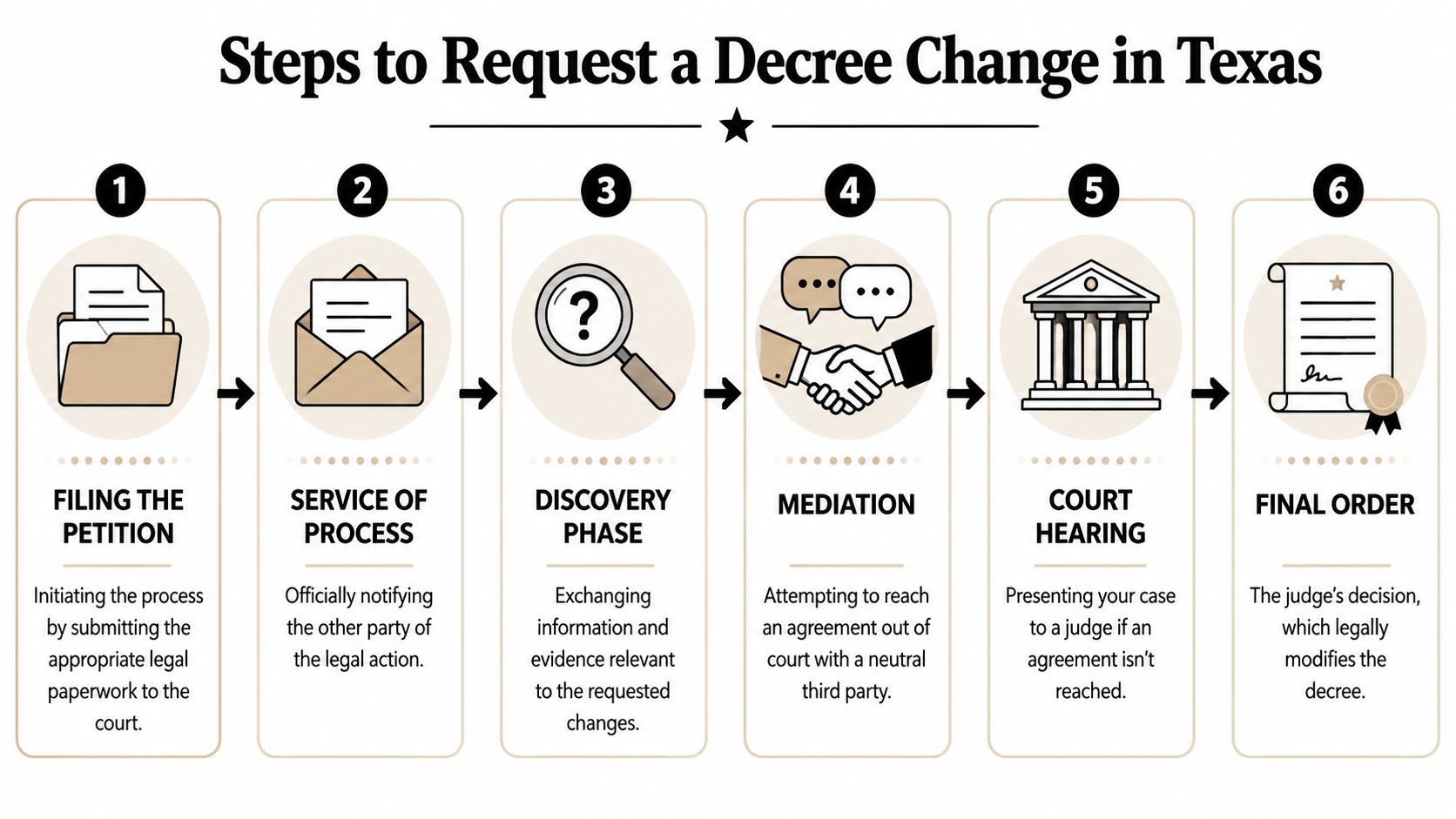
Most post-divorce requests in Texas follow a familiar rhythm:
File the right pleading
That might be a petition to modify, a motion to enforce, a request to clarify, or a request to correct a clerical error. The label matters because it tells the court what power you're asking it to use.Serve the other party properly
Your ex must receive formal notice in the way Texas procedure requires. Informal texting about the case isn't a substitute for service.Gather evidence
Financial records, school records, medical documents, calendars, emails, texts, and witness testimony often shape the outcome.Exchange information through discovery when needed
In contested cases, each side may request documents and answers to written questions.Attend mediation if the court requires or encourages it
Texas courts often prefer parties to try settlement before asking a judge to decide.Present the matter at hearing or trial if no agreement is reached
The judge then signs a new order, enforces the current one, or denies the request.
Timing matters, but so does stability
Sources discussing modification often note that there is no fixed time limit to seek a change, though some courts apply greater scrutiny if a motion is filed within 6 months of divorce, and some guidance recommends waiting about 1 year so the change appears lasting rather than temporary, as explained in this discussion of amending a divorce decree.
That doesn't mean you should always wait. It means you should be ready to show the court that the change is stable, significant, and not just a short-term bump in the road.
Build your case like a paper trail, not an argument
Judges hear strong emotions every day. What persuades them is organized proof.
Try to collect:
- Your final decree and later orders: these set the baseline
- Financial documents: pay records, tax returns, bank statements, and business records
- Child-related records: report cards, attendance records, therapy records, medical paperwork
- Communication history: messages that show cooperation, noncompliance, or schedule issues
In complex financial cases, outside professionals can help sort the numbers. If you suspect hidden income, business manipulation, or unexplained transfers, resources like Lighthouse Consultants' divorce support can give you a practical sense of how forensic accounting fits into divorce-related disputes.
For a Texas-specific overview of the legal process, see this guide on modification of a divorce decree in Texas.
Mediation is often part of the road
Many Texas courts push hard toward mediation, especially when children are involved. That's not a bad thing. A negotiated solution can give you more control than a courtroom decision and may preserve a workable co-parenting relationship.
If the case stays contested, preparation becomes even more important. That's one place where the Law Office of Bryan Fagan, PLLC can assist with post-divorce modification and enforcement matters in Texas family courts.
What to Do Next Taking Control of Your Future
If you're asking whether a divorce decree can be changed after it's final, you're probably not asking a theoretical question. Something in your life stopped working.
Start by sorting the problem into the right category. Is this about modification, enforcement, correction, or a possible effort to set aside part of the decree? Then gather the core documents. Pull your final decree, later court orders, financial records, messages, and any evidence that shows what changed or what your ex failed to do.
After that, be honest about the stakes. A typo may be fixable with a focused request. A custody dispute, support fight, or hidden-asset claim usually needs a strategy built around evidence and procedure. If children, property rights, or long-term support are on the line, guessing can cost you.
Your next move should match the legal problem, not just the frustration you feel.
You don't have to stay stuck in a decree that no longer fits, and you don't have to handle a serious post-divorce dispute alone.
If your final decree no longer reflects your reality, or your ex isn't following it, schedule a free consultation with Law Office of Bryan Fagan, PLLC. You can get clear guidance on whether your issue calls for modification, enforcement, correction, or a more serious challenge to the judgment, and what steps make sense under Texas law.