Skip to content
That sinking feeling that something is financially wrong in your marriage is more than just anxiety; it's an instinct you shouldn't ignore. If you're concerned your spouse is hiding assets, you're not just dealing with a personal betrayal—you're facing a critical moment that will define your financial future. Uncovering hidden assets during a Texas divorce is about securing the fair and just outcome you are entitled to under the law.
Why That Gut Feeling Matters

If you have a nagging suspicion that your spouse isn't being honest about your family's finances, it’s time to pay attention. Perhaps they've suddenly become secretive with mail, changed passwords to shared accounts without telling you, or you’ve noticed odd cash withdrawals that don't add up. These are classic red flags that something is wrong, and your intuition is likely spot on.
In a Texas divorce, this kind of secrecy isn't just a personal betrayal—it's a direct violation of your legal rights. It's critical you understand why this is so serious.
How Texas Law Protects You: Community Property
Texas is a community property state. According to the Texas Family Code, this means any asset, income, or debt acquired by either of you during the marriage is presumed to be owned equally by both of you. This covers everything from the house and retirement accounts to business profits and stock options. Your spouse has a legal duty to be fully transparent about all of it.
When a spouse intentionally hides or gets rid of community property without your consent, the court calls it a "fraud on the community." This isn't a term judges use lightly. It means your spouse deliberately breached the trust of your marriage to cheat you out of your rightful share. For individuals with high-value estates, including business owners, uncovering these schemes is paramount. You can find more details on how courts handle these complex situations and see just how vital it is to get to the truth.
Common Red Flags Your Spouse May Be Hiding Assets
Knowing what to look for is the first step. Some signs are obvious, while others are more subtle.
| Behavioral Red Flags | Financial Red Flags |
|---|---|
| Suddenly becomes secretive about finances. | Large, unexplained cash withdrawals. |
| Mail starts disappearing or is sent to a P.O. Box. | New financial accounts opened in their name only. |
| Changes passwords on shared online accounts. | "Loans" made to friends or family that are never repaid. |
| Becomes defensive or angry when you ask about money. | Sudden decrease in reported business or salary income. |
| Insists on handling all financial matters alone. | Overpaying on taxes or credit card bills (to get a refund later). |
| Mentions unexpected "losses" in investments or business. | Unexplained transfers to unknown accounts. |
| Their lifestyle doesn't match their reported income. | New, expensive purchases that appear to be "gifts." |
This table is just a starting point. A deceptive spouse can be creative, but these patterns are often the first signs that you need to start digging deeper with the help of a legal professional.
The "Just and Right" Division and Its Consequences
Texas law requires a "just and right" division of the community estate. Notice the wording—it doesn't say "equal." While a 50/50 split is the starting point, a judge will look at many factors, and one of the most significant is fault, which absolutely includes financial fraud.
If your attorney can prove your spouse deliberately hid assets, a judge has the power to award you a disproportionate share of the community property. This action serves both to compensate you for the fraud and to penalize the deceptive spouse for their misconduct.
This is where your initial gut feeling transforms into a powerful legal tool. The evidence you gather and the legal strategy you build can completely change the outcome of your divorce. Your concerns are valid, and Texas law provides strong mechanisms to get to the truth and protect your future. The next step is to methodically document your suspicions and prepare for the formal legal process.
How to Document Suspicions and Prepare for Discovery
That nagging feeling has grown into a serious concern, and you're ready to take action. What you do next is critical, not just for uncovering hidden assets but for building a strong foundation for your entire Texas divorce case. Your greatest advantage is to act methodically, not emotionally. This is where you begin gathering the proof your attorney will need.
The initial goal is to collect financial information quietly, without setting off any alarms. If you have legal access to documents—meaning they’re in your home or on a shared computer—you are generally within your rights to make copies. This isn’t about snooping; it’s about protecting your rightful share of the community estate.
Gathering Your Initial Evidence
Start by methodically collecting key financial records. Think of yourself as a detective for your own life, piecing together the financial puzzle of your marriage. Your focus should be on gathering a comprehensive set of documents from the last three to five years.
Here are the key documents to secure:
- Bank Statements: Collect statements for all checking, savings, and money market accounts—both joint and individual, if you can access them. Look for unexplained large withdrawals, frequent cash transfers, or unusual deposits.
- Tax Returns: Personal and business tax returns are a treasure trove of information. They list declared income sources, investments, and business interests that can point to hidden dealings.
- Credit Card Statements: These records can reveal unusual purchases, travel to unexpected places, or payments for services you knew nothing about.
- Investment and Retirement Account Statements: Get every document related to 401(k)s, IRAs, brokerage accounts, and stock options. Look for any sudden liquidations or transfers that don't make sense.
- Loan Applications: Any applications for mortgages, car loans, or personal loans contain a snapshot of your spouse’s declared assets and liabilities. These can be compared against what’s being disclosed now.
Once you have these documents, scan or copy them immediately. Store them securely in a place only you can access, like a new cloud storage account or at a trusted friend’s house.
Creating a Timeline of Suspicious Activity
With your documents in hand, the next step is to create a timeline. This simple organizational tool can transform a confusing pile of papers into a compelling narrative for your attorney and, eventually, the court. Use a spreadsheet or a notebook to log suspicious transactions by date, amount, and a short description.
For example, your log might look like this:
- January 15: $5,000 cash withdrawal from the joint checking account. No corresponding purchase or known expense.
- February 3: A credit card charge for a hotel in a city you’ve never visited together.
- March 20: A large payment to an unknown company listed on the business tax return under "professional services."
This timeline helps your legal team quickly spot patterns—like regular cash withdrawals right before you decided to divorce or a sudden "loan" to a family member that looks more like a gift.
Introducing the Formal Discovery Process
Your personal fact-finding is an essential first step. But the real power to uncover assets comes from the formal legal process known as discovery. Under the Texas Family Code, discovery is the mandatory, court-supervised exchange of information between you and your spouse. This is not optional; it’s a required part of every divorce.
Discovery is the legal mechanism your attorney uses to demand answers and documents your spouse would not otherwise provide. It compels full transparency and holds both parties accountable under oath.
This is where all your initial documentation becomes incredibly valuable. It gives your attorney a roadmap, pointing them toward the exact information they need to request. You can learn more by reading our detailed guide on the discovery process for divorce in Texas. By preparing thoroughly now, you are equipping your legal team to fight effectively for the fair division of property you deserve.
Using Legal Tools to Uncover Hidden Financials
The documents you’ve gathered are a fantastic start, but now it’s time for your attorney to take charge. Having a hunch your spouse is hiding assets is one thing; proving it is another. This is where we move from suspicion to strategy, using the legal process known as discovery to demand answers and paint an undeniable financial picture.
The process is governed by the Texas Family Code, forcing your spouse to provide information under oath. If they refuse to cooperate, they face serious legal consequences. It’s how we turn your suspicions into hard, admissible evidence.
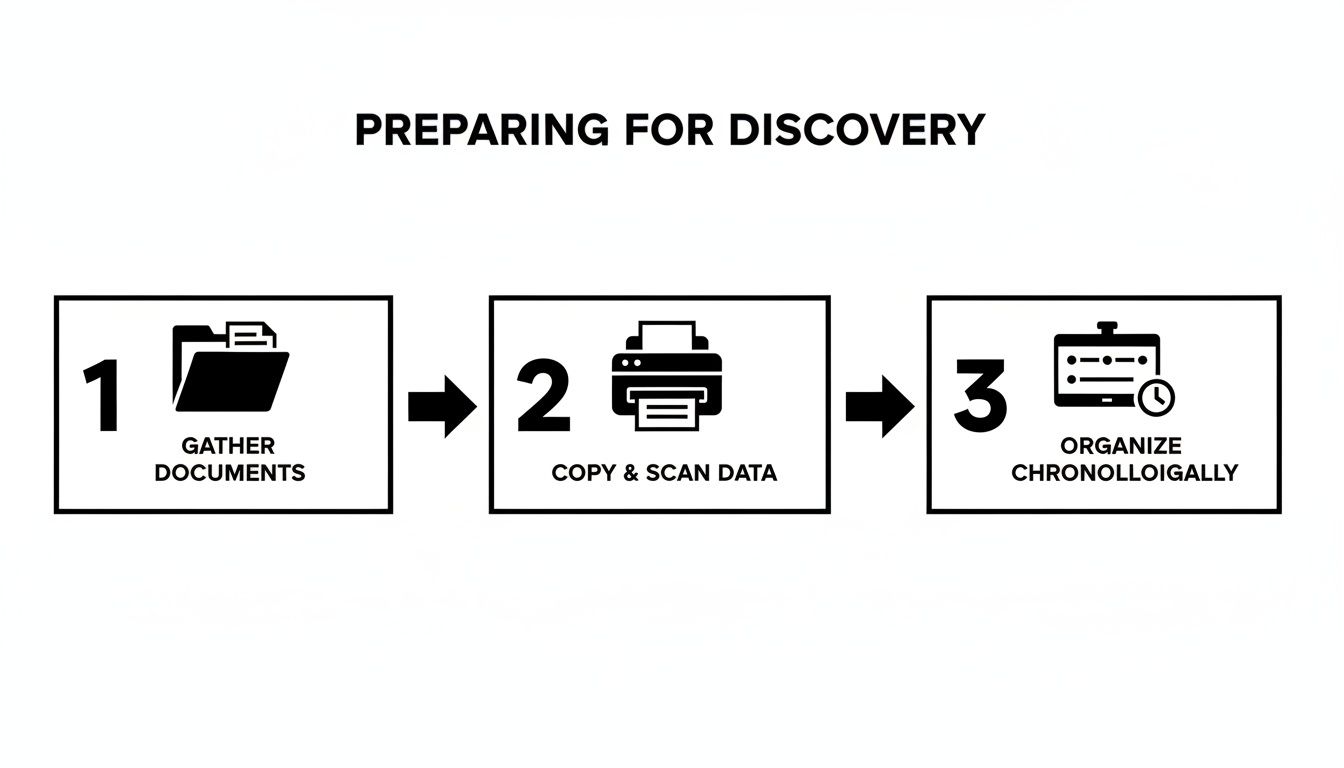
By gathering, copying, and organizing your financial documents, you’re handing your legal team the roadmap we need to pursue targeted and effective discovery.
Formal Requests for Information and Documents
Your attorney will begin discovery by sending your spouse a series of formal, written demands. These aren't friendly requests—they are legally binding tools that compel a complete and honest response.
- Interrogatories: These are written questions your spouse must answer truthfully and under oath. For example, we might ask: "List all financial accounts, including any bank, investment, or cryptocurrency accounts, held in your name or for your benefit at any point in the last five years."
- Requests for Production: This is our formal demand for the actual documents. It’s not enough to ask if an account exists; we demand the statements. A request might read: "Produce all bank and credit card statements from January 1, 2020, to the present for any account to which you have access."
- Requests for Admissions: These are direct yes-or-no questions designed to lock your spouse into a specific fact. For instance: "Admit that you transferred $10,000 to your brother on May 15th." If they deny it and we later prove they did, the court can penalize them.
These tools work together to create a paper trail that becomes harder for a deceptive spouse to explain away.
Compelling Testimony and Third-Party Records
Sometimes, the most important evidence isn’t held by your spouse. Banks, employers, business partners, or even family members might hold the keys. This is where your attorney’s power to look beyond your spouse’s immediate control becomes critical.
A Subpoena is a court-ordered command that compels a third party—like a bank, business, or person—to either produce documents or testify. If your spouse claims their business is failing, we can subpoena their business partner to testify under oath about the company's true financial health.
Another powerful tool is the Deposition. This is out-of-court testimony where your attorney questions your spouse (or another witness) face-to-face, with a court reporter transcribing every word. It's our chance to ask tough follow-up questions in real-time, see how they react under pressure, and lock in their story. If they try to change their testimony later in court, we can use their deposition to destroy their credibility.
To thoroughly prepare, modern tools can help extract data from documents using AI and automation, processing large volumes of financial records efficiently so no detail is missed. When wielded by a skilled family law attorney, these legal instruments leave few places for assets to stay hidden, ensuring the final "just and right" division of your property is based on the whole truth.
When to Hire a Forensic Accountant
Your attorney has a powerful set of legal tools, but what happens when the financial puzzle is especially complex? In these situations, your lawyer acts as the strategist, but a forensic accountant becomes your secret weapon. This is often a critical investment in protecting your financial future.

Think of a forensic accountant as a financial detective. These experts are trained to sift through years of complicated financial records, follow the trail of laundered funds, and place an accurate value on intricate business interests. Their entire job is to spot the subtle discrepancies that even a sharp lawyer might overlook.
When Is a Forensic Accountant Necessary?
While not every divorce calls for one, some situations practically demand this level of financial expertise. If your marital estate includes any of the following, bringing in a forensic accountant can be the difference between a fair settlement and leaving significant money on the table.
Consider hiring a forensic accountant if:
- Your spouse owns a business: A business owner has many opportunities to manipulate income, from paying "phantom" employees to overpaying fake vendors or deferring bonuses until after the divorce is final.
- You have a high-value or complex estate: Assets like stock options, deferred compensation plans, or private equity investments can be intentionally undervalued or conveniently "forgotten."
- There are signs of offshore accounts or shell corporations: Tracing money that has been funneled internationally or layered through corporate entities is a specialized skill that goes beyond standard legal discovery.
- You suspect cryptocurrency is involved: The pseudo-anonymous nature of digital assets like Bitcoin makes them a popular place to hide wealth, but a skilled investigator can often follow the blockchain trail.
The cost might seem high, but it’s crucial to weigh that against the potential value of the assets they could uncover. In many high-asset divorces, their fee is a small price to pay for recovering tens or even hundreds of thousands of dollars in hidden property. For business owners, correctly assessing a company's worth is vital, and you can get more information in our guide to valuing a business for divorce.
Turning Financial Data into Courtroom Evidence
A forensic accountant does more than just find hidden assets; they produce compelling evidence that will hold up in court. Their work culminates in a detailed expert report that methodically documents their findings, showing a judge exactly how, when, and where money was moved or concealed.
An expert report from a forensic accountant transforms complex financial schemes into a clear, understandable narrative. It gives the court the justification it needs to enforce a truly "just and right" division of your property.
This expert analysis can be incredibly persuasive. Their work often leads to better settlements before you ever see a courtroom because the other side knows they can no longer hide behind confusing numbers. If your case does go to trial, the forensic accountant can serve as an expert witness, explaining their findings directly to the judge in a way that is clear, credible, and convincing.
Legal Remedies for Financial Fraud in a Texas Divorce
Confirming your spouse was hiding assets is a moment of deep betrayal. But in a Texas divorce, that feeling can quickly turn into empowerment. Once you prove that financial fraud has occurred, the court has powerful tools to not just level the playing field, but to penalize dishonesty.
Discovering hidden assets is a major turning point, and it completely changes how a judge views your case. Texas law does not reward a spouse who commits fraud on the community estate.
The Power of a Disproportionate Share
Under the Texas Family Code, judges must divide community property in a "just and right" manner. This doesn't always mean a 50/50 split. When your attorney proves your spouse intentionally hid assets, the judge has the authority to award you a disproportionate share of the property.
This means the court can give you more than 50% of the marital estate to make up for the assets that were concealed or wasted. If your spouse stashed away $100,000, a judge might award you an extra $100,000 in assets from their side of the property division. This makes you whole while ensuring their deceit comes at a cost.
Reconstituting the Estate for a Fair Division
But what if your spouse has already spent the money or "sold" a valuable asset to a friend for almost nothing? Texas courts can fix this through a legal concept called reconstituting the estate.
A judge will calculate the value of the asset that was fraudulently transferred or spent and add that amount back into the community estate for calculation purposes. This "phantom asset" is then counted against the deceptive spouse’s share of the property division.
Case Example: Imagine your spouse "sold" a classic car worth $75,000 to their brother for just $5,000 a month before you filed for divorce. Your attorney proves this was a fraudulent transfer. A judge can reconstitute the estate by adding back the $70,000 difference. That $70,000 will then be counted as part of your spouse's share when the property is divided, even though the money is gone.
This powerful remedy ensures you aren't penalized for your spouse's bad acts. You can learn more in our guide on how to prove dissipation of assets in a Texas divorce case.
Court Sanctions for Hiding Assets in Texas
When a spouse is caught, a judge can impose a range of penalties. These sanctions hold the offending party accountable and compensate you for the harm caused.
| Sanction Type | Description | Potential Impact on the Offending Spouse |
|---|---|---|
| Attorney's Fees | The judge orders the deceptive spouse to pay the legal fees you incurred to uncover the fraud. | Significant financial penalty, as these costs can run into thousands of dollars. |
| Forensic Accountant Costs | The full cost of hiring a financial expert to trace the hidden assets is charged to the fraudulent spouse. | Can be very expensive, depending on the complexity of the investigation. |
| Unequal Property Division | The court awards the innocent spouse a larger share of the community property to offset the hidden assets. | Direct loss of marital property, resulting in a smaller final settlement. |
| Monetary Fines | The judge imposes direct financial penalties for lying under oath or refusing to comply with discovery. | Added financial strain and a clear signal of the court's disapproval. |
| Reconstituted Estate | The value of a wasted or hidden asset is added back and counted against the offending spouse's share. | The spouse effectively "pays" for the asset twice—once when they hid it, and again in the property division. |
These sanctions reinforce a core principle of Texas family law: honesty isn't just the best policy; it's the only one the court will accept. Proving financial deceit can dramatically shift the outcome of your divorce. And strong cybersecurity and accounting practices to prevent financial fraud are often what help uncover these schemes in the first place.
What to Do Next to Protect Your Financial Future
Feeling overwhelmed is a completely natural reaction. But you don’t have to face this alone, and the steps you take right now are critical for protecting your financial future.
Your first instinct might be to confront your spouse. Don't. Tipping your hand is often the biggest mistake you can make, as it only gives them a head start to hide money even more effectively. Instead, it’s time to get quiet, get organized, and get help.
Your Immediate Game Plan
Let’s focus on a few smart moves you can make to build a strong foundation for your case. The goal here is to be methodical, not emotional.
- Secure Your Personal Papers: Start by gathering your essential documents like your driver's license, social security card, and passport. Find a safe place to store them where only you have access.
- Keep a Log: Continue to discreetly document every red flag you notice. Write down dates, amounts, and any strange financial behavior. This log will become a crucial starting point for your attorney.
- Avoid Confrontation: Do not accuse your spouse or let them know you're suspicious. Doing so can cause them to panic and start shredding documents or moving assets.
- Get Expert Legal Advice: This is the most important step. An experienced family law attorney can act immediately to protect you, often by requesting a Temporary Restraining Order (TRO) to freeze all assets and stop your spouse from making any unusual financial moves while the divorce is pending.
Key Takeaway: What to Do Next
Your financial future is too important to leave to chance. Trusting your instincts and taking proactive steps are the keys to a fair outcome. Start by quietly gathering any financial documents you can legally access, document all suspicious activity, and most importantly, consult with an experienced family law attorney before confronting your spouse.
The journey to uncover hidden assets and secure the settlement you rightfully deserve starts with one confidential conversation. At The Law Office of Bryan Fagan, PLLC, our team has the experience, resources, and compassion to guide you through this complex process with confidence.
Don’t wait for your financial situation to get more tangled. Schedule a free, no-obligation consultation with our team today. We'll help you understand your rights and build a plan to protect your future. Schedule your consultation here.