Skip to content
Watching the business you poured your blood, sweat, and tears into become a line item in a divorce can be heartbreaking. For many Texas entrepreneurs and their spouses, the business valuation isn't just a formality; it's the most critical—and often most intimidating—step in the entire process. Getting a handle on how your business will be valued is the first move toward protecting your life's work and securing your financial future.
Why Your Business Is the Centerpiece of Your Texas Divorce
When your marriage ends, every asset you and your spouse built together gets put under a microscope. If a business is involved, it almost always becomes the most valuable and complicated piece of that puzzle. The process of business valuation in a Texas divorce isn't just for couples with large corporations; it's a necessary step for anyone with a business asset, whether it's a family-owned restaurant in Austin or a thriving e-commerce shop you run from your home office.
In the eyes of Texas law, your business isn't just your job—it's a marital asset.
The Texas Family Code operates on the principle of community property. This legal standard presumes that any asset, including a business, that was acquired or increased in value during the marriage belongs equally to both spouses.
Because of this rule, a professional valuation is non-negotiable. Without one, you’re just guessing at the worth of what might be your single largest asset, leaving you wide open to an unfair and unjust property division.
Fair Market Value is the Standard
Texas courts don't just pick a number out of thin air. They use a very specific legal standard known as "fair market value" to figure out what a business is worth. The easiest way to think about it is to ask: what would a willing buyer, under no pressure to buy, pay for your business from a willing seller, under no pressure to sell?
This objective approach is designed to remove personal history and emotional attachment from the equation. The court’s only goal is to land on a number that helps achieve a “just and right” division of your entire marital estate.
This Guide is Your Strategic Map
The valuation process can feel like a maze of confusing financial terms and complicated legal procedures. We wrote this guide to clear the fog. We'll walk you through every step, from the legal standards courts use to the financial experts you may need to hire. By the time you're done reading, you won't feel so anxious. You'll have a clear map of the road ahead and the confidence to make smart, informed decisions that protect the business you've worked so hard to build.
The Legal Rules for Dividing a Business in Texas
When a business is part of your divorce, it can feel like the ground is shifting beneath your feet. The first step toward regaining your balance is understanding the specific legal rules that apply in Texas. These rules aren't just jargon; they are the foundation on which your entire case will be built.
The cornerstone of Texas divorce law is the principle of community property. In simple terms, this means that nearly all assets and income acquired by either you or your spouse during the marriage belong to the "community estate." This holds true even if only one person's name is on the business documents.
Community Property vs. Separate Property
The most critical question is whether your business will be classified as community property, separate property, or a mix of both. This distinction determines if it's on the table for division in the first place.
- Separate Property: This category includes anything you owned before the marriage. It also covers property you received during the marriage as a gift or an inheritance. So, a business you started before saying "I do" is generally considered your separate property.
- Community Property: This is the default category for all property acquired by either spouse during the marriage that isn't separate property. A business launched after your wedding day is presumed to be community property, and its value is divisible.
But these lines often blur. Imagine a business you owned before marriage is like a tree you planted on your own land. That tree is your separate property. But if you and your spouse used community funds (like your salaries) and effort to water it, fertilize it, and help it grow, the fruit that tree produces during the marriage can be considered community property.
This is where the concept of a reimbursement claim comes in. If the community estate's time, talent, or money was used to increase the value of a separate property business, your spouse might have a right to be "reimbursed" for their share of that contribution. You can dive deeper into how Texas courts handle these assets in our detailed guide on separate property vs. community property.
Why the Valuation Date Is So Important
Just as critical as what is being valued is when it is being valued. The date chosen for the appraisal can dramatically alter the final number, much like a stock's price changes from one day to the next.
In Texas, courts use the fair market value standard to value a business. This is defined as the price a willing buyer would pay a willing seller, with neither party being forced to act. The ultimate goal is to achieve a "just and right" division of property, which doesn't always mean a rigid 50/50 split.
Picking the right valuation date is a major strategic decision. If the business has seen significant growth since you separated, your spouse's attorney will likely argue for a later date to capture that increased value. On the other hand, if the business has faced a downturn, you might push for an earlier date.
Here’s a look at the most common valuation dates and what they mean for your case.
Choosing the Right Valuation Date in Your Divorce
| Valuation Date | What It Means | Strategic Impact on Business Value |
|---|---|---|
| Date of Separation | The date you and your spouse physically separated and stopped living as a married couple. | Captures the value before any post-separation growth or decline. Can be beneficial if the business value dropped after separation. |
| Date of Filing | The date the Original Petition for Divorce was officially filed with the court. | Provides a clear, indisputable date. It's often seen as a neutral middle ground between separation and trial. |
| Date of Trial | A date close to when your final divorce trial is scheduled to take place. | Captures the most current value of the business, including all growth or losses that occurred during the divorce process. |
| Agreed-Upon Date | A specific date mutually agreed upon by both you and your spouse. | Offers flexibility and control. Can be used to avoid disputes over market fluctuations and simplify the valuation process. |
The date a court uses can have a massive impact on the final numbers, so it's a point that is often heavily negotiated. The path through a divorce involving a business can feel long and uncertain, but it follows a predictable timeline. Moving from the initial anxiety to a secure future is all about having a clear plan.
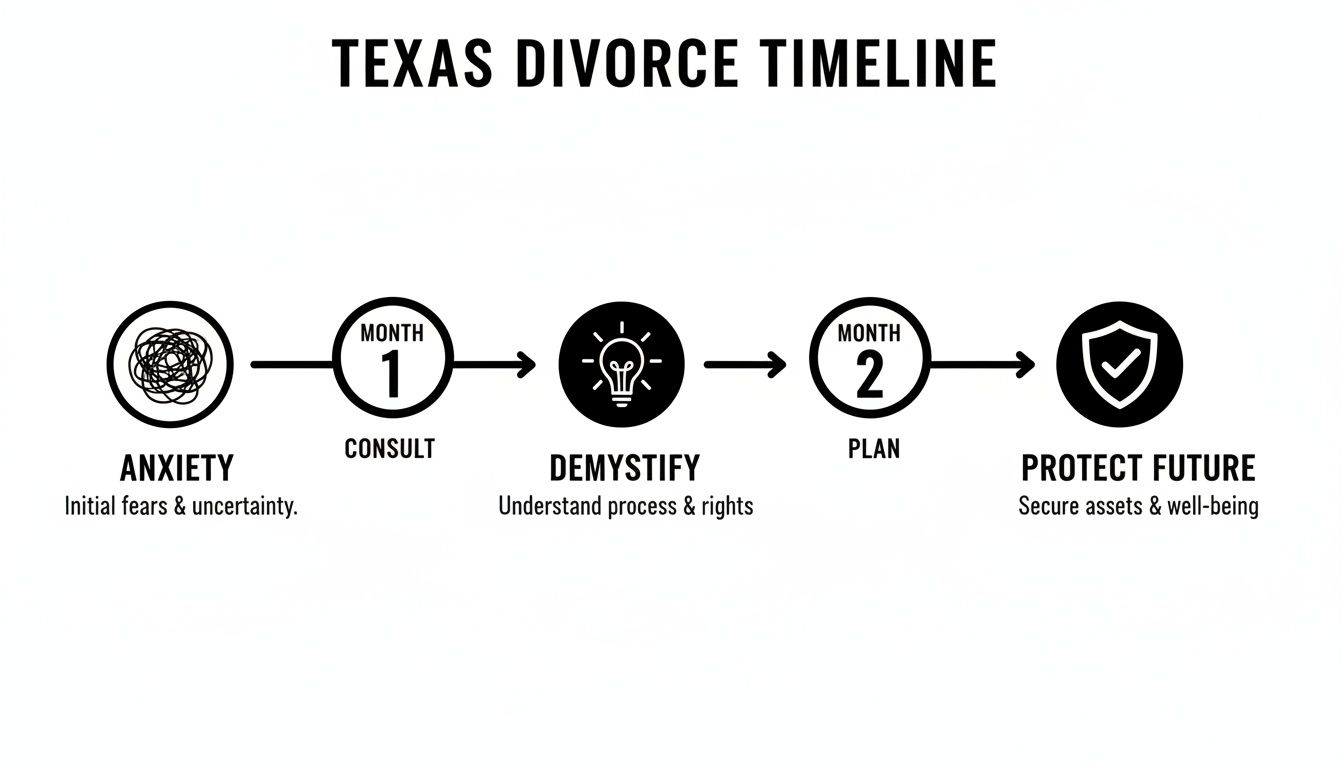
Understanding these foundational legal rules—community property, reimbursement, and valuation dates—is your first step in demystifying the process. With this knowledge, you can start building the right plan to protect your interests and your future.
How Experts Calculate Your Business's True Worth
Watching someone put a price tag on the business you poured your heart and soul into can feel incredibly personal. It’s natural to feel protective and question whether an outsider can really grasp the value of what you've built.
But a professional business valuation isn’t about judging your hard work. It's a structured, objective process designed to arrive at a fair and defensible number for the court. Valuation experts don't just pull a figure out of thin air. They rely on three standard, industry-accepted methods to determine a business’s value. One method isn’t necessarily better than another; the right approach really depends on the kind of business you own.

The Asset-Based Approach
Think of this as the "balance sheet" or "liquidation" method. It’s a straightforward, step-by-step process: an expert takes stock of everything the business owns (tangible assets)—like real estate, machinery, vehicles, and cash in the bank. Then, they subtract everything the business owes (liabilities), such as loans and outstanding bills.
Asset-Based Formula: Total Assets – Total Liabilities = Business Value
This method works best for businesses whose value is primarily tied up in their physical stuff.
- Practical Example: A Houston-area manufacturing plant with millions of dollars in equipment and inventory is a perfect fit for this approach. Its worth is largely based on what it physically owns.
While useful, this method often establishes the "floor" or minimum value of a business. It can fall short for companies where the brand or future earnings are the real prize.
The Market-Based Approach
This one is a lot like how a real estate agent prices a house. The expert digs into recent sales of comparable businesses to see what they sold for. By analyzing these transactions, they can estimate a realistic market value for your company.
- Practical Example: Let's say you own a popular coffee shop in a bustling Dallas neighborhood. A valuation expert would research the sales of other local cafes with similar revenue, foot traffic, and brand strength to figure out what your shop might be worth.
The main hurdle here is finding truly comparable sales. This approach is great for industries with lots of similar businesses (like restaurants or retail shops) but gets tricky for highly specialized or one-of-a-kind companies. For a more detailed look at valuation techniques, you can explore our comprehensive guide on valuing a business for a Texas divorce.
The Income-Based Approach
For many businesses, especially in the service or tech sectors, the real value isn’t in what they own—it’s in what they earn. The income-based approach zeros in on a business's power to generate future profit. Experts will analyze past earnings and project future cash flow to determine a present-day value. A common tool for this is the Discounted Cash Flow (DCF) model. Knowing what a DCF model is helps explain how future profits are translated into a current valuation.
- Practical Example: An Austin-based tech consulting firm might own little more than a few laptops and some rented office furniture. Its value is rooted in its client contracts and consistent revenue stream. An income-based valuation is the only way to truly capture its worth.
Crucial Adjustments to Find the Real Number
A valuation isn't just about plugging raw numbers into a formula. A good expert makes critical adjustments to find the business’s true profitability. One of the first things they do is normalize earnings. This involves stripping out any personal expenses run through the business (like a family car payment or personal travel) and any unusual, one-time windfalls or losses. The goal is to reveal the company's real, sustainable earning power.
Another pivotal concept is goodwill. This is the intangible value of a business—its reputation, customer loyalty, and brand name—that isn’t reflected on the balance sheet. In a Texas divorce, it’s critical to separate the two types:
- Personal Goodwill: This is the value tied directly to you—your unique skills, personal reputation, and client relationships. This is generally considered your separate property and is not divisible in the divorce.
- Enterprise Goodwill: This value belongs to the business itself and would stick around even if you were gone. This is a community asset that is subject to division.
A skilled appraiser’s job is to carefully untangle these two. This ensures you aren't forced to "buy out" your spouse from the value that only you can create. This distinction is often one of the most complex and fiercely debated parts of valuing a business in a Texas divorce.
Finding the Right Financial Expert for Your Case
Feeling overwhelmed by the business valuation process is completely normal, but you don’t have to go through it alone. Putting together the right team of financial professionals is one of the most critical strategic moves you'll make in your divorce. Think of it like preparing for a major project—you need specialists who know the terrain, have the right tools, and can deliver a precise, reliable result.
When you’re dealing with something as complex as valuing a business in a Texas divorce, that team almost always includes a credentialed financial expert. Their job is to give you a clear, objective, and defensible opinion on what your business is worth—an opinion that will hold up in settlement talks or, if it comes to it, in a courtroom.

Business Appraiser vs. Forensic Accountant
You'll likely hear the terms "business appraiser" and "forensic accountant," and while their skills can overlap, they play distinct roles. Knowing the difference helps you hire the right person for what your case truly needs.
Credentialed Business Appraiser: This expert's main job is to figure out the fair market value of the business. They are masters of the valuation methods we've discussed and focus on creating a detailed report that explains their process and final number. Look for credentials like CVA (Certified Valuation Analyst) or ABV (Accredited in Business Valuation).
Forensic Accountant: This professional is more like a financial detective. While they can also perform valuations, their real specialty is digging deep into the books to trace money, uncover hidden assets, or spot irregularities. If you have a gut feeling that your spouse might be hiding income or running personal bills through the business, a forensic accountant is your go-to.
In many high-asset divorces, especially where the finances are tangled, your legal team might suggest hiring both. The appraiser will focus on the valuation itself, while the forensic accountant makes sure the numbers being valued are the right numbers—accurate and complete.
The Step-by-Step Process with a Financial Expert
Once you engage a financial expert, the process tends to follow a predictable path. Knowing what to expect can ease some of your stress and help you focus on getting them the information they need.
- Engagement: Your attorney will guide you in selecting and formally hiring the expert.
- Document Request: The expert will give you a detailed list of the financial records they need to get started.
- Analysis: This is where the heavy lifting happens. The expert dives into the documents, asks follow-up questions, and applies the right valuation methods.
- Draft Report: They'll usually provide a draft report for your attorney to review. This is a chance to check that all the facts and assumptions are correct before it's finalized.
- Final Report: The expert issues their final, signed valuation report. This document becomes a cornerstone piece of evidence in your case.
This whole process can take anywhere from a few weeks to several months, depending on how complex the business is and how quickly everyone provides the necessary documents.
Joint Expert or Your Own Expert?
One of the first strategic calls you'll have to make is whether to agree with your spouse on hiring a single, neutral expert or to hire your own.
A joint expert can save money and cut down on conflict, since both sides work from the same valuation. The downside is that you give up control over who is chosen and how they approach the analysis. If you hire your own expert, you get an advocate focused solely on building a valuation that supports your side of the case, though it naturally comes at a higher cost.
Your attorney at The Law Office of Bryan Fagan, PLLC can walk you through the pros and cons of each approach to help you decide which path makes the most sense for your situation.
Practical Advice: Documents to Start Gathering Now
Getting organized is your best weapon against delays and unnecessary costs. The sooner you can get these key documents together, the smoother the entire valuation process will go.
- Business Tax Returns: At least five years of federal income tax returns for the business.
- Financial Statements: Profit & Loss (P&L) statements, balance sheets, and cash flow statements for the past five years.
- Bank and Loan Statements: All business bank account, credit card, and loan statements.
- Organizational Documents: Things like Articles of Incorporation, partnership agreements, or LLC operating agreements.
- Personal Tax Returns: Your joint personal tax returns for the last five years.
Having these documents ready to go from the start shows the expert—and the court—that you are prepared, transparent, and serious about getting to a fair resolution.
The True Cost and Timeline for a Business Valuation
Worrying about the financial side of your divorce is completely normal. When a business is involved, the cost of a professional valuation can feel like just one more overwhelming expense on an already long list. It’s natural to ask if it's really worth it, especially when money is tight.
We want to give you an honest, clear-eyed look at the real costs and timelines you can expect so you can plan with confidence. Think of a proper business valuation not as just another bill, but as a critical investment in securing a fair outcome. A credible, expert report is the single most powerful tool you have for negotiating a just settlement. It can save you tens of thousands of dollars—and months of stress—by helping you avoid a drawn-out, expensive court battle.
What Drives the Cost of a Business Valuation
The price tag for a business valuation in a Texas divorce can swing quite a bit. In 2026, you can expect a straightforward valuation for a small, well-documented business to run between $7,000 and $12,000. For more complex cases—think multiple entities, messy financial records, or a high-conflict situation—that cost could easily climb past $25,000.
Several key factors will shape the final price:
- Complexity of the Business: A simple service business with clean books is far less expensive to value than a company with multiple locations, significant real estate, or valuable intellectual property.
- Quality of Your Records: If your financial documents are disorganized or incomplete, the expert will have to spend more billable hours reconstructing them.
- Level of Conflict: In a contested divorce where spouses dig in their heels, experts often have to spend extra time defending their findings in depositions or even in court, which drives up the cost.
This expense can be a major part of your total divorce costs. For divorces centered around a business, it’s not uncommon for valuation fees to account for 40-50% of all divorce-related expenses. With the U.S. average for a divorce hitting $11,300 in 2026, this means that $4,500-$5,650 of that could go directly toward appraisals. You can find more insights on divorce and business valuation costs on texasdivorcelawyer.us.
Understanding the Valuation Timeline
Just like the costs, the timeline can vary. A simple, clean valuation might be wrapped up in as little as four to six weeks. However, a more complex case can easily stretch out for three to six months, and sometimes even longer.
The biggest factor affecting the timeline is cooperation. Delays in producing requested documents—whether they are intentional or not—can bring the entire process to a grinding halt.
Your best strategy for keeping the process on track is to be organized and responsive. The sooner your expert has the complete financial picture, the sooner you'll have the valuation report you need to start moving toward a resolution. You can learn more about how this fits into the larger picture by reading our guide to valuing a business in a Texas divorce. We believe in empowering you. By understanding the real-world costs and timelines, you can budget effectively, set realistic expectations, and take a crucial step toward protecting your financial future.
What to Do Next: From Valuation to Resolution
The business valuation report is done. A clear, defensible number is finally on the table. This is a huge moment, shifting you from a place of uncertainty to one of action. With this powerful document in hand, you’re no longer just reacting to the divorce process—you’re now in a position to drive it toward a fair outcome.
Now, the focus moves from analysis to strategy. That report isn’t just a number; it’s leverage. It replaces emotional arguments with objective data, becoming the factual bedrock for all settlement talks.
Using the Valuation as Leverage in Mediation
In Texas, the vast majority of divorce cases—even the most contentious ones—are settled through mediation, not a trial. This is where your expert’s valuation report really proves its worth. In mediation, the report stands as a credible, third-party assessment of what the business is worth, anchoring the entire conversation in reality.
Instead of a "he said, she said" argument over the business's value, you can point directly to the expert's detailed analysis. This transforms the negotiation from pure guesswork into a structured discussion about how to divide a clearly defined asset. It’s your best shot at reaching a fair agreement and dodging the massive cost and stress of a courtroom battle. As you move toward a resolution, it's also smart to understand all financial angles, including potential spousal support. You can use a dedicated Alimony Calculator to get a clearer picture of what that might look like.
Deciding the Future of the Business
With a firm value established, you and your spouse can start exploring practical ways to handle the business itself. There are generally three paths you can take:
- Spousal Buyout: This is the most common solution. One spouse keeps the business and "buys out" the other’s community property share. The buyout can happen as a lump-sum payment, by trading other marital assets (like the house or retirement funds), or through a structured payment plan over time.
- Strategic Sale: If neither of you can or wants to buy out the other, you might agree to sell the business to an outside party. The cash proceeds from the sale are then divided as part of your overall property settlement.
- Continued Co-Ownership: It's rare, but some divorced couples decide to keep owning the business together. This path demands a very high level of trust and a rock-solid operating agreement that spells out everyone's roles, responsibilities, and future exit plans.
Key Takeaway: Your Next Steps
The final steps of a divorce can be exhausting, but this is where sharp focus and strategic action count the most. Your goal now is to turn the valuation report into a final, binding settlement that protects your financial future and the business you’ve worked so hard to build.
To build a personalized strategy for your unique situation, you need guidance from a legal team that gets the nuances of business valuation in a Texas divorce. We invite you to schedule a free, confidential consultation with the Law Office of Bryan Fagan, PLLC. Let us help you take these next steps with confidence and clarity.
Frequently Asked Questions About Business Valuation and Divorce
You've learned the legal rules, the valuation methods, and the big-picture strategies. But when you’re facing a divorce with a business on the line, the "what-if" questions are often the ones that keep you up at night.
Let's tackle some of the most common and pressing questions we hear from clients. Getting clear, straightforward answers can make all the difference as you prepare for the road ahead.
What If My Spouse Tries to Hide Business Assets or Income?
This is a serious concern, and unfortunately, it’s not uncommon. If you have even a small suspicion that your spouse is hiding assets or deliberately lowering the business's reported income, you need to tell your attorney immediately. This isn’t a battle you should try to fight on your own.
When this happens, we bring in forensic accountants—financial detectives who specialize in digging deep into the numbers. They trace funds, follow paper trails, and uncover irregularities that a normal review would miss. If we find concrete evidence of fraud on the community, Texas courts have the power to penalize your spouse, often by awarding you a larger, disproportionate share of the marital estate to make things right.
How Can I Protect a Business I Owned Before Marriage?
Under the Texas Family Code, a business you owned before you got married is generally considered your separate property. But that protection isn't bulletproof. If the business’s value shot up during the marriage because of your time, effort, or money—or even your spouse's—the community estate might have a claim on that increase.
This is what’s known as a reimbursement claim. For instance, if you used money from a joint checking account to pay down a business loan or purchase new equipment, your spouse could be entitled to get their half of those community funds back.
To truly protect your business, you have to meticulously trace its finances and assets back to the day before you were married. This means digging up old bank statements, tax returns, and corporate records to build a clear wall between what's yours and what's shared. Our team has deep experience in constructing these arguments to secure your separate property rights.
Do We Still Need a Formal Valuation If We Agree on Everything?
Even in the most amicable divorces, getting a formal valuation from a neutral expert is one of the smartest decisions you can make. Without it, you and your spouse are essentially just guessing at the value of what is likely your largest marital asset.
This can easily lead to second-guessing and regret down the road. What if you later find out the business was worth far more, or far less, than you thought? A professional valuation gives your settlement agreement a credible, defensible foundation. It provides peace of mind for both of you—and for the court—that your property division is truly just and right, allowing you to move on without looking back.
Will the Business Be Forced to Shut Down During the Divorce?
Absolutely not. Texas courts understand that a running business is a valuable asset. Their goal is to preserve that value, not destroy it. A judge will almost always issue orders demanding that the business continue its normal operations throughout the divorce.
In fact, intentionally disrupting the business, messing with its cash flow, or trying to damage its reputation can land you in serious legal trouble. The court’s priority is keeping the business healthy so its value can be fairly determined and divided, whether that’s through a buyout, a sale, or another creative settlement.
Navigating a divorce involving a business takes more than just legal skill—it demands sharp financial insight and strategic thinking. You need an advocate who knows how to protect the value of what you've worked so hard to build. The team at Law Office of Bryan Fagan, PLLC has the experience to guide you through every step of the business valuation process with clarity and confidence.
Don't leave your life's work to chance. Schedule a free, confidential consultation with us today to discuss your case and create a plan to secure your financial future. Visit us at https://texasdivorcelawyer.us to get started.