Skip to content
Ending a marriage is never easy, especially when a business is on the line.
A business valuation in divorce is how Texas courts determine the fair market value of your company before splitting marital assets. Getting a handle on it early can mean the difference between protecting your life’s work and ending up with less than you deserve under the Texas Family Code.
Why Business Valuation Divorce Matters

Owning a business during a divorce adds layers of complexity—and emotion—to an already stressful process. This guide walks you through every step, from the basics of community property to advanced valuation tactics that safeguard your legacy.
- Preview of Texas Family Code rules on community property and valuation dates
- Breakdown of three common valuation methods: income approach, market approach, asset approach
- Tips for selecting valuation experts and preparing financial records
- Insights on mediation, court adjustments, and tax outcomes
You’ll also find links to related topics—child custody, child support, mediation, and enforcement—scattered throughout for quick reference. Learn more about Texas community property rules in our detailed article on community property division.
How This Guide Helps You
We start with the fundamentals of community property under Texas Family Code Section 3.003. From there, we’ll move into choosing the right expert, handling valuation disputes, and mapping out your settlement strategy.
Concrete examples and real-world analogies break down complex methods—like discounted cash flow—into digestible insights. By the time you finish this section, you’ll know how timing and method choice can boost or reduce your share.
Step-by-Step Texas Divorce Process
Before diving into valuation, you need to understand the divorce process itself. Under Texas Family Code Section 6.301–6.302, you or your spouse must have lived in Texas for six months, and in the county for 90 days, before you can file.
- File the Petition (Texas Family Code § 6.301)
You or your attorney files the divorce petition with the county court. That document outlines property claims and requests regarding custody or support. - Respond and Temporary Orders (Texas Family Code § 105.001)
The other spouse files an answer. You can ask for temporary orders on custody, support, and business use while the case is pending. - Discovery and Mediation
Exchange documents—financial records, tax returns, valuations. Texas often requires you to try mediation before going to trial. - Settlement Negotiations
You may reach an agreement on property, custody, support, and your business through mediation or direct talks. - Trial and Final Decree (Texas Family Code § 7.001)
If you can’t settle, a judge hears evidence, divides property under community property rules, and issues the final decree. - Post-Decree Enforcement
If your ex fails to follow orders, you can file enforcement motions under Texas Family Code Chapter 157.
Knowing these steps gives you confidence and helps you plan the valuation timeline around key deadlines.
Understanding Business Valuation Divorce
Owning a business in a Texas divorce often means betting on your most valuable marital asset. You’ll want to protect what you brought in and fairly account for what you built together.
Texas Family Code classifies everything you earn or grow during marriage as community property, while assets from before the wedding or inherited wind up as separate property. In practice, keeping meticulous records from day one makes dividing those assets far less contentious.
- Community property covers profits and value generated throughout the marriage.
- Separate property safeguards your pre-marriage contributions.
- Active appreciation stems from your hands-on decisions—whether that’s launching a new service or hiring key staff.
- Passive appreciation reflects broader market shifts and industry trends.
Key Concepts
Think of your business like a garden. Active growth is the fertilizer—your daily efforts, strategic hires, marketing campaigns. Passive growth is the rain—industry booms or interest-rate changes you can’t control.
Courts focus on fair market value, which represents what a knowledgeable buyer would pay and a willing seller would accept.
Distinguishing between these types of growth can tip the scales by millions when you move from mediation to trial.
Valuation Dates
In Texas, you get to choose the snapshot date for your business’s value. Opt for the separation date to lock in numbers before any post-filing downturn. Pick the trial date to capture gains (or losses) from new contracts or market swings.
- Separation Date: Shields you if revenue drops after filing.
- Trial Date: Includes any post-separation growth.
- Courts balance both dates for a fair and realistic outcome.
Talk through your business cycle with your attorney. You’ll want to flag revenue peaks, seasonal lulls, big upcoming deals, and potential risks. Getting the timing right prevents surprises and shows the court a clear, well-supported valuation.
Why Fair Market Value Matters
Fair market value is the cornerstone of property division under Texas law. It puts both spouses on the same page during settlement talks or litigation by offering an objective benchmark.
Three Key Approaches to valuation are:
- Income Approach: Uses discounted cash flow analysis to forecast future earnings.
- Market Approach: Compares your company to similar businesses that recently sold.
- Asset Approach: Works out your net worth by tallying assets and subtracting liabilities.
In divorce cases across the U.S., forensic accountants often apply multiple methods to cross-check results and guard against skewed valuations. Learn more about these valuation techniques from LGA.
Common Valuation Approaches In Texas Divorces
When a business is on the chopping block in a Texas divorce, courts and valuation experts lean on three main methods to arrive at fair market value. Each lens—from forecasting cash flow to tallying assets—reveals a different facet of what your company is truly worth.
- Income-Based Approach projects future earnings using a discounted cash flow model to capture real profit potential.
- Market-Based Approach lines up your firm against recently sold peers, much like real estate comps.
- Asset-Based Approach adds up tangible and intangible assets, then subtracts liabilities to pinpoint net worth.
Most experts don’t stop at one figure. They combine results to build a more balanced and defensible valuation.
Comparison Of Valuation Methods
| Method | Description | When It’s Used |
|---|---|---|
| Income-Based | Projects future earnings with discount rates | Service firms with stable cash flows |
| Market-Based | Compares to recently sold similar companies | Businesses in established markets |
| Asset-Based | Values net assets minus liabilities | Inventory-heavy or underperforming firms |
Understanding The Income Approach
Experts forecast cash flows over a three- to five-year span, then apply a discount rate that mirrors industry risk. They make two key adjustments:
- Add-Backs: Stripping out one-time owner perks—say, a personal vehicle lease—to show genuine earnings.
- Normalization: Cutting discretionary expenses like above-market family salaries to reflect true operating profit.
Exploring The Market Approach
Appraisers track recent sales of businesses in your sector and tweak valuation multiples—often based on revenue or profit—to match your company’s size and growth. When comparables are scarce, they fine-tune multiples to align each sale with your profile.
Diving Into The Asset Approach
This tactic lists everything you own—from machinery to trademarks—then subtracts debts to arrive at net enterprise value.
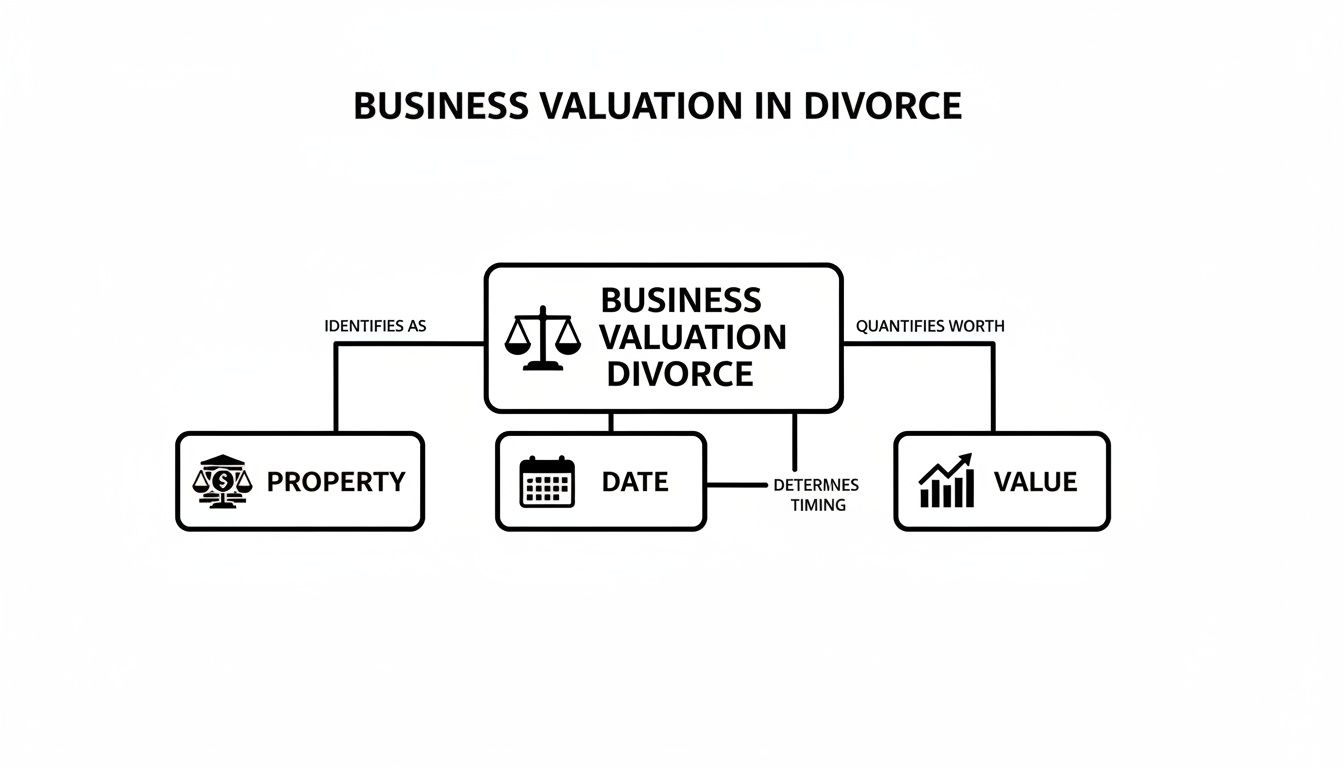
Because goodwill in a service business can be overlooked, most cases call for a blended model—mixing income, market, and asset results for a stronger, court-ready number. Check out our guide on business valuations in divorce for a deeper dive.
Privately held businesses often stand as the single largest marital asset. A valuation misstep—or hidden transfer—can swing a settlement by hundreds of thousands or even millions of dollars. That’s why many couples hire forensic accountants to sniff out irregularities and pin down true enterprise value. Learn more at NSKT Global.
“Applying multiple approaches prevents skewed outcomes and builds credibility in court,” notes a leading forensic accountant.
Selecting And Working With Valuation Experts

Finding the right valuation expert is like choosing a skilled navigator for a complex voyage—it can steer your divorce settlement in the right direction.
In Texas, a forensic accountant or certified appraiser well-versed in community property under Texas Family Code Section 3.003 picks up on local quirks that general practitioners often miss. Look for credentials such as ABV, CVA, or CFF from the American Institute of CPAs.
- Confirm membership in the Texas Society of CPAs
- Review their track record with high-net-worth divorce cases
- Ask for peer-reviewed articles or seminar presentations
Preparing Financial Documents
Organized books are the foundation of a solid valuation. Clear financials let experts strip out owner perks and discretionary expenses—known as normalization—so the business’s true earning power comes through.
Checklist:
- Export three years of profit-and-loss statements
- Itemize personal expenses mixed with business costs
- Include sales forecasts and tax returns for at least three years
Working Through The Valuation Process
Routine check-ins act as guardrails against surprises. Ask for draft reports and dig into key assumptions—growth rates, discount rates, and any unexplained add-backs.
“Transparent communication and timely feedback can prevent costly revisions,” says a veteran forensic accountant.
Tips:
- Schedule biweekly calls or video conferences
- Maintain a shared folder for updates
- Set clear deadlines for each review cycle
Scenario Analysis And Discount Rate Testing
Stress-test your business’s value by mapping different revenue paths and adjusting discount-rate assumptions to account for risk.
| Test Type | Adjustment Factor | Purpose |
|---|---|---|
| Upside | +10% revenue | Highlights peak potential |
| Base | Forecast figures | Reflects standard outlook |
| Downside | -10% revenue | Captures market pressure |
A clear, data-driven report like this trims surprises in mediation or at trial.
Red Flags To Watch For
- Missing documentation for owner salary adjustments
- Unexplained shifts in discount rate assumptions
- Overreliance on one method without cross-checking
Spotting these issues early gives you time to address them before mediation or court.
Next Steps For Valuation Success
- Confirm assumptions align with Texas Family Code guidelines.
- File the valuation report with the court before deadlines.
- Meet with your attorney to review the final report.
How Courts Adjust Business Valuations
Judges in Texas divorce courts hold the power to tweak even the most thorough expert reports. A number that looks iron-clad on paper can shift under their pen.
To match what a savvy buyer would pay, courts often apply discounts for illiquidity, uncertainty, and hindsight bias. These reductions usually land between 10% and 30%, reshaping the outcome of your case.
Common Adjustment Factors
| Adjustment Factor | Reason | Typical Range |
|---|---|---|
| Illiquidity Discount | Private company resale challenges | 10–30% |
| Marketability Discount | Limited buyer pool for niche businesses | 10–25% |
| Uncertainty Adjustment | Forecast volatility | 5–15% |
| Hindsight Bias Reduction | Known events after separation boosting value | 5–10% |
Case Examples And Court Trends
Learn more about judicial adjustments from Financial Remedies Journal.
In one Texas case, a 25% illiquidity discount applied when no buyers emerged during a two-year marketing effort. To counter it, your expert can show active marketing steps—emails, offer sheets, prospect lists—to validate liquidity planning.
Strategies To Counter Discounts
- Document Active Contributions: Show the operations you directly influenced.
- Track Market Data: Use third-party comparables.
- Stress Test Projections: Offer multiple forecast scenarios.
- Highlight Expert Differences: Compare your expert’s methods to opposing valuations.
What To Do Next
- Gather documentation of active and passive appreciation.
- Outline and support your valuation date choice.
- Draft counterarguments for each proposed discount.
- Bring these points into mediation or file a valuation motion.
Tax and Settlement Implications for Business Owners
Dividing business interests in a divorce can feel like stepping into a tax minefield. Under Texas Family Code Section 3.003 and IRS rules, your after-tax share depends on timing, basis, and asset type.
Capital Gains And Depreciation Recapture
If you sell your 50% stake for $500,000, capital gains tax applies to the difference between sale price and adjusted basis. Depreciation recapture can recharacterize past write-offs as ordinary income.
Tips:
- Map out sale scenarios by year
- Flag heavily depreciated assets
- Use a spreadsheet to project liabilities
Structured Settlements And Buy-Out Agreements
A structured settlement spreads payments over time, keeping you in a lower tax bracket. A promissory-note buy-out ties installments to cash flow, avoiding a sudden ownership shake-up.
- Spell out payment schedules and interest rates.
- Tie triggers to revenue or EBITDA milestones.
- Include earn-out or relocation clauses.
Weighing Lump Sum Versus Maintenance
Compare immediate net proceeds of a lump-sum buy-out against long-term support under Texas Support Guidelines. Use IRS Section 1 rates to model scenarios.
| Option | Tax Timing | Cash Flow Impact |
|---|---|---|
| Lump Sum Buy-Out | One-time capital gain | Big immediate liquidity, higher tax bite |
| Structured Installments | Spread over years | Steadier income, lower bracket spikes |
| Spousal Maintenance Offset | Ordinary income rates | Alters support calculations and timing |
Minimizing Future Tax Surprises
- Reserve 15%–20% of installments for taxes
- Review projections quarterly with your CPA
- Adjust your model if revenues swing
Next, we’ll lay out your action plan under Texas law.
Action Plan For Your Business Valuation Divorce
You’re not on this journey alone. This step-by-step guide follows the Texas Family Code, making every move clear and manageable.
Gather Your Financial Records
- Pull three years of profit-and-loss statements
- Collect balance sheets, tax returns, and bank statements
- Track personal vs. business expenses for accurate normalization
- Identify add-backs—auto leases, one-time owner perks, discretionary draws
Choose Your Valuation Date
- Lock in the separation date if pre-filing value favors you.
- Opt for the trial date when post-separation growth helps you.
- Consider market cycles and contract renewals to avoid surprises.
Schedule Expert Consultations
- Verify CVA, ABV, or CFF credentials
- Confirm experience with Family Code Section 3.003 cases
- Review sample reports and client references
- Agree on deadlines for drafts, feedback, and final delivery
“A clear plan keeps you in control,” says Bryan Fagan.
See our guide on protecting corporate assets in a Texas divorce for more strategies.
Prepare For Settlement And Trial
- Pinpoint valuation gaps, discount factors, and tax impacts
- Propose a mediator with valuation expertise
- Draft settlement briefs before court deadlines
| Step | Action Item | Deadline |
|---|---|---|
| File Motions | Submit valuation report and objections | 30 days before trial |
| Expert Depositions | Schedule forensic accountant testimony | Per court scheduling order |
| Exhibit Preparation | Organize financial exhibits and add-back logs | Two weeks before hearing |
Key Takeaway
Divorce is tough, but with a clear plan and expert team, you protect your business and your future:
- Understand Texas Family Code steps and timelines.
- Gather records and choose your valuation date.
- Engage qualified experts early.
- Counter court discounts with solid evidence.
- Structure tax-efficient settlements.
Ready to take confident action? Schedule your free consultation with Law Office of Bryan Fagan, PLLC by visiting Law Office of Bryan Fagan, PLLC.