Skip to content
Feeling like your world is spinning out of control during a divorce or custody battle is a deeply unsettling experience. When you're worried about your spouse draining bank accounts, hiding your children, or creating chaos, you need immediate protection to restore a sense of stability. In Texas, a Temporary Restraining Order (TRO) is a powerful first step to protect yourself, your children, and your finances.
Your First Step Toward Stability and Safety
Filing for divorce or starting a custody case in Texas can unleash a storm of uncertainty. You're likely worried about your spouse draining the bank accounts, trying to take the kids out of state, or even harassing you at home or work. A Temporary Restraining Order, or TRO, is a court order designed to hit the pause button on all that chaos and establish clear ground rules right from the beginning.

A TRO is a civil order, not a criminal one. Its purpose is to preserve the "status quo"—the current state of your family life and finances—until a formal hearing can happen where both you and your spouse can be heard. Think of it not as a punishment, but as a set of guardrails to keep everyone safe and prevent unfair actions while your case gets started.
What a TRO Can Accomplish for You
A standard TRO in a Texas family law case can bring a powerful sense of security by putting legally enforceable boundaries in place. While every situation is different, a judge can issue orders that prevent your spouse from:
- Harassing or Threatening You: This covers everything from threatening phone calls and abusive texts to showing up unannounced at your job.
- Hiding or Selling Marital Property: A TRO can effectively freeze your community assets. It stops your spouse from emptying joint bank accounts, selling the house out from under you, or changing beneficiaries on life insurance policies.
- Disrupting Your Children's Lives: The order can prohibit your spouse from pulling the kids out of their current school or even taking them out of the county or state without your agreement or a court order.
- Interfering with Your Utilities or Mail: It can also put a stop to vindictive behavior, like having the electricity shut off or hiding your important mail.
According to the Texas Family Code Section 6.501, these orders are specifically designed to prevent "immediate and irreparable injury, loss, or damage" before a hearing can be held. This means a judge can grant a TRO very quickly—often the same day you file—to give you immediate protection while you prepare for the next steps in your divorce or custody case.
Understanding if a TRO Is Right for Your Situation
Knowing when to ask a judge for immediate protection can feel overwhelming. A Temporary Restraining Order (TRO) isn't something a court grants lightly; it’s a serious legal tool meant for specific situations where real, tangible harm is either happening or about to happen.
Under the Texas Family Code, a judge can issue a TRO to prevent "immediate and irreparable injury, loss, or damage." This isn't just about hurt feelings; it's about protecting concrete things—your finances, your property, and your children’s stability. The entire point is to hit the "pause" button and preserve the current state of affairs (the "status quo") until you and your spouse can appear for a full hearing.
Common Scenarios Where a TRO Is Granted
In our experience helping Texas families, we see certain patterns of behavior that often justify immediate court intervention. While your situation is unique, a TRO is likely the right move if your spouse is:
- Threatening or Harassing You: This isn't just arguing. This includes relentless text messages, constant aggressive phone calls, or showing up at your job to create a scene. A TRO can legally order them to stop all harassing behavior immediately.
- Wasting or Hiding Marital Assets: Do you have a sinking feeling your spouse is about to drain the joint savings account, sell off stock, or run up credit cards out of spite? A TRO acts like a financial freeze, preventing either of you from making significant financial moves without the court’s permission.
- Interfering with Your Children's Stability: Actions like pulling your child out of their school without your consent or threatening to move them to another county can be stopped cold with a TRO. It ensures that no major decisions about your children are made until a judge can weigh in.
- Changing Important Policies: A TRO can also block a spouse from kicking you or the children off the health insurance plan or changing the beneficiary on a life insurance policy while the divorce is pending.
These orders are designed to stop one person from gaining an unfair advantage by causing chaos right at the start of a case. The court’s goal is to keep the playing field level from day one.
The Critical Difference Between a TRO and a Protective Order
It’s incredibly common to mix up a TRO with a Protective Order, but they are fundamentally different tools under Texas law. Getting this right is crucial for your safety.
A Temporary Restraining Order is a civil order used in family law cases (like divorce or custody disputes) to stop certain actions related to property, money, and conduct. It deals with financial misconduct, harassment, and rash parental decisions. Its main job is to maintain stability.
A Protective Order, on the other hand, is specifically for cases involving family violence. If you have been physically abused, assaulted, or stalked, a Protective Order is what you need. It offers much stronger protections, such as ordering the abuser to stay away from your home, school, or workplace. A violation carries criminal penalties.
If family violence is happening, a Protective Order is the necessary legal tool. But if your immediate worries are about stopping financial damage, ending harassment, or preventing major disruptions for your kids during a divorce, the TRO is the correct instrument. You can learn more about the differences between a protective order vs. a restraining order in Texas to see which path aligns with your needs.
Gathering the Right Evidence for Your Application
Feeling the urgent need for a TRO is one thing; proving that need to a Texas judge is another. A strong application isn't built on emotion—it's built on clear, compelling evidence that tells a factual story. This is your chance to show the court exactly why you need immediate protection for your family and your assets.
A judge often grants the initial TRO ex parte, which means the other party won't be there to tell their side of the story. That makes your first submission absolutely critical. The documents you provide have to paint an undeniable picture of the immediate and irreparable harm you're facing.
Documenting Misconduct and Threats
Your sworn statement, known as an affidavit, is the heart of your application. It is your formal testimony, written down and signed under oath. It needs to be factual, chronological, and specific. This isn't the place for vague feelings; it's for clear descriptions of events with dates, times, and direct quotes whenever possible.
Knowing how to prepare an affidavit is a huge advantage, as it helps you structure your story in a way the court can quickly understand. To back up your affidavit, you'll need to gather tangible proof.
Essential Evidence Checklist for Your TRO Application
Use this checklist to gather the documents and information needed to support your request for a Temporary Restraining Order in Texas.
| Evidence Category | Specific Examples | Why It's Important |
|---|---|---|
| Written Communications | Screenshots of text messages, emails, voicemails, or social media posts (Facebook, Instagram DMs, etc.) | This provides direct, undeniable proof of harassment, threats, or admissions of misconduct. Timestamps are crucial. |
| Financial Records | Bank statements, credit card bills, new loan applications, records of large cash withdrawals or transfers. | Shows attempts to hide, spend, or move community property, which is a classic reason for a TRO. |
| Visual Proof | Photographs or videos of damaged property, injuries, or the other party's behavior. | A picture is worth a thousand words. Visuals can powerfully corroborate your written testimony. |
| Witness Information | A list of names and contact information for people who have seen or heard the behavior (neighbors, friends, family). | Third-party accounts add significant weight to your claims, showing it's not just a "he said, she said" situation. |
This isn't just about collecting papers; it's about building your case piece by piece. The more organized and specific you are, the more seriously a judge will take your request.
Building a Timeline of Events
Judges are incredibly busy. The easier you make it for them to understand what's happening, the better your chances. Don't just dump a pile of random papers on them. Instead, organize your evidence into a logical timeline that walks the judge through the sequence of events.
Start with the most recent incidents and work backward. For each event, attach the corresponding proof. For example, if your spouse threatened you via text last Tuesday, include a screenshot of that message right there with your description of the event. This structure helps the judge quickly see the escalating pattern of behavior that justifies the TRO.
In some situations, getting proof can be tough, especially if it involves hidden assets or discreet actions. In these complex cases, looking into the cost and the process of hiring a private investigator might be a necessary step to uncover the evidence needed to protect your interests.
Getting Your Paperwork Filed with the Texas Courts
This is where you formally ask the Texas court system to step in and help. Taking the evidence you’ve gathered and turning it into an official court filing can feel intimidating, but knowing the right steps strips away the fear and lets you move forward with confidence.
The process begins when you file two critical documents with the district court in your county: the Original Petition for Divorce (or a Suit Affecting the Parent-Child Relationship if you're not married) and your Application for a Temporary Restraining Order. Think of them as a team—the petition officially opens your family law case, while the application asks the judge for immediate protection within that case. It is essential that these forms are filled out with precision, as even small mistakes can cause delays.
Where and How to Get Your Documents in Front of a Judge
You’ll file your completed petition and application at the District Clerk's office in the county where you or your spouse has lived for the last 90 days. Most major Texas counties now use an electronic filing system (e-filing), which allows your attorney to submit everything directly to the court online. Because you are dealing with sensitive information, courts have approved systems for securely transmitting sensitive legal records.
You will also need to pay a filing fee, which varies by county but is typically a few hundred dollars. If you cannot afford this, you can file a "Statement of Inability to Afford Payment of Court Costs." If a judge approves it, the fees are waived.
The Power of an "Ex Parte" Order
One of the most powerful aspects of a TRO is that a judge can grant it ex parte. This legal term means the order is granted based on your side of the story alone, without your spouse being present or even knowing about it yet.
This is specifically designed for emergencies. If you're worried your spouse might drain the bank accounts or destroy property the second they learn you've filed for divorce, giving them advance notice would cause the exact harm you're trying to prevent. The judge will review your petition, your sworn affidavit, and your evidence. If they agree that "immediate and irreparable injury, loss, or damage" is likely, they can sign the order on the spot. This order typically lasts for up to 14 days—just long enough to schedule a full hearing where both sides can present their case.
The infographic below breaks down how to get your evidence ready for this crucial first look from the judge.
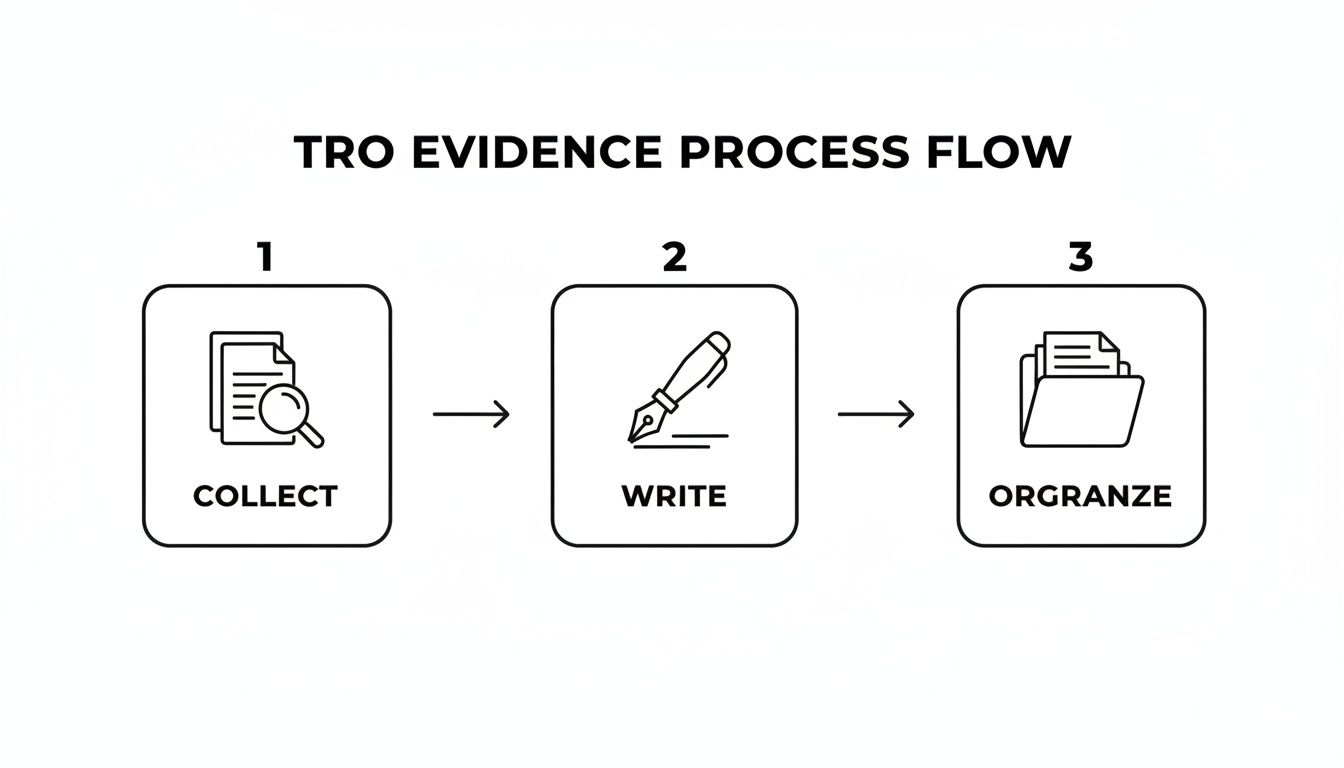
A successful filing boils down to being methodical: collect your proof, write your story clearly, and organize it all so the judge can quickly understand what’s at stake.
What Happens Next?
Once the judge signs the TRO, it’s legally in effect. However, it isn’t enforceable against your spouse until they've been officially notified. This next step is called "service of process," and it has very strict legal rules. Getting the order signed is a huge win, but now you must ensure it's delivered properly so it has its full legal power.
What Happens After a Judge Grants the TRO?
Feeling the relief when a judge signs your Temporary Restraining Order is a huge step forward. You’ve successfully shown the court that you need immediate protection, and that signature gives you a powerful legal shield. But the process isn’t over. The next steps are just as critical to ensure the TRO has the full force of the law behind it.

A signed TRO is legally active, but it can’t be enforced against your spouse until they’ve been formally notified. This essential legal step is called service of process. It ensures your spouse receives a copy of your lawsuit petition, the TRO itself, and a notice for the upcoming hearing date.
The Rules of Proper Legal Service
You cannot simply hand the papers to your spouse yourself or leave them in their mailbox. The Texas Rules of Civil Procedure have very strict requirements to ensure service is done correctly and is legally binding. If it's done wrong, the order could be unenforceable.
Service must be completed by a neutral third party, which usually means one of two options:
- A Sheriff or Constable: A law enforcement officer from the county where your spouse lives or works can deliver the documents.
- A Private Process Server: These are certified professionals whose job is to locate people and deliver legal documents according to the law.
Once your spouse has been personally handed the paperwork, the server files a "Return of Service" with the court. This is a sworn document that proves your spouse was officially notified, making the TRO fully enforceable.
Preparing for the Temporary Injunction Hearing
The TRO is, by nature, temporary. The court documents served on your spouse will include a date for a follow-up hearing, typically scheduled within 14 days. This is where a judge will decide whether to convert the short-term TRO into a Temporary Injunction.
A Temporary Injunction offers longer-lasting protection and will usually stay in effect for the entire duration of your divorce or custody case. This is a contested hearing where you will present your evidence, but this time, your spouse and their attorney will be there to argue their side. Being thoroughly prepared is essential. This is where having an experienced attorney becomes invaluable to help you organize your evidence, prepare your testimony, and anticipate the other side's arguments.
Understanding the Timeline and Next Steps
The legal process for these orders follows a quick and predictable path. Most of the time, courts convert these short-term TROs into longer-term injunctions after this critical contested hearing. You should expect the initial emergency order to be brief (commonly up to 14 days). Then, prepare for a prompt court hearing where you must present your evidence to get an extension, often within 14 days of the initial filing. You can read more about these common legal timelines and conditions. This fast-paced schedule is designed to balance immediate protection with your spouse’s right to be heard.
What to Do Next
Navigating the Texas legal system to secure your safety and assets can feel overwhelming, but you don't have to do it alone. The process of getting a temporary restraining order is a swift and powerful tool that restores order during a chaotic time. It is your first, most decisive step toward taking back control.
The journey starts with gathering strong evidence and drafting a factual affidavit. Once filed, an ex parte TRO can offer immediate protection, but proper legal service and preparation for the follow-up injunction hearing are where you lay the groundwork for long-term stability.
Your immediate action plan should focus on these critical steps:
- Act Quickly: Do not wait for a dangerous situation to escalate before seeking help. The law is designed to respond to urgent needs, and the harm you're trying to prevent could happen while you wait.
- Gather Your Proof: Start organizing everything now. Line up texts, emails, and financial records into a clear, easy-to-follow timeline. Strong evidence is the foundation of a successful TRO application.
- Consult with an Experienced Attorney: An experienced family law attorney ensures your application is filed correctly and can represent you effectively at the crucial injunction hearing that follows.
For situations involving children, the stakes are even higher. The same evidence you gather for a TRO can be critical when you need to understand how to get an emergency custody order.
You have already taken the first step by educating yourself. Now, let us help you with the next one. The attorneys at The Law Office of Bryan Fagan are here to listen to your story, guide you through the process, and fight for the protection you and your family deserve.
Take the next step toward peace of mind. Schedule a free, confidential consultation with us today.
Answering Your Questions About Temporary Restraining Orders
It's natural to have questions about how a temporary restraining order will actually work in your life. Here are straightforward answers to the most common concerns we hear from our clients across Texas.
How Much Does a TRO Cost in Texas?
While attorney fees vary based on your situation, the direct court cost is the filing fee required to open your divorce or custody case. This is usually a few hundred dollars, depending on the county. You pay this fee to the district clerk when you file your initial petition. If you cannot afford it, you have the right to file a Statement of Inability to Afford Payment of Court Costs. If a judge approves this sworn statement, all your court fees will be waived.
What Happens if My Spouse Violates the TRO?
A TRO is a direct command from a judge. If your spouse ignores its terms—whether by contacting you when they aren’t supposed to or trying to drain a frozen bank account—the consequences are serious. A violation is considered contempt of court.
If this happens, you need to act immediately:
- Call the police if you feel you are in any danger.
- Document everything. Get screenshots of texts, save emails, or write down the names of any witnesses.
- Contact your attorney right away so we can file a motion for enforcement with the court.
A judge can enforce the TRO with fines and even jail time. This order has real legal power, and we can help you ensure the court knows when it has been ignored.
How a TRO Can Affect Child Custody
The behaviors that make a TRO necessary—such as harassment, erratic actions, or attempts to hide assets—are highly relevant when a judge is deciding child custody. Under the Texas Family Code, a judge’s primary duty is to protect the best interest of the child.
When a judge sees documented evidence of behavior so concerning that it required a court order, it absolutely influences their decisions on conservatorship (who makes key decisions) and the possession schedule (visitation). It creates a formal record of instability or poor judgment that the court must consider when deciding what kind of environment is safe for your children.
Navigating the complexities of a TRO during an already stressful time requires clear, confident legal guidance. The experienced attorneys at the Law Office of Bryan Fagan, PLLC are here to answer all your questions and fight for the protections you and your family deserve. Schedule your free, confidential consultation by visiting us at https://texasdivorcelawyer.us today.