Skip to content
You may be staring at your company books and your divorce papers at the same time, wondering which one is about to define your future.
If you own a business, divorce does not feel like a normal property dispute. It feels personal. You built something that pays your bills, supports employees, carries your name, and may represent years of risk and sacrifice. When your marriage is ending, the fear is not only about losing money. It is about losing control.
Texas law gives you a process. That matters. It means your case is not decided by panic, pressure, or whoever speaks first. It is decided through rules about property, valuation, temporary orders, negotiation, and, when needed, court intervention. If you understand those rules early, you can make better decisions at each stage.
Your Business and Your Divorce An Introduction
For many people, the business is the part of life that still feels steady when everything else is shifting. Then divorce starts, and suddenly even that feels exposed.
You might be asking questions like these:
- Can my spouse claim part of the business if their name is nowhere on it?
- Will the court force a sale?
- Can I keep operations running without disruption?
- What should I do before temporary orders are entered?
Those questions are common, and they are reasonable.
Business-owning couples face unusual strain. According to a Bryan Fagan discussion of divorce among business-owning couples, approximately 50% of small business owners experience at least one divorce, a rate that often exceeds the national average. If you are dealing with business ownership divorce texas issues right now, you are not alone, and you are not overreacting by treating this as a high-stakes problem.

What makes these cases hard is that a business is rarely just one thing. It can be income, property, debt, goodwill, contracts, payroll, tax exposure, and future earning power all at once. A family court has to sort through all of that while also handling the rest of the divorce.
The good news is that there is a practical path through it.
You need to know whether the business is separate or community property. You need a defensible valuation. You need a plan for temporary orders so operations do not get damaged while the case is pending. You need to decide whether negotiation, mediation, or litigation gives you the best chance of keeping the business intact.
Key point: The earlier you build a strategy, the more choices you usually keep.
If you are calm, organized, and proactive, you can often protect both your ownership interests and the company’s day-to-day stability. That starts with the first major issue in any Texas divorce involving a business: classification.
Is Your Business Separate or Community Property
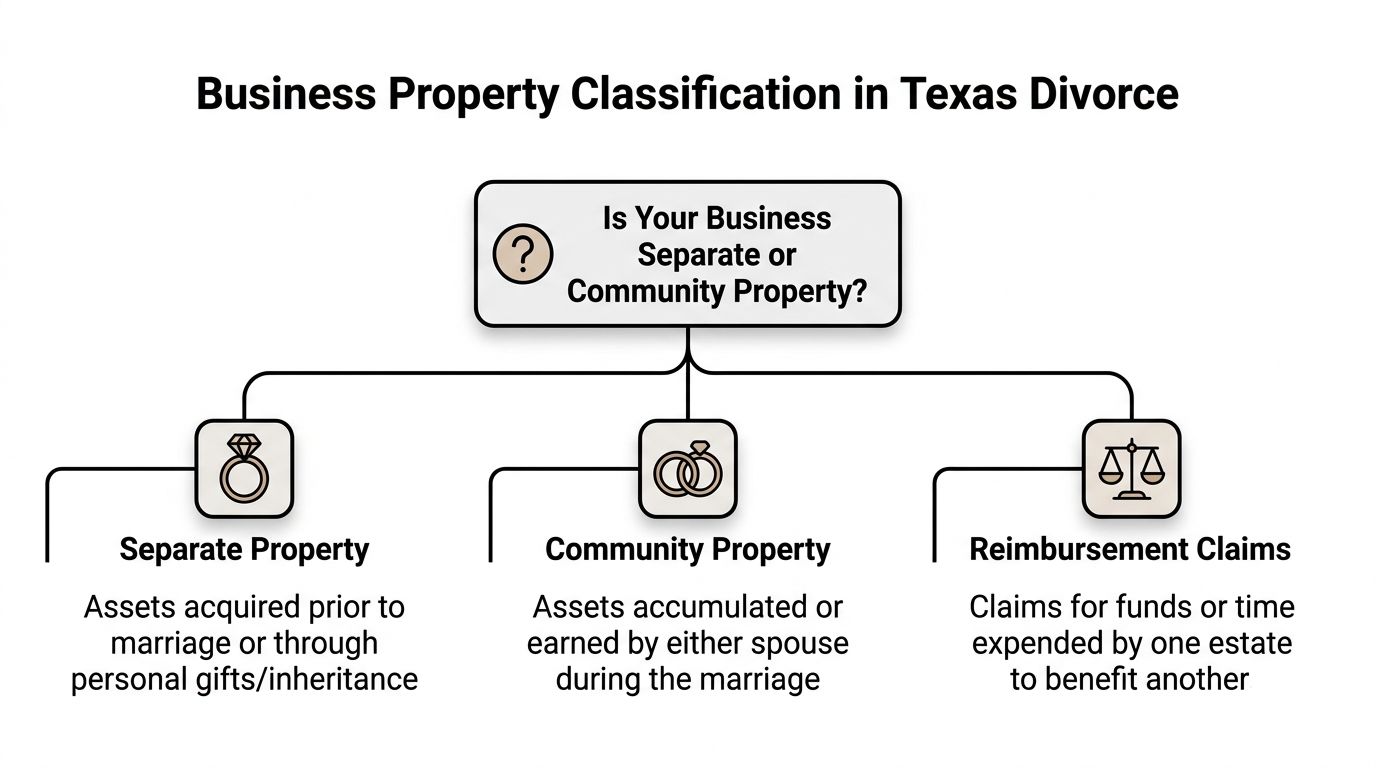
The first legal question is simple to ask and often hard to answer. What part of your business belongs to you alone, and what part belongs to the marital estate?
Texas Family Code § 3.003 creates a presumption that property possessed during or on dissolution of marriage is community property unless a spouse proves otherwise. In plain English, the court starts from the idea that property connected to the marriage is shared unless you can clearly show it is separate.
Think of the business like a tree
A useful way to understand this is to think of your business as a tree.
If you planted the tree before marriage, the trunk may be your separate property. But if the marriage supplied water, fertilizer, labor, or money that caused major growth, the marriage may have a claim to some of that growth.
That is why business owners get confused. They hear, “I started it before marriage, so it’s mine.” Sometimes that is partly true. It is not always the whole answer.
What separate property usually means
In Texas, separate property generally includes property you owned before marriage, along with certain property received by gift or inheritance.
A business can begin as separate property if you formed or acquired it before the wedding. But you still need proof. Courts look for documents such as formation papers, ownership records, early tax returns, capital contribution records, and bank statements that trace the business back to a separate source.
Problems start when records are thin or funds were mixed.
What community property usually means
Community property generally includes property acquired during marriage by either spouse, other than separate property. If you started the business during the marriage, the court will usually treat it as community property unless there is a strong legal reason not to.
Even when one spouse did all the visible work, the legal analysis does not stop there. Texas courts look at the character of the property, not just whose name appears on the paperwork.
Why growth can still be disputed
A pre-marriage business can still create a fight if it grew during the marriage through shared money, unpaid help from a spouse, or business reinvestment tied to community earnings.
That is where people often hear terms like reimbursement or community claim. These concepts matter because a judge may decide that one estate benefited another and that fairness requires compensation.
Examples include:
- Community funds paid business debt
- A spouse worked in the business without fair compensation
- Marital income was reinvested to expand operations
- Personal and business accounts were mixed together
Practical tip: If you have ever paid business expenses from a joint personal account, or personal expenses from a business account, tell your attorney early. Hiding that issue only makes classification harder later.
The court’s four-step process
Texas courts follow a structured approach in business division cases. A Gray Becker explanation of business division in Texas divorce states that courts use a mandatory four-step process for dividing business assets: identification, classification, valuation, and division.
Here is what that means in plain English:
Identification
The court determines what the business is. Is it an LLC, corporation, partnership, sole proprietorship, or professional entity? Who owns what percentage? What assets and debts belong to it?Classification
The court decides what is separate property and what is community property under Texas law.Valuation
Someone has to determine what the business interest is worth.Division
The court or the parties decide how to handle that value in a “just and right” division.
The phrase just and right does not always mean equal
Texas does not require a strict equal split in every divorce. Courts divide community property in a manner they consider just and right. That means the result must be fair under the facts of your case. It may or may not be a perfect half-and-half outcome.
That distinction matters for business owners. If your business is part of the community estate, the court is not automatically handing half the company to your spouse. The court is looking for a fair overall division of value.
A good strategy starts with accurate classification. If you get that wrong, every number and every negotiation that follows can drift off course.
How Texas Courts Value a Business in Divorce
Once the court knows what part of the business is in play, the next fight is usually about value. At this point, many business owners feel blindsided.
You may know what the business means to you. You may know what it took to build it. But divorce law needs a number. That number affects settlement options, buyouts, property offsets, and sometimes whether the case can resolve without trial.

A valuation is not a guess
A business valuation should be grounded in records and expert analysis. For closely held businesses, this step often becomes the foundation for every serious settlement conversation.
According to an HBW Law discussion of dividing closely held business ownership in Texas divorce, courts often favor buyouts over co-ownership because 80-90% of post-divorce co-ownership arrangements fail due to conflict, and a neutral business appraisal typically costs $5,000 to $20,000. That appraisal often becomes the anchor for negotiation.
If you want a deeper look at how this process works, this guide on business valuation in Texas divorce can help you understand what experts review and why.
Three common valuation approaches
Different businesses call for different methods. You do not need to become an accountant overnight, but you do need to understand the logic.
| Valuation method | What it looks at | Simple example |
|---|---|---|
| Asset-based | The value of business assets minus liabilities | Useful when the company’s value sits heavily in equipment, inventory, or real property |
| Income-based | The business’s earning power | Common when the company’s value comes from reliable cash flow |
| Market-based | Comparable business sales or market indicators | Helpful when similar businesses are bought and sold in a way that creates meaningful comparisons |
A forensic accountant or valuation expert may use one method, or a combination, depending on the business type and available data.
Why owners and spouses often see different numbers
A business owner may look at the bank balance and say the business is struggling. The other spouse may look at revenue, benefits paid through the company, and retained earnings and say the business is worth far more.
Both perspectives can miss key facts.
A proper valuation usually examines things like:
- Tax returns
- Profit and loss statements
- Balance sheets
- Payroll records
- Owner compensation
- Debt obligations
- Customer concentration
- Industry risk
- Business continuity if you stepped away
The point is not to inflate or deflate value. The point is to arrive at a number a court can trust.
Goodwill can become a major issue
This is especially important if you own a service business, professional practice, or firm built around your personal reputation.
There is a difference between personal goodwill and enterprise goodwill.
- Personal goodwill is tied to you as an individual. Your relationships, reputation, and unique skill may drive that value.
- Enterprise goodwill belongs more to the business itself. Systems, staff, brand recognition, location, and repeatable operations may continue even if you are not personally involved every day.
That distinction can shape the valuation in a meaningful way. A business that depends heavily on your own personal efforts may be viewed differently from one that could continue operating under new management.
Practical tip: Do not try to “clean up” the books after the divorce is filed by delaying income, accelerating expenses, or changing compensation patterns. Those moves often create more suspicion, not less.
The valuation should support a decision, not just win an argument
The number matters because it drives solutions. If the appraised value is too high, a buyout may become unrealistic. If it is too low, settlement may fail because the other side will not trust it.
A fair valuation helps answer practical questions:
- Can one spouse buy out the other?
- Can the value be offset with retirement, real estate, or other property?
- Does the business need a payment structure over time?
- Is a sale the only realistic option?
This part of the process can feel clinical, but it protects you. A credible valuation gives you something stronger than fear or opinion. It gives you a defensible basis for moving forward.
Your Options for Dividing the Business
Once the business has been classified and valued, the question becomes more practical. What do you do with it?
Most business owners care about one outcome above all others. They want the company to keep operating without chaos. Texas courts usually understand that concern. A functioning business supports income, customers, employees, and often the property division itself.
Option one keeps the business with one spouse
The most common solution is a buyout.
One spouse keeps the business. The other spouse receives value elsewhere. That can happen through cash, retirement assets, home equity, investment accounts, or structured payments over time.
This option often works best when one spouse actively runs the company and the other does not.
Buyout advantages
A buyout can protect continuity. Vendors, employees, and customers usually see less disruption. The operating spouse keeps decision-making control, and the divorcing couple does not stay tied together as business partners.
A buyout can also be customized. Some settlements use a lump sum. Others use installments if immediate cash is tight.
Buyout concerns
The challenge is liquidity. A business owner may be “worth” a lot on paper and still have very little free cash. That is why valuation and tax planning matter. A bad buyout structure can hurt both the company and your personal finances.
Option two is a sale to a third party
Sometimes the parties cannot make a buyout work. In that situation, selling the business may become the cleanest path.
That does not mean it is emotionally easy. It often is not. But it can create a clean break and convert a complicated asset into cash that can be divided.
If you are trying to understand the mechanics of selling your business as an owner, that resource can help you think through timing, preparation, and what buyers usually want to review before a sale.
Option three is continued co-ownership
Some couples ask whether they can just keep owning the business together after divorce. In rare situations, yes. In most situations, it is risky.
Business decisions require trust, speed, and day-to-day cooperation. Divorce usually damages all three. If you already disagree on money, staffing, growth, or transparency, co-ownership can turn the business into a second courtroom.
A continued co-ownership arrangement may only make sense when:
- Both spouses already have defined business roles
- Communication is unusually strong despite the divorce
- The operating agreement supports the arrangement
- There is a detailed written plan for management, compensation, deadlocks, and exit rights
A short comparison
| Option | Main benefit | Main risk |
|---|---|---|
| Buyout | Preserves operations and control | Requires cash flow or asset offsets |
| Sale | Clean break between spouses | Can disrupt relationships and timing |
| Co-ownership | Avoids immediate transfer or sale | Ongoing conflict can damage the company |
| Dissolution | Ends the dispute completely | May destroy a viable business |
Before you decide, it helps to hear a practical explanation of how these choices play out in real cases.
Courts usually care about preserving value
A court generally prefers a solution that protects value rather than one that destroys it. If the business supports your income, the judge will often want to avoid unnecessary harm to operations.
That does not mean you automatically keep it. It means you should arrive with a workable plan.
A strong proposal often answers questions like:
- Who will run the business during and after the divorce?
- How will the non-owner spouse receive a fair share?
- Will payments be immediate or spread out?
- What happens if cash flow dips during the payout period?
Key takeaway: The best division plan is not the one that feels most satisfying in the moment. It is the one that keeps your future workable.
In business ownership divorce texas cases, strategy matters more than pride. A realistic buyout or settlement structure often protects far more than a fight over abstract ownership rights.
Protecting Your Business During the Divorce
The period between filing and final decree is where many business owners make avoidable mistakes. They panic, move money too fast, cut a spouse off without court approval, or stop keeping good records because they are emotionally exhausted.
Do not do that.
If divorce is pending, your goal is to preserve value, protect operations, and avoid any appearance that you are hiding, wasting, or manipulating assets.
Temporary orders are often the first real battlefield
Texas courts can enter temporary orders early in the case. These orders can govern who pays which bills, who controls accounts, whether salaries continue, and what each spouse can or cannot do with property while the divorce is pending.
In some cases, the court may also issue a Temporary Restraining Order or temporary injunction to stop harmful conduct. That can include draining accounts, taking on unusual debt, transferring business property, or interfering with operations.
If your case involves serious concern about preserving assets, this resource on how to protect assets during divorce gives a useful overview of protective steps and common risks.
Keep the business running normally
Judges and valuation experts pay attention to whether the business kept operating in a stable, ordinary way.
That means you should:
- Maintain payroll and vendor payments: Keep ordinary obligations current if cash flow allows.
- Avoid unusual withdrawals: Large transfers raise immediate questions.
- Separate business and personal spending: If lines were blurry before, tighten them now.
- Document major decisions: Write down why a business action was necessary and ordinary.
- Preserve records: Do not delete emails, bookkeeping files, or transaction histories.
Review your governing documents
If your company has an operating agreement, shareholder agreement, partnership agreement, or corporate bylaws, review them early with counsel.
Some businesses also have a buy-sell agreement that addresses transfers triggered by divorce, death, disability, or owner departure. That kind of agreement can affect both bargaining power and options in settlement talks.
Be careful with taxes and transfers
How property is divided can create tax consequences. In many divorces, spouses and their advisors try to structure transfers in a way that avoids triggering unnecessary tax costs during the division itself.
That is one reason business cases often require a team approach. Your family law attorney may need input from a CPA, valuation expert, and sometimes business counsel. The Law Office of Bryan Fagan, PLLC handles Texas divorce matters involving property division, temporary orders, and business-related disputes, which can help when your legal and financial issues overlap.
Practical tip: Do not promise your spouse a buyout amount, payment schedule, or ownership change before your lawyer and financial professionals review the numbers. A well-meant promise can become a serious problem later.
Protect relationships inside the company
Employees do not need a running commentary on your divorce. Neither do clients.
Share only what is necessary. Reassure key people that business operations continue. If your spouse worked in the company, address access, authority, and communications carefully and lawfully. A rushed internal decision can create both legal and operational damage.
You cannot stop the stress of divorce. You can stop it from driving business decisions that make the case worse.
Mediation vs Litigation Which Path Is Right for You
Business owners usually want three things during divorce. They want privacy, control, and a result the company can survive.
That is why many business-related divorce disputes are better resolved through negotiation and mediation when possible. Litigation is still necessary in some cases, but court should usually be the backup plan, not the first instinct.
Why mediation often fits business cases better
In mediation, you and your spouse work with lawyers and a neutral mediator to try to reach a settlement. The process is private. It also gives you room to create solutions that a judge may not design from the bench.
That matters when the asset at issue is a living business.
A mediated settlement can include:
- a structured buyout
- payment terms tied to business cash flow
- control over who keeps which assets
- confidentiality terms
- timing that avoids major disruption to operations
If you want to understand how the process works, this overview of mediation in Texas divorce explains why many families resolve difficult property disputes outside the courtroom.
When litigation becomes necessary
Mediation is not magic. It does not work if one spouse is hiding information, refusing to negotiate in good faith, or using the business as a weapon.
Litigation may be necessary when:
| Issue | Why court may be needed |
|---|---|
| Hidden or incomplete records | Formal discovery may be required |
| Valuation disputes | Experts may need to testify |
| Control fights | Temporary orders may need judicial enforcement |
| High conflict | One side may refuse all reasonable settlement options |
A judge can issue orders, compel disclosure, and make final decisions. Sometimes that authority is exactly what a case needs.
Prepare for court even if you want peace
The strongest mediation position usually comes from being ready for trial.
That means having your records organized, your valuation work underway, your legal theory clear, and your goals defined. When the other side sees that you are prepared, settlement often becomes more realistic.
Key point: Mediation gives you more influence over the outcome. Litigation gives the judge more influence over the outcome.
If your spouse is reasonable, mediation can protect privacy and preserve flexibility. If your spouse is not reasonable, strong trial preparation can still protect you by creating pressure for a better settlement or by giving the court what it needs to rule fairly.
The right path is the one that protects your business and your future, not the one that sounds less stressful at the start.
A Practical Checklist for Business Owners
When your marriage is ending and your company is still demanding your attention every day, it helps to reduce the next steps to a clear list. You do not need to solve everything this week. You do need to avoid costly delay.
Start with the records
Gather the documents that explain the business from formation to present day.
- Formation papers: Articles, certificates, operating agreements, shareholder documents.
- Financial records: Tax returns, profit and loss statements, balance sheets, payroll reports, bank records.
- Ownership proof: Stock certificates, membership certificates, partner records, contribution documents.
- Debt documents: Promissory notes, loan statements, equipment financing, lines of credit.
Protect your position early
Talk with a Texas family law attorney before you make changes to compensation, ownership, or account access.
Also consider whether you need support from a CPA, valuation expert, or business lawyer. A business case often turns on coordination between these professionals.
Do not make unilateral decisions
Many owners hurt their case by acting first and explaining later.
Avoid steps like these unless your attorney specifically advises otherwise:
- removing your spouse from accounts without authority
- changing payroll practices abruptly
- transferring ownership interests
- selling assets below market value
- taking unusual owner draws
Build a negotiation plan
Think in terms of outcomes, not only rights.
Ask yourself:
- Do you want to keep the business at all costs, or is a sale acceptable?
- What assets could offset your spouse’s share?
- Can the business support a payout over time?
- What information will your expert need to value the company properly?
What to do next
A solid checklist is not just about gathering paperwork. It gives you back some control.
Your immediate priorities are simple:
- Preserve records
- Stabilize operations
- Get legal advice early
- Avoid emotional financial decisions
- Prepare for valuation and temporary orders
If you follow those steps, you put yourself in a stronger position whether your case resolves in mediation or in court.
Frequently Asked Questions
Can my spouse claim part of the business if they never worked there
Yes, that can happen. Texas courts look at whether the business or its growth is community property, not only whether your spouse drew a paycheck from the company. Indirect contributions to the marriage can still matter in property division.
Can the court force me to sell the business
It can happen, but it is not always the first choice. Courts often prefer solutions that preserve value, such as a buyout or offset with other marital assets, if those options are workable.
Who takes the business debt
Debt tied to the business often becomes part of the larger property division analysis. The answer depends on how the debt was incurred, how the business is classified, and who receives the related asset or ownership interest in the final decree.
What if the business is in my name only
Title alone does not decide the issue in Texas. The court will still examine when the business was acquired, how it was funded, whether it grew during the marriage, and whether any community claim exists.
What if my spouse helped informally
Informal help still matters. If your spouse handled bookkeeping, scheduling, customer calls, or other support without formal compensation, that may become relevant in classification, reimbursement, or valuation disputes.
You do not have to guess your way through a business-related divorce. If you are worried about protecting the company you built, your income, or your long-term financial stability, schedule a free consultation with the Law Office of Bryan Fagan, PLLC. You can get clear guidance, a practical strategy, and a confidential conversation about what to do next in your Texas divorce.