Skip to content
When your safety is on the line during a family dispute, knowing which legal tool to reach for can feel overwhelming.
In Texas, the difference is critical: a Protective Order is a powerful order from a criminal court designed to stop family violence, stalking, or assault. If someone violates it, they can be arrested on the spot. A Temporary Restraining Order (TRO), on the other hand, is a civil court order, usually part of a divorce, that sets ground rules—like preventing your spouse from draining the bank account or harassing you. Understanding which one applies to your situation is the first step toward regaining control and peace of mind.
Your Guide to Legal Protection in Texas
Navigating a divorce or custody battle is tough. Emotions run high, and sometimes, someone's behavior can escalate from difficult to downright dangerous. You might find yourself needing the court to step in, either to guarantee your physical safety or to protect your property from being sold or hidden.
In Texas, your two primary options are Protective Orders and Temporary Restraining Orders (TROs). While they both offer a form of "protection," they serve very different functions and carry vastly different legal consequences.

Understanding which one applies to your situation is the first step toward getting the right kind of help. A Protective Order is your shield against physical harm, rooted in the Texas Family Code's strict provisions against family violence. Think of a TRO as a tool for managing behavior and finances within a civil lawsuit.
At a Glance: Protective Order vs. Restraining Order in Texas
To help you quickly see the fundamental differences, here is a simple comparison of a Protective Order vs. a Restraining Order in Texas. This table breaks down the key distinctions you need to know.
Comparing Texas Protective and Restraining Orders
| Feature | Protective Order | Temporary Restraining Order (TRO) |
|---|---|---|
| Primary Purpose | To protect you from family violence, assault, stalking, or sexual abuse. | To set rules of conduct and preserve property during a lawsuit. |
| Type of Case | Can be a standalone criminal matter or related to a family law case. | Part of a civil lawsuit, most commonly a divorce or custody case. |
| Legal Basis | Requires proof that family violence has occurred and is likely to happen again. | Requires a claim that the order is needed to prevent harm or preserve assets. |
| Enforcement | Violation is a criminal offense, leading to immediate arrest and jail time. | Violation is a civil matter, handled through a contempt of court hearing. |
| Duration | Can last up to two years, and sometimes longer in severe cases. | Typically lasts for 14 days until a Temporary Orders hearing. |
Choosing the correct order isn't just a matter of paperwork; it's about deploying the right legal strategy to protect what truly matters. Whether you need to stop physical harm or just establish financial and behavioral boundaries during a case, knowing your options empowers you to act decisively and effectively.
Understanding the Texas Protective Order
When you’re afraid for your physical safety, you need more than just a piece of paper. You need a powerful legal shield, and that’s exactly what a Texas Protective Order is designed to be—a court order that creates an enforceable legal barrier between you and someone who poses a threat of violence. It is an absolutely critical tool for ensuring your safety and that of your children.
A Protective Order isn't a civil suggestion; it’s a direct command from a judge, often with criminal consequences if violated. Its entire purpose is to stop future instances of family violence, sexual assault, stalking, or human trafficking. The Texas Family Code defines family violence broadly, covering not just physical harm but also threats that put a family or household member in fear of imminent physical harm.

Who Qualifies for a Protective Order
To get this kind of order, you must show a specific relationship with the person causing the harm. This isn't just for spouses going through a divorce. The law is written to protect a wide range of individuals.
You may be eligible if you've experienced violence from:
- A current or former spouse
- Someone you are dating or have dated
- A person you have a child with
- A relative (by blood or marriage)
- A member of your household
The court needs to believe two things to grant a Protective Order: first, that family violence has occurred, and second, that it is likely to occur again. This requires presenting clear and convincing evidence to a judge, which is exactly why having experienced legal guidance is so important.
Different Types of Protective Orders in Texas
Texas law offers a few different types of orders, each built for specific situations. Knowing the difference helps you see the path to safety more clearly.
A Magistrate's Order of Emergency Protection (MOEP) is often issued by a criminal court judge right after an abuser is arrested for an offense involving family violence, sexual assault, or stalking. It provides immediate, but short-term, protection, typically lasting from 31 to 91 days.
A Final Protective Order is a much longer-term solution. It's granted by a civil court after a hearing where both sides can present their evidence. If the judge grants it, these orders typically last for up to two years, and in certain felony-level cases, they can be extended even longer.
The core function of a Protective Order is to command the abuser to cease specific actions. This isn't just a recommendation—it's a legally binding order backed by the full force of the law. Violation can lead to immediate arrest.
These orders are reserved for serious threats. In fact, protective orders in Texas are overwhelmingly issued to shield people from family violence, with 74% of final protective orders granted for this very reason. Just as significantly, 26% of all final protective orders also involve cases of sexual assault, highlighting their critical role in protecting victims of these horrific crimes. You can read the full 2024 protective order report from Texas courts for a deeper dive into the data.
Ultimately, a Protective Order can prohibit someone from coming near your home, workplace, or your children's school. It can also prevent them from contacting you in any way—no calls, texts, emails, or social media messages. This comprehensive protection is what sets it apart from a civil restraining order and makes it an essential tool when your well-being is on the line.
Understanding the Texas Temporary Restraining Order
Watching a shared life unravel during a divorce can make you feel like the ground is shifting beneath your feet. A Temporary Restraining Order, or TRO, is a legal tool designed to create stability when everything else feels chaotic. Unlike a Protective Order, which is meant to stop physical violence, a TRO is a civil court order that establishes necessary boundaries during a divorce or custody case.
Think of it as a set of ground rules for you and your spouse while the legal process plays out. Its main job is to maintain the status quo—meaning it prevents either party from making sudden, drastic moves that could harm the other person or the marital estate. It’s a strategic tool used to encourage peaceful conduct and preserve financial stability from the very start of your divorce filing.
What a TRO Can Accomplish
A TRO can address a wide range of behaviors, but its focus is almost always on conduct and property. It's not designed to handle threats of violence—that’s what a Protective Order is for. Instead, a TRO sets civil guidelines for how you and your spouse must act.
Common prohibitions in a Texas TRO include orders preventing a spouse from:
- Draining joint bank accounts or running up massive credit card debt.
- Selling or hiding marital property, like a car, house, or valuable assets.
- Changing insurance beneficiaries for life or health insurance policies.
- Making disparaging remarks about you in front of your children.
- Disrupting your children's routine or removing them from the county or state.
These orders aren't automatic; you have to specifically request one when you file for divorce. Your attorney will present a sworn statement to the judge explaining why the TRO is necessary to prevent immediate and irreparable harm.
The Lifespan of a Temporary Restraining Order
One of the most critical things to understand about a TRO is its very short fuse. It is, by definition, temporary.
A TRO in a Texas family law case typically lasts for only 14 days. Its purpose is to provide immediate, short-term rules until the court can hold a more formal hearing for Temporary Orders, where both sides can present their case.
This initial 14-day period acts as a crucial cooling-off period. It ensures that no one makes any rash financial decisions or engages in harmful behavior while waiting for that first court date. Once the TRO expires, the judge will hold a Temporary Orders hearing. At this hearing, the judge listens to both you and your spouse and then issues Temporary Orders that will stay in place for the rest of your divorce.
Those subsequent orders can be much more detailed, covering everything from temporary child custody and visitation schedules to who pays which bills. As time goes on, life changes, and you might need to revisit these arrangements. If you find yourself needing to change the terms of a court order after it's been finalized, you'll need to seek a legal adjustment, and you can learn more about how family law order modification lawyers in Texas can help with that process.
Ultimately, while a Protective Order serves as a shield against physical danger, a TRO acts as a rulebook for civil behavior, preserving peace and assets until your case can be resolved.
Comparing the Filing Process and Legal Power
When you’re weighing a protective order against a restraining order in Texas, how you get one—and what happens if someone violates it—is the whole ballgame. The path to securing each order and the legal teeth they have are worlds apart because they're designed to solve completely different problems. Making the right call for your family starts with getting crystal clear on these differences.
A Protective Order is what you seek when you are genuinely in fear for your safety because of family violence. In sharp contrast, a Temporary Restraining Order (TRO) is a standard tool in civil lawsuits, like a divorce, used to set ground rules and prevent financial or emotional gamesmanship.
How Each Order Is Initiated
The process for getting a Protective Order usually starts in a crisis. Because it deals with criminal acts like assault or stalking, the process often brings in law enforcement or the District Attorney's office. As the person applying, you have to prove to a judge that family violence has already happened and is likely to happen again. This isn't a simple request; it requires a formal hearing where the judge will look at hard evidence—think police reports, medical records, threatening texts, or testimony from witnesses.
On the other hand, filing for a TRO is a straightforward civil procedure, typically handled by your family law attorney as part of kicking off a divorce. It's usually filed right alongside your Original Petition for Divorce. Your lawyer submits a sworn statement explaining why the order is needed to keep property safe or protect you and your kids from harmful (but not physically violent) actions. A TRO is often granted ex parte—meaning the other person isn’t even there—and acts as a quick, temporary fix until a full hearing can be scheduled.
The Critical Difference in Enforcement and Penalties
This is where the rubber really meets the road. The legal power behind each order dictates how a violation is handled, and the consequences couldn't be more different.
A Protective Order is a court directive backed by the full weight of criminal law. If the respondent breaks the order—by contacting you, showing up at your house, or making threats—it is a criminal offense. You can call 911 immediately, and the police can arrest them on the spot without a warrant.
Violating a TRO, however, is a civil matter. It’s a serious breach of a judge's order, but it doesn't automatically lead to an arrest. Instead, your lawyer has to file a Motion for Enforcement with the court. A hearing gets scheduled where you must prove the violation took place. If the judge agrees, the other party can be held in contempt of court, which might mean fines or even jail time, but it lacks the immediate, decisive punch of a criminal charge.
A violation of a Protective Order can result in immediate arrest and criminal charges. A violation of a TRO is addressed through a civil contempt of court hearing, which is a slower, less immediate process.
Texas law treats these violations with starkly different levels of severity. Violating a protective order can lead to a Class A Misdemeanor, punishable by up to a $4,000 fine and a year in jail. If the person has priors or commits another assault, it can even be bumped up to a third-degree felony, carrying a prison sentence of two to ten years.
To make these distinctions even clearer, let's break them down side-by-side.
Detailed Comparison of Texas Protective and Restraining Orders
This table lays out the fundamental differences between a Protective Order and a Temporary Restraining Order (TRO) so you can see exactly how they function in a Texas family law context.
| Criteria | Protective Order | Temporary Restraining Order (TRO) |
|---|---|---|
| Purpose | To protect individuals from family violence, assault, stalking, or sexual assault. | To set temporary rules for conduct and property during a civil lawsuit (e.g., divorce). |
| Legal Basis | Criminal Law (Texas Family Code, Title 4). | Civil Law (Texas Rules of Civil Procedure). |
| Initiation | Filed as a separate application, often with help from the D.A. or law enforcement. | Filed along with a civil petition, like a divorce, by a family law attorney. |
| Evidence Required | Proof that family violence has occurred and is likely to occur again. | A sworn affidavit stating why the order is needed to prevent irreparable harm. |
| Enforcement | Criminal. Violations can lead to immediate arrest and new criminal charges. | Civil. Violations are addressed through a contempt of court motion filed by an attorney. |
| Penalties for Violation | Class A Misdemeanor or Felony charges, fines, and jail time. | Civil contempt penalties, such as fines or jail time, decided by a judge after a hearing. |
| Duration | Can last up to 2 years or even a lifetime in certain circumstances. | Typically lasts for 14 days until a temporary orders hearing can be held. |
Understanding these key procedural and legal differences is essential for choosing the right path for your situation. One is a shield with criminal consequences, while the other is a rulebook for a civil dispute.
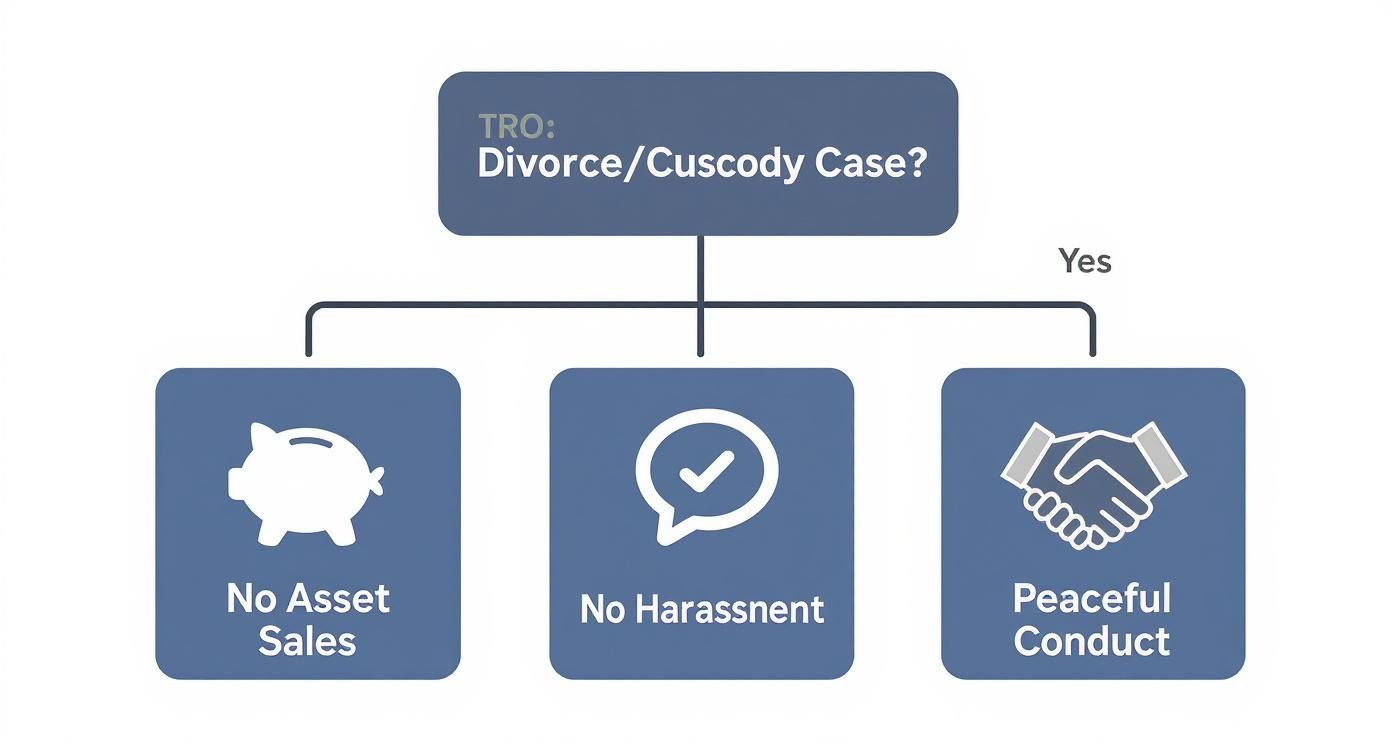
The flowchart above really drives home that a TRO is a strategic tool for managing assets and behavior within a lawsuit, not a solution for physical danger.
Making the Right Choice for Your Situation
Choosing the right order isn't about which one is "better"—it's about which one was built for your specific circumstances.
- If you fear for your physical safety or are a victim of stalking, sexual assault, or family violence, a Protective Order is the necessary legal shield. Its criminal enforcement provides the immediate, powerful protection you need. The connection between abuse and family law is profound, and it is vital to understand how domestic violence affects divorce and custody cases in Fort Worth.
- If you are starting a divorce and need to stop your spouse from draining bank accounts, racking up debt, or engaging in harassing (but non-violent) behavior, a Temporary Restraining Order is the right tool for the job. It establishes crucial ground rules to ensure the process is fair and orderly from the start.
Ultimately, the filing process and legal power of each order are tailored for different missions. One is a shield against physical harm with criminal consequences; the other is a rulebook for civil conduct during a lawsuit. Talking with an experienced family law attorney is the most important step you can take to make sure you’re using the right legal instrument to protect your family and your future.
How These Court Orders Are Enforced in Texas
A court order is only as strong as the system that backs it up. When your safety or financial stability is on the line, understanding exactly how that piece of paper is enforced is everything. This is where the difference between a protective order and a restraining order in Texas becomes crystal clear. Their enforcement mechanisms are built for entirely different worlds—one for immediate criminal intervention, the other for civil accountability.
Knowing how violations are handled gives you the practical knowledge you need to act confidently if the other person fails to comply.
Enforcing a Texas Protective Order
When a judge grants a Protective Order, it isn't just filed away at the courthouse. It's immediately registered in the statewide Texas Crime Information Center (TCIC), a massive law enforcement database. This single step is what gives a Protective Order its teeth, giving any police officer in Texas instant access to the order's details during a traffic stop or a 911 call.
This immediate accessibility makes enforcement direct and swift. If the respondent violates the order—by contacting you, showing up at your home, or coming near your child's school—the process is straightforward:
- You call 911. Report the violation and tell the dispatcher you have a Protective Order in place.
- Police respond. When officers arrive, they can immediately pull up the order and its terms in the TCIC database right from their patrol car.
- A warrantless arrest can be made. If an officer has probable cause to believe the order was violated, they can arrest the individual on the spot. No warrant needed.
This power to make an immediate, warrantless arrest is the game-changing difference. The violation isn't just a misstep; it's a new criminal offense, typically a Class A Misdemeanor punishable by up to a year in jail and a $4,000 fine.
To make this system even more effective, Texas launched the Texas Protective Order Registry (PROTECT) in 2021. This registry requires courts to input order details within 24 hours, ensuring law enforcement has the most current information possible. You can discover more insights about this registry on tdcaa.com and see how it's designed to enhance victim safety.
Enforcing a Temporary Restraining Order
Enforcing a Temporary Restraining Order (TRO) follows a civil path, not a criminal one. A TRO violation isn't a crime, so you can't call the police and expect them to make an arrest. Instead, you have to go back to the same civil court that issued the order in the first place.
The enforcement process for a TRO involves several steps that your attorney will handle:
- Filing a Motion for Enforcement: Your lawyer will draft and file a formal legal document explaining exactly how and when the TRO was violated.
- Gathering Evidence: You'll need to provide solid proof. This could be bank statements showing a prohibited withdrawal, screenshots of harassing texts, or testimony from a witness.
- Attending a Court Hearing: The judge will schedule a hearing where your attorney presents the evidence, and the other party gets a chance to respond.
If the judge finds the TRO was willfully violated, they can hold the other party in contempt of court. The penalties can include fines, an order to pay your attorney’s fees, or even jail time in serious cases. While this is a powerful tool, the process is much slower and less immediate than the criminal consequences of violating a Protective Order.
What to Do Next to Protect Your Family
Dealing with the fear and uncertainty of a family conflict is one of the toughest experiences anyone can go through. Now that you have a clearer understanding of the differences between a protective order and a restraining order in Texas, it’s time to take the next step. The right path forward is unique to your situation, but the goal is always the same: bringing safety and peace of mind to you and your family.
Here's the bottom line: Protective Orders are your legal shield against physical violence and carry criminal penalties. Temporary Restraining Orders (TROs) are civil court tools used to set financial and behavioral boundaries during a lawsuit like a divorce.
Take Decisive Action for Your Safety
- If you are in immediate danger or experiencing threats, stalking, or any form of family violence, a Protective Order is the necessary legal tool. Its criminal enforcement provides the immediate, powerful protection you and your children need. When children are at risk, you may also need to file an emergency petition for custody to get them out of a harmful environment while the legal case proceeds.
- If you need to establish rules during a divorce and your main worry is that your spouse might empty bank accounts, sell property, or engage in harassing (but non-violent) behavior, a TRO is the right tool. It establishes the ground rules needed to keep the divorce process fair and orderly from the very beginning.
The Most Important Step You Can Take
The single best thing you can do right now is talk to an experienced Texas family law attorney. A good lawyer will listen to your story, assess your unique circumstances, and advise you on the correct legal strategy to pursue. They will help you gather the proof you need and file the right paperwork to protect what matters most.
You don't have to figure this out on your own. At The Law Office of Bryan Fagan, PLLC, our team has guided countless Texas families toward safety and security during their most difficult moments. We're here to offer the compassionate advice and strong representation you need to move forward.
We invite you to schedule a free, confidential consultation with us today. Let us help you understand your options and take the decisive steps needed to secure the protection you and your family deserve.
Frequently Asked Questions
When you're dealing with a tough family situation, it's completely normal to have questions about your legal options. Here are some clear, straightforward answers to the questions we hear most often about getting a protective order versus a restraining order in Texas.
How Much Does It Cost to Get a Protective Order in Texas?
There are no court filing fees to apply for a protective order related to family violence in Texas. The law was specifically designed this way to make sure cost isn't a barrier for someone seeking safety. Keep in mind, though, you might still have costs if you decide to hire a private attorney to represent you and make sure your case is presented as effectively as possible.
Can I Get a Protective Order Against Someone I'm Not Married To?
Yes, absolutely. A Texas Protective Order isn't just for spouses. It's available to victims of family violence, which the law defines broadly to include people in a dating relationship, former partners, family members by blood or marriage, and even roommates.
What Happens If the Other Person Doesn't Show Up for the Court Hearing?
If the respondent was properly served with the hearing notice and they simply don't show up, the judge can move forward without them. This is called a default judgment. The judge will listen to your evidence and can grant the protective order based on your testimony and any other proof you've brought.
Can a Restraining Order Force Someone to Move Out of the House?
A Temporary Restraining Order (TRO) generally can't kick a spouse out of the marital home. However, during the Temporary Orders hearing—which usually happens about 14 days after the TRO is issued—a judge can grant one spouse the exclusive use of the marital residence while the divorce is ongoing.
One of the biggest misconceptions is that a TRO can evict someone. In reality, its power is in setting rules of conduct and preserving property. The more significant decisions, like who stays in the house, are decided at the subsequent Temporary Orders hearing.
Can a Protective Order Be Permanent?
In most situations, a Final Protective Order lasts for up to two years. But under certain severe circumstances, like cases involving a felony-level offense or a long history of violence, a judge has the authority to issue a protective order that lasts longer than two years—sometimes, even for a lifetime.
What Should I Do If the Other Person Violates the Order?
How you respond depends entirely on which type of order is in place, and the difference is critical.
- If a Protective Order is violated: Call 911 immediately. Violating a protective order is a criminal offense, and the police can make an arrest on the spot.
- If a Temporary Restraining Order is violated: Contact your attorney right away. They will need to file a Motion for Enforcement with the civil court to have the other person held in contempt.
Understanding these key differences is the first step toward getting the right kind of protection for your specific situation. The compassionate, experienced attorneys at The Law Office of Bryan Fagan, PLLC are here to help you understand your options and take decisive action.
Schedule your free consultation with The Law Office of Bryan Fagan, PLLC today.