Skip to content
Some marriages do not end with one shocking moment. They end after months or years of quiet strain, repeated misunderstandings, and the hard realization that staying together is no longer healthy.
If that is where you are, you are not alone, and you are not required to prove that someone is the villain for a Texas court to grant a divorce. In many cases, the legal path is insupportability, which is Texas’s no-fault ground for divorce. It gives you a way to move forward when the marriage has broken down, even if there was no adultery, no abandonment, and no dramatic event you can point to.
For many people, that is a relief. It also creates confusion.
You may be asking questions like these: If I file on no-fault grounds, do I give up advantage on property? Does it affect custody? Can my spouse stop the divorce? Is it still smart to raise fault issues if money was wasted or the children were exposed to harmful conflict?
Those are the right questions. An insupportability divorce texas case is often the simplest way to get the divorce granted, but “no-fault” does not mean “no strategy.” You still need to protect your rights, your finances, your parenting role, and the final court orders you will live under after the divorce is over.
Introduction When a Marriage Is Over But No One Is to Blame
A lot of people feel guilty when they cannot name one single reason their marriage failed.
Maybe you and your spouse did not have one explosive betrayal. Maybe you just stopped functioning as partners. Conversations turned tense. Decisions became harder. The future you once planned together no longer feels shared.
Texas law recognizes that reality.
If your marriage has reached the point where the relationship no longer works and there is no reasonable expectation of repairing it, Texas gives you a formal legal ground to ask for a divorce without putting blame on either spouse. That ground is insupportability.
For many families, it is the most practical starting point because it lowers the temperature. You do not have to build your case around proving cruelty, adultery, or abandonment just to end the marriage. Instead, you focus on the issues that matter going forward:
- How property will be divided
- How parenting decisions will be handled
- How bills, support, and daily life will work during and after the case
That does not mean the case is automatically easy.
A no-fault filing can still involve complicated property questions, business valuation concerns, parenting disputes, temporary orders, mediation, and post-divorce enforcement risks. The legal ground for the divorce is only one part of the picture.
If you are trying to understand your options, the key is to separate two ideas that often get mixed together. First, what ground are you using to get the divorce? Second, what evidence matters for dividing property and deciding issues involving children?
Key point: In Texas, choosing insupportability often makes the divorce itself simpler. It does not eliminate the need for careful planning on money, parenting, and final orders.
What Insupportability Means Under Texas Law
Texas uses the word insupportability to describe a marriage that has broken down beyond repair.

Under Texas law, insupportability has been the state’s legal standard for no-fault divorce since 1970, and it was formally codified under Texas Family Code § 6.001 effective April 17, 1997, as explained in this discussion of Texas no-fault divorce and insupportability under Section 6.001.
The legal definition in plain English
The statute allows a court to grant a divorce without regard to fault if the marriage has become insupportable because of discord or conflict of personalities that destroys the legitimate ends of the marital relationship and prevents any reasonable expectation of reconciliation.
That sounds formal, but the idea is simple.
Two things must be true:
- There is serious discord or conflict between the spouses
- That conflict has damaged the marriage so badly that reconciliation is no longer reasonably expected
In plain language, the marriage is no longer workable.
What “discord or conflict of personalities” usually means
This phrase confuses many people. It does not require constant screaming or dramatic misconduct.
It can mean that you and your spouse have become unable to function as marital partners. The problem might show up as constant tension, emotional distance, repeated arguments, opposing values, or a total breakdown in communication.
Consider it a business partnership. Two people may both be decent people, but if they can no longer make decisions together, trust each other’s judgment, or work toward the same goals, the partnership stops being viable. Marriage can reach the same point.
What “destroys the legitimate ends of the marriage” means
This part of the law focuses on whether the marriage can still serve its basic purpose as a committed relationship.
If you and your spouse no longer share trust, cooperation, emotional support, or any realistic path forward together, the court may treat the marriage as legally insupportable. The law does not require you to stay stuck because no one can prove a traditional fault ground.
What proof is usually required
In many cases, meeting the legal standard is straightforward. When one or both spouses want to end the marriage, testimony that the marriage has broken down beyond repair is typically enough.
That is one reason this ground is so widely used in Texas.
If you want a broader overview of how no-fault and fault grounds compare, this guide on grounds for divorce in Texas can help.
Practical takeaway: Insupportability does not require you to document every fight or prove one spouse “caused” the divorce. It requires you to show that the marriage is no longer sustainable and is not likely to be restored.
Insupportability Versus Fault Grounds Choosing Your Strategy
When you file for divorce, you are making two decisions at once.
The first is emotional. How much conflict do you want to bring into the case?
The second is strategic. Will alleging fault help you protect your interests on property or other issues?

Why many people choose insupportability first
Insupportability is the most common path because it is usually the least complicated way to get the court to dissolve the marriage.
Practitioner benchmarks estimate that insupportability divorces make up about 85–95% of Texas cases, and the same source explains that fault can still matter for remedies such as property division. It also notes that under Murff v. Murff a court may award a disproportionate division of assets, including examples such as a 60/40 split, when economic fault is shown through conduct like adultery-related dissipation of marital assets, according to this analysis of insupportability in Texas divorce and the role of fault in remedies.
In day-to-day practice, that means many spouses file on insupportability because it avoids turning the divorce itself into a trial about personal wrongdoing.
When fault may still matter
No-fault gets you in the courthouse door. It does not erase harmful conduct that affected the marriage financially.
Here are common examples of why fault evidence may still matter:
- Money spent on an affair: If one spouse used marital funds in a way that harmed the community estate, that may matter in property division.
- Hidden or wasted assets: If a spouse drained accounts, transferred property, or manipulated business income, the court may consider that behavior.
- Cruel conduct tied to financial or parenting harm: Sometimes the issue is not the label itself, but how the conduct affected the family.
That is the nuance many people miss. You can use insupportability as your main ground for divorce and still develop evidence about conduct that affects outcomes.
A simple way to think about the choice
Use this framework when deciding how to proceed:
| Situation | Insupportability may fit | Fault grounds may deserve review |
|:—|:—|
| You want the divorce granted with less conflict | Yes | Maybe not necessary |
| You and your spouse may settle in mediation | Often yes | Sometimes raising fault increases tension |
| You believe marital money was wasted or concealed | Yes, but with evidence on remedies | Often worth discussing with counsel |
| You have a business, professional practice, or complex estate | Often yes | Fault facts may still affect negotiation position |
| You want to focus the case on children and future planning | Often yes | Only if conduct directly matters |
A fault claim is not always the strongest move. Sometimes it increases cost, hardens positions, and makes settlement harder. In other cases, it provides a necessary advantage because it helps explain why an equal-looking result would not be fair.
A short video can help if you are weighing those options in real life.
What business owners and high earners should notice
If you own a company, earn irregular income, receive bonuses, or hold complex assets, strategy matters more than labels.
The ground for divorce may be insupportability, but your case may still require:
- Careful tracing of separate and community property
- Review of account transfers and large expenditures
- Business records and valuation materials
- Temporary orders that protect cash flow and operations
For professionals and business owners, the smart question is rarely “Should I file fault or no-fault?” The better question is “Which filing approach helps me end the marriage while preserving my ability to protect property and present the right evidence later?”
Strategic takeaway: Choose insupportability when you want the clearest path to divorce. Consider fault evidence when it could change the financial result or explain unfair conduct to the court.
The Step-By-Step Process for Filing Your Insupportability Divorce
The process feels less intimidating when you break it into tasks.
An insupportability divorce texas case still follows the same court structure as other divorce cases. The difference is that you are not required to prove one spouse committed a traditional fault ground to get the marriage dissolved.
Step one meets the residency rules
Before filing, make sure the court has authority to hear your case.
In Texas, one spouse must have lived in the state for at least six months and in the county of filing for at least 90 days before the case is filed. If you are unsure which county is proper, verify that first. Filing in the wrong place can create delay and unnecessary expense.
Step two files the Original Petition for Divorce
The divorce officially starts when one spouse files an Original Petition for Divorce.
That petition identifies the parties, states the ground for divorce, and tells the court what relief you want. If children are involved, the petition may also address conservatorship, possession, support, and related requests. If property is at issue, it will ask the court to divide the marital estate.
Some cases also include requests for temporary restraining orders or temporary orders. Those requests can help stabilize finances, use of property, child routines, or communication while the case is pending.
If you want a broader filing roadmap, this guide on steps to file for divorce in Texas is a useful companion.
Step three gives proper notice to your spouse
After filing, the other spouse must receive legal notice unless they sign a valid waiver.
This part matters. Service has to be done correctly. If service is defective, the case can stall or orders can be attacked later.
Typical paths include:
- Formal service by constable, sheriff, or private process server
- Waiver of service signed by the responding spouse
- Other court-approved methods in special situations
Do not treat service as a technical side issue. It is the step that gives the court power to move the case forward with due process.
Step four handles temporary issues early
Many families cannot wait until the final decree to resolve urgent problems.
If needed, the court can address temporary issues such as:
- Who stays in the home
- Who pays which bills
- How parenting time works during the case
- Temporary child support
- Temporary use of vehicles or accounts
- Orders preventing waste or concealment of assets
Temporary orders do not usually decide the entire case forever, but they can strongly shape settlement and daily life while the divorce is pending.
Step five exchanges information
Once the case is underway, both sides may need to exchange documents and information.
This may include:
- tax returns
- pay records
- bank and credit card statements
- retirement information
- deeds and mortgage records
- business records
- information about the children’s schools, routines, and health needs
In a simple agreed divorce, formal discovery may be limited. In a contested or high-asset case, discovery can become one of the most important parts of the process.
Tip: Start gathering documents early. Delays often happen because one or both spouses wait too long to collect financial records.
Step six tries to settle through negotiation or mediation
Most Texas divorce cases do not end in a full trial.
Even when emotions are high, mediation often helps spouses resolve disputes about property, parenting plans, support, and final language in the decree. A mediated settlement can give you more control than waiting for a judge to make every decision.
If your case is relatively cooperative, settlement may happen through informal negotiation, attorney discussions, or mediation. If not, the court may set hearings and eventually a trial.
Step seven waits through the required timeline and finalizes the case
Texas requires a 60-day waiting period before most divorces can be finalized. That period starts on the day the petition is filed.
After the waiting period passes, an uncontested case may move to a prove-up hearing, where the court reviews the agreement and signs the Final Decree of Divorce if everything is in order. In a contested case, the case finalizes after settlement or trial and entry of final orders.
The decree is the document that matters most when the case ends.
It should clearly address:
- division of property and debts
- conservatorship and possession
- child support and medical support
- spousal maintenance if applicable
- transfers, deadlines, and enforcement language
A divorce is not “done” just because the judge grants it. It is done when the written orders protect you and can be enforced later.
How Insupportability Affects Property Division and Child Custody
People often hear “no-fault” and assume it means everything else becomes automatic.
That is not how Texas divorce works.

The ground for divorce answers one question: should the court dissolve the marriage? Property division and child custody answer very different questions.
Property division is not controlled by the no-fault label
Texas courts divide community property in a manner that is just and right. That does not always mean a perfect split down the middle.
The fact that you filed on insupportability does not lock the court into a mechanical result. The court still looks at the facts surrounding the marital estate, including the character of property, debts, reimbursement issues, waste, and practical fairness.
That matters a great deal if your estate includes:
- A closely held business
- Professional goodwill questions
- Real estate
- Retirement accounts
- Bonuses or commissions
- Claims that one spouse spent money unfairly
A spouse can pursue a no-fault divorce and still argue for a result that reflects what happened financially during the marriage.
Child custody is decided under a different legal standard
In Texas, courts use the child’s best interest as the guiding standard for conservatorship, possession, and access.
That means your choice to file under insupportability does not weaken your position as a parent.
The court still focuses on questions like:
- Who has been providing day-to-day care?
- What schedule supports the child’s needs?
- Can the parents make decisions cooperatively?
- Is there any conduct affecting the child’s emotional or physical well-being?
- What arrangement promotes stability?
So if you are worried that a no-fault filing somehow tells the judge that nothing important happened in the home, take a breath. Parenting evidence still matters when parenting issues are being decided.
Why this distinction matters even more in repeat-family cases
Texas’s overall divorce rate declined to 1.4 per 1,000 residents in 2021, but divorce rates for second marriages rise to 60–67% and for third marriages to nearly 74%, according to this review of Texas divorce patterns including remarriage divorce rates.
Those figures matter because repeat marriages often bring layered property and parenting issues. People may enter later marriages with separate property, blended families, retirement concerns, premarital assets, or obligations from prior orders.
An insupportability filing may simplify the legal ground for divorce, but the underlying family and financial structure can still be complex.
Parents should separate emotion from legal proof
You may feel hurt, disappointed, or angry. That is human.
But custody cases are stronger when you focus on facts that relate directly to the child’s welfare. Judges want specifics. School logistics, medical needs, communication patterns, safety concerns, consistency, and follow-through carry more weight than generalized frustration.
A useful way to think about it
| Issue | Main legal focus |
|---|---|
| Granting the divorce | Whether the marriage is insupportable |
| Dividing property | What is just and right under the facts |
| Deciding custody | The child’s best interest |
| Setting parenting time | Practical schedules and the child’s needs |
Key takeaway: Filing no-fault does not mean you surrender important arguments on money or parenting. It changes how you ask the court to end the marriage.
Your Timeline and Checklist for an Insupportability Divorce
On Monday, you decide the marriage is over. By Friday, you are already wondering what happens first, what can wait, and what mistakes could affect your property or parenting case later.
A clear timeline helps turn that stress into a plan.
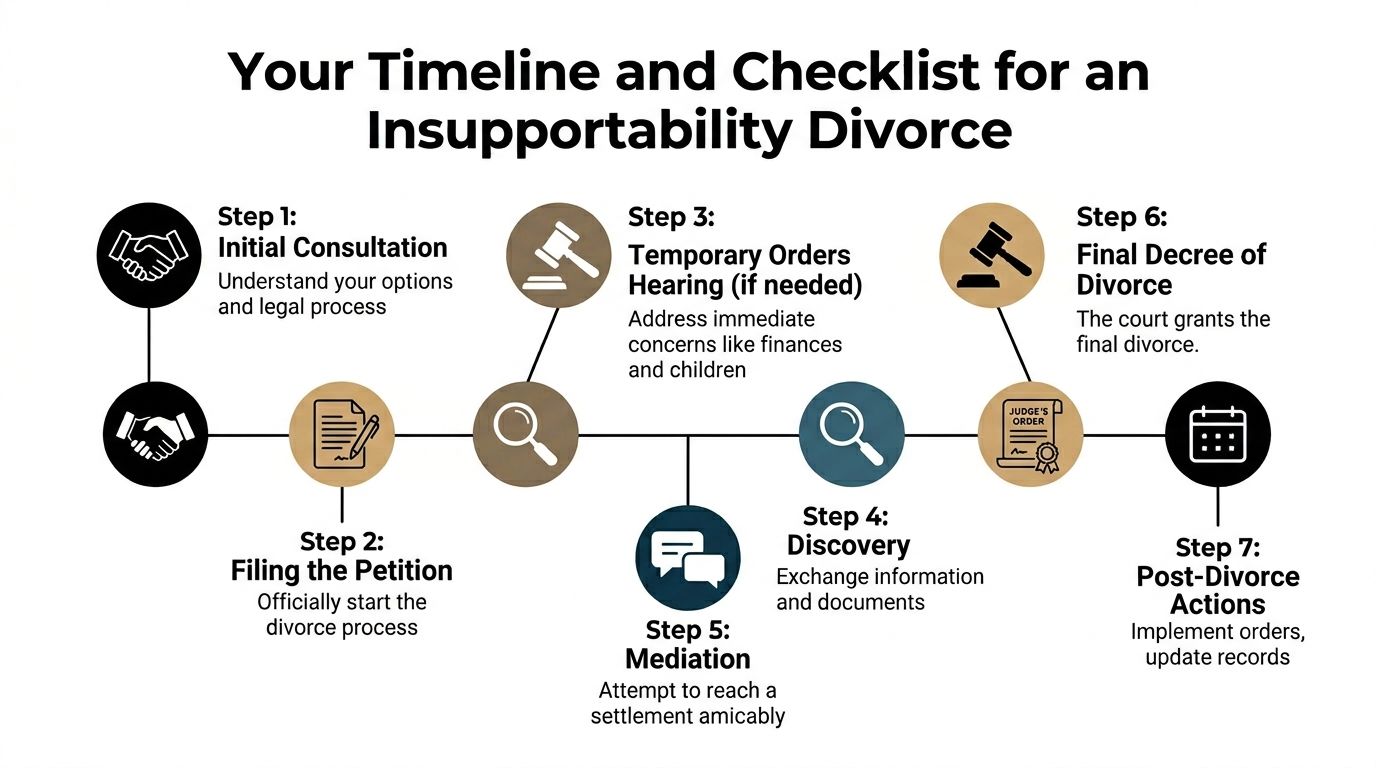
An insupportability divorce usually follows a familiar path, even if the pace varies from case to case. The legal ground may be simple, but the strategy is not. Early choices about documents, temporary routines, and settlement positions can shape how smoothly the case resolves. If you want a deeper overview of pacing and court expectations, this article on understanding the timelines of divorce in Texas can help.
A practical timeline
Day 1
You file the Original Petition for Divorce. Filing starts the case, but it also starts the calendar. Texas generally requires a 60-day waiting period before a divorce can be finalized.
Soon after filing
Your spouse is formally served or signs a waiver. If there is immediate tension over the house, bills, parenting time, or account access, this is often the stage where temporary orders are requested. Temporary orders work like guardrails. They create rules while the larger issues are being resolved.
Early case stage
You begin collecting records and identifying what needs to be decided. For some families, that means tracing separate property. For parents, it may mean setting a workable exchange schedule and making sure school and medical routines stay stable.
Middle stage
Both sides exchange information, negotiate, and often attend mediation. This stage tends to matter more than people expect. A well-prepared mediation can save time, legal fees, and unnecessary conflict, especially in an insupportability case where the focus is often on solutions rather than proving blame.
After the waiting period
Once the waiting period has passed, an agreed case may be finalized by prove-up. A contested case may stay active longer if property values, custody terms, or final decree language are still disputed.
Final stage
The judge signs the Final Decree of Divorce. Then the practical work begins. Titles may need to be transferred, retirement orders may need to be prepared, accounts may need to be closed or divided, and parenting terms need to be put into daily practice.
Your divorce checklist
Use this checklist early, before deadlines and emotions start crowding out details.
Basic identification documents
Driver’s license, current address information, date of marriage, and children’s names and birth informationFinancial records
Bank statements, pay stubs, tax returns, retirement statements, loan documents, and credit card recordsProperty documents
Deeds, mortgage statements, vehicle titles, business records, and information about valuable personal propertyParenting information
School contacts, medical providers, childcare arrangements, activity schedules, and any existing court ordersDigital and practical records
Account lists, insurance information, household bills, and a written summary of recurring monthly expenses
One preparation habit that pays off
Create one folder for documents and one running list of questions.
That simple system works like a map and a toolbox. The folder keeps your proof in one place. The question list keeps you from forgetting issues that matter, such as who will claim a child for tax purposes, how a retirement account will be divided, or what language needs to go into the decree to prevent future disputes.
If you are comparing legal help, firms such as the Law Office of Bryan Fagan, PLLC offer family law guidance on divorce, custody, support, mediation, and enforcement issues through their Texas-focused resources and consultations.
What to Do Next Protecting Your Rights and Your Future
The biggest mistake people make is assuming that a no-fault divorce is a paperwork exercise.
Sometimes it is straightforward. Often it is not.
Key Takeaway
Insupportability is the standard no-fault path to divorce in Texas, but it is only the starting point. The significant work involves protecting your property rights, building workable parenting orders, handling temporary issues, and making sure your final decree is clear enough to enforce.
If you are a parent, focus on facts that support your child’s best interest.
If you own a business, hold significant assets, or suspect money has been hidden or wasted, treat the case like a financial project as well as a legal one.
If your spouse seems agreeable today, still be careful. Friendly conversations do not replace enforceable court language.
A strong next step usually includes:
- Gathering records before conflict grows
- Writing down your top priorities
- Identifying immediate risks involving children, money, or access to property
- Getting legal advice before signing anything
You do not need to know every answer before you speak with a lawyer. You only need enough clarity to take the next responsible step.
When you understand how insupportability interacts with property division, custody, mediation, and final orders, you are in a much stronger position. You can move forward calmly instead of reacting under pressure.
Frequently Asked Questions About Insupportability Divorce
Can my spouse stop an insupportability divorce?
No. A spouse can contest issues in the case, but they generally cannot force you to stay married if the legal standard for insupportability is met.
That is one reason this ground is so commonly used. The court does not require mutual agreement to grant a no-fault divorce.
Do I have to prove specific bad acts?
Usually, no.
In many cases, testimony that the marriage has broken down and cannot reasonably be repaired is enough to support an insupportability divorce. You do not need to build your whole case around accusations just to obtain the divorce itself.
If I file no-fault, can I still bring up adultery or wasted money?
Yes, in many situations.
The divorce ground and the remedy issues are not the same thing. You may file on insupportability and still present evidence relevant to property division if one spouse wasted marital assets or acted in a way that financially harmed the community estate.
Does insupportability mean property will be split equally?
Not necessarily.
Texas courts divide community property in a just and right manner. That analysis can involve many facts beyond the name of the divorce ground. If your estate is simple, the division may be close to equal. If it is complex or one spouse engaged in harmful financial conduct, the result may look different.
Does filing on insupportability hurt my custody case?
No.
Custody decisions are based on the child’s best interest, not on whether you used a fault or no-fault divorce ground. If parenting issues are disputed, the court will still look at evidence about the child’s needs, parental involvement, stability, and any conduct that affects the child.
Is an uncontested insupportability divorce still something I should have a lawyer review?
Often, yes.
Even agreed divorces can go wrong when the decree is vague, property is described poorly, retirement issues are ignored, or parenting language is incomplete. Problems that seem small during the divorce can become expensive after the divorce if the order is hard to enforce.
What if we agree on ending the marriage but disagree on the children or money?
You can still proceed on insupportability.
Agreement on the reason for divorce does not require agreement on every other issue. Many couples accept that the marriage is over but still need negotiation, mediation, temporary orders, or court rulings on finances and parenting.
What should I do first if I think my case may become contested?
Start preserving information.
Gather financial documents, keep records organized, avoid impulsive transfers of money or property, and get legal advice early. If children are involved, document schedules, caregiving responsibilities, school information, and important communications in a calm, factual way.
If you are considering divorce and need clear advice about insupportability, property division, child custody, mediation, or enforcement, schedule a free consultation with Law Office of Bryan Fagan, PLLC. You can get answers specific to your situation and take the next step with more confidence and less uncertainty.