Skip to content
Facing the possibility of losing your parental rights is one of the most frightening experiences any parent can go through. In Texas, parental rights termination is a court action that permanently ends the legal relationship between you and your child. This step is so final and severe that it’s often called the "civil death penalty."
This isn't something that happens out of the blue. Termination can happen voluntarily, like when you agree to an adoption, or it can be involuntary, where another parent, a relative, or even Child Protective Services (CPS) files a lawsuit to take your rights away.
Defining Parental Rights Termination in Texas
When you’re served with a lawsuit trying to terminate your rights, it can feel like the ground has completely fallen out from under you. It is absolutely critical to understand what this legal action means and, just as importantly, what the other side has to prove to a judge to make it happen.
This isn't just about custody or visitation. A termination lawsuit aims to completely and permanently sever the legal bond that makes you a parent in the eyes of the law.

If a court terminates your rights, you would no longer have the right to make decisions about your child’s schooling or healthcare. You’d lose the duty to support them financially and even the right to inherit from them. It’s a profound and irreversible step that Texas courts never take lightly.
The Two-Part Legal Test
For a judge to grant a request to terminate parental rights in Texas, the person suing you has a very high mountain to climb. They must prove two specific things with what's called clear and convincing evidence—a much higher legal standard than in most civil cases.
- Grounds for Termination: First, they have to prove that you committed at least one specific act listed in the Texas Family Code, Section 161.001. These "grounds" include serious actions like endangering your child, abandoning them, or consistently failing to provide support.
- Best Interest of the Child: Second, even if they prove a ground for termination, they also have to prove that terminating your rights is in the child’s best interest. This is a completely separate and equally important finding the court has to make.
Think of it like a vault with two different locks. Proving one of the grounds gets you the key to the first lock, but it’s not enough. The court also has to be convinced that termination is in the child’s best interest before the second lock will turn. Both must be proven for the vault to open.
Voluntary Relinquishment vs. Involuntary Termination
Understanding the path you're on is crucial. Are you considering giving up your rights willingly, or are you being forced into a court battle? This table breaks down the fundamental differences between voluntarily relinquishing parental rights and having them terminated by a court order, helping you quickly understand your situation.
| Aspect | Voluntary Relinquishment | Involuntary Termination |
|---|---|---|
| Initiation | You willingly sign an affidavit to give up your rights, often for an adoption. | A lawsuit is filed against you by another party (e.g., other parent, CPS, stepparent). |
| Parental Consent | You agree to the termination and actively participate in the process. | You do not consent and actively fight the lawsuit in court. |
| Court Process | A court must still approve the relinquishment, but it's typically a more straightforward process. | A full legal battle ensues, requiring evidence, testimony, and a trial. |
| Legal Standard | The court confirms the decision was made knowingly and voluntarily. | The petitioner must prove statutory grounds and best interest by "clear and convincing evidence." |
| Outcome | Your rights are terminated by your own choice, usually leading to an adoption. | A judge issues an order terminating your rights against your will. |
Whether you're facing a forced termination or contemplating a voluntary relinquishment, the consequences are permanent. Knowing the distinction is the first step in making an informed decision.
Who Can File a Termination Lawsuit
It’s a common misconception that only the other parent or CPS can try to terminate your rights. The law actually allows several different people or entities to file a petition.
A petition for parental rights termination in Texas can be a standalone lawsuit or part of another family law case, such as a divorce, a custody modification, or an adoption.
Figuring out who is bringing the case against you is the first step in building a solid defense. In Texas, the following parties may have the legal standing to file:
- The child’s other parent
- A legal guardian or the person with primary custody (managing conservator)
- The Texas Department of Family and Protective Services (DFPS), which most people know as CPS
- A prospective adoptive parent, which is very common in stepparent adoption cases
- Certain family members, but only under very specific circumstances
Knowing what you’re up against is the first step toward protecting your family. This foundational knowledge is your starting point for building a strong, strategic defense to keep your family intact.
The Legal Grounds for Involuntary Termination
When you're fighting to protect your family, the thought of a court taking away your parental rights against your will is terrifying. It’s critical to understand that a judge can't just do this on a whim or because they don't like you. The person suing you has a high bar to clear—they must prove, with clear and convincing evidence, that you committed a specific act outlined in the Texas Family Code.
These legal reasons are called "grounds," and they are the absolute bedrock of any case for involuntary termination. Think of them as a specific list of charges. The other party has to pick at least one from this list and then bring solid, undeniable proof to the court that it actually happened.
Endangerment: The Most Common Ground
By far, one of the most frequently used grounds for termination is endangerment. This sounds like a broad term, but Texas Family Code Section 161.001(1)(D) and (E) gives it shape. It's not just about physical harm. Endangerment means knowingly placing or allowing your child to stay in conditions or surroundings that threaten their physical or emotional well-being.
So, what does that actually look like in the real world? A judge might find a child is endangered if you:
- Expose your child to illegal drug use or severe alcohol abuse in the home.
- Allow your child to witness repeated instances of domestic violence.
- Fail to provide a safe and clean living environment—think a home with no running water, exposed electrical wiring, or extreme filth.
- Leave a young child unsupervised for long stretches of time.
At its core, endangerment is about behavior that creates a risky or harmful environment for your child. It’s a serious accusation, and the person making it has to back it up with specific, credible evidence.
Abandonment and Failure to Support
Two other major grounds for termination center on a parent's absence from a child's life, whether that's physical or financial. These are separate issues, but they often go hand-in-hand.
Abandonment happens when you have voluntarily left the child alone or with another person, failed to provide adequate support, and stayed away for a set period. For example, if you leave your child with their other parent and for at least six months you have no contact and provide zero support, a court could see that as abandonment.
The key here is intent. The court will dig into whether you ever planned on coming back and if you made any real effort to keep a relationship with your child going while you were gone.
Similarly, failure to support can be a ground for termination. If you have the ability to pay child support but don't for a full year (ending within six months of the lawsuit being filed), your parental rights could be on the line. This is much more than just falling behind on a few payments; it's about a consistent, long-term failure to meet your financial duty to your child.
Non-Compliance in CPS Cases
When Child Protective Services (CPS) gets involved, a court will often order parents to complete a "Family Service Plan." This is basically a to-do list designed to fix the problems that put the child at risk in the first place, like attending parenting classes, going to counseling, or getting drug treatment.
Failing to follow this court-ordered plan can become a ground for termination. Under the Texas Family Code, if you don't comply with the specific actions a court ordered for you to get your child back, that failure can be used against you. From the court's perspective, this shows that you are either unable or unwilling to provide a safe home, even with the state's help.
Understanding the specific legal grounds you're being accused of is the first step in building a defense. It allows you and your attorney to zero in on disproving those exact claims and showing the court why keeping your family together is what’s truly best for your child.
How the Court Process Unfolds Step by Step
The thought of facing a lawsuit to terminate your parental rights is terrifying, and the legal system can feel like a confusing, intimidating maze. Knowing the road ahead, however, can give you a measure of control and dial down the anxiety. Let's walk through the typical timeline of a termination case, not as one giant, scary event, but as a series of manageable stages.
This entire process is designed to move carefully, making sure every single person has a fair chance to be heard before a judge makes a final, life-altering decision. The journey begins the moment a formal petition is filed with the court.
Filing the Petition and Getting Served
The first official step is the filing of a petition. This is the legal document that kicks off the lawsuit. It will be filed by the other parent, another family member, or the Texas Department of Family and Protective Services (DFPS), which most people know as CPS. The petition lays out who is suing you, exactly why they believe your rights should be terminated, and which legal grounds they are claiming.
Soon after, you will be formally "served" with the lawsuit. This isn't a casual thing—it means a constable, sheriff, or private process server will hand-deliver a copy of the petition and a legal notice called a citation. You absolutely cannot ignore these papers. The citation gives you a strict deadline to file a legal response, known as an "Answer." If you miss that deadline, the court could issue a default judgment against you, potentially terminating your rights without you ever getting to tell your side of the story.
Initial Hearings and the Role of the Ad Litem
Once you've been served and your attorney files an Answer on your behalf, the court will start scheduling initial hearings. The first is usually a hearing for Temporary Orders. In this hearing, the judge makes immediate, short-term decisions about where the child will live, who gets to see the child (and under what conditions), and other rules everyone has to follow while the case is active.
Because the child's best interest is the court's number one priority, the judge will also appoint an attorney ad litem. This is a neutral lawyer whose only client is your child. The ad litem acts as an investigator, interviewing you, the other parent, the child (if they're old enough), teachers, therapists, and anyone else relevant to the case. After gathering all this information, they will make a recommendation to the judge about what they believe is truly in the child’s best interest.
This flowchart shows some of the core issues, like endangerment and abandonment, that often start these court proceedings in the first place.
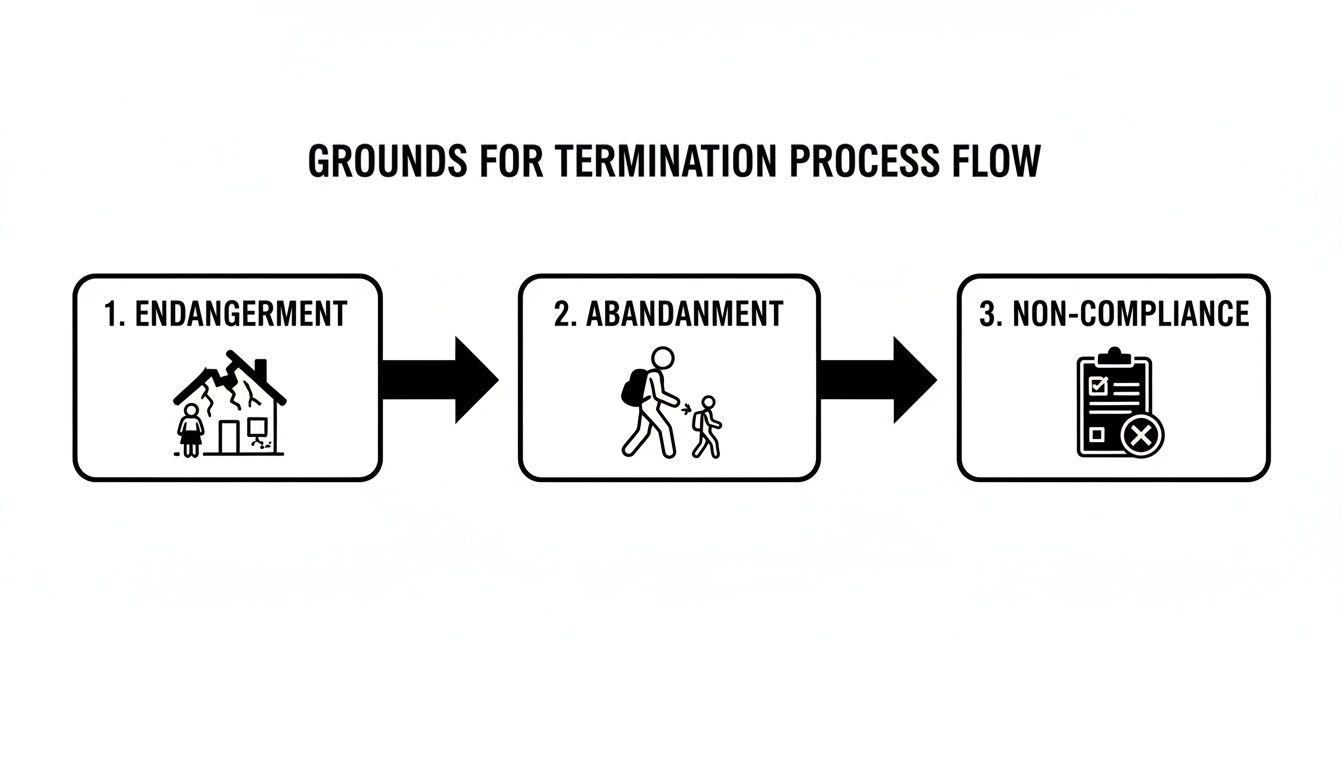
As you can see, serious allegations are what trigger this complex legal process and set everything in motion.
Discovery, Mediation, and Final Trial
With temporary orders in place, the case moves into the discovery phase. Think of this as the formal evidence-gathering stage where both sides exchange all their information. Your attorney might send written questions (Interrogatories), request specific documents (Requests for Production), or take sworn testimony outside of court (Depositions). This is where all the facts of the case are brought into the light.
Before a case can go to a final trial, Texas courts require both sides to attend mediation. This is a confidential negotiation where you, the other party, and your lawyers sit down with a neutral third-party mediator to try and find common ground. It might feel impossible to reach an agreement, but mediation can sometimes lead to creative solutions that avoid a painful trial and result in a better outcome for your child.
If mediation doesn't produce an agreement, the last stop is the trial. This is where each side presents their evidence, calls witnesses to the stand, and makes their legal arguments directly to the judge. After hearing everything, the judge will make a final, binding decision on whether to terminate your parental rights based on the evidence.
Given the high stakes, Texas has historically seen a significant number of these cases. Federal data shows that Texas finalized TPRs for approximately 91,589 children between 2006 and the last reported year. This figure reflects both a high rate of adoption from foster care and a proactive approach by state agencies in filing these petitions. You can explore more data about these trends and their impact on Texas families.
Understanding this step-by-step process is the first move toward building a strong defense. Knowing what’s coming next helps you and your attorney stay one step ahead.
Understanding the Best Interest of the Child Standard
When you're facing a lawsuit to terminate your parental rights, it feels like your entire world is on the line—because it is. The other party has to prove a specific legal reason, like endangerment or abandonment, but that’s only half the battle. They also have to convince a judge that permanently severing your relationship with your child is truly in their best interest. This isn't just a vague feeling; it's a tough legal standard that steers every single decision a Texas family court makes.
Think of the "best interest of the child" as the North Star of your case. Everything revolves around it. A judge can’t terminate your rights just because a mistake was made. They must find, with clear and convincing evidence, that your child will have a better, safer, and more stable future without you as their legal parent. This is a profound decision, and Texas courts do not take it lightly.
What Are the Holley Factors?
So, how does a judge figure out what's really in a child's best interest? They don't just guess. The Texas Supreme Court laid out a specific set of criteria, famously known as the Holley Factors, to guide their analysis. These factors give the judge a roadmap for looking at the entire family situation from multiple angles.
Understanding these factors is crucial because they show you exactly what the court is looking for. This is your blueprint for building a defense that shows why keeping your family together serves your child’s needs. Your attorney will help you present evidence related to each relevant factor to paint a complete and honest picture for the court.
A Breakdown of Key Factors
While there are many factors, some carry a lot of weight in termination cases. A judge will carefully consider the evidence presented on each of these points before making a final decision. For a deeper dive, you can learn more about the guiding principles for custody decisions under the best interest of the child standard in our detailed article.
Here are some of the most critical Holley Factors a judge will examine:
- The Child’s Needs: This covers the child's emotional and physical needs, both now and in the future. The court will ask if you can provide a safe, nurturing home where the child can truly thrive.
- Parental Abilities: The judge will look at the parenting skills of everyone involved. This means assessing your ability to provide daily care, guidance, and the emotional support a child needs.
- Stability of the Home: The court strongly prefers a stable home environment. Evidence of a secure, consistent, and predictable home life is incredibly powerful in these cases.
- Acts or Omissions of the Parent: The judge will review any actions—or failures to act—that might point to an unhealthy parent-child relationship. This is where allegations of endangerment or neglect are closely examined.
- The Child’s Desires: If the child is mature enough (usually age 12 or older), the judge may listen to their wishes, although the child’s preference is not the only thing that matters.
A judge’s role is to weigh all these factors together. No single factor decides the outcome. Instead, the court looks at the total picture to decide what arrangement will best protect the child’s long-term well-being. Proving that termination is not in your child's best interest is a central pillar of your defense.
How to Defend Your Parental Rights
Getting served with a petition to terminate your parental rights feels like a punch to the gut. It's a moment of pure fear and disbelief, but it is not the end of the road. It’s actually the beginning of your defense. You have every right to fight back, to tell your side of the story, and to show a judge exactly why your child belongs with you.
This is the time for proactive, strategic action. Your entire defense will revolve around challenging the evidence brought against you, showing the positive steps you’ve taken, and ultimately, arguing why termination is simply not in your child’s best interest. You have more control than you might think right now, and this is your chance to use it.
Challenging the Evidence and Building Your Case
The person suing you—whether it’s the other parent or the state—has a very high legal mountain to climb. They must prove their case with clear and convincing evidence, which is a tough legal bar to meet. Your first line of defense is to poke holes in their arguments and present your own counter-evidence. This means directly taking on the specific grounds they've alleged in their petition.
For example, if you're being accused of neglect, you can start building a case that proves you provide a safe and stable home. This isn’t just about what you say; it’s about what you can show. Evidence could include:
- Photographs and videos of your clean, well-maintained home.
- Testimony from neighbors, teachers, or friends who can vouch for your parenting skills and the condition of your home.
- Medical records showing consistent well-child checkups with your pediatrician.
If the accusation is a failure to support your child financially, you can fight back with receipts for clothes, food, or school supplies you've bought. Bank statements showing money transfers also work. The goal here is to systematically dismantle their claims with concrete proof that tells a different, more accurate story.
Demonstrating Positive Change and Stability
Judges want to see parents who are committed to doing what’s right for their kids. Period. One of the most powerful ways to defend your parental rights is to show the court you've made tangible, positive changes in your life. This is all about showing, not just telling.
Have you taken steps to address the issues that led to the lawsuit in the first place? If substance abuse was a concern, you can present certificates from a completed treatment program and evidence of ongoing sobriety. If your housing situation was unstable, you can provide a copy of your new lease and utility bills.
The court looks for evidence of stability and a parent's commitment to creating a safe environment. Proving you have secured stable housing, maintained steady employment, and completed court-ordered services like counseling or parenting classes can significantly strengthen your defense.
Every single positive step you take becomes another piece of evidence. It shows the court that you are a capable and dedicated parent who is willing to do whatever it takes to provide a healthy future for your child.
Exploring Alternatives to Termination
Sometimes, the best defense involves finding a middle ground. An all-or-nothing trial isn't always the only path forward. In some situations, it may be possible to negotiate an outcome that avoids the permanent finality of termination while still addressing the court's concerns about your child's well-being.
One common alternative is a modified custody order. This could involve appointing someone else, like a grandparent or a trusted relative, as the child's primary caregiver (or "managing conservator") while you retain your legal parental rights. This kind of arrangement allows you to keep your legal status as a parent, have visitation, and maintain a relationship with your child—a far better outcome than termination. Mediation is an excellent place to explore these kinds of creative, family-focused solutions.
Even in situations where rights have been terminated, not all hope is lost. Recent Texas legislation has started to create pathways for parents to seek reinstatement of their rights under specific conditions, particularly for those who have overcome significant challenges like incarceration. If CPS has been involved, you can learn more about your options in our guide on how a parent can regain custody after a CPS removal in Texas. This shift highlights the state's growing recognition that people's circumstances can—and do—change for the better.
Your Immediate Next Steps to Protect Your Family
When you get served with a lawsuit seeking to terminate your parental rights, it feels like the ground has crumbled beneath your feet. But this is not the time to freeze. It's time for clear, deliberate action. The legal system waits for no one, and those court deadlines are non-negotiable.
Here’s a straightforward, actionable plan to guide your very next moves.

How you react in these first few critical days can set the stage for your entire case. Taking the right steps now builds the foundation for a strong defense and shields your family from even more distress.
Your Action Plan
Don't wait a single day to start protecting your relationship with your child. Follow these steps immediately:
- Never Ignore the Lawsuit: This is the single biggest mistake you can make. When you're served with papers, Texas law gives you a very short, specific window to file a formal answer with the court. If you miss that deadline, the other side can win by default—meaning your rights could be terminated before you ever get a chance to tell your side of the story.
- Organize Every Document: Start gathering every single piece of paper related to your case. This means the court papers you were served, any letters or emails from the other party or their lawyer, and even relevant text messages. Keep everything together in one safe place.
- Document Everything: From this moment forward, keep a detailed journal. Log every single interaction concerning your child—phone calls, visits, exchanges, and any important events. Be specific with dates, times, and what was said or done. These details are your evidence.
- Comply with All Court Orders: If there are any existing custody or visitation orders in place, follow them perfectly. Showing the court that you respect its authority is vital to your credibility. If a genuinely dangerous situation arises, you may need to learn how to get an emergency custody order in Texas to keep your child safe.
- Hire an Experienced Attorney Immediately: The stakes in a termination case are the highest they get in family law. This isn't a DIY situation. You absolutely need a skilled advocate who lives and breathes this area of the law and knows how to fight for you.
The most powerful thing you can do for your family right now is get expert legal advice. You do not have to walk through this fire alone.
Common Questions About Parental Rights Termination
Facing a legal battle over your parental rights is overwhelming. It’s a storm of emotions, legal jargon, and fear for your child's future. We get it. You have a million questions running through your mind, and you need clear, straightforward answers. This section tackles the questions we hear most often from parents in your exact situation.
Can the Court Terminate My Rights Without My Agreement?
Yes, a court absolutely has the authority to end your parental rights even if you are completely against it. This is what the legal system calls an involuntary termination.
It’s not a decision any judge takes lightly. But if the person suing you can provide clear and convincing evidence that a legal reason exists (like endangerment) and can also show that termination is in your child's best interest, the judge can permanently sever your legal bond with your child. In these cases, your consent is not a factor.
How Long Will a Termination Lawsuit Take?
There's no single answer to this one; the timeline for a parental rights termination in Texas really depends on the specifics of your case. It can be a quick process or a very long one.
- Uncontested Cases: If everyone is in agreement, like in a stepparent adoption where you voluntarily sign over your rights, the whole process can be wrapped up in just a few months.
- Contested Cases: This is a different story. If you fight the termination, especially if Child Protective Services (CPS) is involved, you're looking at a much longer journey. These cases often require a full trial and can easily stretch out for a year or even longer.
Texas courts try to move these cases forward because they know children need stability. But the process has to be thorough, which means giving both sides the time to build their case and be heard.
Is It Possible to Reverse a Termination Order?
Once a judge’s signature is on that final termination order, the door is almost completely shut. Undoing that decision is incredibly rare and exceptionally difficult. The court system views termination as a final, permanent step to give a child a stable, lasting home.
While some very recent and narrow changes in Texas law have opened a tiny window for reinstatement in highly specific circumstances, you should never, ever bank on this being an option. Your only real chance to win is to fight with everything you have during the initial lawsuit.
This is why you have to act decisively from the moment you're served with papers. The fight for your child isn't something you can put off—it's happening right now.
What to Do Next
The fear and confusion you're feeling are completely understandable, but you are not powerless. At The Law Office of Bryan Fagan, we stand beside parents during their toughest battles, offering the strong, compassionate guidance needed to navigate this crisis. We have helped countless Texas families protect what matters most, and we are ready to build a powerful defense for you.
Schedule a free, confidential consultation with our team today. Let’s sit down, talk through your case, examine the allegations against you, and start building a clear strategy to fight for your future with your child. Learn more about our services.