Skip to content
That sinking feeling when your current custody agreement just doesn't work anymore is a heavy burden. Life changes, children grow, and what once seemed fair can quickly become impractical, leaving you feeling stuck and your child caught in the middle. To legally change your custody order in Texas, you must file a formal Petition to Modify the Parent-Child Relationship with the court. It’s not enough to simply want a change; you have to prove two critical things: that a material and substantial change in circumstances has occurred since your last order, and that your proposed modification is in the best interest of your child. A simple handshake deal won't hold up in court—only a new, signed order from a judge can legally change your rights and duties.
When Your Custody Order No Longer Fits Your Life

Life doesn’t stand still after a divorce decree is signed. You might get a new job, your ex may move, or your child’s needs can evolve in ways you never anticipated. An order that was perfect for a toddler can become completely impractical for a teenager juggling school, sports, and a social life. It’s easy to feel overwhelmed by an outdated arrangement that no longer serves your family.
The good news is, you’re not stuck. The Texas Family Code was written with the understanding that families change. The law provides a clear path for parents like you to adjust their orders to match their current reality. This process is called a modification, and it’s a necessary tool for co-parents seeking to create a stable, supportive environment for their children.
The Two Legal Pillars for Modification
Before a Texas judge will consider changing your custody order, you have to prove two fundamental things. Think of these as the legal keys that unlock the courthouse door for your case:
- A Material and Substantial Change in Circumstances: This is the legal standard you'll hear over and over. It means something significant has to have happened after your last order was signed. Minor disagreements or small scheduling conflicts won't be enough. As outlined in the Texas Family Code, this change must be a major shift in the life of the child or one of the parents.
- The Best Interest of the Child: This is the guiding principle in every Texas family law case. Any change you're asking for must be proven to benefit your child's physical and emotional well-being. The court’s primary focus is always on your child, not on the parents' convenience.
These two pillars work together. First, you prove the substantial change happened. Then, you prove that modifying the order because of that change is what's best for your child.
What Counts as a "Substantial Change"?
That legal phrase can feel vague, but in practice, it applies to many common life events. So what does a judge actually look for? Here are some of the most common reasons we see for a modification:
- One parent is relocating for a new job, making the current possession schedule impossible to follow.
- A child's medical or educational needs have changed significantly, requiring a different living environment or school district.
- The other parent’s living situation has become unstable or dangerous due to substance abuse, criminal activity, or neglect.
- One parent has consistently refused to follow the current court order, creating constant conflict and instability for the child.
- The child, if over the age of 12, has expressed a clear and strong desire to change which parent they live with primarily.
To give you a clearer picture, here’s a quick breakdown of common scenarios that courts often consider.
Common Reasons for Custody Modification in Texas
| Change of Circumstance | Real-World Example | Why a Court May Consider It |
|---|---|---|
| Parental Relocation | The primary parent gets a major job promotion but has to move 200 miles away. | A long-distance move makes the standard possession order impractical and requires a new travel and visitation plan. |
| Change in Child's Needs | A child is diagnosed with a severe learning disability and needs to attend a specialized school in the other parent's district. | The child's educational and developmental needs now outweigh the previous arrangement, making a change necessary for their well-being. |
| Unsafe Environment | The other parent has a new partner with a history of domestic violence or begins abusing drugs or alcohol. | The court's primary duty is to protect the child from physical or emotional harm, making this a very compelling reason for change. |
| Failure to Comply | One parent consistently denies the other their court-ordered visitation time for months on end. | This pattern shows a disregard for the court's authority and creates instability, which is not in the child's best interest. |
| Child's Preference | A 14-year-old child expresses a strong desire to live with their other parent to be more involved in a specific school program. | While not the only factor, a mature child's preference is given significant weight by the court when considering their best interest. |
This table isn't exhaustive, but it shows the kinds of significant life changes that typically get a judge's attention.
A Texas court won't reopen a custody case for minor reasons. The goal is to provide stability. Your reason for seeking a change must be significant enough to justify disrupting the child’s current routine for their long-term benefit.
Why Informal Agreements Are a Risky Shortcut
It's tempting to work out changes with your ex over a text message, especially if you’re on good terms. "Let's just switch weekends from now on" seems simple enough. But these verbal agreements are not legally enforceable.
If your co-parent suddenly changes their mind and decides to stick to the old order, you have no legal recourse. The original court order is the only document that matters. A formal modification protects both you and your child by creating a clear, predictable, and legally binding plan that everyone must follow. This process is governed by specific legal standards, and when parents live in different states, it can get even more complicated. You can explore insights into custody dispute jurisdiction to better understand these complexities.
Understanding the Material and Substantial Change Standard
That feeling when you realize your life has completely changed but your court order is stuck in the past can be deeply frustrating. In Texas, you can’t just ask a judge to change a custody agreement because it’s inconvenient; you have to prove a very specific legal requirement: a “material and substantial change in circumstances.”
This legal phrase is the gatekeeper for all modification cases. Getting a handle on what it actually means in the real world is the first critical step toward building a successful case. This isn't about small annoyances or parenting disagreements over screen time. A court is looking for a major shift in the life of the child or one of the parents that has a real, tangible effect on the child's well-being. And here's the key part: this change must have happened after your current order was signed by a judge. The court's main goal is to keep things stable for kids, so it won’t shake up a child's life without a very good reason.
What Does "Material and Substantial" Mean in Practice?
Let's cut through the legal jargon. A "material" change is something relevant and significant to the child's life. A "substantial" change means it's a big deal, not a minor hiccup. The two concepts work together to create a high bar you have to clear.
Think of it this way: your ex getting a 5% raise probably isn't a substantial change. But if your ex suddenly triples their income, quits their job, and moves into a dangerous neighborhood, that combination of events could absolutely be seen as material and substantial.
Here are a few scenarios that often meet this standard:
- A Parent's Remarriage and Relocation: If your co-parent gets married and their new spouse’s job forces them to move to another state, this is a classic example. It directly impacts the current visitation schedule and your ability to see your child.
- A Child's Worsening Performance in School: Maybe your child was an A-student, but now they're failing classes and the school has documented severe behavioral problems. This can be a material change because it suggests their current environment isn't working for them anymore.
- Development of a Serious Health Condition: If you, your co-parent, or your child develops a serious medical issue that impacts caregiving or requires specialized treatment, a judge will almost always view this as a substantial change.
At the end of the day, the core question a judge asks is this: "Has something significant happened since the last order was signed that now makes the old arrangement unsuitable for this child's well-being?"
Changes That Typically Don't Make the Cut
It’s just as important to know what won’t work. Filing a modification petition without a solid reason can waste a ton of time, money, and emotional energy. Courts have no interest in re-litigating old fights or policing minor parenting differences.
These situations generally do not meet the material and substantial change threshold:
- Minor disagreements over parenting styles (e.g., diet, bedtimes).
- Small or temporary dips or increases in a parent’s income.
- A parent getting a new boyfriend or girlfriend, unless that person poses a genuine danger to the child.
- The normal challenges that come with a child getting older, unless they are extreme.
A judge expects parents to figure out how to co-parent through the small stuff. The court system is designed to step in only when a major life event fundamentally changes the game. For a deeper dive into what qualifies, you can get some great perspective by understanding material circumstances in Texas family law and how judges tend to see these issues. Before you file anything, you must be able to point to the specific, significant event that happened after your last order and explain exactly how it's harming your child. This is the foundation your entire case will be built on.
Building Your Case with Compelling Evidence
Knowing you need to change your custody order is one thing. Proving it to a judge is another ballgame entirely. A successful modification hinges on credible proof, not just your gut feelings or frustrations with the other parent. The court needs to see a clear, factual picture of the material and substantial change in circumstances. This is where building a strong case with compelling evidence becomes your most important job.
Your goal is to show the judge why the old order no longer works for your child, not just tell them. This means getting past the "he said, she said" and presenting a solid foundation of documented proof.
Documenting Your Co-Parent's Instability or Unsafe Behavior
If your request is driven by concerns about your co-parent's behavior or a chaotic new environment, your documentation has to be meticulous. Vague claims of "instability" won't cut it. You need to create a clear timeline of events, supported by hard evidence.
This is where you become a diligent record-keeper. Save absolutely everything that illustrates the problem.
- Text Messages and Emails: Keep screenshots of hostile, threatening, or concerning communications. Make sure every screenshot clearly shows the date and time. One angry text might be brushed off, but a consistent pattern over several months tells a much more serious story.
- Social Media Posts: If your co-parent is posting about illegal drug use, excessive drinking, or other reckless behavior, these can be powerful evidence in court. Screenshots are crucial here, because posts can vanish in an instant.
- Witness Observations: What other people have seen can be invaluable. Ask trusted friends, family members, teachers, or neighbors who have witnessed the behavior if they'd be willing to provide a statement or even testify. A neutral, third-party perspective carries significant weight.
- Police Reports or CPS Records: If law enforcement or Child Protective Services has been involved, getting copies of these official reports is a must. They provide an objective record of serious incidents that a judge will take very seriously.
Sometimes, a co-parent's toxic behavior is more subtle and manipulative, like trying to turn a child against you. If you suspect this is happening, it’s critical to document specific instances. Understanding how to prove parental alienation can give you a solid framework for gathering the right kind of evidence for these incredibly difficult situations.
Evidence for Changes in Your Child’s Needs
Not every modification is about bad behavior. Often, a change is necessary simply because your child’s own needs have evolved. This happens all the time as kids become teenagers or if they develop new health or educational challenges.
The strongest evidence in these cases often comes straight from the professionals who work directly with your child. A doctor’s note or a teacher’s email carries far more weight than a parent’s opinion alone because it’s seen as objective and focused purely on the child's well-being.
To build your case, concentrate on collecting these key documents:
- Medical Records and Doctor’s Notes: If your child has a new medical diagnosis or needs specialized care, get letters from their doctors. These should explain the condition and why a specific routine or living environment is necessary.
- Therapist or Counselor Recommendations: If your child is in therapy, their counselor may be able to provide a letter (with all the proper legal and ethical permissions) detailing your child's emotional state and what environment would best support their mental health.
- School Records and Report Cards: Has there been a sharp drop in grades? Attendance issues? Notes from teachers about behavioral problems? This can be powerful evidence that the child is struggling under the current arrangement.
- Emails from Teachers or School Counselors: Direct communications from the school that document their concerns can create a clear link between your child's struggles and their home environment.
Organizing Your Evidence for Maximum Impact
Gathering evidence is only half the battle. How you present it to the court matters immensely. Showing up with a disorganized shoebox full of papers can confuse a judge and undermine your argument. You need to create a clear, chronological story.
Get a binder or create a digital folder with labeled sections for each type of evidence (e.g., "Text Messages," "School Records," "Witness Statements"). For each piece of proof, add a short note explaining why it's important. For example: "Email from teacher, Oct. 15, 2023, discussing John's fatigue and unfinished homework after weekends at his father's house."
This level of organization does more than just help you prepare for mediation or court. It shows the judge that your request is well-thought-out and based on a consistent pattern of facts, not just a single, emotional outburst. It proves you are a prepared, credible, and responsible parent focused on one thing: your child's best interest.
Navigating the Texas Court Process for Modification
So you've gathered your evidence and you're confident it's strong enough. What happens now? The road from knowing you need a change to holding a new, signed court order in your hands can feel overwhelming. Let's break down the Texas court process, step by step, so you know exactly what to expect.
Your journey starts by officially asking the court to step in. You can't just write a letter or make a phone call; you have to file a formal legal document called a Petition to Modify the Parent-Child Relationship. This petition is your formal request. It lays out the "material and substantial" changes that have happened and, most importantly, explains why the modification you’re asking for is truly in your child's best interest.
Once your petition is filed with the court clerk, it has to be legally delivered to the other parent. This is called service, and it’s not as simple as dropping a copy in the mail. Usually, a sheriff, constable, or a private process server will personally hand them the lawsuit papers. This crucial step ensures they are officially notified of the case and have an opportunity to respond.
The Role of Temporary Orders
Sometimes, waiting months for a final hearing just isn't an option. If your child is in an unsafe environment or there's an urgent issue—like the other parent suddenly planning to move out of state with your child without your permission—you can ask the court for Temporary Orders.
These are short-term rulings a judge can make to put protections in place while the modification case moves forward. To get them, you'll have a brief hearing where a judge listens to the immediate concerns and decides if urgent action is needed to protect your child's physical or emotional well-being.
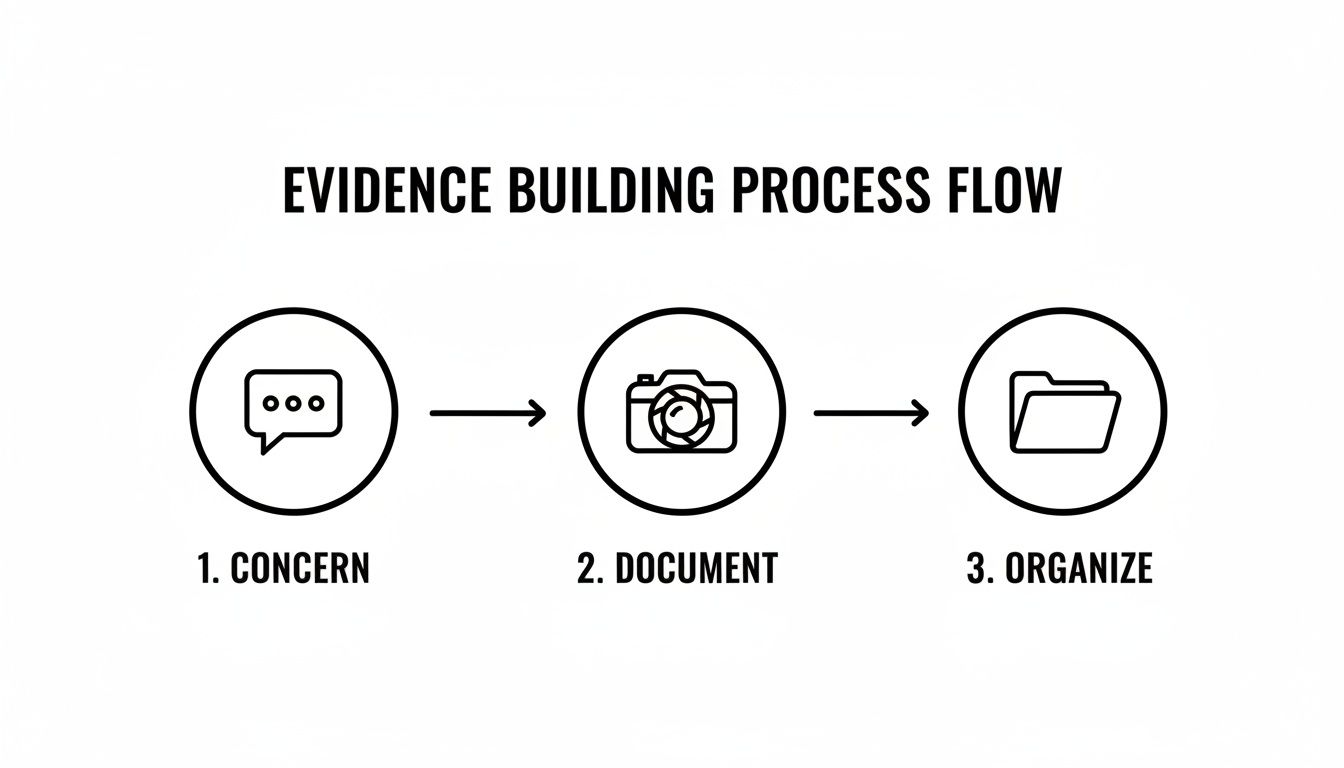
This structured approach is how you turn your concerns into the kind of compelling evidence that gets a judge's attention.
Mediation: The Heart of the Process
Before you ever set foot in a courtroom for a final trial, you will almost certainly be ordered to attend mediation. Most counties in Texas mandate that parents try to work out their dispute with a neutral, third-party mediator before taking up a judge's time.
Mediation isn’t about winning or losing. It's a confidential, structured negotiation where you and your co-parent—with your attorneys present—have the control to create a custom agreement that actually works for your family's unique situation.
The mediator doesn't make any decisions for you. Their job is to facilitate a productive conversation and help both sides find common ground. If you're successful, you'll sign a Mediated Settlement Agreement (MSA). An MSA is a powerful document; once signed, it's irrevocable and becomes the blueprint for the final order the judge will sign. This process can save you an immense amount of stress, time, and money compared to a full-blown court battle.
When You Cannot Reach an Agreement
But what happens if mediation doesn't work? If you and the other parent are truly at an impasse and can't find a middle ground, your case will start moving toward a final hearing or trial. This is where things get more formal, kicking off a process called discovery, where both sides legally exchange information.
Discovery can involve several tools:
- Requests for Production: Asking for specific documents like text messages, emails, financial statements, or school records.
- Interrogatories: Sending a list of written questions that the other party must answer under oath.
- Depositions: Questioning the other parent or key witnesses in person, under oath, while a court reporter transcribes every word.
The whole point of discovery is to make sure there are no bombshells or surprises at trial. Both sides get to see the evidence and arguments the other plans to present. During this time, if your co-parent is blatantly ignoring parts of the current order, you may need to take action. This often means filing a separate motion to enforce the existing custody order to hold them accountable.
If you ultimately can't reach an agreement, a judge will hear the testimony, review all the evidence, and make a final, binding decision based on one single standard: what they believe is in the child's best interest.
The Specific Changes You Can Request from the Court
Knowing you need a change is one thing, but pinpointing exactly what needs to change is the critical next step. When you file a modification suit, you aren't just telling the judge things are different now; you're asking for specific, legally defined parts of your custody order to be rewritten. It’s about tailoring the order to fit where your family is today.

In Texas, your custody order is built on three main pillars defined by the Texas Family Code. You can ask to modify one, two, or all three of them.
Modifying Conservatorship: Your Decision-Making Rights
Conservatorship is the legal term Texas uses for a parent's rights and responsibilities. Think of it as the power to make the big decisions for your child. A modification here is often needed when the current decision-making arrangement is either causing constant gridlock or simply doesn't serve your child’s best interest anymore.
For instance, you might need to ask the court for:
- The Right to Designate the Primary Residence: This is a huge one. It means asking to be the parent the child lives with most of the time and who receives child support.
- Exclusive Medical Rights: Let's say your child develops a serious medical condition and the other parent is uncooperative with treatment. You might need to ask for the exclusive right to consent to all medical and dental care.
- Exclusive Educational Rights: In the same vein, if you and your co-parent are at a complete standstill about where your child should go to school, one of you could ask for the final say on educational decisions.
These aren't casual requests. You'll need to present a compelling argument for why giving you these exclusive rights is a clear improvement for the child over the current setup.
Adjusting Possession and Access: The Visitation Schedule
The most common reason parents head back to court is to change the possession and access schedule—what everyone else calls visitation. A schedule that made sense for a kindergartener is often totally unworkable for a 15-year-old juggling a part-time job and a demanding sports schedule.
Common changes you could request include:
- Tweaking the holiday schedule to accommodate new family traditions or travel.
- Shifting weekday or weekend pickup times to align with new work or school hours.
- Moving from a Standard Possession Order to a more customized 50/50 schedule if both parents now live much closer to each other.
Family courts are also evolving with the times. There's a growing recognition of the benefits of shared parenting, with national research showing shared physical custody arrangements have more than doubled in recent decades. Judges are often more receptive to these schedules when they see parents who can cooperate. You can discover more insights about shared parenting trends on demographic-research.org.
The Special Case of Relocation
Without a doubt, one of the toughest and most emotionally draining modifications is a relocation case. If your order has a geographic restriction (like you must live within a certain county or school district), you have to get the court's permission to move outside that area with your child.
In a relocation case, you aren't just changing a schedule; you are asking a judge to fundamentally alter the other parent's relationship with their child. The legal hurdles are high, and you must prove that the move is in the child’s best interest, not just your own.
This requires putting together a very detailed plan. You'll need to show the judge exactly how the child will maintain a strong, consistent relationship with the other parent. This includes a new long-distance possession schedule, a clear plan for who pays for travel, and how you'll use virtual visitation to bridge the distance.
What to Do Next
Trying to figure out a custody modification can feel like you're staring at a mountain with no clear path up. But you can move forward with confidence by taking clear, deliberate steps. This whole process is really about making your legal orders match your family’s real life, and most importantly, keeping your child’s needs front and center.
So, where do you start? The best way forward is with a structured, thoughtful approach.
- Assess Your Situation: Take a hard, honest look at what has changed in your life. Does it truly meet the "material and substantial" standard required by the Texas Family Code?
- Organize Your Evidence: Start gathering and organizing every document, message, and potential witness that backs up your case.
- Define Your Goal: What specific changes do you believe are in your child’s best interest? Is it a change to the visitation schedule? Decision-making rights? Or all three?
- Consult a Professional: Before you file a single piece of paper, talk to an experienced family law attorney. They can give you a realistic assessment of your chances and guide you through every step.
Your family's future is far too important to leave to chance. Taking decisive, informed action now can create the stability and peace of mind your child truly deserves.
Navigating a custody modification is a complex journey, but you don't have to walk it alone. We invite you to schedule a confidential, free consultation with The Law Office of Bryan Fagan, PLLC. Let us help you understand your options and map out a clear strategy for your path forward.
Common Questions About Modifying Custody in Texas
When you're thinking about changing your custody order, your mind is probably racing with questions. It’s completely normal. Let’s walk through some of the most common concerns we hear from parents in your exact situation.
How Long Does a Modification Take in Texas?
This is one of the first things everyone asks, and the honest answer is: it depends. The timeline for modifying a custody agreement can vary wildly.
If you and your co-parent are on the same page and agree on all the changes, the process can be wrapped up in just a couple of months. But if it's a contested case—meaning you disagree on major issues—it can easily stretch from six months to over a year. It all comes down to the court's schedule, the complexity of your family's situation, and the level of cooperation between you and the other parent.
Can My Child Decide Who to Live With?
We get this question a lot, especially from parents with teenagers. It’s a common misconception. Under the Texas Family Code, a child who is 12 or older can meet with the judge in private to state their preference.
The judge is required to listen to what they have to say, but—and this is the critical part—it's not the deciding factor. The judge’s final decision will always come down to the child's overall best interest, which includes their safety, emotional well-being, stability, and many other factors far beyond their stated wishes.
What if We Both Agree on the Changes?
Reaching an agreement is fantastic news. It's always the simpler, faster, and much less expensive way to handle a modification.
Even with a full agreement, however, you can't just shake hands and call it a day. You still have to file the official legal paperwork and submit an Agreed Order for a judge to sign. Without that signature on a court order, your private agreement isn't legally binding or enforceable. It's a crucial final step to make your new arrangement official.
Navigating the specifics of a custody modification requires clear strategy and knowledgeable guidance. The attorneys at the Law Office of Bryan Fagan, PLLC are here to protect your family and your future. Schedule a free, confidential consultation with us today to get the answers you need. Visit https://texasdivorcelawyer.us to get started.