Skip to content
Divorce can make you feel like the floor has dropped out from under your finances, especially if you've spent years building a home, raising children, or supporting your spouse's career instead of your own.
If you're searching for answers about rehabilitative spousal support texas, you're probably asking a very practical question: how am I supposed to support myself while I rebuild? Texas law does offer a path in some cases, but it's a narrow one. The court doesn't treat spousal maintenance like an automatic right, and it doesn't award it just because one spouse earns more.
What Texas does allow is a temporary, structured form of support meant to help a qualifying spouse move toward self-sufficiency. That sounds simple enough, but many individuals get stuck on the same points. Who qualifies? What does “minimum reasonable needs” mean? What proof does a judge expect? And how do you show that you're really trying to get back on your feet?
Careful preparation is of great importance. In many cases, the outcome turns less on emotion and more on documentation, timing, and the credibility of your evidence.
Facing Your Financial Future After Divorce
You may be looking at your life right now and seeing a gap between where you are and where you need to be. Maybe you've been out of the workforce while raising children. Maybe you worked part time so your spouse could pursue a demanding career. Maybe you have skills, but they need updating before they can support you after divorce.
Texas law recognizes that this situation is real. It just addresses it in a limited way. Instead of long-term dependence, Texas focuses on temporary support that gives a spouse time to get education, training, or work.

Why this matters so much
A lot of people hear the word “alimony” and assume the court will order one spouse to pay the other. In Texas, it doesn't work that way. Judges look closely at whether you can meet your basic needs after property is divided, and whether you have a realistic path toward earning enough to support yourself.
That can feel intimidating, but it can also give you confidence. The more clearly you understand the rules, the better you can prepare.
Practical rule: Spousal maintenance in Texas is usually about transition, not permanence.
The questions you need answered early
When people sit down with a divorce lawyer for the first time, they usually want clear answers to these points:
- Am I even eligible: A long marriage by itself may not be enough.
- What documents should I start gathering: Financial records and proof of your efforts matter.
- Can I ask for help while the divorce is pending: In many cases, temporary court orders may address immediate support issues during the case.
- What if my spouse owns a business or controls the money: That often makes documentation and discovery more important.
- Will I have to go to court: Possibly, but many cases also involve negotiation and mediation.
Texas family cases often move through filing, temporary orders, information exchange, negotiation, mediation, and then either settlement or a final hearing. If maintenance is part of your divorce, it needs to be handled as part of that larger process, along with property division, child-related issues, and any enforcement concerns.
What Texas Law Means by Spousal Maintenance
Many people use the word alimony, but Texas law usually uses the term spousal maintenance for court-ordered post-divorce support. In everyday conversation, you may also hear rehabilitative spousal support. That phrase helps explain the point of the law. The support is meant to help a spouse regain or build financial independence.
Texas adopted this framework by statute in 1995, and it was the last state in the country to do so, according to this Texas spousal maintenance overview. That same source explains that Texas designed maintenance as a temporary remedy aimed at self-sufficiency, not permanent alimony.
Court-ordered maintenance versus contractual alimony
This distinction confuses a lot of people.
Court-ordered spousal maintenance is created by statute. A judge can order it only if the legal requirements are met. The court has to apply the Texas Family Code and stay within strict limits.
Contractual alimony is different. That's an agreement between spouses as part of a divorce settlement. If both sides agree, they can build support terms into their final decree or settlement documents, even when a court might not have ordered maintenance on its own.
That matters in mediation. Some divorcing couples use negotiated support as part of a broader settlement involving the house, retirement accounts, business interests, or other property issues. In other words, even if the statute is narrow, settlement options can be more flexible.
If you want a basic primer on the language people use, this guide on what is alimony in Texas is a helpful companion.
Why Texas treats maintenance differently
Texas has long favored a policy that pushes both spouses toward independence after divorce. That policy affects how judges view these cases. A spouse doesn't receive maintenance solely because the other spouse earns more, or because the marriage lasted a long time. The court wants evidence that support is necessary and tied to a realistic plan for transition.
Texas doesn't treat spousal maintenance as a lifestyle guarantee. It treats it as a limited tool for a spouse who can't yet meet basic needs alone.
What this means in real life
If you've been a homemaker for years, the law may give you temporary breathing room while you pursue work or training. If you're defending against a request, the same law gives you a framework to challenge unsupported claims.
The practical lesson is simple. Don't rely on assumptions from movies, stories from other states, or what happened in someone else's divorce. Texas uses its own rules, its own limits, and its own evidentiary standards.
Who Qualifies for Spousal Maintenance in Texas
Eligibility is where many claims succeed or fail. Texas courts don't stop at a simple income comparison. They look at a broader statutory analysis that includes each spouse's financial capacity, education, work skills, marriage length, health, and contributions to the other spouse's earning potential, as described in this discussion of the court's eight-factor framework.
The basic legal threshold
For many spouses, the main path to eligibility starts with two ideas working together:
Minimum reasonable needs means your basic post-divorce living needs, not every expense you had during the marriage.
First, you must show that you lack sufficient property after divorce to provide for those minimum reasonable needs. Second, you must fit into a qualifying category under Texas law.
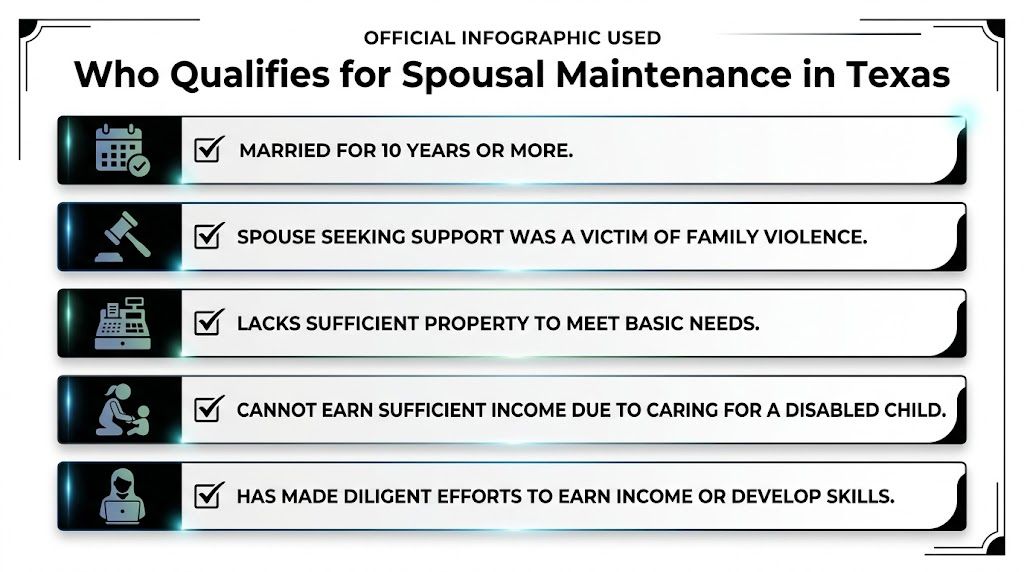
One common path applies when the marriage lasted at least 10 years and the spouse seeking maintenance can't earn enough to meet minimum reasonable needs. The law also requires evidence that the spouse has been making diligent efforts toward earning income or gaining needed skills.
If you want a focused explanation of the threshold issue, this page on how do you qualify for spousal support is useful.
Situations that may qualify even without the long-marriage path
Some cases don't depend on the usual marriage-length route. A spouse may still qualify when other circumstances exist, including:
- Family violence: A conviction related to family violence can create a separate path to eligibility.
- Disability of the spouse seeking support: If a physical or mental disability limits earning ability, the court may consider maintenance.
- Care of a disabled child: A spouse who must provide substantial care to a child of the marriage with a disability may have reduced earning capacity.
- Long-term economic dependence: Even where a spouse has some work history, years spent in homemaking or supporting the household can matter if those choices reduced present earning ability.
These categories aren't loopholes. They still require proof.
What judges actually want to see
Courts look for evidence, not labels. Saying “I was a stay-at-home parent” helps provide context, but it doesn't by itself prove present need or inability to earn enough. The judge will want a practical picture of your current circumstances.
Useful proof often includes:
- A clear monthly budget: Show housing, utilities, groceries, transportation, insurance, and other basic expenses.
- Property information: Identify what assets you'll receive in the divorce and why those assets won't cover your basic needs.
- Employment history: Include gaps in work, prior earnings, licenses, and outdated skills.
- Education and training information: Show what you already have and what you still need to become employable.
- Health-related records when relevant: If health affects your ability to work, that has to be supported.
Where people get confused
Some spouses think poverty alone qualifies them. It doesn't. Others think a long marriage guarantees maintenance. It doesn't. Judges are deciding whether statutory requirements have been met, and whether the evidence supports them.
A spouse with limited income may still be denied if the court believes that person can work, hasn't shown enough effort, or will receive property that covers basic needs. On the other hand, a spouse with a modest work history may still qualify if the evidence clearly shows a real gap between present capacity and immediate need.
The strongest cases connect three things clearly. Need, limited earning ability, and a concrete path toward self-support.
How Courts Determine Maintenance Amount and Duration
You may already be asking the question clients ask in my office all the time. "If the judge agrees I qualify, what does that mean in dollars and months?"
That is where many people expect a simple formula. Texas does not use one neat number-crunching worksheet for spousal maintenance. The court starts with a legal ceiling, then looks closely at the proof. The result is less like plugging numbers into a calculator and more like building a case file that shows what support is reasonably needed, what the other spouse can pay, and how long it should take to become more self-supporting.
Texas law limits maintenance. As explained in this summary of Texas spousal support limits, the court generally cannot order more than the lesser of 20% of the paying spouse's average gross monthly income or $5,000 per month.
That cap matters immediately. If your budget shows you are short by more than the legal maximum, the judge still cannot go above it. A maintenance request has to be grounded in the law as it exists, not the lifestyle the marriage once supported.
Duration works the same way. Texas sets maximum time periods based largely on the length of the marriage, but the judge is supposed to order maintenance only for as long as reasonably necessary for the receiving spouse to meet minimum reasonable needs, unless a disability or another qualifying circumstance supports a longer period.
Texas spousal maintenance duration limits
| Length of Marriage | Maximum Duration of Maintenance Payments |
|---|---|
| 10 years to 20 years | Up to 5 years |
| 20 years to 30 years | Up to 7 years |
| 30 years or more | Up to 10 years |
Those are ceilings, not promises.
A good way to understand this is to picture a rehab plan after an injury. The doctor may say recovery could take up to a certain number of months, but that does not mean every patient gets the full period. The court is asking a similar question here. What amount and what length of time are reasonably needed, based on credible evidence, to help this spouse regain financial footing?
That practical proof is where many maintenance requests become stronger or weaker.
Judges usually look at several facts at once, including:
- Post-divorce financial resources: What cash, property, debt, and liquid assets will each spouse leave the marriage with?
- The spouse's ability to earn income: What can the requesting spouse earn now, not just in theory?
- Education and training needs: Is there a realistic plan to complete school, renew a license, or get job training?
- Age, health, and caregiving duties: Do physical limits, mental health issues, or child-care responsibilities affect immediate earning ability?
- Work history and time out of the workforce: A long employment gap often requires more explanation and more evidence.
- Contributions during the marriage: Homemaking, child-rearing, and support for the other spouse's career can help explain why one spouse is starting from behind.
- Misconduct the law allows the court to consider: In some cases, family violence, adultery, cruel treatment, or hidden assets may affect the court's decision.
The legal standard sounds abstract until you connect it to documents. For amount, judges want to see a grounded monthly budget. For duration, they want to see a believable timeline. If you are asking for rehabilitative support, show the path. Enrollment records, tuition estimates, licensing requirements, job applications, rejection emails, interview logs, and a projected completion date help answer the question the court is really asking: "How long should support last if this person is making a real effort to become self-supporting?"
That diligence piece is often overlooked.
A spouse who says, "I need three years to get back on my feet," is making an argument. A spouse who brings proof of a certificate program, class schedule, child-care costs, and a record of job searching is giving the judge something concrete to rely on. Courts are much more comfortable ordering maintenance when the request comes with a map, not just a destination.
If you want a practical comparison between the statutory cap and real-world payment questions, this guide on how much is alimony in Texas can help.
Income proof can also become a battle of detail, especially if the paying spouse owns a business, works on commission, receives bonuses, or controls cash flow through a company. In those cases, the maintenance amount may turn on whether the court believes the reported income reflects reality. Tax returns, pay stubs, bank records, business statements, expense reports, and testimony about personal expenses paid through a business can all matter.
The same is true on the receiving spouse's side. If you are asking for maintenance, be ready to show why the property you receive in the divorce will not cover basic needs for long. A retirement account that cannot be used without penalties, a house with no liquid cash, or an asset that creates expenses instead of income may look helpful on paper but not solve the immediate problem.
Courts decide maintenance amount and duration by combining law, limits, and proof. The spouse with the clearer evidence usually has the stronger position.
The Process to Request or Defend Against Maintenance
A maintenance claim doesn't begin at the final hearing. It starts much earlier, often with the first divorce paperwork and the decisions you make in the opening weeks of the case.

Step one starts in the divorce filing
If you're asking for maintenance, your pleadings need to put that request before the court. In practical terms, that usually means raising the issue in the divorce petition or responsive pleading so the other side has notice.
After filing, many cases move into requests for temporary orders. Those are separate from post-divorce maintenance, but they can address immediate concerns such as who stays in the house, who pays what bills during the case, temporary child-related arrangements, and short-term financial obligations.
If you're defending against maintenance, your early goal is different. You want to identify whether the legal threshold is met and what evidence the other spouse does or doesn't have.
Discovery is where many cases are won
Discovery is the formal process for exchanging information and documents. In a maintenance case, that often includes:
- Income records: Pay stubs, tax returns, bonuses, commissions, and other compensation records.
- Banking and spending records: Statements that show actual cash flow and household expenses.
- Property records: Information about retirement accounts, real estate, business interests, and debts.
- Employment materials: Resumes, job applications, licensing records, and training program information.
- Health documentation when relevant: Records that support a disability claim or work limitation.
For business owners or spouses in high-value estates, discovery may also involve business financials, profit distributions, or tracing separate and community property. The maintenance issue can't be separated neatly from the rest of the divorce. Property division, child support, and support claims all affect one another.
The most overlooked requirement is due diligence
Texas Family Code requires the spouse seeking maintenance to show due diligence in seeking employment or training, according to Texas Law Help's explanation of spousal maintenance. This is one of the most common weak points in a case.
Many people say, truthfully, that they need time to rebuild. But judges don't just want to hear that. They want proof that you're already trying.
If you're asking the court for time, show the court what you've done with the time you've already had.
How to prove due diligence in a practical way
A simple paper trail can make a major difference. You don't need dramatic evidence. You need organized, credible evidence.
Keep a record of efforts like these:
Job applications
Save copies of applications, confirmation emails, interview invitations, rejections, and recruiter messages.Resume work
Keep dated versions of your resume and cover letters. If you worked with a career coach or used a platform to improve your job search materials, keep those records too.Training and education
Save enrollment confirmations, course descriptions, tuition information, attendance records, and certificates.Licensing or credential updates
If your prior profession requires renewed credentials, document each step you've taken.Workforce preparation
Keep notes from job fairs, networking events, workforce center visits, or online employment workshops.
Presenting your evidence clearly
You don't want to hand the court a pile of unsorted papers. Create a simple packet or binder with sections. A chronological log helps. So does a summary sheet that ties your efforts to a clear rehabilitation plan.
A practical example might look like this:
- Your prior work experience was interrupted by years of homemaking.
- Your former license needs renewal.
- You enrolled in a qualifying course.
- You updated your resume.
- You applied for jobs you are currently qualified to do.
- You can explain why additional training is still necessary to reach self-support.
This short video gives added context on how support issues can arise in Texas divorce cases.
Mediation and final hearing
Many Texas divorce cases go through mediation before trial. Mediation can be especially useful when both spouses want to avoid the cost and stress of a contested hearing. It may also allow more flexible solutions, especially if maintenance is part of a larger tradeoff involving property division.
If the case doesn't settle, the judge decides after hearing evidence. That usually includes testimony, exhibits, budgets, employment history, and proof about current and future earning ability.
For the spouse seeking support, the strongest presentation is usually practical, organized, and modest in tone. For the spouse opposing support, the strongest defense usually focuses on missing statutory elements, available property, earning ability, and weak diligence evidence.
Modifying or Enforcing a Spousal Support Order
A common post-divorce problem looks like this. The order says support is due on the first. The payment does not arrive. Or your former spouse says a job loss means the amount should change, but nothing has been filed with the court.
At that point, the decree works less like a suggestion and more like a rulebook. The question is not just what feels fair. The question is what you can prove.
Enforcement when payments aren't made
If court-ordered maintenance is not paid, Texas courts can enforce the order. Depending on the wording of the decree and the facts, that may include wage withholding, a money judgment for unpaid amounts, attorney's fees, and contempt proceedings.
Proof matters here just as much as it did when maintenance was first awarded. Judges want a clean record. Bring the signed order, a payment ledger, bank statements, screenshots or receipts showing what was received, and a timeline of missed payments. If there were partial payments, note the exact dates and amounts. If there were excuses or promises to catch up, save those messages too.
That evidence does two jobs at once. It shows the amount owed, and it reduces room for argument about confusion, side deals, or bad memory.
A signed decree gives you rights. Good records help you enforce them.
When modification may come into play
Support orders can sometimes be modified after divorce, but not because one side is unhappy with the result. The spouse asking for a change must show a legally sufficient change in circumstances under Texas law.
Common examples include a serious illness, a meaningful change in income, or proof that the receiving spouse has become able to meet reasonable needs without support. The court will look closely at timing and proof. A bare statement like "things are worse now" usually is not enough. Pay stubs, medical records, termination paperwork, updated budgets, and job search records often matter far more than broad testimony.
The evidentiary burden takes on a very practical dimension. If you receive rehabilitative support and your former spouse asks to reduce or end it early, be prepared to show your continued diligence toward self-sufficiency. That may include enrollment records, licensing applications, class attendance, job applications, interview logs, and proof that your expenses still exceed your available income. If you are the paying spouse seeking a reduction, you need the same level of detail from your side. Courts respond better to documents than conclusions.
Practical post-divorce steps
For the spouse receiving maintenance:
- Track every payment: Keep a simple ledger with due dates, amounts due, amounts paid, and any shortfall.
- Save supporting records: Bank statements, deposit records, and messages should all match your ledger.
- Document your rehabilitation efforts: Keep a folder for training, job applications, interviews, certifications, and income updates.
- Act early: Waiting through months of missed payments often makes enforcement more expensive and more stressful.
For the spouse paying maintenance:
- Pay exactly as ordered: Do not rely on verbal changes or casual text agreements.
- Keep proof of each payment: Use a method that creates a clear record.
- File before you fall behind if circumstances changed: Courts usually care about what was ordered until a new order is signed.
- Build your evidence carefully if you seek modification: Job loss, reduced income, or medical limits should be documented, not just described.
A maintenance case after divorce often turns on organization. The court already made the first decision. If you need to enforce or change that order, your job is to show, step by step, what happened, what changed, and how your documents prove it.
Frequently Asked Questions About Texas Spousal Support
Is spousal maintenance only for women
No. Texas spousal maintenance law is gender-neutral. Either spouse can request it if the legal requirements are met. Courts focus on financial need, earning ability, caregiving responsibilities, health, and the statutory grounds. The question isn't whether you're a husband or wife. The question is whether the evidence supports eligibility.
How does a high-net-worth estate or business ownership affect a maintenance claim
These cases often become more document-heavy. If one spouse owns a business, receives irregular income, or controls complex assets, the central dispute may center on what income exists, what property is available after divorce, and whether one spouse lacks sufficient resources to meet basic needs.
Business records, tax returns, account statements, valuation issues, and tracing questions can all matter. In those cases, maintenance strategy should be coordinated with property division strategy. A spouse may receive valuable assets on paper that don't produce cash flow right away.
Can adultery prevent me from getting spousal support
Not automatically. Misconduct such as adultery may be considered by the court as part of the overall analysis, but it doesn't create a simple yes-or-no rule by itself. A judge will still look at the statutory eligibility requirements and the evidence of need, earning capacity, and other relevant circumstances.
If you're worried that marital misconduct will dominate the case, don't assume the answer without reviewing the full picture. In Texas family law, facts usually matter more than labels.
Is maintenance the same as getting a larger share of community property
No. They are related, but they are not the same thing.
Property division deals with what each spouse receives from the marital estate. That can include the home, retirement accounts, debts, business interests, and other assets.
Spousal maintenance deals with post-divorce support paid over time in qualifying cases.
A court may consider the property a spouse receives when deciding whether that spouse can meet minimum reasonable needs. That's why the two issues often interact. Still, one does not automatically replace the other. A spouse might receive a meaningful share of community property and still argue that immediate cash flow is inadequate. Or a court may decide that the property award itself removes the need for maintenance.
What to Do Next Your Path to Financial Stability
If you're facing divorce and worried about support, the most important thing to remember is that Texas maintenance cases are built on proof. You need more than a hard story. You need a documented one.
Key takeaways
- Texas maintenance is usually temporary: The law is designed to support transition toward self-sufficiency.
- Eligibility is strict: Need alone isn't enough.
- Evidence decides close cases: Budgets, property records, work history, and diligence records all matter.
- Preparation should start early: Waiting until the final hearing to gather proof can hurt your case.
- Career rebuilding is part of the legal story: If your plan involves training, education, or a career change, document it carefully. Resources on how to pivot careers can also help you think practically about the steps between divorce and stable employment.
Whether you're seeking maintenance or defending against it, clear strategy matters. So does understanding how maintenance fits with mediation, property division, custody concerns, child support, and post-divorce enforcement.
If you need guidance specific to your situation, schedule a free consultation with Law Office of Bryan Fagan, PLLC. Their Texas family law team helps clients across divorce, custody, support, mediation, and enforcement matters with practical advice, compassionate counsel, and a strategy built around your future.