Skip to content
Facing the financial uncertainty of a divorce can be one of the most overwhelming parts of the process. In Texas, what most people call "alimony" is legally known as spousal maintenance. It's a court-ordered payment from one spouse to the other after the divorce is final, but it is far from guaranteed. To even be considered, you must prove you lack sufficient property from the divorce to meet your minimum reasonable needs and also satisfy strict legal criteria.
How Spousal Support Works in Texas
When your financial future feels uncertain, understanding your options is the first step toward regaining control. The Texas legal system is specific about post-divorce financial support. It's not an automatic right, and a judge can't award it simply because one person made more money during the marriage. The entire framework is designed to provide temporary help for a spouse to get back on their feet, not to create a permanent income stream.
This support generally falls into two categories, and knowing which one might apply to you is critical. The path you take will depend on your unique circumstances, how long you were married, and whether you and your spouse can reach an agreement on your own through processes like mediation.
Court-Ordered vs. Contractual Alimony
In Texas, post-divorce support comes in two main forms: court-ordered spousal maintenance and contractual alimony. Each one works very differently, and understanding the distinction is key to your divorce strategy.
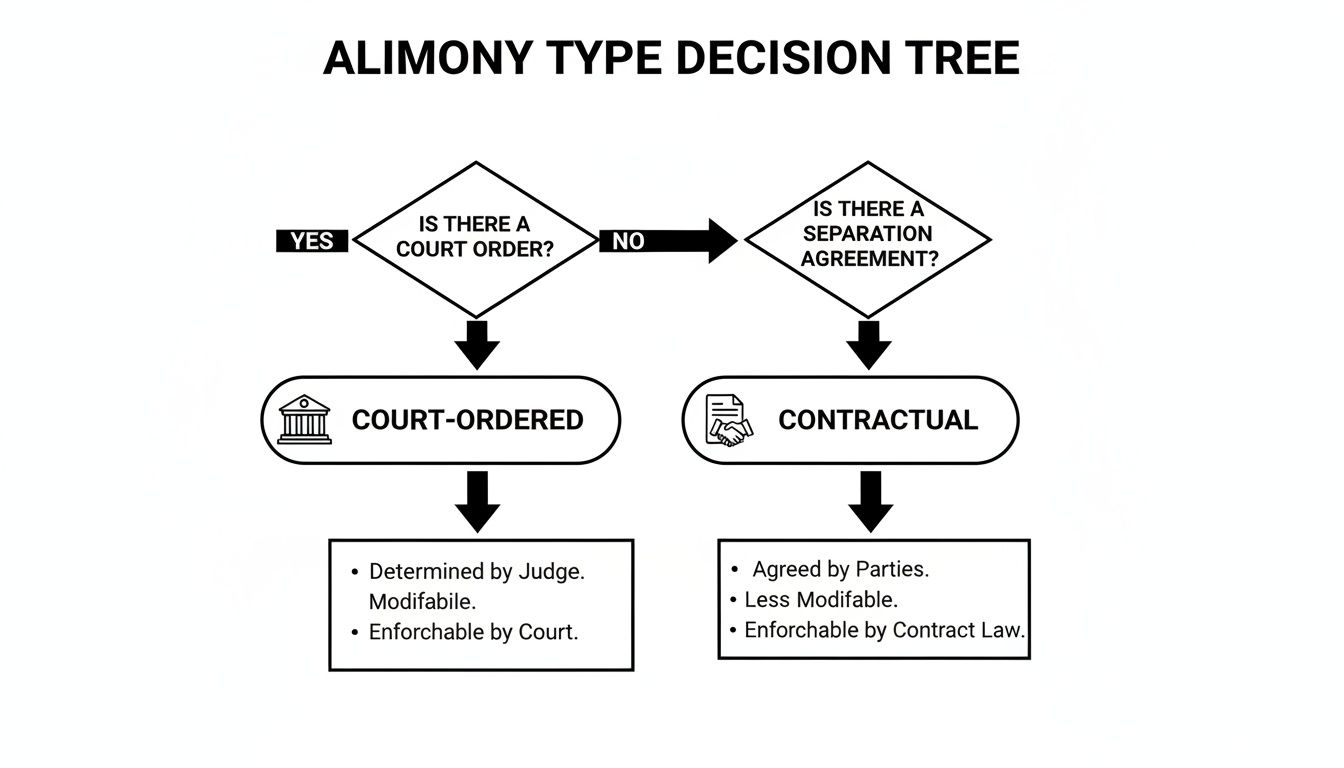
As you can see, the core difference is who makes the decision—a judge applying strict laws, or you and your spouse negotiating a private agreement.
Court-Ordered Spousal Maintenance is the official version governed by the Texas Family Code. The eligibility requirements are high. You have to convince a judge that you cannot provide for your "minimum reasonable needs" with the property you receive in the divorce and meet at least one of these conditions:
- The marriage lasted 10 years or longer, and you have made diligent efforts to earn a sufficient income or develop skills to do so.
- Your spouse was convicted of an act of family violence against you or your child within two years of filing for divorce or during the divorce itself.
- You have an incapacitating disability that prevents you from earning enough to be self-sufficient.
- You are the primary caregiver for a child of the marriage who has a significant disability requiring your substantial care, which in turn prevents you from working.
If you don't meet one of these criteria, a Texas judge simply does not have the authority to order spousal maintenance.
Contractual Alimony is entirely different. It’s a private agreement you and your spouse create as part of your divorce settlement, often during mediation. Think of it as a contract—it isn't bound by the strict rules of court-ordered maintenance. This gives you both the flexibility to design a financial arrangement that works for your specific situation. This is especially useful for business owners, individuals with high-value estates, or anyone who wants terms that a court couldn't order, providing more control and predictability.
The table below breaks down the key differences to help you see how these two types of support compare.
Court-Ordered Spousal Maintenance vs. Contractual Alimony
| Feature | Court-Ordered Spousal Maintenance | Contractual Alimony |
|---|---|---|
| Legal Basis | Based on the Texas Family Code | A private contract between spouses |
| Eligibility | Requires meeting strict statutory criteria (e.g., 10+ year marriage, disability) | No legal requirements; completely negotiable |
| Flexibility | Amount and duration are capped by law | Amount, duration, and terms are fully flexible |
| Modification | Can be modified by a court if circumstances change | Generally cannot be modified unless the contract allows it |
| Enforcement | Enforceable by contempt of court (jail time, fines) | Enforced like any other contract debt (lawsuit for breach of contract) |
Because contractual alimony is a private deal, every detail—from the payment amount and duration to what happens if one of you remarries—is on the table for negotiation.
These are complex topics, and the path you choose can have long-lasting financial consequences. For a deeper look at these options, you can learn more about spousal support and alimony in our comprehensive guide. Understanding which type of support might be relevant to your case is the first step toward building a stable financial foundation after divorce.
How Much Alimony Can You Get and for How Long?
When you’re facing a divorce, two questions almost always rise to the top: How much will I have to pay (or receive)? and How long will it last? If you've met the high standard to qualify for spousal maintenance in Texas, the next step is understanding how a judge will answer those questions. While every case is unique, Texas law sets clear and firm limits on both the amount and duration of these payments.

How Alimony Payments Are Capped in Texas
First and foremost, you should know that Texas law puts a hard ceiling on court-ordered spousal maintenance. A judge must order the lesser of two possible amounts:
- $5,000 per month, or
- 20% of the paying spouse's average monthly gross income.
Let's walk through a practical example. If the higher-earning spouse has a gross monthly income of $10,000, the 20% cap comes out to $2,000 per month. Since $2,000 is less than the $5,000 cap, the absolute most a judge could order in this scenario is $2,000 a month.
However, even that isn't a guarantee. This calculation is just the maximum possible award. A judge will only award what's needed to meet your minimum reasonable needs. The goal is to provide a financial bridge, not to fund a lavish lifestyle. The court will carefully review your monthly budget, assets, and earning potential to determine what you truly need while you work toward becoming self-sufficient.
Factors That Shape the Final Amount and Duration
Beyond those strict caps, the Texas Family Code, Section 8.052, gives judges a list of factors to consider when deciding on a fair amount and timeline. Since no two divorces are the same, the court looks at the entire picture of your marriage to arrive at an order that is just and right for your specific situation.
Some of the key factors include:
- Each spouse’s ability to provide for their own basic needs.
- The education and job skills of both spouses, and the time it might take you to get the training needed to find a job.
- The duration of the marriage.
- The age, employment history, health, and emotional state of the spouse requesting maintenance.
- Any acts of marital misconduct, like adultery or cruelty, by either spouse during the marriage.
A critical factor is the length of your marriage, which directly impacts how long you can receive payments. The law creates specific time limits to encourage financial independence.
How Marriage Length Affects How Long Alimony Lasts
Texas law is designed to help you get back on your feet, not to provide support indefinitely. To that end, the law sets maximum timeframes for how long maintenance can last, tied directly to the length of the marriage. These timelines are set by the Texas Family Code and are the absolute longest periods a judge can order, not a guaranteed duration:
- 5 Years of Payments: For marriages lasting 10 to 20 years. This also applies if maintenance was awarded due to family violence in a marriage under 10 years long.
- 7 Years of Payments: For marriages that lasted between 20 and 30 years.
- 10 Years of Payments: For marriages of 30 years or more.
The court is required to order payments for the shortest realistic time that allows you to become financially independent. For a more detailed walkthrough of these numbers, you can read our guide on how much alimony is in Texas. Having a realistic grasp of these caps and timelines is the first step toward planning your financial future post-divorce.
The Process to Request or Contest Spousal Maintenance
Whether you’re the one asking for spousal support or the one being asked to pay, the legal process can feel intimidating. Understanding the step-by-step procedure is the best way to feel more in control. The request for post-divorce financial support isn’t a separate lawsuit—it’s a key part of the main divorce case itself.
How to Formally Request Spousal Maintenance
If you are the spouse needing financial support, you must make that clear from the beginning. Here's the step-by-step process:
- File the Petition: You must formally include the request for spousal maintenance in your Original Petition for Divorce, the first legal document filed with the court. This officially puts the issue on the table.
- Gather Evidence: Simply asking isn't enough. You must be ready to prove your case. This means gathering detailed financial evidence to show that you meet the strict eligibility rules and that you lack sufficient assets to provide for your “minimum reasonable needs.”
- Prepare Financial Documents: One of the most important documents you'll prepare is the Inventory and Appraisement. This is a sworn statement listing all your assets and debts, and it becomes central evidence when a judge is deciding your financial need.
How to Contest a Request for Maintenance
If you are the spouse being asked to pay, you have every right to challenge the request. Your defense will focus on showing that your spouse does not meet the legal requirements for a spousal maintenance award.
For example, you and your attorney might argue that:
- Your spouse has enough property—including assets they will receive in the divorce—to support themselves.
- Your spouse has the education or skills to earn an income that meets their needs but has not made a genuine effort to find a job.
- The marriage does not meet the 10-year minimum duration, and no exceptions like family violence apply.
You are not automatically required to pay just because you earn more money. The person asking for maintenance has the burden to prove they qualify, and a skilled attorney can help you build a strong case to protect your financial future.
The Role of Temporary Orders and Mediation
Many arguments over spousal maintenance are resolved before a final trial. While the divorce is pending, a judge can issue temporary orders that require one spouse to pay temporary support to the other.
These temporary orders often provide a reality check, motivating both sides to settle. In fact, most Texas courts require couples to attend mediation to try and work things out. In mediation, you, your spouse, and your respective attorneys sit down with a neutral third party to negotiate a solution you can both accept. The process is confidential and empowers you to control the outcome instead of leaving a life-altering decision in a judge’s hands.
Special Circumstances That Affect Alimony Awards
Divorce is rarely straightforward, and life doesn't always fit neatly into legal boxes. While Texas has specific rules for spousal maintenance, the law also provides important exceptions for situations that require more flexibility and compassion, ensuring vulnerable individuals are protected.

If your marriage involved family violence, a disability impacting your ability to work, or military service, the standard rules for alimony might not apply. It's crucial to understand how these factors can change the outcome and protect your financial future.
The Family Violence Exception
One of the most critical exceptions in the Texas Family Code bypasses the usual 10-year marriage requirement. If your spouse was convicted of (or received deferred adjudication for) a criminal act of family violence against you or your child, you can qualify for spousal maintenance even in a much shorter marriage.
For this exception to apply, the act of violence must have occurred within two years of when the divorce was filed or during the divorce proceedings. This rule is a vital lifeline, giving survivors the financial means to escape an abusive situation and rebuild their lives safely.
Disability and Spousal Maintenance
A significant physical or mental disability can make it impossible to earn a living. The Texas Family Code recognizes this reality and provides two paths to qualify for maintenance, regardless of how long the marriage lasted.
You may be eligible for support if:
- You are unable to earn enough to support yourself because of an incapacitating physical or mental disability.
- You are the main caregiver for a child of the marriage (of any age) who has a disability that requires your substantial care and prevents you from working outside the home.
When a qualifying disability is proven, a court has the authority to order support for as long as the disability continues. This is one of the rare instances where spousal maintenance can potentially be ordered for an indefinite period.
Military Divorce and Alimony
Divorces involving a military service member add another layer of complexity. Federal laws, like the Uniformed Services Former Spouses' Protection Act (USFSPA), work together with Texas law to determine how military benefits are handled.
Military retirement pay is considered marital property that can be divided in a divorce. It is also counted as income when a judge calculates spousal maintenance. The court will look at the paying spouse’s total gross income—which includes military pay and benefits—when applying the 20% income cap on any maintenance award. This ensures all financial resources are considered when determining a fair outcome.
Navigating these special circumstances requires a deep understanding of both family law and the specific rules that apply to your situation. An attorney can help you gather the necessary proof and advocate for an outcome that protects your future.
How to Modify or Enforce a Spousal Maintenance Order
A divorce decree isn't the end of the story; life continues to change. When circumstances shift dramatically, a spousal maintenance plan might need to change, too. Conversely, if your ex-spouse simply stops making court-ordered payments, you have powerful options to enforce the order.

Changing the Terms of Your Alimony Order
You can't ask a court to change a spousal maintenance order on a whim. To be considered, you must prove there has been a "material and substantial change" in the circumstances of either you or your ex-spouse. This is a high standard, requiring you to show a major—and likely permanent—shift in your situation.
Common reasons a judge might grant a modification include:
- Involuntary Job Loss: The paying spouse is laid off or loses their job for reasons beyond their control.
- Significant Income Change: The receiving spouse gets a major promotion, or the paying spouse takes a substantial pay cut.
- A Change in Health: One of you develops a new disability or serious illness that affects the ability to work or creates new financial needs.
It's absolutely critical to know that contractual alimony—support you both agreed to in a private settlement—is usually not modifiable by a court unless your original divorce decree specifically states that it can be changed later.
A modification only applies to future payments. The court cannot go back and retroactively change payments that were already due. This is why it’s so important to act quickly if your circumstances change.
Enforcing a Spousal Maintenance Order
If your former spouse stops paying the maintenance a judge ordered, you have the right to take swift legal action. That financial support is a court order, not a suggestion.
Your first step is to file a Motion for Enforcement with the court. This legal document formally notifies the judge that your ex is violating the order. If the judge agrees, they have several powerful tools to compel payment. You can learn more about this process in our guide on filing a motion to enforce in Texas.
A judge can impose serious consequences for non-payment, such as:
- Wage Garnishment: An order sent directly to their employer, requiring them to withhold the owed amount from their paychecks.
- Contempt of Court: This finding can lead to steep fines or even jail time until the past-due balance is paid.
- Payment of Your Attorney's Fees: The court can order your ex to cover the legal costs you incurred to enforce the order.
These enforcement tools give your divorce decree real teeth and help protect your financial stability. You don't have to navigate this alone.
What to Do Next: Your Path to Financial Security
Sorting out spousal maintenance in Texas can feel like a heavy burden, but understanding the rules is the first step toward regaining control. The path forward isn’t just about knowing the law; it’s about taking clear, strategic steps to protect your future.
Key Takeaways
As you move forward, keep these core principles about Texas spousal maintenance in mind:
- Eligibility Is Not a Given: You can’t get spousal maintenance just by asking. You must meet one of the specific requirements laid out in the Texas Family Code, like the 10-year marriage rule or the family violence exception.
- The Law Sets Firm Limits: A judge cannot order unlimited payments. Court-ordered maintenance is capped at the lesser of $5,000 per month or 20% of the paying spouse’s average gross monthly income.
- Negotiation Is a Powerful Tool: Contractual alimony allows you and your spouse to create a custom agreement outside of the courtroom, offering much more flexibility and control. This is often achieved through mediation.
The stress of a divorce is immense, and you shouldn’t have to face it alone. The most important step you can take is to find a skilled and empathetic attorney who will stand in your corner, educate you on your options, and fight to protect your financial stability.
While you're figuring out spousal maintenance, it's also smart to understand how major life changes impact your taxes, including divorce and what it means for your broader financial picture.
The decisions made in your divorce will have a ripple effect for years. You deserve a clear strategy that defends your interests and gives you a secure foundation to start your new chapter. The team at The Law Office of Bryan Fagan, PLLC, is here to provide the compassionate, authoritative guidance you need.
We invite you to schedule a free, confidential consultation to discuss your unique situation. Let us help you move forward with clarity and confidence. Call us today.
Answering Your Top Questions About Texas Spousal Maintenance
When you’re staring down the complexities of a divorce, it’s only natural for your head to be spinning with questions. We get it. To bring some clarity, we’ve gathered the most common questions we hear from clients about spousal maintenance in Texas.
Can I Get Alimony If I Was a Stay-at-Home Parent?
Yes, this is a very important factor. If you stepped away from your career to run the household and raise your children, the court will look very closely at how that decision affects your ability to earn a living today.
The time you spent out of the paid workforce is a critical piece of the puzzle when proving you need temporary support to get back on your financial feet. It helps demonstrate that you lack the ability to earn sufficient income to provide for your minimum reasonable needs.
Does Adultery Affect an Alimony Decision?
It absolutely can. The Texas Family Code gives a judge the discretion to consider marital fault, like adultery, when deciding whether to award spousal maintenance and in what amount and for how long.
While cheating doesn't automatically grant or deny alimony, it can definitely sway a judge's decision. More often than not, it works against the unfaithful spouse, potentially impacting the final property division and the maintenance order.
What Is the Difference Between Alimony and Child Support?
This is a crucial distinction. Spousal maintenance (alimony) is financial support for the ex-spouse’s reasonable needs, while child support is paid exclusively for the care and well-being of the children.
They are calculated with entirely different formulas and serve completely separate purposes. It’s also possible to be ordered to pay or receive both at the same time, as long as you meet the unique qualifications for each.
Spousal maintenance legally terminates if the receiving spouse remarries. If they cohabitate (move in) with a new romantic partner on a continuing basis, you can file a motion with the court to terminate the payments.
Understanding your rights and what you’re entitled to is the first step toward securing your financial future. At The Law Office of Bryan Fagan, PLLC, our team is here to give you the compassionate and expert guidance you need to navigate these complex family law issues. We are dedicated to helping Texas families face divorce with empathy and confidence.
We invite you to schedule a free, confidential consultation to talk about your specific situation and start building a strategy for what comes next. Contact us today at https://texasdivorcelawyer.us to get started.