Skip to content
Facing a divorce can feel like you're staring at a huge, tangled map with no idea which way to turn. The good news is that the Texas divorce process, while complex, follows a clear and predictable path. Understanding that path is the first step toward getting your bearings and moving forward with confidence.
A divorce in Texas officially starts when you or your spouse files an Original Petition for Divorce. To do this, you or your spouse must have lived in the state for at least six months and in the county where you file for at least 90 days. This is a basic requirement under the Texas Family Code.
Understanding the Texas Divorce Process
When you’re thinking about divorce, your mind is probably racing with questions. How does it all work? Where do you even start? Let’s break it down. At its heart, a divorce is a legal process that accomplishes three main things for your family:
- Property Division: It officially separates your shared assets and debts in a way that is "just and right."
- Child Custody and Support: It establishes a clear, court-enforceable plan for where your children will live and how they’ll be financially cared for.
- Spousal Support: It determines if you or your spouse needs temporary financial help from the other after the separation.
The Grounds for Divorce in Texas
One of the first things you might worry about is having to prove someone was "at fault." Fortunately, Texas is a "no-fault" divorce state. This makes things much simpler.
The most common reason cited is insupportability, which is the legal term for when a marriage has broken down due to disagreements with no reasonable chance of getting back together. As explained in the Texas Family Code, you don’t need to point fingers or assign blame to get a divorce.
That said, Texas law does allow for fault-based grounds, like cruelty or adultery. While data shows that women initiate divorce about 69% of the time, it's interesting to note that adultery is still cited by around 60% of divorcing couples in Texas. You can discover more insights about these divorce statistics and what they mean for Texas families. Proving fault can sometimes impact how a judge divides your property, but it isn’t required to end the marriage.
This flowchart gives you a bird's-eye view of the fundamental steps every divorce follows.
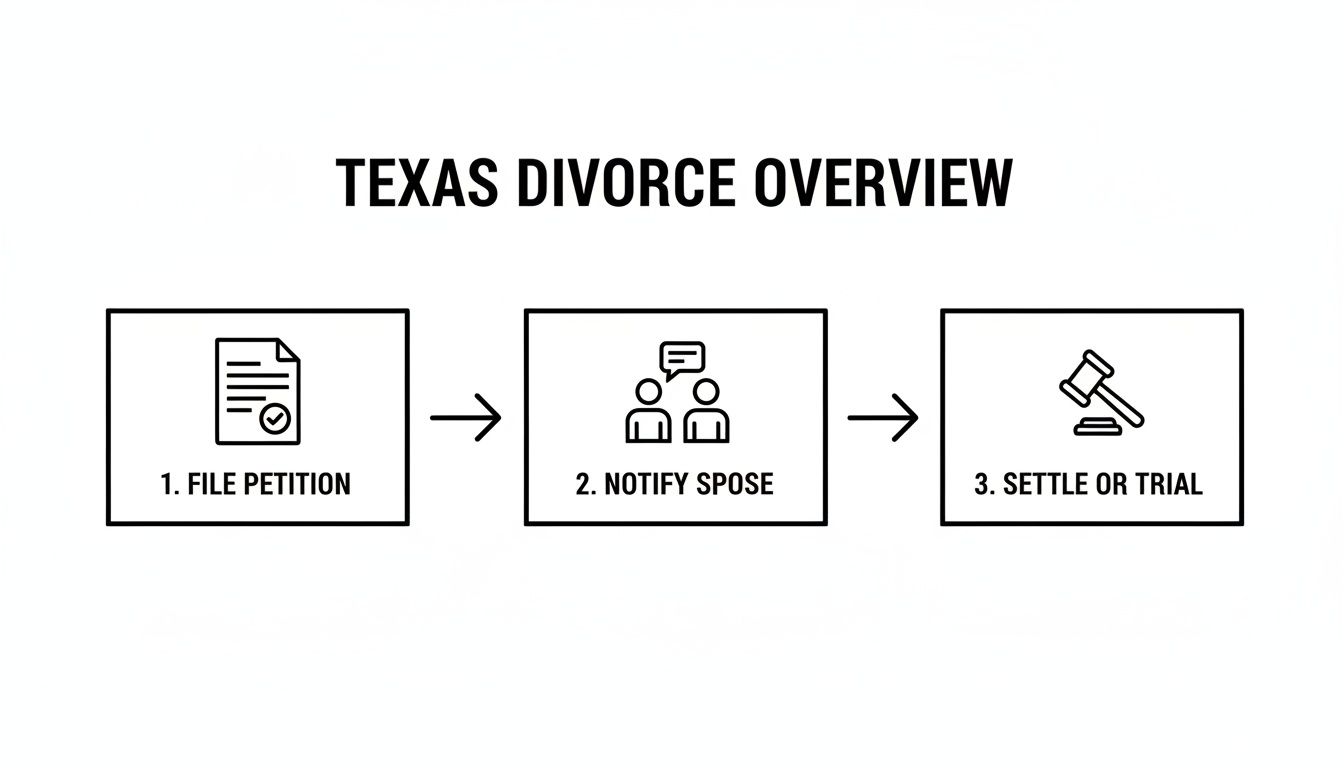
As you can see, every case starts by filing the initial paperwork, notifying the other spouse, and then moving toward a final resolution, either through a negotiated settlement or, as a last resort, a trial.
The Texas Divorce Timeline at a Glance
While every divorce is unique, the procedural steps are fairly consistent. The table below outlines the typical sequence of events so you can get a clearer picture of the road ahead, from filing to the final decree.
| Stage | What Happens | Key Considerations |
|---|---|---|
| Filing the Petition | You or your spouse files an "Original Petition for Divorce" with the court, officially starting the case. | This document states the grounds for divorce (usually "insupportability") and outlines what you're asking the court for regarding property and children. |
| Serving the Papers | The other spouse must be formally notified of the lawsuit. This is called "service." | This can be done by a constable or a private process server. If you are on good terms, your spouse can sign a Waiver of Service to save time and money. |
| The Answer | Your spouse files an "Answer" with the court to formally participate in the case. | The Answer is a general denial that prevents a default judgment. It must be filed by a specific deadline. |
| Temporary Orders | The court can issue orders to establish rules for property and child-related matters while the divorce is pending. | These orders can address who stays in the house, temporary custody schedules, and who pays which bills. They provide stability. |
| Discovery | Both sides exchange information and documents about finances, property, and other relevant issues. | This is the fact-finding phase and can involve requests for documents, written questions (interrogatories), and sworn testimony (depositions). |
| Mediation | A neutral third-party mediator helps you and your spouse try to reach a settlement on all issues. | Most Texas courts require you to attend mediation before you can go to a final trial. It is a highly successful and solution-focused process. |
| Trial or Settlement | If you reach a full agreement, it's finalized at a "prove-up" hearing. If not, a judge decides the unresolved issues at trial. | The vast majority of cases settle out of court. For business owners or those with high-value estates, a negotiated settlement is often the best way to protect assets. |
| Final Decree | The judge signs the Final Decree of Divorce, which is the legally binding document that ends the marriage and outlines all final rulings. | This document contains all the final rulings on property division, the parenting plan, and support. It is the rulebook for your post-divorce life. |
Understanding this timeline helps demystify the process and allows you to anticipate what's coming next, giving you a greater sense of control during a turbulent time.
Filing Your Petition and Establishing Temporary Orders
Taking the first official step in a Texas divorce is all about moving from uncertainty to stability. It begins by filing a document known as the Original Petition for Divorce. This paperwork formally opens your case with the court and states the grounds for ending your marriage.

After the petition is filed, your spouse has to be officially notified. This is a non-negotiable step called service of process, and it’s designed to make sure the divorce proceeds fairly. In short, it’s the law’s way of ensuring both people are aware that a case has started.
Notifying Your Spouse
You have a couple of routes for serving the divorce papers. The most common method involves having a constable or a private process server hand-deliver the documents to your spouse. This provides official proof that they received them.
If things are amicable, there's a simpler way. Your spouse can sign a Waiver of Service, a document they sign to acknowledge they've received the petition. This waives the need for formal service, which can save time, money, and unnecessary conflict right out of the gate.
Establishing Stability with Temporary Orders
Life doesn’t hit the pause button just because you’ve filed for divorce. The process can take months, and in the meantime, bills pile up, the kids need a routine, and you both need clear rules to follow. This is exactly what Temporary Orders are for.
Think of Temporary Orders as the official rulebook for your family while the divorce is pending. They are court-enforceable orders that establish financial and parental stability from day one, preventing chaos and protecting your family’s well-being.
These orders tackle the immediate, high-stress questions that can keep you up at night:
- Who gets to stay in the family home?
- Who is responsible for paying the mortgage, car notes, and other bills?
- What will the temporary custody and visitation schedule be for the children?
- How will temporary child support be calculated and paid?
For instance, a Temporary Order can stop one spouse from emptying a joint bank account or selling off shared assets. It also creates a predictable parenting schedule, giving your kids a much-needed sense of security. While these orders aren’t permanent, they create a stable foundation for the rest of the divorce process. You can dig deeper into the initial paperwork by exploring our complete guide on the steps to file for divorce in Texas.
Navigating Community Property and Asset Division
For many couples, untangling a shared financial life is the single most complicated part of a divorce. It’s the process of taking everything you’ve built together—the house, the cars, the retirement accounts, the business—and figuring out how to divide it all in a way that’s fair. Getting this right is absolutely essential for protecting your financial future.
In Texas, your marriage is viewed as a financial partnership. The law that governs this is called community property law. This core principle from the Texas Family Code sets the rules for splitting up everything you and your spouse have accumulated.
Under this law, community property is generally defined as any asset or debt that either of you acquired during the marriage. It doesn't matter whose paycheck bought it or whose name is on the title. If it came into your lives while you were married, it's typically considered part of the marital estate to be divided. This includes the income you earned, the home you bought together, and the 401(k) funds that grew over the years.

Separate Property vs. Community Property
Not everything is thrown into that shared pot. Texas law also recognizes separate property—assets that belong exclusively to one spouse and aren't subject to division. Drawing this line correctly can dramatically change the outcome of your financial settlement. For business owners or those with high-value estates, this distinction is critical.
So, what counts as separate property? It typically includes:
- Assets you owned before the wedding: Anything you brought into the marriage is yours to take out of it.
- Gifts you personally received during the marriage: If your aunt gave you a sum of money, that’s yours, not the community’s.
- Inheritances you received: Any money or property you inherited during the marriage belongs to you alone.
The catch? You have to prove it. The court presumes everything is community property unless you can show "clear and convincing evidence" that an asset is separate. This means having the right documentation, like old bank statements, property deeds, or a will. To get a clearer picture, it’s worth exploring the critical differences between separate property vs. community property in our detailed guide.
How Does a "Just and Right" Division Work?
You've probably heard that Texas is a 50/50 state, but that’s one of the biggest myths in family law. While a 50/50 split is the starting point, the law requires a “just and right” division. This gives a judge the authority to award a lopsided share—like 55/45 or even 60/40—if the circumstances warrant it.
A judge might award a disproportionate share based on factors like:
- A significant difference in earning power between you and your spouse.
- The physical and mental health of each person.
- Who was at fault for the divorce (for example, if adultery or cruelty was proven).
- The benefits an innocent spouse might have lost because of the marriage ending.
Interestingly, Texas has long had one of the lowest divorce rates in the nation, with a rate of just 1.4 per 1,000 people in 2021. While that's an interesting statistic, it doesn't make the process any less complex for those who do go through it. Often, a lower rate means couples are divorcing after longer marriages with more significant and entangled assets, making the property division process all the more challenging.
Creating a Stable Future for Your Children
When you have children, a divorce isn't just about you and your spouse anymore. Your first and most important job becomes protecting your kids and giving them a stable, predictable life through the transition. The legal process for this can seem full of confusing terms, but the goal is simple: create a clear, predictable plan that puts your children’s best interests first.

In Texas, the words you'll hear used are conservatorship, possession and access, and child support. Let's translate this legalese from the Texas Family Code into plain English so you know exactly how your parenting plan will come together.
Understanding Conservatorship (What Most People Call Custody)
You'll notice quickly that the word “custody” isn't really used in the Texas Family Code. Instead, our laws use the term conservatorship to describe a parent's legal rights and responsibilities.
There's a strong presumption in Texas law that it’s best for both parents to be named Joint Managing Conservators (JMCs). This doesn't automatically mean a 50/50 split of time, but it does mean you and your co-parent will share the rights and duties of raising your children.
As JMCs, you both typically have the right to:
- Make decisions about your child’s education and healthcare.
- Consent to medical, dental, and psychological treatment.
- Access your child's school and medical records.
- Attend your child’s school activities.
Usually, one parent is named the "primary" conservator. This is the parent who has the exclusive right to decide where the child lives (within a certain geographic area) and is the one who receives child support payments.
Possession and Access: The Visitation Schedule
"Possession and access" is just the court's formal way of saying "visitation schedule." While you and your spouse are free to agree on any schedule that works for your family, Texas provides a default framework called the Standard Possession Order (SPO). The SPO is designed to give children a consistent and predictable routine, and courts presume this schedule is in the child’s best interest.
The Standard Possession Order is the default visitation schedule in Texas. It generally gives the non-primary parent possession of the children on the first, third, and fifth weekends of a month, along with a split of holidays and a longer period during the summer.
This framework gives both you and your kids a clear calendar to follow, which helps minimize the confusion and conflict that can come from scheduling disagreements. You can absolutely create a custom schedule if the SPO doesn't fit your family's needs, as long as the court approves it as being in your child's best interest.
If you need a solid starting point, our guide on a parenting plan template for Texas can give you a valuable structure. As you build your plan, it’s also helpful to think about what co-parenting style will work best for your situation; understanding parallel parenting vs co-parenting can help you choose the right path for your family.
Calculating Child Support in Texas
Child support is the financial payment one parent makes to the other to help cover the costs of raising a child. Here in Texas, child support is calculated using a straightforward formula based on the paying parent's net monthly resources, as outlined in the Texas Family Code.
The state guidelines are percentage-based:
- One child: 20% of net resources
- Two children: 25% of net resources
- Three children: 30% of net resources
- Four children: 35% of net resources
- Five or more children: 40% of net resources
These percentages apply to income up to a certain cap, which is adjusted for inflation over time. While the formula provides a clear baseline, a judge has the discretion to order more or less support if it's proven to be in the child's best interest based on their specific needs.
Choosing Your Path to Resolution: Mediation vs. Trial
When most people think of divorce, they picture a dramatic courtroom battle. But that’s mostly Hollywood fiction. The reality in Texas is that a public trial is rarely the best way to finalize your divorce. In fact, the vast majority of Texas families find a way to resolve their issues privately and respectfully. How you get to the finish line is one of the most important decisions you’ll make, and it sets the tone for your family’s future.
The Power of Mediation
In Texas, mediation is the go-to method for settling divorce cases. Most family court judges will require you and your spouse to attend at least one mediation session before they’ll schedule a final trial. It’s that effective.
So, what exactly is it? Mediation is a confidential, solution-focused meeting where you, your spouse, and your respective attorneys sit down with a neutral third-party—the mediator—to negotiate a settlement. The mediator’s job isn't to take sides or make decisions for you. Instead, they act as a guide, facilitating productive conversation and helping you find middle-ground solutions.
Mediation puts you in control of the outcome. Instead of a judge making life-altering decisions for you, you and your spouse have the power to craft a customized agreement that truly works for your family’s unique situation.
During the session, you and your spouse are usually in separate rooms. The mediator shuffles back and forth, relaying offers, reality-checking proposals, and helping you inch closer to common ground on everything from property division to the parenting plan. It’s an incredibly powerful tool for resolving disputes respectfully and getting your case done efficiently.
Informal Settlement vs. Mediation
Another path is an informal settlement agreement. Here, your attorneys negotiate directly with each other on your behalf, without a mediator involved. This can work well if you and your spouse are already on the same page for the most part and just need help finalizing the legal details.
However, mediation often has a distinct advantage. The presence of a neutral mediator can break through communication logjams and de-escalate the emotional tension that stalls negotiations. A skilled mediator helps both sides see the bigger picture—and the very real risks of going to trial—which often provides the push needed to find a compromise.
When You Cannot Agree: The Path to Trial
What happens if you simply cannot reach an agreement, even after trying mediation? This is when your case is put on the path toward a final trial. Going to trial means you are handing over all decision-making power to a judge who will listen to evidence, hear testimony, and issue a final, binding ruling on every unresolved issue.
Trial is always the last resort for good reason. The risks are incredibly high:
- Cost: Trials are exponentially more expensive than settling. The costs for extensive attorney preparation, expert witness fees, and days spent in court can be staggering.
- Time: It can take many months—sometimes more than a year—to get a final trial date on a court’s busy calendar.
- Stress: The entire trial process is adversarial by nature. It can be an incredibly draining and painful experience for you and your family.
- Uncertainty: The outcome is a complete gamble. You are asking a judge who knows very little about your family to make permanent decisions about your property, your finances, and your kids.
Because the stakes are so high, almost everyone works hard to avoid this path.
The Final Steps: Costs, Timelines, and Your Decree
As you approach the end of your divorce, two big questions come to mind: "How much will this all cost?" and "How much longer will this take?" Getting a handle on the costs and timelines is about regaining a sense of control and being able to plan your next steps. This final stage is where all the negotiations and decisions become legally official, giving you a clear path forward.
The reality is, a divorce in Texas can be expensive. On average, you might see costs around $15,600 for cases without children, and that figure can jump to $23,000 or more when custody is involved. These numbers, which cover attorney fees, court costs, and mediation, put Texas among the top five most expensive states for divorce. While many cases settle for less, it's a stark reminder that having a solid legal strategy from day one can save you significant time and money. You can learn more about the financial factors in Texas divorce and how they might affect your situation.
Understanding Texas Divorce Timelines
Everyone wants to know how long the process will take. While there's no single answer, Texas law sets a few ground rules. First, there's a mandatory 60-day waiting period that begins the day after you file your Original Petition for Divorce. No matter how quickly you agree on things, a judge cannot legally finalize your divorce until this period is over.
It's a common myth that most divorces wrap up right on day 61. That’s the absolute minimum, not the average. The real timeline depends entirely on how well you and your spouse can work together and how complex your assets are.
- Uncontested Divorce: If you and your spouse agree on every single issue from the start, your divorce can be finalized shortly after the 60-day waiting period. This is the fastest and most affordable route.
- Contested Divorce: When disagreements force you into negotiations, mediation, or court hearings, the timeline stretches out. Expect the process to take anywhere from 6 to 12 months, and sometimes even longer for highly complex or contentious cases.
The Final Decree of Divorce
The finish line in every divorce case is a document called the Final Decree of Divorce. This isn’t just a certificate; it's a comprehensive court order that legally ends your marriage and spells out every single rule you and your ex-spouse must follow.
Your Final Decree of Divorce is the official, legally binding rulebook for your post-divorce life. It contains every agreement you made on property, debts, and your children, and it is enforceable by the court.
Once a judge signs the decree, it becomes a final, enforceable order. Think of it as the ultimate instruction manual for your new reality. It will have specific sections that cover:
- A complete list of all community property and how it’s been divided, plus confirmation of each spouse’s separate property.
- A clear assignment of every debt, detailing who is responsible for paying what.
- The complete parenting plan, which includes conservatorship (custody), a detailed possession schedule, and child support orders.
Reaching this point is a huge accomplishment. It means you’ve successfully navigated one of life’s toughest challenges and now have a legally sound foundation to start your next chapter.
What to Do Next
You’ve just taken in a lot of information. Understanding the Texas divorce process is a huge first step, and just by reading this far, you’re already ahead of the game. Knowledge gives you a sense of control, but the next step—taking action—is what will actually carry you toward the next chapter of your life with confidence.
It's completely normal to feel overwhelmed. But you don't have to figure this out on your own. Now is the time to move from simply learning about the process to actively preparing for it.
Your Action Checklist:
- Organize Your Financial Documents: Start gathering statements for bank accounts, credit cards, mortgages, car loans, and retirement accounts like 401(k)s or IRAs. A clear financial picture is the foundation of any divorce settlement.
- Clarify Your Goals: Before you talk to anyone, take a quiet moment for yourself. What does a successful outcome look like for you? Think about your top priorities for your home, your assets, and most importantly, your children.
- Write Down Your Questions: Your mind is probably swimming with "what-ifs." Grab a notebook and write down every single question you have. No question is too small. This will ensure you make the most of your first consultation.
The point of this prep work isn't to have all the answers. It's to arm yourself with the right information so you can ask the right questions and help your attorney understand your unique situation from day one.
At The Law Office of Bryan Fagan, PLLC, we help good people get through difficult times. We understand the weight you're carrying and are committed to protecting your rights, your family, and your future with compassionate and skilled legal representation. We invite you to schedule a free, confidential consultation to discuss your case and learn how we can help you navigate this chapter with confidence. Contact us today to start building your plan for a new beginning.