Skip to content
Facing the end of a marriage is a deeply personal and emotional journey. For many couples who agree it’s time to move forward separately, a divorce in Texas uncontested offers a compassionate, efficient, and dignified path to a new beginning. This process allows you and your spouse to maintain control, make decisions together, and close this chapter of your life with respect, not conflict.
What an Uncontested Divorce in Texas Really Means

When you hear "uncontested divorce," you might picture a process with zero friction. While it's the most amicable route, it’s not just about avoiding a fight. It means you and your spouse have already done the hard work of reaching a 100% agreement on every single issue before a judge is ever involved.
Think of it like building a house. Instead of arguing with a contractor over every wall and wire, you and your spouse have already sat down and finalized the entire blueprint together. You’ve agreed on the foundation, the layout, and who gets what. That collaborative plan is the heart of an uncontested divorce.
The Power of Full Agreement
The single most important requirement for an uncontested divorce is that nothing is left for a judge to decide. You and your spouse must have a complete, mutual agreement on everything, including:
- Property Division: How you'll divide all assets acquired during the marriage, from the family home and cars to retirement accounts and business interests. This is outlined in the Texas Family Code as a "just and right" division.
- Debt Allocation: Who takes responsibility for paying off shared debts like mortgages, credit card balances, and personal loans.
- Child Custody and Support: If you have minor children, you need a full agreement on the possession schedule (custody), who makes key decisions, and the exact amount of child support, all following Texas guidelines.
This isn't the same as a "default" divorce, where one spouse files and the other simply doesn't respond. An uncontested divorce is an active, cooperative effort where you both work together to write the final terms of your separation.
In the eyes of the court, an uncontested divorce is a "divorce by agreement." You aren't asking a judge to solve your problems—you're presenting them with a finished solution. This proactive approach is why the process is faster and less stressful.
Why Choose This Path?
Opting for an uncontested divorce is about more than saving money on legal fees. It’s a conscious choice to end your marriage with respect, shield your children from conflict, and keep control over your own future. By drafting the Final Decree of Divorce yourselves, you are the ones making the big decisions, not a stranger in a black robe. This path allows you to start your next chapter on solid, peaceful ground.
Meeting the Requirements for an Uncontested Divorce
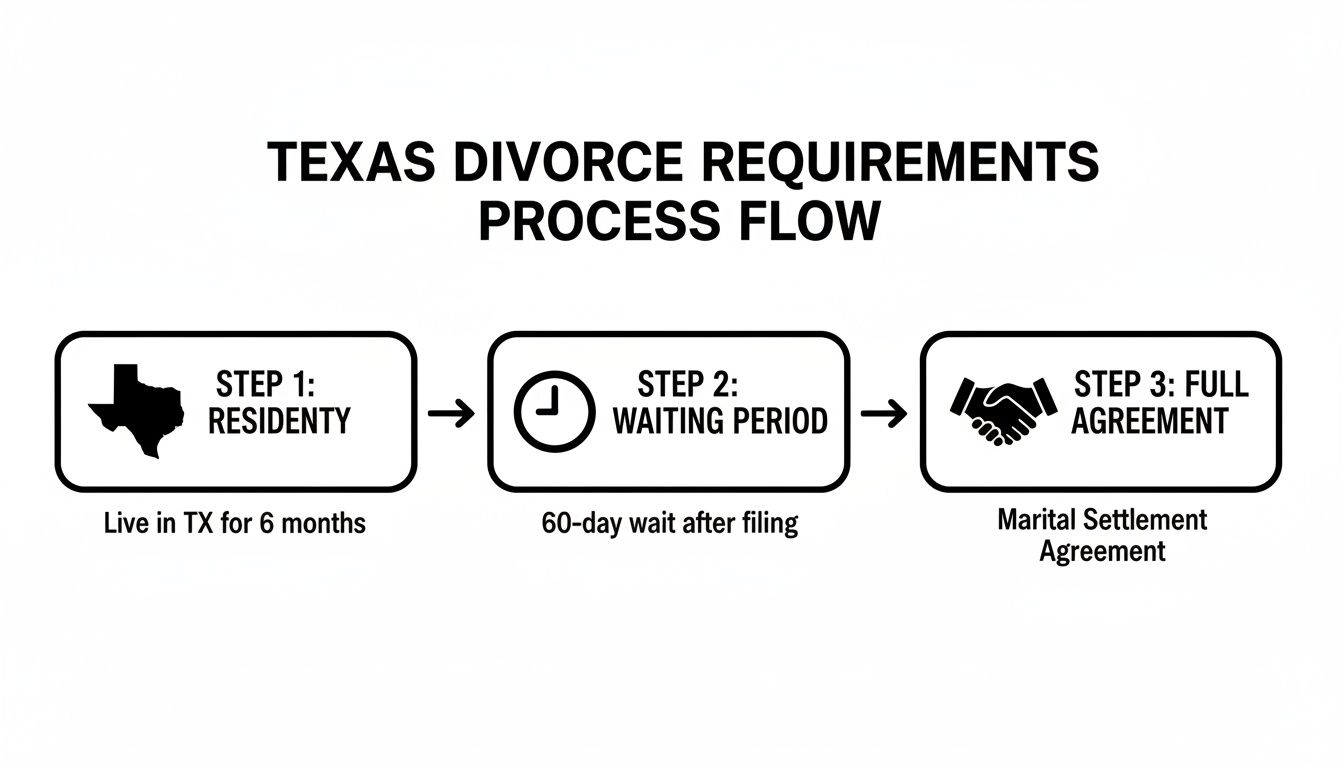
Before pursuing this simpler path, you need to ensure it's available to you. Think of it as a legal checklist you and your spouse must complete together. In Texas, a few non-negotiable requirements determine if you qualify for a divorce in Texas uncontested.
The Residency Rule: Where You Live Matters
First, Texas must have legal authority—or "jurisdiction"—over your marriage. This is a straightforward requirement outlined in the Texas Family Code § 6.301. To file for divorce in Texas, at least one of you must have:
- Lived in Texas for the past six months.
- Lived in the specific county where you plan to file for the last 90 days.
For example, if you’ve lived in Harris County for the last year but your spouse moved to Fort Bend County two months ago, you would still file in Harris County. As long as one of you meets both the state and county timelines, you can proceed.
The 60-Day Waiting Period
Once you file the Original Petition for Divorce, a mandatory waiting period begins. Under the Texas Family Code § 6.702, a judge cannot legally finalize your divorce until at least 60 days have passed from the filing date.
This isn't a penalty; it’s a required “cooling-off” period. It gives couples a final moment to reconsider or, more practically, to ensure every detail in the Final Decree of Divorce is sorted out correctly without being rushed.
This time is far from wasted. You can use these two months to negotiate, draft, and finalize your settlement agreement. That way, as soon as the waiting period ends, you’re ready for the final hearing.
The 100% Agreement Rule: The Foundation of Your Divorce
This is the most important requirement. You and your spouse must be in complete, 100% agreement on every issue. If even one point remains unresolved, your divorce is technically "contested."
Your agreement must cover:
- A "Just and Right" Division of Property: How you'll split all community assets and debts.
- Child Custody and Visitation: A detailed Possession Order explaining when the children will be with each parent.
- Child Support: The specific amount, duration, and payment method.
Interestingly, Texas has one of the lowest divorce rates in the U.S., which has made the efficiency of uncontested divorce an attractive option for couples seeking an amicable split. With a state divorce rate of just 2.1 per 1,000 residents, the streamlined nature of an agreed divorce is a major reason why many Texans can finalize their cases in just over 60 days. You can review key divorce and custody statistics in Texas to learn more.
The Uncontested Divorce Process Step by Step
When you and your spouse have managed to agree on everything, the legal process shouldn't feel like another mountain to climb. The uncontested divorce process in Texas is a predictable, step-by-step journey designed for clarity and efficiency.
Step 1: File the Original Petition for Divorce
The first official step is filing the Original Petition for Divorce. This document formally opens your divorce case with the court. It’s a straightforward form that tells the court who you are, confirms you meet Texas's residency requirements, and states whether children are involved. One of you will be the "Petitioner" (the one who files) and the other the "Respondent." In a cooperative divorce, these are just labels; it doesn’t mean one person is suing the other. Filing the petition also starts the mandatory 60-day waiting period.
Step 2: Sign a Waiver of Service
In a contested divorce, one person must be formally "served" with legal papers by a constable. It can be awkward and add unnecessary costs. In an uncontested divorce, you can skip this step. The Respondent simply signs a Waiver of Service in front of a notary. By signing this, your spouse tells the court they've seen the petition and agree to move forward without formal service. It’s a simple yet powerful act of cooperation.
A signed Waiver of Service is a powerful signal. It tells the judge from the beginning that you and your spouse are working together toward a resolution, setting a positive and efficient tone for the entire case.
Step 3: Draft the Final Decree of Divorce
This is the most critical document in your divorce. The Final Decree of Divorce is the comprehensive legal order that locks in every detail of your agreement. Think of it as the master blueprint for your post-divorce lives.
This document must cover everything with no room for ambiguity, including:
- A detailed division of all community and separate property.
- A clear breakdown of who is responsible for which debts.
- If you have kids, a detailed Possession Order (your custody schedule) and the specifics of child support payments.
Getting the legal language right here is crucial. Vague terms or omissions can create massive headaches and expensive court fights down the road. This is precisely why having an experienced attorney draft or review your decree is a wise investment, even when you agree on the big picture.
Step 4: Attend the Final Prove-Up Hearing
The final step is a brief court appearance known as a "prove-up" hearing. It sounds formal, but it’s usually straightforward and often lasts only 5 to 10 minutes. In most uncontested cases, only the Petitioner has to attend.
During the hearing, the judge will ask a few simple questions to confirm your identity, that the marriage is beyond repair, and that the Final Decree you’ve brought is fair and represents your mutual agreement. Once satisfied, the judge will sign the decree, and your divorce is final. For a deeper dive, you can learn more by understanding the Texas divorce prove-up process.
Handling Property and Children in an Agreed Divorce

The core of your agreement will be how you handle the two most important parts of your shared life: your property and your children. This isn’t just about checking boxes; it’s about creating a clear, stable foundation for everyone to move forward. A divorce in Texas uncontested gives you the power to make these vital decisions for yourselves, rather than leaving them to a judge.
Dividing Your Property the Texas Way
Texas is a community property state. As defined in the Texas Family Code, this means most assets and debts acquired from your wedding day until your divorce belong to both of you. It doesn't matter whose name is on the account or who earned the paycheck that bought the car—it’s all part of the marital estate. Your task is to divide this estate in a way the court finds "just and right." This doesn’t always mean a 50/50 split, but it must be fair.
Your agreement needs to cover everything you’ve accumulated together:
- The family home and other real estate
- Vehicles, boats, and other assets
- Checking, savings, and investment accounts
- Retirement plans like 401(k)s, IRAs, and pensions
- Ownership in any businesses
- All debts, including mortgages, car loans, and credit cards
Just as solid financial planning for married couples requires open communication, dividing your assets demands total honesty. Full transparency is the only way to build an agreement a judge will sign—and one that won’t cause problems later.
Creating a Plan for Your Children
If you have minor children, nothing is more important than protecting their stability. Your divorce agreement must lay out a detailed plan that puts their needs first.
First is the Possession Order, the official term for your custody and visitation schedule. It details exactly when the children will be with each parent—covering weekdays, weekends, holidays, and summer vacation. You can create a custom schedule, but many parents find it helpful to start with the Texas Standard Possession Order as a framework. You can see what this looks like with our parenting plan template for Texas.
Next, you must address child support. The Texas Family Code provides specific guidelines to calculate support based on the non-custodial parent's net monthly income and the number of children. In an uncontested divorce, you and your spouse agree on this figure, ensuring your kids have consistent financial backing from both of you.
Understanding Costs, Timelines, and When to Hire a Lawyer
When you're facing divorce, two questions are always top of mind: "How long will this take?" and "How much will it cost?" An uncontested divorce provides a much clearer, more manageable path forward. Because you and your spouse have already agreed on the big issues, the process is faster and far less expensive than a court battle.
The Typical Uncontested Divorce Timeline
Once your Original Petition for Divorce is filed, Texas law imposes a mandatory 60-day waiting period. This means the absolute earliest a judge can sign your Final Decree of Divorce is on day 61.
The timeline usually looks like this:
- Days 1-60: This is your window to get the paperwork finalized. You'll file the petition, your spouse will sign a Waiver of Service, and you’ll work with an attorney to draft a rock-solid Final Decree of Divorce.
- Day 61 (or soon after): You’ll attend a brief "prove-up" hearing where the judge reviews your agreement, asks a few questions, and signs the decree. At that point, your divorce is official.
All told, most uncontested divorces in Texas conclude within 61 to 90 days from the filing date.
Comparing the Costs: Uncontested vs. Contested Divorce
The financial gap between an agreed divorce and a contested one is massive. An uncontested divorce can save families from the staggering $15,000-$30,000 average cost of a contested divorce involving children. In contrast, an attorney-assisted uncontested divorce typically costs between $1,500 and $5,000 total.
| Cost Element | Uncontested Divorce | Contested Divorce |
|---|---|---|
| Court Filing Fees | Approx. $250 – $400 | Approx. $250 – $400 |
| Attorney Fees | Affordable flat-rate fees | High hourly rates, often with large retainers |
| Total Estimated Cost | $1,500 – $5,000 | $15,000 – $30,000+ |
Why You Still Need a Lawyer, Even If You Agree
It’s tempting to think, "We agree on everything, so why can't we just file a form ourselves?" While understandable, trying to DIY your divorce can be a very expensive mistake.
An attorney's most valuable role in an uncontested divorce isn't to fight; it's to protect. Your lawyer is there to transform your handshake agreement into an ironclad legal document that leaves no room for future conflict.
Your Final Decree of Divorce is one of the most important legal documents you will ever sign. A small mistake, a vague phrase, or an overlooked detail could spark expensive court fights years later over property, retirement accounts, or parenting schedules. Think of hiring an experienced family law attorney as an investment in your future peace of mind. For a more detailed look, check out our guide on the cost of an uncontested divorce in Texas.
Common Questions About Uncontested Divorce in Texas
Even when you agree to part ways amicably, it’s normal to have questions. Here are clear, practical answers to some of the most common ones we hear.
Can We Have an Uncontested Divorce If We Disagree on One Thing?
Not exactly. A true uncontested divorce requires 100% agreement on every issue. However, a minor disagreement doesn't mean you’re headed for a court battle. This is the perfect time to consider mediation. A neutral mediator can help you work through that last sticking point in a cooperative way, allowing you to get back on the uncontested track.
Do We Both Have to Go to Court for the Final Hearing?
In most Texas counties, no. Typically, only the "Petitioner" (the spouse who filed the case) has to attend the final, brief "prove-up" hearing, which usually lasts 5 to 10 minutes. As long as the "Respondent" has signed a Waiver of Service and approved the Final Decree of Divorce, their presence isn't necessary.
What Happens If I Cannot Find My Spouse?
If you can’t locate your spouse to get them to sign the required papers, you cannot move forward with an uncontested divorce. This process is built entirely on cooperation. In this scenario, your case will likely proceed as a "default divorce," which involves giving notice through methods like "citation by posting." It is critical to speak with an attorney to ensure you follow these strict legal steps correctly.
What to Do Next
You’ve done the hard emotional work of reaching an agreement. Now it’s time to turn that knowledge into action. Your top priority should be ensuring the agreement you've reached is legally solid and fully protects your long-term interests.
An uncontested divorce doesn’t mean you have to do it alone. It means you’ve chosen collaboration over conflict. The next step is to bring in an expert to formalize that collaboration correctly. A generic DIY template can easily leave you exposed to future conflicts. While this path is smoother, remember that any divorce is a major life event. Learning about grieving from divorce is a healthy, necessary part of the process.
Let Us Help You Secure Your Future
You and your spouse found common ground. Now, let us handle the rest. At The Law Office of Bryan Fagan, PLLC, we specialize in helping Texas families navigate divorce with precision and empathy. We will draft your Final Decree of Divorce to perfectly reflect your agreement, protecting your rights and giving you the peace of mind you deserve.
Your next chapter is waiting. Don't leave its foundation to chance. We invite you to schedule a free, compassionate consultation with our experienced attorneys. Let's talk about your situation and take the final steps toward a peaceful resolution together. Visit us at https://texasdivorcelawyer.us or call us today to get the expert guidance you need.